Seasonal Timeline
Breeding and building activity run from spring through summer and into early fall across most of the range, starting as early as late March in southern regions and opening with spring ice-out in Alaska. Muskrats stay active through winter rather than going dormant, building vegetation "push-ups" through cracks in the ice to keep feeding and travel routes open.
Breeding and building activity run from spring through summer and into early fall across most of the range, starting as early as late March…
Muskrat range is tied tightly to permanent water rather than spread evenly across a region's land area. That matters most in the drier Southwest and Mountain West, where activity concentrates along river corridors and irrigation systems rather than showing up broadly across the region.
Where They're Found
Muskrats live in wetlands with abundant aquatic vegetation: freshwater and coastal marshes, swamps, lakes, ponds, slow-moving streams, drainage ditches, and farm ponds. Depending on water depth and bank type, they build one of two kinds of shelter. In shallow water or a marsh with heavy emergent vegetation, they pile up a dome-shaped lodge of vegetation and mud, 4 to 6 feet across. Where the bank is steep enough, they dig a bank burrow with an underwater entrance instead, which can run up to 45 feet long with multiple chambers inside.
Muskrats are established across most of Alaska's mainland, with a few named exceptions including some Southeast Alaska islands, part of the Alaska Peninsula, and the Arctic Slope north of the Brooks Range. In the Southwest, established populations are documented in southwestern Utah, western and south-central Arizona, southern Nevada, and western and southeastern New Mexico, generally tied to the Colorado River and its tributaries and to irrigation systems that provide permanent water and cattail or bulrush growth. There is no established muskrat population in Hawaii.
Life Cycle
Litter size and litters per year are stated as ranges, not fixed numbers. Sources disagree on both, with figures shifting by latitude and season length.

Gestation
Kit
Juvenile
Adult
Signs of Activity
Identification
Length and weight
Total length 18 to 25 inches, including an 8 to 11 inch tail. Weight typically 1.5 to over 4 pounds, most commonly around 2 to 2.5 pounds.
The coat
Medium to dark brown dense underfur with long, coarse, glossy guard hairs. Some individuals appear nearly black.
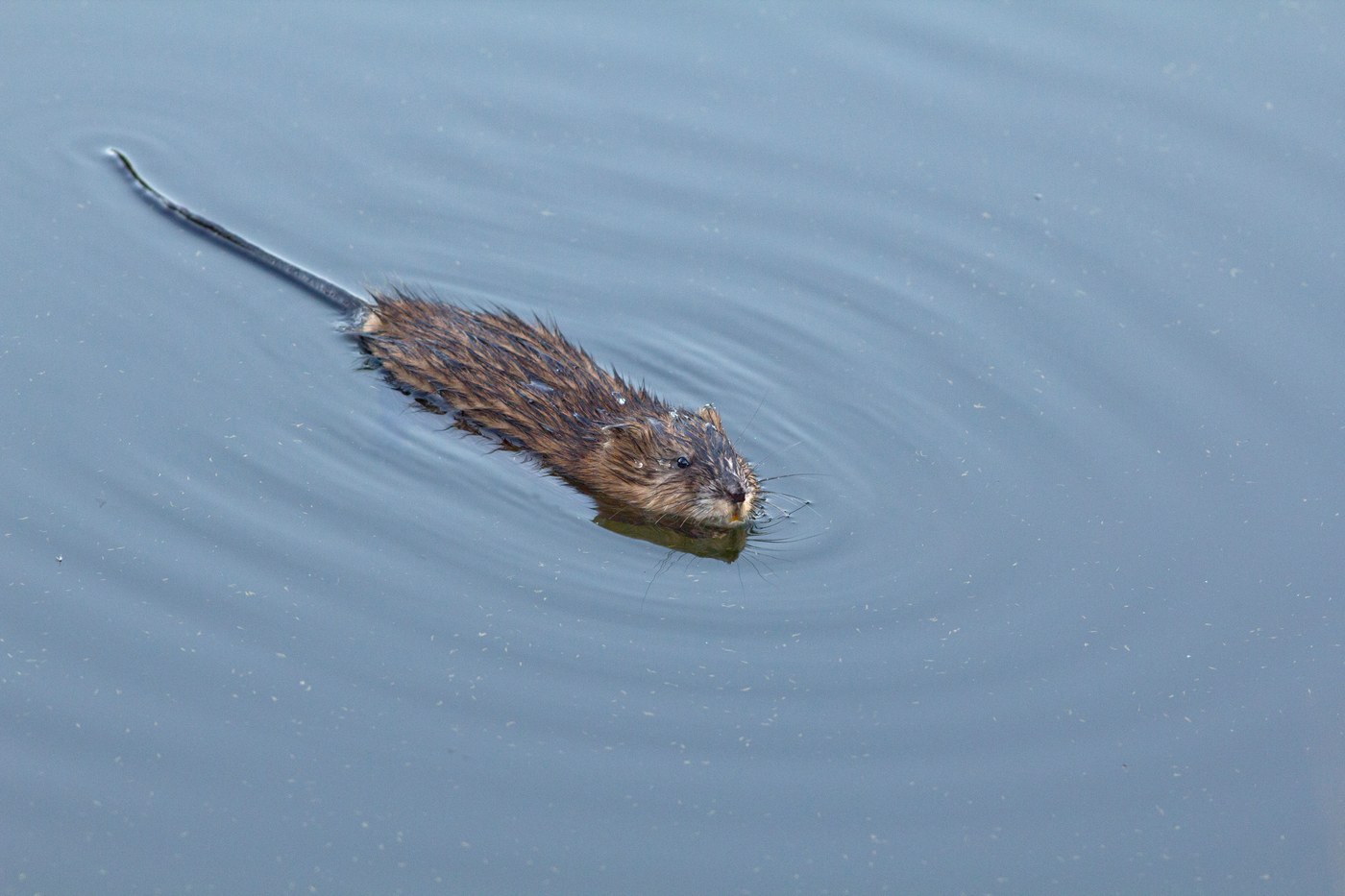
The tail is the clearest tell
Long, scaled, and nearly hairless, flattened side to side (laterally) rather than horizontally. It visibly undulates side to side as the animal swims.
Webbed hind feet, small ears
Large, partially webbed hind feet versus smaller front feet with four slender toes. Small eyes and ears that sit close to the head, with ears barely visible above the fur line.
Commonly confused with beaver
Beavers are far larger, 25 to 85 pounds versus the muskrat's 1.5 to 4 pounds, and have a broad, flat, horizontally paddle-shaped tail, versus the muskrat's thin, laterally flattened, rope-like tail.
Commonly confused with nutria
Nutria are intermediate in size between muskrat and beaver. The tail is the clearest field tell: a nutria's tail is long, round in cross-section, covered in fine hair, and stays still while swimming, while a muskrat's tail is flattened and visibly undulates side to side. Nutria also have long white whiskers versus the muskrat's black whiskers.
Signs of Infestation
A dome-shaped vegetation lodge
It runs 4 to 6 feet across.
A bank burrow
It has an underwater entrance.
Winter push-ups
Smaller vegetation mounds over holes in the ice.
Feeding platforms and worn runs
Feeding platforms, worn underwater "runs" between the den and feeding areas, and five-toed tracks near water with a tail-drag mark visible in soft mud.
Scat in latrine spots
Small, dark, oval scat left in latrine spots on rocks, logs, or other structures projecting into the water, along with cut vegetation floating near a lodge or burrow entrance.
A musky scent near an active lodge
A musky scent from paired scent glands, most noticeable in the immediate area of an active lodge or burrow, especially during breeding season.
Prevention and When to Call a Pro
Check your state rule first
Check state and local rules before trapping or relocating a muskrat. Rules vary by state and change over time, so a licensed nuisance wildlife control operator or the state wildlife agency is the right first call, not a DIY trap purchase.
Riprap the shoreline
Protect pond and lake shorelines, dams, and levees with stone riprap along the waterline. This is the most consistently cited structural fix for the burrowing damage that is muskrat's primary property risk.
Bury the fencing
Bury fencing below the soil surface. Chain-link or welded wire fencing extended roughly 6 to 12 inches below the soil line along a shoreline or dam face can block new burrow starts where riprap isn't practical.
Build dams and banks to spec
Build or maintain dams and pond banks to spec where new construction or repair is planned. A recommended earthen dam profile keeps water at least 3 feet below the top of the dam, uses roughly a 3:1 inner slope and 2:1 outer slope, and keeps the dam at least 8 feet wide at the crown, specifications that make burrowing and bank collapse both less likely and less consequential if it happens.
Reduce dense shoreline cover
Reduce dense shoreline vegetation cover where practical. Muskrats rely on emergent vegetation for both food and building material, so thinning cattails and other heavy growth right at a pond edge reduces the habitat quality that draws them to a specific bank in the first place. This is a habitat-modification step, not a guaranteed fix.
Call at once for a burrow in a dam
Any active burrow into a dam, dike, levee, or pond bank that's holding back water calls for a professional right away, especially on a flood-control or agricultural structure. This is a structural-integrity and safety issue, not just a nuisance-tolerance one.
Do not handle a sick muskrat
Do not handle a dead or sick-looking muskrat. If a family member develops fever and flu-like symptoms after contact with a muskrat, its burrow, or water near an active muskrat site, treat it as a medical concern and report it per state guidance rather than a routine wildlife-contact question.
Frequently Asked Questions
Is it legal to trap or relocate a muskrat on my own property?
It depends on your state. Rules vary and change, so check with your state wildlife agency or a licensed nuisance wildlife control operator before doing anything yourself.
Why is a muskrat burrowing into my pond dam or levee a serious problem?
Muskrat tunnels can weaken and eventually breach earthen dams, dikes, and pond banks through what wildlife agencies describe as hydraulic short-circuiting of the structure, sometimes well before any visible damage shows up on the surface.
How is a muskrat different from a beaver or a nutria?
Size and tail shape are the two clearest tells. A muskrat weighs 1.5 to 4 pounds with a thin, laterally flattened, rope-like tail that undulates side to side while swimming. A beaver is much larger with a broad, flat, paddle-shaped tail. A nutria is in between in size with a long, round, hairy tail that stays still while swimming.
Can you get sick from a muskrat?
Yes. Muskrats are a documented host for tularemia, a bacterial illness that can spread through direct contact, broken skin, tick or biting-fly bites, or contaminated water, and they also carry Giardia at high rates in some studied populations. Avoid handling a muskrat or a dead muskrat directly and wash hands thoroughly after any contact with muskrat habitat.
What are muskrat "push-ups," and why do they matter in winter?
Push-ups are small vegetation mounds muskrats push up through cracks or thin ice, used as feeding and breathing stations along travel routes between the lodge and a food source. They're a visible sign of active muskrat presence even when a pond is otherwise iced over and appears empty.
Sources
- Muskrat Wildlife Illinois (University of Illinois Extension / Illinois Natural History Survey)
- Tularemia National Park Service
- Muskrat fact sheet Connecticut Department of Energy and Environmental Protection (CT DEEP)
- Ondatra zibethicus, common muskrat (species review) US Forest Service, Fire Effects Information System (FEIS)
- Muskrats in South Carolina South Carolina Department of Natural Resources
- Muskrat (Ondatra zibethicus) species profile Alaska Department of Fish and Game
- Giardia Infection: Causes and How It Spreads Centers for Disease Control and Prevention
Image Credits
- Image: Adobe Stock, licensed.