Seasonal Timeline
Red squirrels are active year round and do not hibernate. The conspicuous stretch is late summer through October, when the animal is cutting and stacking its winter cone cache and defending the territory around it hardest. Winter activity continues off that cache, which is when the branch-tip pruning of spruce and pine shows up.
Red squirrels are active year round and do not hibernate. The conspicuous stretch is late summer through October, when the animal is…
The autumn peak has one driver, and it is the cache. Alaska's own wildlife agency notes that much of a red squirrel's summer is spent cutting and storing green spruce cones, with caches running to several bushels. That single store is worth a great deal to the animal, which is why the chattering and territory defense are loudest during the same weeks. Colorado State University Extension puts it in economic terms: a midden holds one to two years of cone resources, and territories are centered on the midden for exactly that reason.
Litters per year is a regional difference, not a source conflict. Alaska reports one litter a year, bred in February and March. Minnesota describes mating in late winter with young independent within about twelve weeks. Penn State Extension, writing for Pennsylvania, describes a February through September breeding season with two litters. Animal Diversity Web resolves it: once or twice annually depending on latitude, with breeding windows of March to May and August to early September. So a northern homeowner should expect one spring litter and a Northeast or Midwest homeowner should allow for a second one in late summer, which matters for exclusion timing.
Winter is not a quiet season for tree damage. Michigan State University Extension documents red squirrels pruning branch tips off spruce, Scots pine, and white pine specifically when other foods get scarce, biting the tip off first, eating the bud, then dropping the branch. The sign is a pile of severed tips on the snow under the tree. Colorado State University Extension reports the same behavior under ponderosa pine, and notes that mule deer tend to clean up the clippings.
Where They're Found
Red squirrel is a conifer forest animal across the northern half of the continent, and it turns up in Alaska, the Midwest, the Mountain West, and the Northeast, among other regions.
Alaska is a core region, not an edge case. The Alaska Department of Fish and Game places the species in forested country through most of the state, from the crest of the Brooks Range south to the temperate forests of southeastern Alaska, and ties it to spruce forest specifically. The state's own note on habitat loss is worth repeating, since it is the local pressure on this species: spruce forest die-off and clear-cutting have forced squirrels to abandon affected areas.
Midwest. Minnesota's Department of Natural Resources reports red squirrel in every Minnesota county, most abundant in coniferous forest, and calls it the state's smallest tree squirrel. Michigan State University Extension treats it as a routine yard and woodlot animal in Michigan, which is why the branch-tip damage guidance exists there at all.
Northeast. Federal range descriptions run the species from Quebec and Ontario west to Alaska and south through the Appalachians. Penn State Extension covers it as a Pennsylvania species, University of New Hampshire Extension covers it as a New Hampshire one, and Maine's own hunting rules name it by species. The maple sap behavior described below was documented in western Maine, with the same tooth marks recorded at 22 more sites across Maine and Vermont.
Mountain West, where the animal is usually called a pine squirrel. Federal range accounts run it south through the Rocky Mountains to New Mexico. Colorado State University Extension describes it in montane and subalpine conifer, restricted to mature pine, Douglas-fir, fir, spruce, and mixed-wood riparian forest, and Colorado Parks and Wildlife lists pine squirrel as a small-game mammal. Idaho's own species catalog carries the species as well.
One honest complication in the Mountain West, and it is a taxonomy question rather than a range question. A 2016 molecular revision split the southwestern lineages off as a separate species, Fremont's or southwestern red squirrel. The American Society of Mammalogists' own database lists that species from Arizona, Colorado, New Mexico, Utah, and Wyoming, describing its range as the Southern Rockies. Two of this region's four states, Colorado and Wyoming, sit inside that range. Montana and Idaho animals remain Tamiasciurus hudsonicus. Every agency covering these regions still uses T. hudsonicus, which is why it is the name you will see, but a Colorado reader should know the current scientific answer is genuinely less settled than a state web page suggests.
Hawaii has no red squirrels. No range description places any squirrel of this genus in Hawaii, and the islands have no native squirrels at all. The species is also established in the Pacific Northwest interior and, as the newly separated Fremont's squirrel, in the Southwest sky islands.
On the ground, look at the conifers and then at the pile beneath them. Nesting is in a natural tree cavity or an abandoned woodpecker hole where one is available, otherwise a leaf or grass nest out in a tree crotch, and Colorado's extension account adds underground tunnels and multiple nests per animal. Density tracks cone crop hard, from about 4 squirrels per 25 acres in poor habitat to 27 per 25 acres in optimal white spruce.
Life Cycle
One litter in the north, two further south, and the difference changes when it is safe to seal a structure. Alaska and Minnesota report a single late-winter or early-spring breeding. Pennsylvania is reported with two litters across a February to September season. Animal Diversity Web reconciles the two as a latitude effect rather than a contradiction. On a practical level that means a Northeast or Midwest exclusion job in late August or September can still put kits behind a sealed wall, which is why the first rule of exclusion is not sealing an animal in.
The published sizes do not agree. Alaska gives 11 to 13 inches including the tail. Minnesota gives 11 to 13 inches of body length plus a 4 to 5 inch tail, which would put total length at 15 to 18 inches. Penn State gives 9 to 13 inches. Colorado extension gives an average of 12 to 13.5 inches. Museum-measured ranges give 270 to 385 millimeters total, about 10.6 to 15.2 inches, with a 92 to 158 millimeter tail. The most likely explanation is a mislabeled measurement in one state account rather than a real regional size difference, so the museum-measured range is the one to trust.
The larder is the signature behavior, but there is one caveat. Red squirrels are the tree squirrels that store food in one place, which is why a single large cone pile is diagnostic. But museum-collected data for eastern North America records red squirrels scatter-hoarding 85 percent of all hoards and more than half of all cones stored, with scatter caches holding roughly 37 days of food against a midden that lasts one to two seasons. Larder hoarding is the tell. It is not the only thing this animal does.

Mating
Kits
Juvenile
Adult
Identification
Small, and the comparison helps more
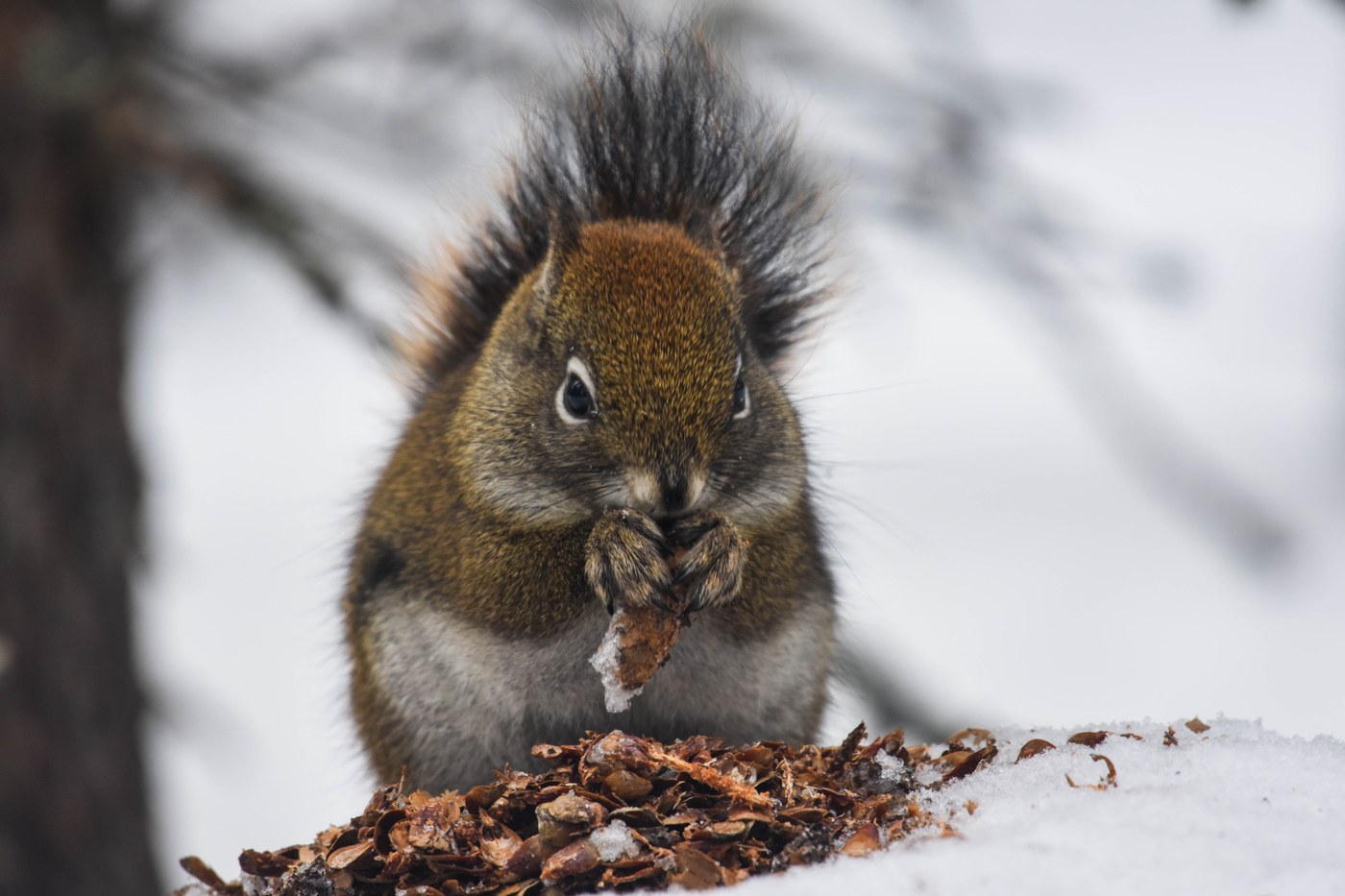
Small, and the comparison is more useful than the measurement. A red squirrel is less than 30 percent the mass of a gray squirrel, and University of New Hampshire Extension describes it as about half the size by eye with a proportionally smaller tail. Colorado State University Extension calls it the smallest tree squirrel in Colorado. Published totals run roughly 10 to 15 inches including the tail, at 7 to 10 ounces, with real disagreement between sources on the exact figures.
A white eye-ring, in every season
Museum-measured descriptions state the white eye ring is present year round, and New Hampshire's extension service calls it out as a field mark. It is the single most reliable feature on the animal, because the coat color is not.
Small ear tufts, but only in winter
That is the opposite of the tassel-eared Abert's squirrel, whose tufts diminish in spring and summer. If you are looking at tufts in July, you are not looking at a red squirrel.
A dark line where the back meets the belly
Both squirrels in this genus are red-brown above with white underparts, with small ear tufts and often a black stripe separating the dark upper color from the light belly. That stripe plus a white belly is the combination to look for.
Red is undependable out west
Red is not a dependable color in the Mountain West, and an extension author says so plainly. Published coat color runs from reddish to rusty brown to olivaceous gray, shifting through two annual molts, spring and fall. Colorado State University Extension's own account notes that most of the pine squirrels the author encounters in that region tend toward the gray coloration. Minnesota describes a dull reddish-gray summer coat turning orange-red in the cold months. Anyone identifying this animal on redness alone will get it wrong somewhere.
Douglas squirrel: the belly
Douglas squirrel is the closest relative, and the tell is the belly. Douglas squirrel carries a tawny orange chest and belly. Red squirrel is white to cream underneath. The two are sister species that function as geographic replacements for one another, meeting only in narrow contact zones rather than overlapping broadly, so in practice you have one or the other. Where the ranges do meet, look down, not up.
Chickaree means two animals
Chickaree and pine squirrel both mean two different animals depending on where you are standing. Colorado State University Extension writes "the pine squirrel, red squirrel, or chickaree" for this species. In the Pacific Northwest, chickaree is the standard nickname for Douglas squirrel instead. Both usages are legitimate regional names and neither is a synonym for the other animal, so the nickname on its own does not identify the species. The state you are in does.
The scientific name is unsettled
The scientific name is genuinely unsettled, and the split affects part of this squirrel's range. A 2016 molecular revision elevated the southwestern lineages to a separate species, Fremont's or southwestern red squirrel, and the American Society of Mammalogists' database lists that species from Arizona, Colorado, New Mexico, Utah, and Wyoming. The federal listing has not followed the change. The federal forest-ecology species review covering these four regions carries the endangered Mount Graham squirrel as Tamiasciurus hudsonicus grahamensis and treats the species as one taxon with 25 subspecies, and every state agency across those regions still uses Tamiasciurus hudsonicus too. T. hudsonicus is the name a homeowner will find on a state wildlife site, and the split matters to a Colorado or Wyoming reader.
Signs of Infestation
The midden, and disputed sizes
The midden, and two agencies give sizes that do not agree. A midden is the pile of stripped cone scales under a favored feeding tree. Alaska's wildlife agency, describing spruce country, says caches may reach 15 to 18 feet in diameter and 3 feet deep, and holds several bushels of green cones. Colorado State University Extension, describing Colorado conifers, says middens may be 30 feet across and up to 2 feet deep, and that a very large one is evidence of several generations of squirrels using the same feeding tree. Both figures stand rather than being blended, because they are measurements of different forests.
A golf-ball-sized entry hole
This is the most useful structural sign there is. Red squirrels use holes about the size of a golf ball, against baseball-sized for fox and gray squirrels and quarter-sized for flying squirrels. The hole tells you which animal you have before you ever see it.
Cone piles inside the building
Trash-bag-sized piles of pine cones inside attics or gutters are red squirrel work. New Hampshire's extension service describes the same thing as piles of cones between attic joists or in wall cavities. A gray or fox squirrel does not do this, because it scatters its caches instead.
Severed branch tips in winter
Severed branch tips on the ground under spruce and pine, in winter. Michigan State University Extension documents the pattern precisely: the squirrel prunes the branch tip off the tree first, eats the bud, then discards the branch. The result is a scatter of clipped tips beneath the tree. Colorado reports the same thing under ponderosa pine.
Paired chisel grooves in sugar maple bark
Red squirrels tap maples for sap, and the tooth marks are distinctive: a single pair of grooves from an apparent single bite, punched through to the sap-bearing xylem. Independent extension material notes the same species stripping bark and clipping maple branches to reach sweet sap. This is a Northeast sign more than a Mountain West one.
Mushrooms wedged and drying on tree branches
Alaska's wildlife agency records red squirrels caching mushrooms up on branches in addition to hoarding cones. It is an odd sign, and it is a real one.
Daytime noise, aimed at you
Rattles, screeches, growls, buzzes, and chirps, including a high-frequency call and a harsher bark. Whether the two are predator-specific is still argued, and the evidence for it is thin. Minnesota describes a chattering rattle and a whistle when a person approaches. Colorado's extension account says the animal is easily identified because it scolds intruders. Because it is diurnal, attic noise from this species happens in daylight, which is the opposite of a flying squirrel.
A resin-smeared coat in autumn
Minnesota notes that red squirrels working conifers in fall often end up covered in pine resin. If the animal you are looking at is sticky and matted in September, that is normal for this species.
Odor: none typical
No characteristic smell is documented for this species. A strong smell in a structure points to a different animal, or to a dead one.
Prevention and When to Call a Pro
Trim branches off the roofline
Trim branches back from the roofline first. Standard tree squirrel guidance from University of Missouri Extension is to trim overhanging tree branches to prevent access to the roof. On a conifer-shaded property this is the highest-value single step, because the animal is arriving from the canopy.
Half-inch cloth, tighter tolerance
Exclude with half-inch hardware cloth, and mind that the tolerance here is tighter than for a gray squirrel. Missouri's extension guidance is to cover the inside of attic vents and similar openings with half-inch hardware cloth, repair rotten boards along soffits and eaves, replace broken windows, and cap chimneys. Half-inch mesh matters specifically because this animal fits a golf-ball-sized hole, so a gap that would not concern a fox squirrel inspection is a working entry point here.
Check low as well as high
New Hampshire's extension service reports red squirrels entering along rooflines and soffit gaps, and also through gaps in stone foundations and dirt-floored crawlspaces in older homes. An inspection that only looks at the roof will miss the second pattern.
Do not seal the animal inside
Close openings, but make sure not to trap a squirrel in the structure, because a trapped animal can do a great deal of damage chewing its way out. Where young are not a concern, a spring-loaded one-way door plus an apron of at least one square foot around the opening reduces the chance the animal simply chews a new hole beside it. Red squirrels are easier to exclude than gray or fox squirrels because they do not have the same jaw strength.
Time the work around the litters
One litter in the north, bred February to March, and up to two further south, spring and again in late summer. Late August and September exclusion work in the Midwest or Northeast can seal kits in, so confirm the space is empty before it is closed.
Leave an outdoor midden alone
A midden can hold one to two years of the animal's cone resources, and clearing a cone pile in the yard does nothing about a structural entry point if one exists. If cone debris on a deck is the whole complaint, the branch trimming above is the fix.
For branch-tip damage, modest options
For spruce and pine branch-tip damage, the extension options are modest. Michigan State University Extension lists raking the debris, a bud repellent spray described as inexpensive and perhaps worth a try, offering sunflower seed or corn as a distraction, live-trapping and relocating several miles away, and lethal control under a valid small game license. Those are options of varying merit rather than a recommendation, and the trapping and shooting options run straight into the state rules.
The legal picture swings by state
The legal picture for this species swings hard from state to state, so start here. Alaska's Department of Fish and Game states there is no closed season and no bag limit for hunting and trapping of red squirrels. Maine's own season table lists woodchuck, porcupine, and red squirrel together with no closed season, against a fall-to-January season and a four-per-day bag limit for gray squirrel. Colorado is the opposite: pine squirrel is a listed small-game mammal, and the state's 2025 small game brochure gives a statewide season of September 1 to March 31 with a daily bag limit of 5 and a possession limit of 10. Colorado's own web season calendar shows an October 1 opener instead, which does not match the brochure, so confirm the current opener with the state before relying on either date. Michigan State University Extension describes red squirrel as year-round with no bag limit under a valid small game license, though that is an extension statement rather than the state regulation itself, so confirm it with Michigan before relying on it.
Two states are a real gap
Two states in these regions are a real gap in the record. Wisconsin's small game pamphlet defines a small game mammal as squirrel, rabbit, and hare, runs its squirrel season as gray and fox only, protects flying squirrel by name, and defines unprotected species to include all other wild mammals not named in the pamphlets and not listed as endangered, threatened, or protected. Red squirrel is not named anywhere in it, which would place it in the unprotected default by the pamphlet's own logic. But that is an inference from a definition, not a rule, and no Wisconsin publication says red squirrel is unprotected in those words. The edition available also carried older season dates, so it may have been superseded. Minnesota lists gray and fox squirrel on its small game seasons and does not name red squirrel at all, and no Minnesota rule names the species. In either state, verify the current rule with the state wildlife agency before trapping or relocating anything.
It is protected in some places
Do not assume this species is fair game everywhere, because in some places it is protected. Washington classifies red squirrel, Douglas squirrel, and northern flying squirrel as protected species that can be trapped or killed only in emergency situations involving crop or livestock damage, and only with a special permit. Washington is outside these regions, but it proves the point. At the far end of the same species complex, the Mount Graham population on a single Arizona mountain is federally endangered, with fewer than 250 animals; surveys ran 200 to 300 until a 2017 wildfire cut the population to 35, and the state estimated 78 by the fall of 2019.
Rabies is not the concern
The evidence is specific. A national surveillance study of rabies in rodents and lagomorphs covering 2011 through 2020 broke results out species by species, including groundhog at 368 positives of 9,084 tested, beaver at 21 of 283, eastern cottontail at 8 of 1,364, Alaska marmot at 2 of 109, eastern gray squirrel at 2 of 6,195, rat at 0 of 1,052, house mouse at 0 of 840, muskrat at 0 of 835, and eastern chipmunk at 0 of 658. No squirrel of this genus appears in that dataset at all. Separately, New Jersey's health department states that small rodents including squirrels and chipmunks have not been known to transmit rabies to humans, and Minnesota's health department lists squirrel and chipmunk among the species it strongly discourages testing. That is not proof the animal cannot carry rabies, and no wild rodent should be handled bare-handed.
Call for cone piles indoors
Call a professional when cone piles are already inside the structure. A trash-bag-sized cache between attic joists or in a wall cavity means the animal has been resident long enough to move its larder in, which is past the point a one-way door alone resolves. The cache also needs removing, not just the squirrel.
Call an electrician for wiring
Call an electrician for chewed wiring, once the animal is out. New Hampshire's extension service documents red squirrels chewing wood, insulation, and wiring, and describes the fire hazard that creates. Missouri's general tree squirrel guidance says the same, that attic and chimney entry damages electrical wiring, siding, or insulation. Either way, the repair is an electrician's job.
Call before buying a trap
Do it if you are in a state where the rules are not clear. The spread above, from no closed season to permit-only, is the reason. A licensed nuisance wildlife control operator who works with current state requirements is the safer first call than a retail live trap, and the phone call is cheaper than the wrong assumption.
Frequently Asked Questions
What is the difference between a red squirrel and a gray squirrel?
Size first. A red squirrel is less than 30 percent the mass of a gray squirrel, roughly half its size by eye, with a proportionally smaller tail. Then look for the white ring around the eye, which is present year round, small ear tufts in winter only, a white to cream belly with a dark line above it, and a chattering scold aimed straight at you. At a building, the entry hole settles it: red squirrels use a hole about the size of a golf ball, gray and fox squirrels a hole about the size of a baseball.
What are those big piles of shredded cone scales under my trees?
That is a midden, the animal's central food store, and it is the behavior that separates this squirrel from gray and fox squirrels. Alaska's wildlife agency measures spruce-country middens at 15 to 18 feet across and 3 feet deep, holding several bushels of green cones. Colorado State University Extension measures Colorado middens at up to 30 feet across and 2 feet deep, and treats a very large one as evidence of several generations of squirrels using the same feeding tree. A midden can hold one to two years of cone resources, so it is best left alone.
Do red squirrels carry rabies?
No squirrel of this genus appears anywhere in a decade-long national surveillance study of rabies in rodents and lagomorphs covering 2011 through 2020, which broke its results out species by species including groundhog, beaver, cottontail rabbit, Alaska marmot, eastern gray squirrel, rat, house mouse, muskrat, and eastern chipmunk. State health departments group squirrels among the small rodents not known to transmit rabies to people, and at least one discourages testing them at all. That is not proof the animal cannot carry rabies, so ordinary caution around any wild mammal still applies and no wild rodent should be handled bare-handed.
Is it legal to trap a red squirrel that has gotten into my attic?
It depends on the state, and the differences are large, so check before you buy a trap. Alaska states there is no closed season and no bag limit. Maine lists red squirrel with no closed season. Colorado treats pine squirrel as small game, with a September 1 to March 31 season and a daily bag limit of 5 in its 2025 brochure. Michigan is described by its state extension service as year-round under a small game license. No current Minnesota or Wisconsin rule names the species. And Washington protects red squirrel outright, permit only. Verify locally, then decide.
Something is clipping the tips off my spruce branches in winter. What is it?
Very likely a red squirrel. Michigan State University Extension documents the exact sequence: the squirrel prunes the branch tip off the tree first, eats the bud, then drops the branch, leaving a scatter of severed tips on the ground below. It happens mainly in winter when other foods get scarce. The same behavior turns up under ponderosa pine in Colorado.
Why are there rows of small holes in the bark of my sugar maple?
Red squirrels tap maples. A 1992 study in the Journal of Mammalogy documented squirrels in western Maine biting a single pair of chisel-like grooves through the bark to the sap-bearing xylem, then coming back later, after most of the water had evaporated, to lick up a residue whose sugar content measured considerably higher than the original sap. The same characteristic tooth marks were recorded at 22 more sites across Maine and Vermont. It is deliberate, and the squirrel understood the evaporation step.
Sources
- Red Squirrel Species Profile: Alaska range from the Brooks Range to southeastern Alaska, size, February to March breeding, gestation, litter size, spruce cone caching and 15 to 18 foot middens, mushroom caching, predators, and spruce die-off habitat loss Alaska Department of Fish and Game
- Red Squirrel Management: no closed season and no bag limit for hunting and trapping of red squirrels in Alaska Alaska Department of Fish and Game
- Tamiasciurus hudsonicus species review: continental range, 25 recognized subspecies, habitat, nesting in cavities and woodpecker holes, litter size, breeding season, population density by habitat quality, home range, and the Arizona figure of 42,000 to 131,000 cones consumed per squirrel per year USDA Forest Service, Fire Effects Information System
- Tamiasciurus hudsonicus, red squirrel: measured size and mass ranges, year-round white eye ring, two annual molts, territory and home range, gestation and litter mean, one-day estrus, weaning, first-year survival, lifespan, alarm-call types, diet, and the eastern scatter-hoarding proportions Animal Diversity Web, University of Michigan Museum of Zoology
- The Nature of Teller: Abert's and pine squirrels. Pine squirrel as Colorado's smallest tree squirrel, size and coloration including the gray-tending note, forest types, multiple nests and underground tunnels, middens up to 30 feet across and 2 feet deep with one to two years of cone resources, two-acre territory, no hibernation, and clipped needle tips under ponderosa pine Colorado State University Extension, Teller County
- Tree Squirrels: red squirrel size and weight, winter ear tufts, dark separating stripe, conifer forest preference, ground foraging, and the Pennsylvania two-litter February to September breeding season Penn State Extension
- Red squirrel: presence in every Minnesota county, smallest Minnesota tree squirrel, size and weight, seasonal coat color, chattering rattle call and whistle, resin-covered autumn coat, litter size, and independence within twelve weeks Minnesota Department of Natural Resources
- Looking for Red Squirrels: white eye ring, roughly half the size of a gray squirrel, single large cache against gray squirrel scatter caching, cone piles between attic joists and in wall cavities, entry via rooflines, soffit gaps, stone foundations and dirt-floored crawlspaces, chewing of wood, insulation and wiring with fire hazard, and songbird nest predation University of New Hampshire Extension
- Red squirrel injury to spruce trees in winter: branch-tip pruning of spruce, Scots pine and white pine, what the injury looks like, winter timing, and Michigan management options including the statement that red squirrel is year-round with no bag limit under a small game license Michigan State University Extension
- Tree Squirrel Damage Identification: red squirrels use holes the size of a golf ball against baseball-sized for fox and gray and quarter-sized for flying squirrels, bark stripping on ponderosa pine, jack pine and paper birch, maple bark stripping and branch clipping for sap, and 60 to 80 percent cone removal in poor seed years Internet Center for Wildlife Damage Management
- Tree Squirrel Biology: smaller squirrels such as red squirrels store food in one place, and trash-bag-sized piles of pine cones inside attics or gutters are red squirrel work Internet Center for Wildlife Damage Management
- Tree Squirrels species overview and prevention: red-brown above with white underparts, small ear tufts and black separating stripe in both pine squirrels, size range, northern North America plus Appalachian and Rocky Mountain range, not sealing squirrels inside, and one-way doors with a one-foot-square apron Internet Center for Wildlife Damage Management
- Season Dates and Bag Limits: woodchuck, porcupine and red squirrel listed together with no closed season, against the gray squirrel season and four-per-day bag limit Maine Department of Inland Fisheries and Wildlife
- 2025 Colorado Small Game and Waterfowl Hunting brochure: pine squirrel listed as a small-game mammal, statewide September 1 to March 31 season, daily bag limit of 5 of each species and possession limit of 10 of each species Colorado Parks and Wildlife
- Small Game hunting page listing fox and pine squirrel among huntable small game, with an October 1 opener that does not match the brochure date Colorado Parks and Wildlife
- Small game and wild turkey hunting regulations: definitions of Protected Species, Unprotected Species and Small Game Mammal, the gray and fox squirrel season table, and the absence of any named red squirrel provision Wisconsin Department of Natural Resources
- Tamiasciurus fremonti, Fremont's or southwestern red squirrel: accepted name, Southern Rocky Mountains range, and state distribution list of Arizona, Colorado, New Mexico, Utah and Wyoming Mammal Diversity Database, American Society of Mammalogists
- Revision of widespread red squirrels (genus: Tamiasciurus) highlights the complexity of speciation within North American forests, Molecular Phylogenetics and Evolution 100:170-182, the 2016 revision that elevated the southwestern lineages to a separate species National Institutes of Health, National Library of Medicine (PubMed)
- ECOS species profile, Mount Graham red squirrel (Tamiasciurus fremonti grahamensis): federal endangered listing under the revised genus name U.S. Fish and Wildlife Service
- The Mount Graham Red Squirrel's Fight for Survival: fewer than 250 animals, surveys of 200 to 300 before the 2017 Frye Fire, the drop to 35, and the state estimate of 78 by fall 2019 U.S. Fish and Wildlife Service
- Rabies in Rodents and Lagomorphs in the USA, 2011 to 2020, Journal of Wildlife Diseases 59(4): species-level positivity data for groundhog, beaver, cottontail rabbit, Alaska marmot, eastern gray squirrel, rat, house mouse, muskrat and eastern chipmunk, with no Tamiasciurus line item National Institutes of Health, National Library of Medicine (PubMed Central)
- Communicable Disease Service rabies chapter, February 2025: small rodents and lagomorphs including squirrels and chipmunks have not been known to transmit rabies to humans New Jersey Department of Health
- Rabies risk Table 1: squirrel and chipmunk among the small rodents the department strongly discourages testing for rabies Minnesota Department of Health
- Maple Sugaring by Red Squirrels, Journal of Mammalogy 73(1):51 (1992): paired chisel-like grooves bitten to the xylem in western Maine, the delayed return to lick sugar-concentrated residue, and the same tooth marks recorded at 22 further sites in Maine and Vermont American Society of Mammalogists, Journal of Mammalogy (Oxford Academic)
- Sexually selected infanticide by male red squirrels in advance of a mast year, Ecology (2018): male infanticide timed ahead of a heavy cone crop, from the long-running Yukon study population National Institutes of Health, National Library of Medicine (PubMed)
- G9455 Tree Squirrels: Managing Habitat and Controlling Damage: attic and chimney entry damaging electrical wiring, siding or insulation, half-inch hardware cloth on attic vents, soffit and eave repair, chimney caps, and branch trimming to block roof access University of Missouri Extension
- Species catalog record for Tamiasciurus hudsonicus, confirming the species in Idaho under the unrevised name Idaho Department of Fish and Game
Image Credits
- Image: Mary Lewandowski, National Park Service via Wikimedia Commons. Public domain.
License.