Seasonal Timeline
There is no season. Rats and mice breed year round in Hawaii, and nothing in the islands' climate forces a pause. What varies for this species is not the month, it is the habitat: field margins, gulches, rock walls, and orchard ground rather than the roofline.
The calendar is not the useful variable here, and saying so honestly is more helpful than inventing a swarm window. The Hawaii Department of Health states that rats and mice breed year round in the islands, and every activity figure found for this species in Hawaii is continuous rather than seasonal. A property that is exposed in February is exposed in August.
This species is genuinely seasonal somewhere else, and that is worth knowing so you can ignore it. In temperate New Zealand, where the same rat is called kiore, breeding is restricted to spring and summer and populations peak in autumn before crashing back. A great deal of the world literature on Rattus exulans is New Zealand literature, so a search will turn up that seasonal pattern quickly. It does not transfer to Hawaii.
What does change through the year is food, and food is what moves this animal. Reproduction in this species tracks food availability and weather rather than daylight. On a Hawaii property that means nut drop, fruit drop, and harvest timing in macadamia, coffee, coconut, and garden produce set the pressure, not the month on the calendar.
Where They're Found
Hawaii, statewide, and nowhere else in the United States. USDA wildlife damage management states it in one sentence: the Polynesian rat is not present in the mainland United States. It occurs on every major island of the Hawaiian archipelago, having accompanied early Polynesian settlers, and it is established across almost every Pacific island within 30 degrees of the equator, from the Asian mainland south to New Guinea and New Zealand and east as far as Easter Island.
Alaska is confirmed absent rather than left unaddressed. No source places this species anywhere in Alaska, which follows directly from a distribution confined to tropical and subtropical Pacific islands. Alaska's real rat problem is the Norway rat in its coastal and island ports, covered on that species' own page here. Two other US jurisdictions do carry Polynesian rats, Wake Atoll and Rose Atoll in American Samoa, both the subject of federal eradication projects.
On the ground in Hawaii, this is a field animal, and that is the single most practical fact about it. The University of Hawaii extension bulletin describes it as a field rat, rarely found near buildings in Hawaii, nesting in burrows, gulches, rock piles, rock walls, wastelands, fields, and embankments. USDA states that although this species lives in close association with people through much of its world range, in Hawaii it is not a commensal pest and instead favors wild lowland habitat. The Hawaii Department of Health's own rodent guidance names roof rat and Norway rat as the species behind rodent complaints in the islands and says the Polynesian rat does not often inhabit human dwellings. A federal review of rat lungworm hosts repeats the point: in Hawaii this rat is not considered commensal and prefers forested or agricultural habitat.
Elevation runs low, with striking exceptions. The species is most common below 2,500 feet, but individuals have been captured at 4,900 feet on Mauna Loa and at 9,700 feet on the rim of Haleakala Crater. It has also been recorded in montane rainforest.
How abundant it is depends entirely on where you stand. In three mesic forests in Oahu's Waianae Mountains, black rats dominated at 7.1 individuals per hectare while Polynesian rats ran only 0.3 per hectare. In wet forest at Lava Tree the figure was 5 per hectare, and in Oahu dry forest 1.5 to 8 per hectare. USDA describes the species as the most abundant lowland rat in many parts of the state. All of those can be true at once because the distribution is patchy, tied to lowland and agricultural ground with good cover on well drained soil.
Life Cycle
Small litters, fast turnover, and a short life. Individually this is an unimpressive breeder next to a Norway rat. Litters average somewhere between about 2.5 and 4.9 depending on the population studied, which is well under what most people picture when they hear the word rat. What makes the arithmetic work is frequency and speed: one laboratory colony produced anywhere from 1 to 13 litters a year, averaging 5.2, animals can be sexually mature inside a few months, females can breed in the season of their own birth, and breeding runs continuously in Hawaii's climate. Set against a lifespan of about a year in the wild, the population is essentially always turning over.
Two figures are reported inconsistently across sources. Sexual maturity is reported at 60 to 70 days in captivity but at 8 to 12 months in a New Zealand based account, a gap far too wide to average. The likeliest explanation is that captive animals with unlimited food mature far faster than wild animals in a temperate, seasonal environment, but no published account says so directly, so both figures stand. Litter size is the same story: the published means differ, and no single blended number would reflect what anyone actually measured.
The Hawaii Department of Health publishes a generic rat figure that is worth knowing and worth keeping separate. It gives about 20 offspring a year in litters of 4 to 8, gestation of about three weeks, and breeding from about three months of age. Those numbers describe rats in Hawaii generally, not this species specifically, and where the two conflict the species specific figures above should win.

Gestation
Pup
Juvenile
Adult
Three Rat Species Compared
Identification
Size settles it fastest
Size settles it faster than anything else, and there are real Hawaii numbers behind that. In a study that trapped 200 Polynesian rats and 310 black rats from the same eleven sites near Hilo, the Polynesian rats averaged 48.0 grams and topped out at 88.0 grams, while the black rats averaged 96.8 grams and reached 241.8 grams. A second Hilo area study of 417 rats found the same split, 48.8 grams against 103.0 grams. A Hawaii Polynesian rat is roughly half the animal a local roof rat is.
Body length, from one source
Keeping to one source holds the comparison together. Head and body, excluding the tail: Norway rat 203 to 254 mm, black or roof rat 127 to 178 mm, Polynesian rat 102 to 127 mm. Those figures match the University of Hawaii extension bulletin's own inch measurements exactly, 8 to 10 inches, 5 to 7 inches, and 4 to 5 inches, which is how you can tell they are body lengths rather than nose to tail tip. The federal wildlife damage handbook gives this species 4.5 to 6 inches nose to base of tail at 1.5 to 3 ounces. Add the tail and a Polynesian rat runs roughly 8 to 12 inches overall.
The tail runs three ways
The tail is the tell you can use at a glance, and it runs three different ways across the three species. A Polynesian rat's tail is about the same length as head and body combined, and it carries prominent fine scaly rings, with bristles that give the impression of faint, narrow bands. A roof rat's tail is distinctly longer than head and body. A Norway rat's is distinctly shorter and thicker.
Color and feet
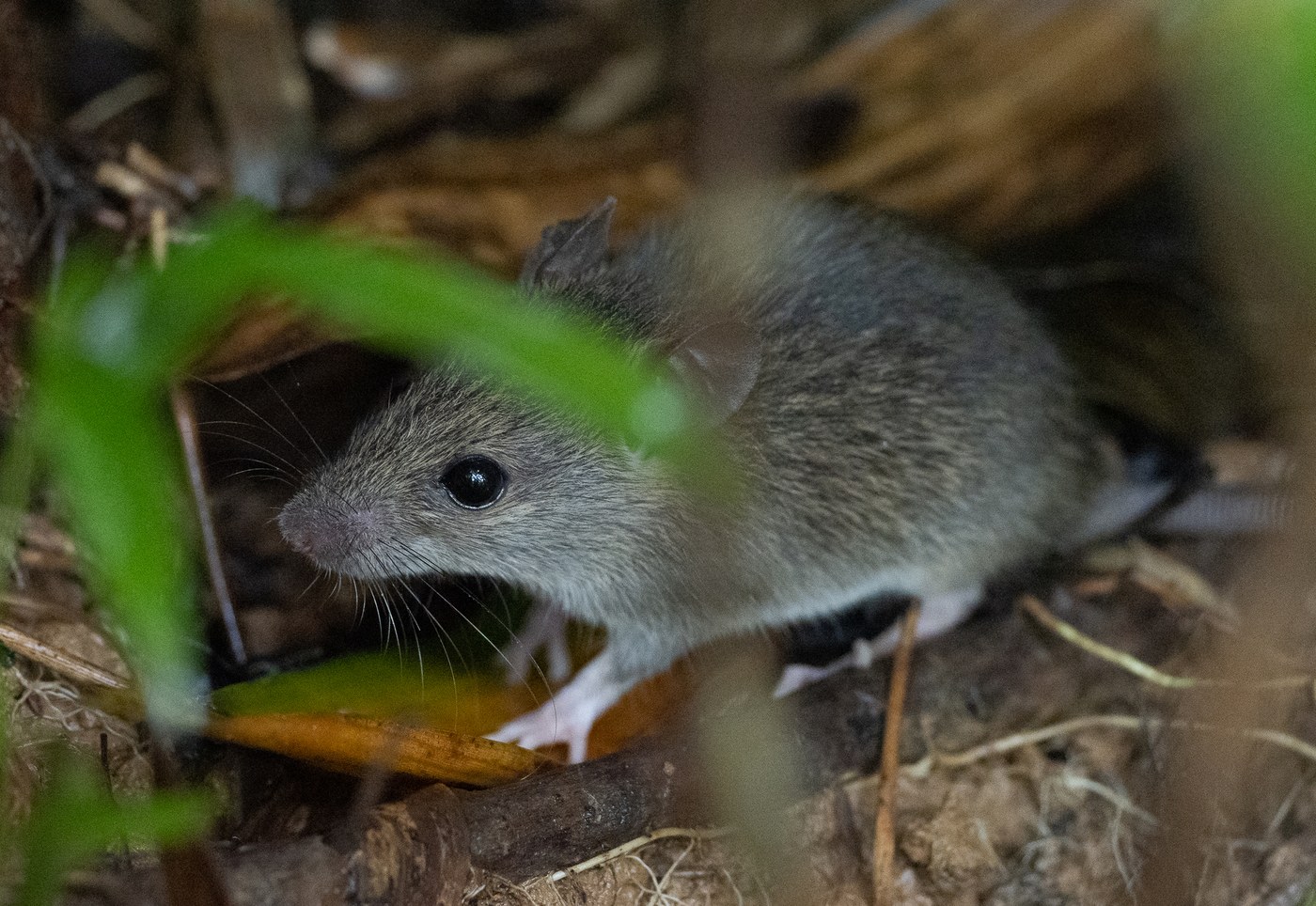
Ruddy or cinnamon brown to cinnamon buff on the back with stiff black guard hairs, a whitish, light buff, or gray belly, and dark undersides to the hind feet. The feet themselves are small and delicate, and the body is slender rather than thickset.
A note on the ears
Two good sources describe them differently, and the difference is real. The federal wildlife damage handbook describes large ears. The University of Hawaii extension bulletin describes ears rather short. A Pacific rodent identification key gives adult ear length of 15.5 to 20.5 mm for this species against 19.0 to 26.0 mm for a ship rat, so the ear is absolutely smaller than a roof rat's while being proportionally large against this animal's much smaller head. Both descriptions are defensible and neither is usable on its own, so the measurement is the reliable guide.
For a specimen in hand, count nipples
A female Polynesian rat has 4 pairs, a roof rat 5 pairs, a Norway rat 6 pairs. It is the least ambiguous character on the list.
At the small end, a house mouse
The look alike at the small end is a house mouse, not another rat. A house mouse tops out around 25 grams while a Hawaii Polynesian rat averages about 48, but juveniles genuinely overlap. The Pacific identification key advises separating them on tail length, fur color, hind foot, and ear characteristics rather than on overall impression, and keeping the specimen if there is any doubt.
Habit is the last and often the first clue
This is a ground and burrow animal that can climb, not a climber. In an Oahu forest tracking study, 70 percent of monitored Polynesian rat movements were on the ground surface and every den site recorded was below ground, while black rats denned both above and below ground and moved up to 3 m high when aboveground. If the animal is living in a tree canopy or an attic, it is a roof rat.
ʻIole is the Hawaiian name
The Hawaiian name is ʻiole, and kiore is not Hawaiian, which is worth getting right on a Hawaii page. The Hawaiian dictionary defines ʻiole first as the Hawaiian rat, Rattus exulans, and only secondarily as the later introduced rats and mice, and it records that the animal was considered by some an ʻaumakua, a family guardian. The Hawaii Department of Health's own rodent guidance gives ʻiole for rat and ʻiole liʻiliʻi for mouse. Kiore is the Maori and Cook Islands name for the same species, a cognate of ʻiole from the same Proto-Polynesian root, and because so much of the published research on this rat is New Zealand research, kiore is the name most literature searches will return. Pacific rat is the other name in general use for Rattus exulans.
Signs of Infestation
Where you found it is diagnostic
Start with where you found it, because for this species that is diagnostic. Signs inside a dwelling point away from this rat. Signs along a field margin, a gulch bank, a rock wall, an orchard floor, or an embankment point toward it. Burrow entrances in rock walls, rock piles, embankments, and dense grassy cover on well drained soil are the classic sign.
Husking stations
Husking stations, which almost nothing else written about Hawaii rats mentions. These rats carry seeds, nuts, and fruit to dry sheltered spots and work on them there, leaving small accumulations of gnawed husk and shell. Look among tree roots, in fissures at the base of tree trunks, under rock piles, and under the shed frond bases of palms. They are not caches, because nothing is stored, and they are common throughout the Pacific including Hawaii. Finding one is a much stronger signal than finding a single dropping.
Damage in a specific crop list
Crop and produce damage in a specific list of crops. The University of Hawaii extension bulletin records great damage from this species to sugarcane, pineapple, macadamia nuts, coconuts, coffee, and other fruit and vegetable crops. Gnawed macadamia shells, damaged coffee cherries, and opened coconuts around a rural property are worth taking seriously.
Droppings, with an honest caveat
Pacific rat droppings run 6.4 to 9.0 mm long, against 3.9 to 7.6 mm for a house mouse, 6.8 to 13.8 mm for a ship rat, and 13.4 to 19.1 mm for a Norway rat. The overlap with both mouse and ship rat is real, so droppings narrow the field but do not close it.
The general rodent list still applies
The general rodent sign list still applies to outbuildings and sheds. Droppings, rub marks, runways, tracks, gnawings, nests, and live or dead animals are what the extension bulletin lists for any rodent infestation.
No sound or smell to look for
Do not go looking for a sound or a smell for this one. No published account describes a distinctive call or odor cue homeowners notice for this species, and the scratching in the ceiling that people associate with rats belongs to an animal that gets into ceilings. Sending someone hunting for evidence that does not exist wastes their time.
Prevention and When to Call a Pro
Identify the species first
Identify the species before you plan anything, because the answer changes what you do. If the activity is in an attic, a roofline, or a wall void, the Hawaii Department of Health names roof rat and Norway rat as the species behind rodent complaints in the islands, and the odds strongly favor a roof rat. A genuine Polynesian rat problem is a yard, orchard, garden, outbuilding, or field margin problem. Treating a field rat as a structural rat means sealing a house that was never the point.
Work the field margin
Not the foundation. Burrows go into rock walls, rock piles, embankments, gulch banks, and dense grassy cover on well drained soil. Thinning and clearing that band, keeping cut vegetation and debris piles away from the property edge, and opening up the strip between an orchard or field and any structure removes the habitat this animal actually uses.
Pick up fallen nuts and fruit
Do it thoroughly, and keep doing it. Macadamia, coconut, coffee, and garden produce are named food sources, and the husking station behavior means dropped nuts get carried off and worked on repeatedly. A property with continuous nut drop feeds a population no amount of trapping will keep up with.
Exclude coops to state spec
Exclude outbuildings and coops to the state's own specification. The Hawaii Department of Health calls for closing any opening larger than 1/2 inch for rats, 1/4 inch for mice, using 19 gauge hardware cloth, 26 gauge sheet metal, or cement mortar or concrete. Wood only works where no gnawable edge is exposed. That standard applies to a shed, a coop, or a catchment enclosure just as much as to a house.
Protect the water catchment
This is Hawaii-specific advice with no mainland equivalent. State health guidance on leptospirosis asks residents to keep catchment collection areas clear of overhanging branches and to prevent animal access. Rodents, along with mongoose and feral pigs, are named hosts, and Hawaii reports more leptospirosis cases than any US jurisdiction except Puerto Rico.
Rat lungworm is food handling
Rat lungworm prevention is mostly food handling, and this is the part people get wrong. The parasite passes from rat droppings to snails and slugs, and people are infected by eating a raw or undercooked snail, slug, freshwater prawn, land crab, or frog, very often a small snail or slug hidden in unwashed produce. Wash all produce thoroughly, inspect leafy greens, and control snails and slugs around a garden. Removing rats reduces the reservoir but does not by itself protect anyone at the dinner table.
Trap with coconut
USDA records that Polynesian rats are captured easily with coconut bait in standard snap traps, modified wire cage live traps, or other appropriate traps. That is a specific, sourced, Hawaii appropriate detail worth more than a generic instruction to bait a trap.
The legal position is simple
Understand the legal position, which is unusually simple. USDA states it directly: rats are an exotic species in Hawaii, are not protected by law, and may be controlled by any method consistent with state and federal laws and regulations. There is no permit, no closed season, and no protected status question for this animal. What still binds is pesticide law, meaning any rodenticide must be used exactly as its label allows.
Do not borrow the mongoose rules
They do not transfer to this animal. Mongoose was brought to Hawaii as a rat control measure and is treated as a separate regulated animal. The restrictions that apply to mongoose do not apply to rats, so check what actually governs rats before acting on advice written for mongoose.
Efficacy varies by rat species
Choose rodenticide products with care, because efficacy varies by rat species. A controlled comparison of nine commercial bait formulations tested on Hawaii caught Polynesian rats, roof rats, and house mice found both efficacy and bait acceptance varied substantially by product and by species, and specifically that zinc phosphide pellets performed poorly against Polynesian rats in choice tests. A product that clears roof rats off a property is not automatically the right product for this one.
Call when it is inside the house
Call a professional when the complaint is inside the house. That is the clearest signal that the animal is not this species, and a correct identification changes the entire treatment plan. Getting it wrong means chasing a field rat around a sealed attic.
Call before treating near forest
Call before treating anywhere near native forest, a gulch system, or coastal or offshore seabird nesting ground. Rodent control in those settings is conservation work with permitting and non target considerations, run by the state forestry and wildlife division and federal wildlife services, not something to improvise with bait from a hardware store.
Call after a storm or flood
The Hawaii Department of Health notes rodent populations can rise following storms and flooding, and the same events raise leptospirosis risk through contaminated water, soil, and mud. That is the moment to get an inspection rather than wait for damage.
Frequently Asked Questions
How do I tell a Polynesian rat from a roof rat?
Size and tail proportion, then habit. In matched Hawaii Island field samples, Polynesian rats averaged about 48 grams while roof rats caught at the same sites averaged about 97 grams, so a Polynesian rat is roughly half the animal. Its tail is about the same length as head and body combined and carries fine scaly rings, while a roof rat's tail is clearly longer than head and body. And the habit differs completely: roof rat is the climber that gets into attics, trees, and roofline voids, while the University of Hawaii extension bulletin calls the Polynesian rat a field rat, rarely found near buildings in Hawaii. If it is in your ceiling, it is not this species.
Which rat arrived in Hawaii first?
The Polynesian rat, by roughly six centuries, and it came on Polynesian voyaging canoes rather than on a ship. The exact date is genuinely contested. Current high precision radiocarbon work places Polynesian arrival in Hawaii at about AD 1219 to 1266, and an independent assessment of 926 radiocarbon dates from Hawaii Island alone reached AD 1220 to 1261, calling that 250 to 450 years later than the previous consensus. Older published estimates ran several centuries earlier, and one Hawaii state fact sheet still gives approximately AD 400, a figure that sits outside every radiocarbon based estimate reviewed. What is not in dispute is the order: Norway rat arrived around 1825 to 1842 and roof rat around 1870 to 1890, both on European and American ships. Even on the latest arrival date for the Polynesian rat, that is a head start of well over 500 years.
Do Polynesian rats carry rat lungworm?
Yes, and at the highest rate of any rat in Hawaii. In a study of 545 wild rats from eleven sites near Hilo, 93 percent of the 200 Polynesian rats carried adult worms against 57 percent of the 310 black rats, and counting all detection methods, 99 percent of the Polynesian rats were infected. An independent study of 417 rats found the same pattern, 77 percent against 48 percent, with infected Polynesian rats carrying more worms on average. A federal wildlife research review reaches the same conclusion across six decades of Hawaii surveys. Important qualifier: the rat does not infect a person directly. It sheds larvae in its droppings, snails and slugs pick them up, and people are infected by eating a raw or undercooked snail, slug, or similar host, very often one hidden in unwashed produce. Between 2014 and 2023 Hawaii recorded 80 laboratory confirmed human cases, 77 percent of them on Hawaii Island.
Is it true this rat destroyed Hawaii's native lowland forest?
That is a serious, twice published, peer reviewed argument rather than a settled fact, and it is the most consequential thing about this species. Working from wetland sediment cores, pollen sequences, and radiocarbon dated rat and bird bone on Oahu's Ewa Plain, J. Stephen Athens and colleagues found that the native lowland forest collapsed almost immediately after Polynesian settlement and before Hawaiian agricultural clearing and burning reached the area. Their conclusion was that the main agent of that collapse was Rattus exulans eating the forest's seed, not people clearing land. The case was published in 2002 and again in 2009 under the title Rattus exulans and the catastrophic disappearance of Hawaii's native lowland forest. A University of Hawaii dissertation restates the linkage for the loulu palm specifically, once a common and perhaps dominant lowland tree. Other researchers weigh the evidence differently, so it stands as a leading hypothesis with real evidentiary weight rather than a closed question.
Are Polynesian rats a threat to Hawaii's native birds?
Yes, but the honest version is more specific than the usual one, and the specificity matters. The federal environmental assessment for the Mokapu Island eradication, where Rattus exulans was the only rat present, states these rats eat seabird eggs, young, and adults, and documents predation on Bulwer's petrel and wedge tailed shearwater. On Lehua Island, also a Polynesian rat only island, the state reports that rat predation was likely preventing the threatened Newell's shearwater from breeding, and that smaller open nesting terns and noddies were conspicuously absent. After the island was declared rat free in April 2021, a peer reviewed assessment recorded a dramatic increase in Bulwer's petrel breeding and significantly better nest success for wedge tailed shearwater. Here is the counterweight: in Kauai's montane endangered seabird colonies, a seven year study of 309 confirmed kills attributed 50 percent to black rats, 36 percent to feral cats, 10 percent to pigs, and 4 percent to barn owls, with Polynesian rat not appearing as a separate line item. The same federal assessment says why, noting that because the black rat is arboreal it has substantially greater effects on tree nesting birds. The accurate statement is that this species' documented bird impact falls on ground and burrow nesting seabirds, especially on low offshore islets where it is often the only rat present.
Did the mongoose ever control the rats?
No, and the popular explanation is right but incomplete. Sugarcane planters imported mongoose in 1883 specifically to control cane rats, and the standard account is that it failed because mongoose hunt by day while rats are active at night. That mismatch is real. But the federal wildlife damage handbook adds a caveat worth knowing: rodents actually made up the major portion of the mongoose diet in and around cane fields. A 1925 study found rodent parts in 88 percent of 356 mongoose pellets, with 52 percent containing nothing but rodent remains, and a 1964 study found rodent fur and bone in 72 percent of 393 mongoose scats. The mongoose ate a great many rats. It still failed, because rat reproduction outran mongoose predation, and because Hawaii ended up with a second invasive predator of native ground nesting birds. The same thing happened again in the late 1950s, when barn owls were released as rat control and became a documented predator of Hawaiian seabirds themselves.
Is it legal to trap or kill a Polynesian rat in Hawaii?
Yes. USDA states it plainly: rats are an exotic species in Hawaii and are not protected by law, and may be controlled by any method consistent with state and federal laws and regulations. There is no permit requirement, no closed season, and no protected status. The only real constraint is pesticide law, which requires that any rodenticide be used exactly as its label allows, and common sense about non target risk if the property borders native forest or seabird nesting habitat.
I found a tiny rat. Could it be a mouse instead?
Quite possibly, and this is one of the few rodents where a rat and a mouse genuinely overlap in size. A house mouse tops out around 25 grams while an adult Polynesian rat in Hawaii averages about 48, but a juvenile Polynesian rat sits right in mouse territory. The Pacific rodent identification key advises separating them on tail length, fur color, hind foot, and ear characteristics rather than on overall size impression, and keeping the specimen if there is any doubt. Droppings help a little and settle nothing: Pacific rat droppings run 6.4 to 9.0 mm against 3.9 to 7.6 mm for a house mouse, so the ranges touch.
Sources
- Rodents and Rodent Control in Hawaii, Research-Extension Series 002: species-by-species identification of the Polynesian rat, roof rat, and Norway rat including size, weight, tail proportion, color, nipple counts, and plague susceptibility; the field rat, rarely found near buildings characterization; the burrow, gulch, rock pile, and embankment habitat list; the sugarcane, pineapple, macadamia, coconut, and coffee damage list; the below 2,500 feet elevation band; and the general rodent sign list University of Hawaii at Manoa, College of Tropical Agriculture and Human Resources (Cooperative Extension)
- Polynesian Rats, chapter of Prevention and Control of Wildlife Damage (The Handbook), 1994: identification and measurements, the statement that the species is not present in the mainland United States, occurrence on every major Hawaiian island, the non-commensal characterization for Hawaii, the 4,900 foot Mauna Loa and 9,700 foot Haleakala elevation records, the 100 to 165 foot home range, coconut bait trapping, the statement that rats are not protected by law in Hawaii, and the mongoose diet figures from the 1925 and 1964 studies USDA APHIS Animal Damage Control, archived at University of Nebraska-Lincoln DigitalCommons
- Vector Control Branch rodent fact sheet: the statement that rats and mice breed year round in Hawaii, roof rat and Norway rat named as the species behind Hawaii rodent complaints, the Polynesian rat described as not often inhabiting human dwellings and associated with agricultural lands, generic rat reproduction figures, and the exclusion specification of 1/2 inch for rats, 1/4 inch for mice, 19 gauge hardware cloth and 26 gauge sheet metal Hawaii State Department of Health
- Neuroangiostrongyliasis (Rat Lungworm) disease listing and the July 2025 medical advisory: the parasite's life cycle through rats and gastropods, endemic status across all Hawaiian islands, the produce and raw intermediate host infection route, and the 2014 to 2023 count of 80 laboratory confirmed human cases with 77 percent on Hawaii Island Hawaii State Department of Health, Disease Outbreak Control Division
- A review of rat lungworm infection and recent data on its definitive hosts in Hawaii: all three introduced Hawaii rat species documented as definitive hosts, the compiled six decades of prevalence data by species, the AD 1219 to 1266 arrival estimate for Rattus exulans, the 1825 to 1842 Norway rat and 1870 to 1890 black rat arrival dates, and the statement that Rattus exulans is not considered commensal in Hawaii USDA APHIS National Wildlife Research Center with the University of Hawaii at Hilo, archived at University of Nebraska-Lincoln DigitalCommons
- High prevalence of Angiostrongylus cantonensis (rat lungworm) on eastern Hawaii Island, PLOS ONE 12(12): the 545-rat sample with 93 percent of 200 Rattus exulans carrying adult worms against 57.4 percent of 310 Rattus rattus, 99 percent versus 90 percent by all detection methods, mean body masses of 48.0 g and 96.8 g, and total length ranges for all three Hawaii rat species PLOS ONE, work led by the University of Hawaii at Hilo
- Variation in Angiostrongylus cantonensis infection in definitive and intermediate hosts in Hawaii: the independent 417-rat Hilo sample finding 77.4 percent of Rattus exulans infected against 47.6 percent of Rattus rattus, higher worm intensity in Rattus exulans, and mean body masses of 48.8 g and 103.0 g Parasitology, hosted by the National Institutes of Health, National Library of Medicine (PubMed Central)
- Mokapu Island Rat Eradication, Final Environmental Assessment, 2008: Rattus exulans named as the sole target species, Polynesian rats believed to be preventing regeneration of Pritchardia, Diospyros, and Pittosporum by eating seeds and young plants, the threatened Peucedanum sandwicense recruitment finding, documented predation on seabird eggs, young, and adults including Bulwer's petrel and wedge-tailed shearwater, and the note that the arboreal black rat has substantially greater effects on tree nesting birds than the Polynesian rat U.S. Fish and Wildlife Service with the Hawaii Department of Land and Natural Resources Division of Forestry and Wildlife and USDA Wildlife Services
- Success! Lehua Island is Rat Free, news release NR21-076 of April 21, 2021, with the project archive: eradication of Polynesian rats from the 284-acre state seabird sanctuary, the April 2021 rat-free declaration, and the finding that rat predation was likely preventing the threatened Newell's shearwater from breeding while smaller open-nesting terns and noddies were conspicuously absent Hawaii Department of Land and Natural Resources, Division of Forestry and Wildlife
- Update on the status of the avifauna of Lehua Islet, Hawaii, including initial response of seabirds to rat eradication, Pacific Cooperative Studies Unit Technical Report #203: Rattus exulans identified as the eradicated species, the April 20, 2021 rat-free declaration, the dramatic increase in Bulwer's petrel breeding, and significantly higher wedge-tailed shearwater nest success in the three years after eradication Pacific Cooperative Studies Unit, University of Hawaii at Manoa Department of Botany
- Ecology and impacts of introduced rodents (Rattus spp. and Mus musculus) in the Hawaiian islands, PhD dissertation: densities of 0.3 Rattus exulans per hectare against 7.1 Rattus rattus per hectare in Oahu mesic forest, 70 percent of Rattus exulans movements on the ground surface with all den sites below ground, the 1.8 hectare home range, the intermediate diet finding, husking station behavior, and the loulu palm decline linkage University of Hawaii at Manoa
- The Ecology of Rattus exulans (Peale) Reviewed, Pacific Science: litter size range of 1 to 10 with means of 2.5 on Ponape, 3.0 on Majuro, 3.8 in laboratory colony and 4.5 in Malaya, 1 to 13 litters per year averaging 5.2, reproductive lifespan under one year, minimum non-lactating gestation of 23 days extended 3 to 7 days by lactation, and the older Pacific plantation literature describing this species as diurnal Pacific Science, University of Hawaii Press, hosted at University of Hawaii ScholarSpace
- Rattus exulans (Polynesian rat) species account: slender body, pointed snout, delicate feet and ruddy back description, the 11.5 to 15.0 cm and 40 to 80 g measurements, eight nipples, nocturnal and sedentary behavior, year-round breeding with a summer and early fall peak, roughly four litters a year averaging four young, 19 to 21 day New Zealand gestation, weaning at 2 to 4 weeks, sexual maturity at 8 to 12 months, and a lifespan of up to one year in the wild and up to 15 months in captivity Animal Diversity Web, University of Michigan Museum of Zoology
- Rattus exulans entry in the Global Invasive Species Database: the New Zealand pattern of breeding restricted to spring and summer with densities peaking in autumn, the statement that the species climbs trees readily but is not a good swimmer, husking station locations, and the note that some adults survive into a second breeding season where food and shelter allow. IUCN Species Survival Commission, Invasive Species Specialist Group
- Hawaiian dictionary entry for ʻiole: defined first as the Hawaiian rat Rattus exulans and secondarily as the introduced rats and mice, with the note that the animal was considered by some an ʻaumakua, and the Proto-Polynesian root shared with Maori kiore Pukui and Elbert Hawaiian Dictionary, hosted by Ulukau and Wehewehe Wikiwiki
- Guidelines on Rodent Identification, Resource Kit for Rodent and Cat Eradication: comparative head-body length, weight, ear length, hind foot length, and dropping length for house mouse, Pacific rat, ship rat, and Norway rat, plus the advice to separate juvenile rats from mice on tail length, fur color, hind foot and ear characteristics Pacific Invasives Initiative
- Rattus exulans and the catastrophic disappearance of Hawaii's native lowland forest, Biological Invasions, 2009, with the earlier Avifaunal extinctions, vegetation change, and Polynesian impacts in prehistoric Hawaii, Archaeology in Oceania 37(2), 2002: the Ewa Plain sediment core, pollen, and radiocarbon evidence that native lowland forest collapsed immediately after Polynesian colonization and before agricultural clearing, with Rattus exulans identified as the main agent Biological Invasions and Archaeology in Oceania, work by J. Stephen Athens and colleagues
- The 13th century Polynesian colonization of Hawaii Island, Journal of Archaeological Science: assessment of 926 radiocarbon dates concluding the most reliable estimate for initial colonization is AD 1220 to 1261, roughly 250 to 450 years later than the previous consensus Journal of Archaeological Science
- The Facts about Rats fact sheet, June 2008: the source of the approximately AD 400 arrival date, along with the 1780s date it gives for black and Norway rat arrival Kahoolawe Island Reserve Commission, State of Hawaii
- Managing the Effects of Introduced Predators on Hawaiian Endangered Seabirds, Journal of Wildlife Management: 309 confirmed depredations at Kauai montane seabird colonies between 2011 and 2017, attributed 50.2 percent to black rats, 35.6 percent to feral cats, 10.4 percent to pigs, and 3.9 percent to barn owls, with Polynesian rat not appearing as a separate line item The Wildlife Society, work by the Kauai Endangered Seabird Recovery Project
- The impact of an introduced avian predator, the Barn Owl Tyto alba, on Hawaiian seabirds, Marine Ornithology 47: the late 1950s introduction of barn owls by the Hawaii Department of Agriculture as biological control for rats threatening the sugar industry, and 379 recorded barn owl depredations of eight seabird species on Kauai and adjacent islets between 2011 and 2018 Marine Ornithology
- Leptospirosis disease listing and Disease Investigation Branch fact sheet: rodents named as hosts, Hawaii second only to Puerto Rico for US case counts, the recommendation to control rats, mice, and mongooses around homes and work sites, and the guidance to keep catchment water collection areas clear of overhanging branches and closed to animals Hawaii State Department of Health
- Efficacy of Rodenticide Baits for the Control of Three Invasive Rodent Species in Hawaii: nine commercial bait formulations tested on wild-caught Hawaii Rattus exulans, Rattus rattus, and Mus musculus, finding efficacy and bait acceptance varied substantially by product and species, with zinc phosphide pellets performing poorly against Rattus exulans in choice tests USDA APHIS National Wildlife Research Center, archived at University of Nebraska-Lincoln DigitalCommons
Image Credits
- Image: Forest Botial-Jarvis via iNaturalist. CC BY 4.0.
License.