Seasonal Timeline
Moose are present year-round throughout their range, with no dormancy and no long-distance migration, though many populations shift downslope in winter as snow deepens. What changes through the year is risk rather than presence. Two aggression windows and a region-dependent collision peak set the calendar, and moose are most active at dawn, at dusk, and overnight in every season.
Moose are present year-round throughout their range, with no dormancy and no long-distance migration, though many populations shift…
The two collision peaks are both real, and they are not the same season. Alaska research found moose-vehicle collisions 2.4 to 5.7 times more frequent from December through February, tied to snow pushing moose downslope into roadside habitat. A peer-reviewed New England study found the opposite pattern in the Northeast, where collisions are most frequent in the summer months and evening hours, and New Hampshire Fish and Game specifically flags June because moose come to roads for road salt. Which pattern applies to you depends on where you live, so treat the local one as the rule rather than assuming a single national season.
One pattern does hold everywhere. Most collisions happen after dark. In the Alaska study, 82 percent did.
Where They're Found
The single biggest misconception about moose is the map. Moose are routinely written about as an Alaska and Canada animal. In the United States they are documented by the state wildlife agencies themselves across six regions, and the state-by-state numbers are not marginal.
Alaska carries 175,000 to 200,000 moose, found throughout most of the state except the Aleutian Islands, per the Alaska Department of Fish and Game. Northeast: Maine holds roughly 60,000, the largest population in the Lower 48, per Maine's Department of Inland Fisheries and Wildlife; New Hampshire is reported in the range of about 3,300 to 5,000; Vermont Fish and Wildlife counts roughly 2,000 to 2,100; and New York's Department of Environmental Conservation puts about 600 to 700 in the Adirondacks, with periodic sightings in the Taconic Highlands along the Vermont and Massachusetts border.
Midwest: Minnesota's own 2026 aerial survey counted about 4,470, concentrated in the northeast Arrowhead and down sharply from roughly 8,000 in the mid-2000s. Michigan's Upper Peninsula holds about 300 in the core surveyed range per the Michigan DNR's 2025 survey, down from 426 in 2023 and far short of the 1,000 the 1980s reintroduction aimed for. A Michigan DNR bulletin names Wisconsin as one of only four Great Lakes states with an established moose population, alongside Minnesota, Michigan, and New York.
Mountain West: Colorado holds 2,300 to 3,000, every one of them descended from a Colorado Parks and Wildlife reintroduction launched in 1978 with Utah and Wyoming stock, and still growing while other states decline. Wyoming's statewide estimate was about 4,050 as of a 2014 Game and Fish figure, down from roughly 13,657 in 2001, with the historic Jackson Hole herd down about 70 percent from its 1988 peak. Montana estimates 9,800 to 11,700 statewide from a 10 year Fish, Wildlife and Parks study. Idaho is estimated near 10,000 and has served as the source population for moose in Wyoming, Washington, and Nevada.
Southwest: Utah's Division of Wildlife Resources counts 2,500 to 3,000, concentrated along the Wasatch Front and in northern and northeastern Utah. Nevada is the genuinely new one. The Nevada Department of Wildlife documents an established, growing, breeding resident population of more than 100 moose in Humboldt and Elko counties in the state's northeast corner, arrived by natural in-migration from Idaho and Utah, with collared females showing high calf survival, and Nevada held its first regulated moose hunt in 2025. Pacific Northwest: Washington's Department of Fish and Wildlife estimated about 5,000 as of 2015, almost all Shiras moose in the Selkirk and Kettle Mountains of the northeast corner and expanding into the Okanogan, Blue Mountains, and Columbia Basin. Oregon's population is much smaller but genuinely established and breeding, with the first documented Oregon-born calf in 2005 and roughly 50 to 70 animals today in the Blue Mountains and Wallowa County.
The absences are worth stating plainly. Arizona and New Mexico are both Southwest states here, and neither has an established population. No Arizona Game and Fish source describing a resident moose population turned up at all, and New Mexico appears only as an occasional traveler state. California has no resident population either. South Central, the Southeast, and Hawaii have none. Moose is a cold-adapted boreal and subalpine species that is heat-stressed in warm climates, so its range is fundamentally northern and high-elevation.
On the ground, this is an outdoor animal that does not enter structures. Moose use boreal and mixed forest, willow, aspen, and birch thickets, wetlands, and riparian corridors, and they move readily into suburban and even urban areas where that habitat abuts development. In summer they feed on aquatic vegetation in ponds and lakes, submerging their heads to reach bottom plants. In winter they shift to dense conifer stands and river-bottom tall shrub habitat. They generally avoid open tundra and rarely occupy ground above 5,000 feet in Alaska.
Life Cycle
One generation a year, and the calendar is the whole point. Unlike an insect, there is no brood count to track and no population that explodes in a warm summer. What the life cycle tells a homeowner is when to be careful. The rut in late August through early October is the bull window. Calving in late May and the calf-rearing months that follow are the cow window. Those two stretches, not the animal's presence, are what should change how you use a trail, walk a dog, or approach a yard at dusk.
Wild moose typically live about 15 to 20 years, though most state agency material tracks population and age structure rather than a single maximum-age figure.

Rut
Gestation
Calving
Calf-rearing
Antler cycle
Identification
Size alone settles most identifications
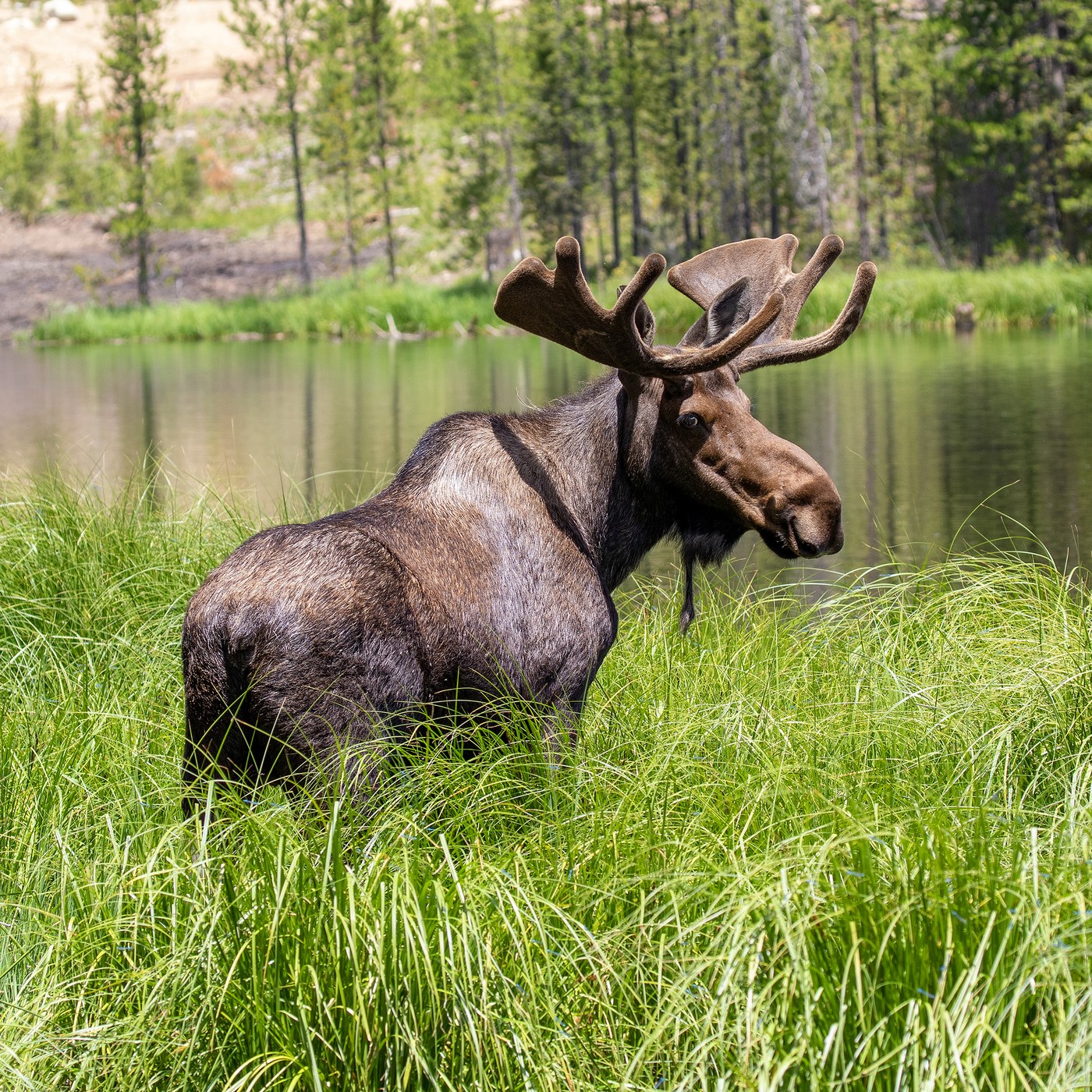
Moose are the largest member of the deer family and the second-largest land animal in North America after bison. Adults run from about 800 pounds for a small cow to 1,600 pounds for a large bull, standing up to 6 feet at the shoulder and up to 7.5 feet in some accounts. The Alaska-Yukon subspecies is the largest in the world, with the biggest bull on record at 1,808 pounds and 7.6 feet at the shoulder.
The naming overlap with elk
It is real, and it is worth getting straight. In Europe, Alces alces is called an elk. That is the same animal as the North American moose, and it is genuinely not the same animal as the North American elk, Cervus canadensis. So a European source saying elk and an American source saying elk are describing two different species. Some references also treat North American moose as a separate species, Alces americanus, and both names are in active use, though most North American state agencies use Alces alces.
Antler shape is the cleanest tell
Antler shape is the cleanest moose-versus-elk tell in the field. Only bulls carry antlers, and moose antlers are broad and palmate, flattened like an open hand, rather than branching into points the way deer and elk antlers do. A large set can reach more than 5 feet across and weigh up to 77 pounds.
Body shape works on cows too
Body shape backs the antlers up, and works on cows too. Moose have a pronounced shoulder hump and long legs built for deep snow and water, while elk are more evenly proportioned with a lighter build. Moose are larger and darker, running near-black to dark brown, against an elk's lighter tan-brown body with a distinct pale rump patch.
The dewlap and the muzzle
Both are moose-only features. A flap of skin called the bell hangs under the throat, and the muzzle is large and drooping. Neither has an equivalent on an elk or a deer.
Coat color
Color runs golden brown to almost black depending on season and age. Newborn calves are the exception, born with a solid reddish-brown coat that is notably not spotted, unlike other deer-family young, and it fades within a few weeks.
Four North American subspecies
Four subspecies occur in North America, separated by body size, coat, antler shape, and geography: the Alaska moose of Alaska and western Yukon, the largest subspecies in the world; the Northwestern moose of British Columbia east to western Ontario, Michigan's Upper Peninsula, northern Wisconsin, and northern Minnesota; the Eastern moose of central Ontario to the Maritimes plus New Hampshire, Maine, Vermont, and New York; and the Shiras moose, the smallest North American subspecies, found in Colorado, Idaho, Montana, Wyoming, Utah, Washington, and Oregon.
Signs of Infestation
Not an infestation species
This is not an infestation species, and pretending otherwise would mislead you. Moose are large, visible animals that nobody fails to notice. The signs below matter for confirming which animal is doing the damage, not for detecting a hidden problem.
Browsing up to about 6 feet
Browsed and stripped woody plants up to roughly 6 feet off the ground. Moose are browsers rather than grazers, so the damage is bark stripped off and branch tips broken and clipped on ornamental shrubs, fruit trees, and young trees. The height is the tell, since a moose can reach far higher than a deer.
Winter is when landscaping takes the hit
Willow is the single most preferred natural browse, with aspen, birch, and conifer needles and bark filling in, because those stay available above the snowline once herbaceous plants die back. When natural browse is buried, ornamental shrubs and fruit trees become the available option.
Large heart-shaped tracks
Roughly 5 to 7 inches long on an adult. Nothing else in the same habitat leaves a cloven track that size.
Large oval pellets in browse areas
Large oval pellet-shaped droppings in browse areas, along with trampled garden beds where the animal has simply walked through.
Grunting during the fall rut
Grunting and bellowing during the fall rut, from bulls, and cows calling for calves. Outside those windows moose are generally quiet.
Rutting pits, rarely suburban
Rutting pits are a real sign but rarely a suburban one. These are small dug depressions scent-marked with urine, and they show up in backcountry and true wilderness settings far more than in yards.
Prevention and When to Call a Pro
Never approach or corner a moose
Never approach, feed, or corner a moose. This is first on the list because the risk is genuinely different from most yard wildlife. The Alaska Department of Fish and Game states directly that more people in Alaska are injured by moose than by bears each year, and Utah's Division of Wildlife Resources and Wild Aware Utah independently report the same pattern in areas where both animals occur. The National Park Service notes moose weigh up to 1,600 pounds and will charge anything they think is threatening. Stay at least 25 yards away per National Park Service guidance for Alaska parks, and give cows with calves and rutting bulls considerably more room than that.
Learn the warning signs
A moose tells you before it charges. Ears laid back, hackles raised on the neck or hump, a lowered head, snout-licking, and swaying are all documented independently by the Alaska Department of Fish and Game, Colorado Parks and Wildlife, and Utah's Division of Wildlife Resources. If you see any of them, back away immediately and put a solid object between you and the animal, a vehicle, a tree, or a building. If a moose charges, running is an acceptable response, unlike with a bear, because moose rarely give sustained chase. If you are knocked down, curl into a ball, protect your head, and stay still until the animal retreats.
Two seasons carry the risk
Two seasons carry most of the risk, and they belong to different animals. Bulls are aggressive during the rut, roughly late August through early October, per the Alaska Department of Fish and Game. Cows with calves are the other window, starting with calving in late May and running well into summer. Alaska says cows are very protective and will attack humans who come too close, Colorado Parks and Wildlife says cows stay more likely to be aggressive toward people and especially dogs well into the summer, and Utah says cows can be especially defensive when they have calves. Three state agencies, same finding, independently.
Keep dogs leashed
Treat this as its own risk rather than a footnote. The Alaska Department of Fish and Game, Colorado Parks and Wildlife, and Utah's Division of Wildlife Resources all state independently that moose perceive dogs specifically as a predator threat, a stand-in for wolves, and will attack them even when the dog is leashed or behind a fence. That puts the person holding the leash in the middle of it. In high-density moose areas during calving season and the rut, consider leaving the dog at home.
Drive as if it is serious
Drive as though the collision is the serious one, because it is. A moose's body mass sits high off the ground on long legs, so a vehicle's bumper and crumple zones strike only the legs. The animal's full-weight upper body then travels over the hood and directly into the windshield and roof, instead of being absorbed by the front end the way a lower-slung deer's body is. A CDC report on Maine collisions describes the same mechanism, with the body rolling onto the hood and often collapsing the windshield and roof. A peer-reviewed 2019 study in the Journal of the American College of Surgeons, covering Maine, New Hampshire, and Vermont, found occupant death 13.4 times more likely after a moose collision than a deer collision once other factors were controlled for. In Maine from 2003 to 2017, moose collisions produced a human fatality in 0.37 percent of cases against 0.02 percent for deer collisions.
Slow down at dawn and dusk
Slow down at dawn, at dusk, and after dark, and know your region's peak. Most collisions happen after dark, 82 percent in one Alaska study. Alaska research found collisions 2.4 to 5.7 times more frequent from December through February as snow pushes moose downslope toward roads, while in the Northeast a peer-reviewed New England study found them most frequent in summer months and evening hours, with New Hampshire Fish and Game flagging June specifically because moose come to roads for road salt. Do not swerve to avoid a moose if swerving creates a worse hazard, and where a strike is unavoidable, aim for a glancing blow to the flank rather than a head-on hit.
What feeding actually causes
Do not feed a moose, and understand what feeding actually causes. The Alaska Department of Fish and Game and Colorado Parks and Wildlife both confirm that feeding moose, which is illegal in both states, produces habituation and increases aggressive, food-demanding behavior toward people. Both also note the end of that road: a moose with a history of unprovoked attacks is likely to be euthanized by wildlife officers to protect the public. Feeding a moose is not a kindness to it.
Fencing for browsed plants
For browsed shrubs, fruit trees, and garden crops, fencing and property-specific deterrents are the state-recommended fix. Colorado Parks and Wildlife's Living with Moose program directs landowners with fence or crop damage to their local wildlife officer, and routes agricultural losses specifically to its Game Damage Program rather than to do-it-yourself removal. That is the model to follow wherever you are.
Never trap or handle a moose
Do not attempt to trap, relocate, or handle a moose yourself under any circumstances. Trapping and relocation rules vary by state and change over time, so verify current state and local wildlife regulations before taking any action. This is one place where the usual nuisance-wildlife advice does not apply. Moose are large, powerful game animals managed under state wildlife law in every region above, so they are not handled by a private nuisance wildlife operator the way a raccoon or a squirrel would be.
Call the state, not pest control
Call your state wildlife agency, not a pest control company, and call it in these situations. A moose showing repeated aggressive behavior toward people or pets in a residential area. A moose that looks injured, sick, or is showing heavy hair loss from winter tick. Repeated crop or landscaping damage that fencing and deterrents have not resolved. Or a moose-vehicle collision where the animal did not leave the scene. The Alaska Department of Fish and Game, Colorado Parks and Wildlife, Utah's Division of Wildlife Resources, or the equivalent agency in your state is the correct first call in every one of those.
Frequently Asked Questions
Are moose and elk the same animal?
No, though the names collide in a way that confuses almost everyone. In North America, moose (Alces alces) and elk (Cervus canadensis) are two distinct species. The confusion comes from Europe, where Alces alces is called an elk, so a European elk is a North American moose and not a North American elk at all. In the field the difference is easy. Moose antlers are broad and paddle-shaped, elk antlers branch into points. Moose have a pronounced shoulder hump, long legs, a drooping muzzle, and a flap of skin called a bell under the throat, and they run near-black to dark brown. Elk are lighter tan-brown with a distinct pale rump patch and a more evenly proportioned build.
Why is hitting a moose so much worse than hitting a deer?
Because of where the mass sits. A moose's body rides high off the ground on long legs, so a vehicle's bumper and crumple zones strike only the legs. The animal's full-weight upper body then travels over the hood and into the windshield and roof, rather than being absorbed by the front of the car the way a lower-slung deer's body is. A CDC report on Maine collisions describes exactly that, with the body rolling onto the hood and often collapsing the windshield and roof. A peer-reviewed 2019 study in the Journal of the American College of Surgeons, covering Maine, New Hampshire, and Vermont, found vehicle-occupant death 13.4 times more likely after a moose collision than a deer collision after controlling for other factors. In Maine between 2003 and 2017, a moose collision caused a human fatality in 0.37 percent of cases against 0.02 percent for deer.
Is it really true that moose hurt more people than bears do?
Yes, in the regions where both animals are found. The Alaska Department of Fish and Game states that more people in Alaska are injured by moose than by bears each year, and Utah's Division of Wildlife Resources and Wild Aware Utah independently report that in some areas of the country wildlife agencies see more people injured by moose than by bears. It is not that moose are hunting anyone. It is that they are enormous, they are far more common near homes and trails than a bear is, and they have two seasons of the year when they will charge over a perceived threat. Bulls in the rut, late August through early October, and cows with calves from late May well into summer.
Why do moose go after dogs?
Because a dog reads as a wolf. The Alaska Department of Fish and Game, Colorado Parks and Wildlife, and Utah's Division of Wildlife Resources all state independently that moose perceive dogs specifically as a predator threat and will attack them, including dogs that are leashed or behind a fence. The danger to people is secondary but real, since the person is usually standing right there. Keeping a dog leashed and under control is the most useful single thing a homeowner in moose country can do, and during calving season and the rut in a high-density area, leaving the dog at home is worth considering.
Why does that moose look like it is losing its fur?
That is winter tick, and in the Northeast it is a serious problem. Winter tick attaches to a single moose for its entire life cycle, roughly October through May, and does not transmit disease to the animal the way a deer tick does. The damage comes from sheer numbers. Heavy infestations, documented averaging more than 47,000 ticks per animal in one Maine and New Hampshire study and reaching 70,000 to 95,000 on individual calves in University of Maine research, cause severe blood loss and drive constant grooming, more than two hours a day against under five minutes for an uninfested moose. The rubbed-out hair exposes pale skin and hair shafts, which is where the ghost moose name comes from. Maine's Department of Inland Fisheries and Wildlife calls winter tick the leading cause of death for moose under one year old in the state, and a state study found nearly 90 percent of tracked calves in one part of Maine died of tick-driven emaciation in a single winter. Maine's own wildlife agency ties this directly to climate change, since milder, shorter winters extend the tick's fall questing window and let more larvae survive to find a host. This pattern is documented in Maine and New Hampshire specifically, and should not be assumed for Alaska, Mountain West, or Pacific Northwest moose.
Can I feed the moose that keeps showing up in my yard?
No, and this is one of the rare cases where the reason is not just the animal's health. Feeding moose is illegal in the states that address it directly, including Alaska and Colorado, and both agencies confirm it causes habituation and increases aggressive, food-demanding behavior toward people. The end of that sequence is usually the moose being euthanized by wildlife officers for public safety once it has a history of unprovoked attacks. If the animal is coming for browse rather than handouts, fencing and property-specific deterrents are the state-recommended approach.
Do moose only live in Alaska?
No, and that is the most common misconception about this species. Alaska carries the largest population by far, 175,000 to 200,000 animals. But state wildlife agencies document established, breeding populations across five more regions. Maine holds roughly 60,000, the largest in the Lower 48, and New Hampshire, Vermont, and New York all have herds. Minnesota, Michigan's Upper Peninsula, and Wisconsin hold the Midwest populations. Montana, Idaho, Wyoming, and Colorado carry the Mountain West. Utah has 2,500 to 3,000 and Nevada now has an established, growing herd of more than 100 in its northeast corner, which supported the state's first regulated moose hunt in 2025. Washington and Oregon round out the Pacific Northwest. What moose do not have is a warm-climate population. There is none in California, the Southeast, South Central, Hawaii, Arizona, or New Mexico.
What is a moose doing eating my landscaping?
Browsing, which is what moose do instead of grazing. Their winter diet is dominated by woody browse, willow above all, plus aspen, birch, and conifer needles and bark, because that is what stays available above the snowline after herbaceous plants die back. Ornamental shrubs, fruit trees, and young trees fit that description exactly, which is why the damage concentrates in winter when natural browse is buried. In spring and summer the diet shifts to herbaceous plants, grasses, sedges, and aquatic vegetation, and moose will swim and submerge their heads to feed on pond and lake-bottom plants. Garden vegetables get taken in that season.
Sources
- Moose Species Profile: size, subspecies, coloration, statewide population, and range across Alaska Alaska Department of Fish and Game
- Moose distribution and habitat: elevation limits, seasonal habitat shifts, and aquatic feeding Alaska Department of Fish and Game
- Living With Moose: browse damage on residential property and homeowner guidance Alaska Department of Fish and Game
- Aggressive Moose: more people injured by moose than bears each year, rut and cow-with-calf aggression, charge warning signs, dog-triggered attacks, and the consequences of feeding Alaska Department of Fish and Game
- Maine Moose and Winter Ticks: winter tick as the leading cause of death in calves under one year, calf mortality figures, and the climate linkage Maine Department of Inland Fisheries and Wildlife
- Living with Moose: cow aggression into summer, dog-triggered attacks, warning signs, feeding habituation, and the Game Damage Program for fence and crop damage Colorado Parks and Wildlife
- Moose conservation and management: the 1978 reintroduction program and current Colorado population Colorado Parks and Wildlife
- How to avoid conflicts with moose: more people injured by moose than bears, cow-with-calf defensiveness, dog risk, and charge warning signs Utah Division of Wildlife Resources
- Moose: Utah population estimate and distribution along the Wasatch Front and northern Utah Wild Aware Utah
- Help Us Track Nevada's Moose Populations: the established breeding herd in Humboldt and Elko counties and collared-female calf survival Nevada Department of Wildlife
- Moose species page: Washington population estimate, Shiras subspecies, and range expansion from the Selkirk and Kettle Mountains Washington Department of Fish and Wildlife
- Minnesota's moose population remains relatively stable: the 2026 aerial survey estimate and long-term decline Minnesota Department of Natural Resources
- Moose: Adirondack population estimate and New York distribution New York State Department of Environmental Conservation
- Moose Management FAQs: Vermont population estimate and management approach Vermont Fish and Wildlife Department
- Moose and elk surveys: Wyoming statewide and Jackson Hole herd population trends Wyoming Game and Fish Department
- Moose Rutting in Denali: rut timing, bull fat gain, rutting pits, sparring, and rut vocalizations National Park Service
- Moose, Rocky Mountain National Park: antler cycle, gestation, calving, and calf-rearing National Park Service
- Moose Safety: the 25 yard distance rule, charge response, and what to do if knocked down National Park Service, Kenai Fjords National Park
- Avoiding moose collisions: regional differences in peak collision timing National Park Service
- Injuries from Motor-Vehicle Collisions with Moose, Maine 2000 to 2004, MMWR: the collision mechanism and windshield and roof collapse Centers for Disease Control and Prevention
- Moose-Motor Vehicle Collision, A Continuing Hazard in Northern New England: the 13.4 times fatality finding and Northeast summer and evening collision timing Journal of the American College of Surgeons, via PubMed
- Maxillofacial injuries in moose-motor vehicle collisions versus other high-speed collisions: the injury pattern behind the elevated severity National Library of Medicine, PubMed Central
- Alces americanus: subspecies ranges, browse preferences, and habitat use USDA Forest Service, Fire Effects Information System
- Dermacentor albipictus: the one-host winter tick life cycle from October through May Western College of Veterinary Medicine, University of Saskatchewan
- A Tick-ing Time Bomb, Parasite Populations and their Effect on Moose in Maine: infestation loads, grooming time, and ghost moose hair loss North Atlantic Coast Cooperative Ecosystem Studies Unit
Image Credits
- Image: Dan Vickers via iNaturalist. CC BY 4.0.
License.