Seasonal Timeline
Activity peaks vary by region more than for almost any other wildlife species. Some regions see a single spring peak as bears leave their dens hungry, others a single fall peak driven by hyperphagia, the round-the-clock feeding drive ahead of winter denning. A few regions carry two separate peaks for two separate reasons.
Activity peaks vary by region more than for almost any other wildlife species. Some regions see a single spring peak as bears leave their…
The exact months and the reasons behind them differ by region, and the reasons matter more than the dates. The spring-peak regions cluster around den emergence, when natural food has not caught up to demand yet: April and May in the Midwest, March through May in South Central. The fall-peak regions cluster in hyperphagia ahead of denning: August through October in the Mountain West and the Southeast, and August through November in California, where the late feeding push runs a month longer. A drought or a failed berry crop pushes fall windows earlier and makes them worse. Colorado's own conflict data is a useful corrective to the common assumption that spring is the busy season. Most bear calls in that state arrive in fall.
The two-peak regions run on separate clocks. The Northeast sees spring den-emergence foraging in April and May, then a second bump in June through August as bears move during the mating season. The Pacific Northwest peaks March through May, before natural foods return, and again September through November, when a dry fall pushes bears onto trash after fruit and berry crops fail.
The summer-peak regions are not one pattern. Southwest activity runs July through September in the sky-island mountain communities and tracks monsoon-driven food availability, acorns, manzanita, and prickly pear, rather than a spring or fall framework at all. Alaska peaks June through August, the latest spring emergence of any region, and garbage, birdseed, and pet food conflict there runs at a peak through the entire active season rather than spiking once.
Where They're Found
Black bears are highly adaptable and occupy dry western forests, temperate eastern hardwoods, the subtropical swamps of the deep South, and northern boreal forest. They are absent from true waterless desert, the Great Plains, and the treeless Arctic barrens. Dens turn up in rock and brush piles, ground excavations, hollow trees, and human-made structures, including crawl spaces and the space under decks and homes. Outside of denning season, bears use forest corridors, riparian strips, and landscape vegetation near roads and houses as cover while approaching human areas.
Presence within a region is often narrower than the region itself, and that nuance matters when judging whether a sighting is plausible. Midwest populations are concentrated in northern Minnesota, Wisconsin, and Michigan's Upper Peninsula, and are largely absent from Iowa, most of Illinois, Indiana, and Ohio, Kansas, Nebraska, and the Dakotas. In the Southeast, bears are concentrated in the southern Appalachians, western North Carolina, north Georgia, and east Tennessee, plus a separate and expanding coastal-plain population, rather than being a statewide presence.
South Central carries two genuinely distinct populations. General black bears occupy the Arkansas Ozarks and Ouachitas and East Texas, while the Louisiana black bear, a recognized subspecies, occupies the Tensas and Atchafalaya river basins. That subspecies was federally listed as Threatened under the Endangered Species Act and was delisted in 2016 after a documented recovery. It has no hunting season and is generating rising nuisance complaints as its numbers grow.
There is no black bear population in Hawaii.
Life Cycle
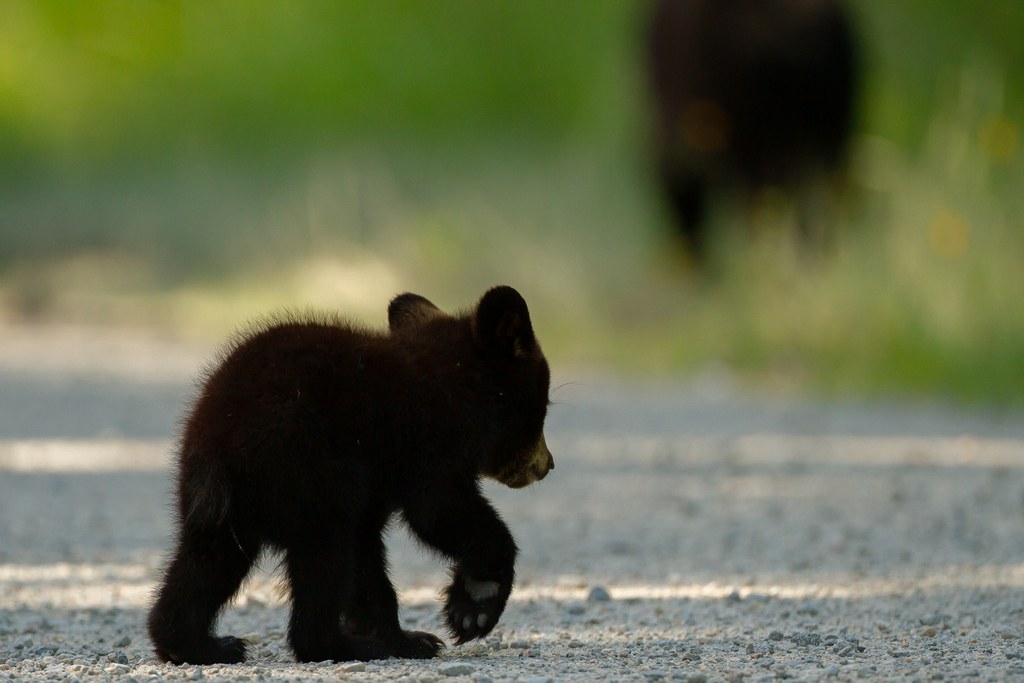
Sources disagree on three figures. They differ on how old a black bear is at sexual maturity, roughly 2 to 8 years with habitat quality driving the difference, on litter size, 1 to 5 cubs with 2 or 3 typical, and on how long cubs stay with their mother, about a year to 18 months. None of the three changes anything practical about identification or timing, so each is better treated as unsettled than pinned to a single invented number.
Cub2

Yearling
Adult
Signs of Activity
Identification
Weight and length
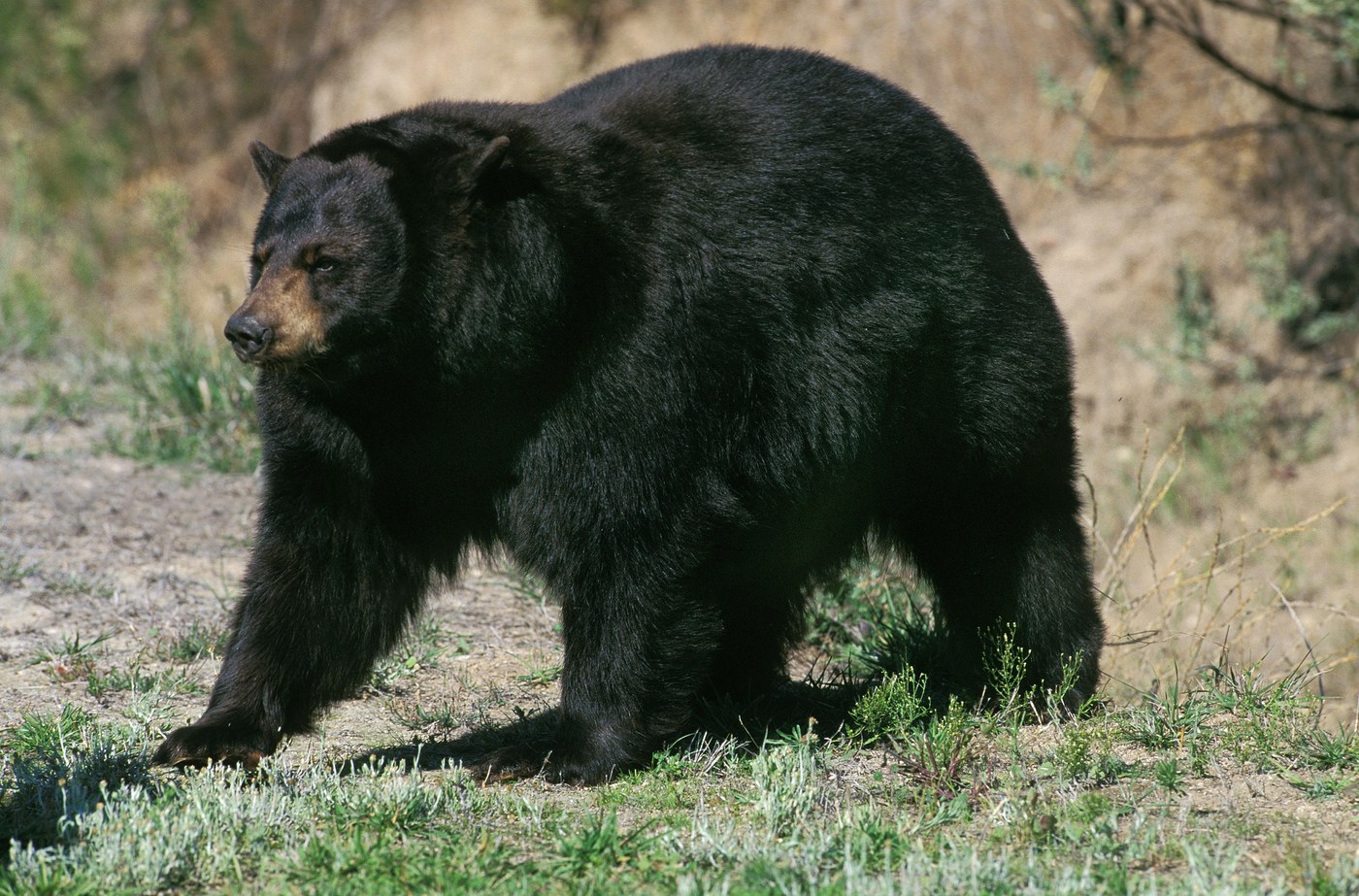
Adults typically weigh 100 to 400 pounds and run 4 to 6 feet long, and some adult males exceed 600 pounds. It is the smallest of North America's three bear species and by far the most widely distributed.
Color is not a reliable identifier
Black bears are predominantly black east of the Mississippi River, but brown, cinnamon, and blond coats are common from the Rocky Mountains westward. Where black bear and grizzly ranges overlap, coat color tells you nothing.
Look at the head profile
A black bear has a moderately sized head with a straight to slightly convex nose line, small rounded erect ears, and a short, inconspicuous tail of 3 to 6 inches.
The claws
Claws are short, curved, and non-retractable, about 1.1 to 2 inches, five per foot, and they leave a pointed imprint in a track. Black bears walk flat-footed, so the whole foot registers. Front feet average about 4.5 by 4 inches, rear feet about 7 by 3.5 inches.
Black bear or grizzly
Telling a black bear from a grizzly is not cosmetic, it changes the safety advice. A grizzly is typically 1.5 to 2 times larger, 400 to 1,300 pounds, carries a pronounced shoulder hump a black bear does not have, has a shortened and often dished facial profile rather than a straight one, and has longer, straighter claws of 1.5 to 4 inches that read as finger-like in tracks. Grizzly guard hairs often carry white or silver tips for a frosted look.
The sounds it makes
Vocalizations include grunts around young, staggered loud grunts from a female warning off an unwanted male, moans as a submissive signal, and jaw-popping or teeth-clicking when agitated. These matter during an encounter rather than as a sign you would notice beforehand.
Signs of Infestation
Brute-force damage to bins
Trash cans and dumpsters destroyed by brute force, rather than tipped or picked at the way a smaller animal would leave them.
Break-ins for food
Vehicles broken into for food, including doors pulled off, and in worse cases ripped siding, broken windows, or a demolished cabin interior.
Vertical canine marks on bark
Bark stripped from trees in vertical canine-mark patterns 3 to 4.5 feet up the trunk, and girdled trees. This is most common in the Pacific Northwest from April through early July, when bears feed on nutrient-rich inner bark.
Acres of flattened crop
Flattened patches of corn or oats several acres across, with connecting trails and scat. Bears eat the whole cob, which separates this from raccoon damage, where ears are stripped off the stalk.
Orchard damage
Broken branches and trunk damage in orchards from a bear pulling itself up to reach fruit, and destroyed beehives with combs broken and scattered and claw or tooth marks on the equipment. A bear will often return to a hive nightly until it is exhausted.
Livestock kills, and the wound spacing
Livestock kills with parallel claw marks and canine punctures 1.4 to 2.5 inches apart, versus 0.8 to 1.25 inches for coyotes and 1.5 to 2.0 inches for wolves. Carcasses are often partly buried or dragged into cover, and the udders of lactating animals are consumed.
The flat-footed track
Tracks showing the entire flat foot with claw imprints, front about 4.5 by 4 inches and rear about 7 by 3.5 inches.
Prevention and When to Call a Pro
Protected by federal and state law
Black bears are protected by federal and state law throughout their range, and the specifics vary by state. Many states run management plans with a seasonal hunting harvest, while a few locally threatened populations have no season at all. Rules genuinely differ and change, so check with your state wildlife agency or a licensed nuisance wildlife control operator before taking any action, even on your own property.
One state, to show the detail
One state's example, to show how specific this gets. In Oregon, it is illegal to feed a bear directly or indirectly, a Class A misdemeanor. Oregon also defines exactly what counts as a threat to human safety that permits lethal removal: aggressive actions such as charging, false charging, growling, teeth-popping, or snarling, breaking into or attempting to break into a residence, attacking a pet or domestic animal, or a documented loss of wariness shown by repeated daytime sightings near a permanent structure. Any bear killed under that statute must be reported to the state within 10 days. That is Oregon's rule specifically, and it is not a statement about what any other state allows.
Attractants are the top priority
Attractant management is the single highest-leverage step, by a wide margin. Store garbage in bear-resistant containers and set cans out the morning of pickup, not the night before. Pull bird feeders during the active season, and check regional timing rather than assuming fall, since Alaska's own agency recommends removing them essentially April through October. Never leave pet food outdoors. Clean grills thoroughly after every use and store them securely. Never intentionally feed a bear.
Exclusion needs a solid structure
Physical exclusion works when the structure is genuinely solid. Solid-frame construction, heavy plywood sheeting, and tight-fitting doors and shutters resist a bear's ability to tear open weaker structures. Electric fencing of 3 to 4 strands at 3,500 to 5,000 volts is highly effective around apiaries, livestock pens, and remote campsites when installed and maintained properly, though cost and terrain make it impractical at larger scale.
Three things that do not work
Three things that do not solve the problem. Frightening devices such as lights, noise, and pyrotechnics buy temporary relief only, and bears habituate quickly. Capsaicin spray is a close-encounter defensive tool under 30 feet, not a property deterrent, and it should never be sprayed on objects or areas because it can attract rather than repel. No toxicant is registered for bear control at all.
Relocation is not humane
Relocation is not the humane default outcome most people assume it is. Relocated bears have a strong tendency to return to where they were captured, in some cases traveling up to 50 miles back, and a bear that already learned to seek human food usually repeats the behavior at the new site. Oregon's wildlife agency reports that most habituated nuisance bears that get captured are euthanized rather than successfully relocated, and wildlife damage guidance generally holds that a problem bear should be released once at most.
Never trap, bait or shoot one
Do not attempt trapping, baiting, or shooting yourself. All of it requires permits or professional involvement in most states, and the equipment involved carries real risk of harm to both the operator and the bear. Route this to a licensed nuisance wildlife control operator or your state wildlife agency instead of buying a trap.
If you meet a bear, do not run
If you actually meet a bear, stay calm and do not run. Back away slowly. Never approach a bear, and never get between a female and her cubs. If the bear notices you and does not leave, stand your ground, talk in a calm voice, and make yourself look larger. Do not scream and do not make sudden movements. Bear spray, an EPA-approved product made specifically for bears rather than human pepper spray, is effective at close range and worth carrying in bear country.
If it makes contact, fight back
If a black bear makes physical contact, do not play dead. Fight back, and target the face and muzzle. Playing dead is the recommendation for a grizzly, and applying it to a black bear is the wrong response. This is one of the clearest practical reasons the black bear versus grizzly identification above actually matters.
Who to Call, and When
Call a professional for any bear that has learned to associate a specific home, campsite, or neighborhood with food. That is the pattern most likely to escalate, and once a bear is habituated, removing the attractant alone often is not enough. Also call for any structural entry, vehicle break-in, or attack on a pet or livestock, and for any encounter where the bear does not leave after normal deterrence. Bear attacks are rare, and serious injuries from black bears are rarer still, but a food-conditioned bear that approaches people is a genuine risk and not a wait-and-see situation.
Frequently Asked Questions
Is it legal to trap or remove a nuisance black bear myself?
Generally no. Black bears are protected by federal and state law across their range, and most states require a permit or involve the state wildlife agency directly. The specifics vary a lot. Oregon, for example, only permits lethal removal when a bear meets a written legal definition of a threat to human safety, and any bear killed has to be reported to the state within 10 days. Check with your state wildlife agency or a licensed nuisance wildlife control operator before doing anything yourself.
If a bear keeps coming back, why not just have it relocated somewhere else?
Relocation has a poor track record. Bears have a strong tendency to return to where they were captured, sometimes traveling as much as 50 miles to get back, and a bear that has already learned to seek human food usually repeats the behavior at the new location. Oregon's wildlife agency reports that most habituated nuisance bears that get captured end up euthanized rather than successfully relocated.
What should I actually do if I see a black bear in my yard or on a trail?
Stay calm, do not run, and back away slowly. If the bear notices you and does not leave, stand your ground, talk in a calm voice, and make yourself look larger. If a black bear makes physical contact, do not play dead. Fight back and target its face and muzzle. Playing dead is grizzly advice, not black bear advice.
Do black bears carry rabies?
It is uncommon. Federal rabies surveillance attributes the large majority of reported wildlife rabies cases to bats, raccoons, skunks, and foxes, and black bear does not appear on that primary vector list.
What is actually attracting bears to my property?
Almost always garbage, bird feeders, pet food left outside, and grills that were not cleaned, rather than random wandering. Bears are opportunistic omnivores, and roughly 80 percent of a natural diet is plant material, so a reliable, high-calorie human food source is worth returning to. Removing those attractants is the single most effective thing a homeowner can do.
Sources
- Black Bears (identification, biology, damage identification, prevention and control methods) Internet Center for Wildlife Damage Management (University of Nebraska-Lincoln / USDA APHIS Wildlife Services)
- Black Bear, Wildlife Damage Management Technical Series USDA APHIS Wildlife Services
- Staying Safe Around Bears National Park Service
- Rabies in the United States: Protecting Public Health Centers for Disease Control and Prevention
- Help Keep Bears Wild Oregon Department of Fish and Wildlife
- The Teddy Bear is Back: U.S. Fish and Wildlife Service Delists Louisiana Black Bear Due to Recovery U.S. Department of the Interior
Image Credits
- Image: Adobe Stock, licensed.
- Image: Joshua Liverman via iNaturalist. CC BY 4.0.