Seasonal Timeline
There is no seasonal window to work against. Hawaii's climate gives this species no dormancy, and the record suggests no reproductive shutdown either, which is a departure from its native range in Kenya. The cycle that actually matters for finding one is daily: slow and deliberate in the trees through daylight hours, and asleep and conspicuously exposed on vegetation after dark.
The seasonal contrast between the native and the introduced population is the interesting part, and it comes with a stated limitation. In Kenya this is a seasonal breeder. A field study at Karatina recorded parturition beginning in mid-January and running into March, with post-reproductive quiescence from January through March. In Hawaii, a histological study of 88 museum specimens from Oahu found both males and females reproductively active in December and in February, and February is the middle of the native range's quiescent period. The researcher who reported the first predation records also states that Hawaii's tropical climate appears to leave the reproductive cycle without seasonality.
One limitation comes with that. The Oahu specimens came from two calendar months only, December and February, and the study's own authors say plainly that they cannot comment on seasonality from that sample. So the defensible claim is that no seasonal shutdown has been documented in Hawaii, on a two-month sample, supported by a separate field observation of no apparent seasonality. That is not the same as a measured year-round breeding cycle, and it should not be treated as one.
What the calendar does not do here, the clock does. These animals are diurnal, they move extraordinarily slowly, and they sleep out in the open on vegetation at night. In the Hawaii Island diet study, 28 of the 34 chameleons collected were taken at night while sleeping on plants. If you want to know whether a property has them, walk it after dark with a light rather than scanning the canopy at noon.
Where They're Found
In the United States, this is a Hawaii animal.
The introduction is unusually well documented, and it is also disputed. The version in the peer-reviewed record is specific: in 1972 a licensed pet shop owner in Kaneohe on the eastern side of Oahu imported several dozen chameleons from Kenya, the shipment arrived dehydrated and in poor condition, the lizards were placed outdoors, and that effectively released them. The authors call it the first and only known introduction in the state. The state's own species profile describes the same event as an intentional release in Kaneohe. Against both, a later dietary and conservation study reports that hundreds of chameleons born in mainland pet stores were also imported and released at numerous Hawaii localities by a number of individuals in the early 1970s, deliberately, with the intention of building a stock of animals to export back to the pet trade. A separate second-hand report, attributed to a personal communication, holds that all three subspecies were released. The 1972 Kaneohe release is the documented founding event, and additional deliberate releases are reported on top of it, because the two accounts tell different stories about how one pet shop release became a statewide population.
Island by island, the sources genuinely disagree, and the state's current position is the one that determines what a resident should do. The current state invasive species profile says the species has established free-ranging populations on Hawaii Island, Maui, and Oahu, that it has not become established on Kauai or Lanai, and that sightings need to be reported on those last two islands but not on the first three. Kauai's invasive species committee lists it as an active target and notes that it helped the state agriculture department capture one Jackson's chameleon in Lihue in 2013, presumed an escaped pet. The older literature is broader: the 2010 predation paper states that established populations were first documented on Lanai and Kauai in the mid-1990s and that self-sustaining populations are now present on all of the main islands, and the 2014 threat assessment says the subspecies became established on all major islands with the possible exception of Kauai. Both readings are in the record. Follow the current state position when deciding whether to report a sighting, and treat the broader historical claims as unsettled.
Where they actually live is warm, wet, and shaded. In the islands the species is most abundant between about 100 and 1,000 meters elevation, in wet shady habitat where daytime temperatures run 21 to 32 degrees Celsius, roughly 70 to 90 Fahrenheit, and nights run 10 to 20 Celsius, with moderate rainfall. On a property that means trees, hedgerows, and ordinary disturbed suburban vegetation. Field observations on Maui put the average perch 4.5 meters off the ground on perches averaging about 2.4 centimeters in diameter, which is why so many residents live near chameleons for years and see them only occasionally.
The conservation concern is about elevation, not about yards. Chameleons were historically rare in native Hawaiian forest, which is why the animal was long assumed harmless. Then 12 were collected from mid-elevation native forest adjacent to higher-elevation pristine forest where endemic prey are abundant, and the authors warned of possible upslope range expansion with devastating consequences if the species establishes there. Monitoring in native forest continues at roughly 600 to 1,300 meters. What makes that concern concrete rather than speculative is that two separate modeling approaches concluded this species is physiologically capable of colonizing most non-alpine habitat in Hawaii.
One out-of-state population is unconfirmed. A widely used industry compendium datasheet states this species is established only in California and Hawaii, and a California herpetology reference documents naturalized populations in San Luis Obispo County near Morro Bay and in Orange County, tracing the Morro Bay animals to a 1981 escape during a state enforcement action. No state or federal agency source confirms a currently established California population, so treat California as unconfirmed.
Alaska is ruled out on climate. This is a warm, wet, montane tropical species with a documented temperature envelope well above freezing, no Alaska detection record, and no introduction pathway. There is no marginal case to argue.
Life Cycle
Live birth is the headline, and it is genuinely unusual. Most chameleons lay eggs. This species retains the eggs internally and delivers fully formed young, each in its own membrane, dropped from a perch by the mother. There is no egg stage to find, no nest, and no clutch buried in soil, which means the usual reptile search image does not apply here.
Almost every number attached to reproduction in this species is contested, so which population was actually measured matters more than any single figure. Litter size in Hawaii was measured once, on 14 gravid specimens from Oahu, at 12.2 young on average with a standard deviation of 4.4 and a range of 7 to 21. That is the figure to go by for Hawaii, because it is the only Hawaii measurement. In the native Kenyan range, field work recorded an average litter of 21.7 and ranges as wide as 6 to 57. Captive and compiled accounts give 8 to 52, 10 to 50, up to 51, and 12 to 40, and one older Hawaii account gives 5 to 50 without stating a sample size. The Oahu researchers attribute their smaller maximum to their small sample, 19 females across two months, rather than to a real difference in Hawaii, and still conclude the species' reproductive potential in the islands is high.
Gestation has three incompatible published figures and no Hawaii measurement at all: about 3 months, 6 to 7 months, and 6 to 9 months, plus one account giving about 190 days, which is roughly 6.3 months. Age at maturity is no better settled: 9 months, 9 to 10 months, and about two years all appear in the literature, against field measurements in Kenya of roughly 13.5 months for females and 16 months for males. Treat it as a range rather than a settled figure.
One Hawaii-specific reproductive finding does stand out. The smallest reproductively mature male from Oahu measured 70 millimeters snout-to-vent, against 90 millimeters for mature males in Kenya. Either Hawaii males join the breeding population at a smaller size and younger age, or they grow more slowly, and the authors say those two explanations cannot be separated without growth data. Combined with the ability to re-mate about 20 days after birth, the practical conclusion drawn in the dietary literature is that this population has a high intrinsic growth rate, which is one reason the conservation concern is treated as urgent.

Neonate
Juvenile
Adult female
Adult male
Identification
Horns mean male
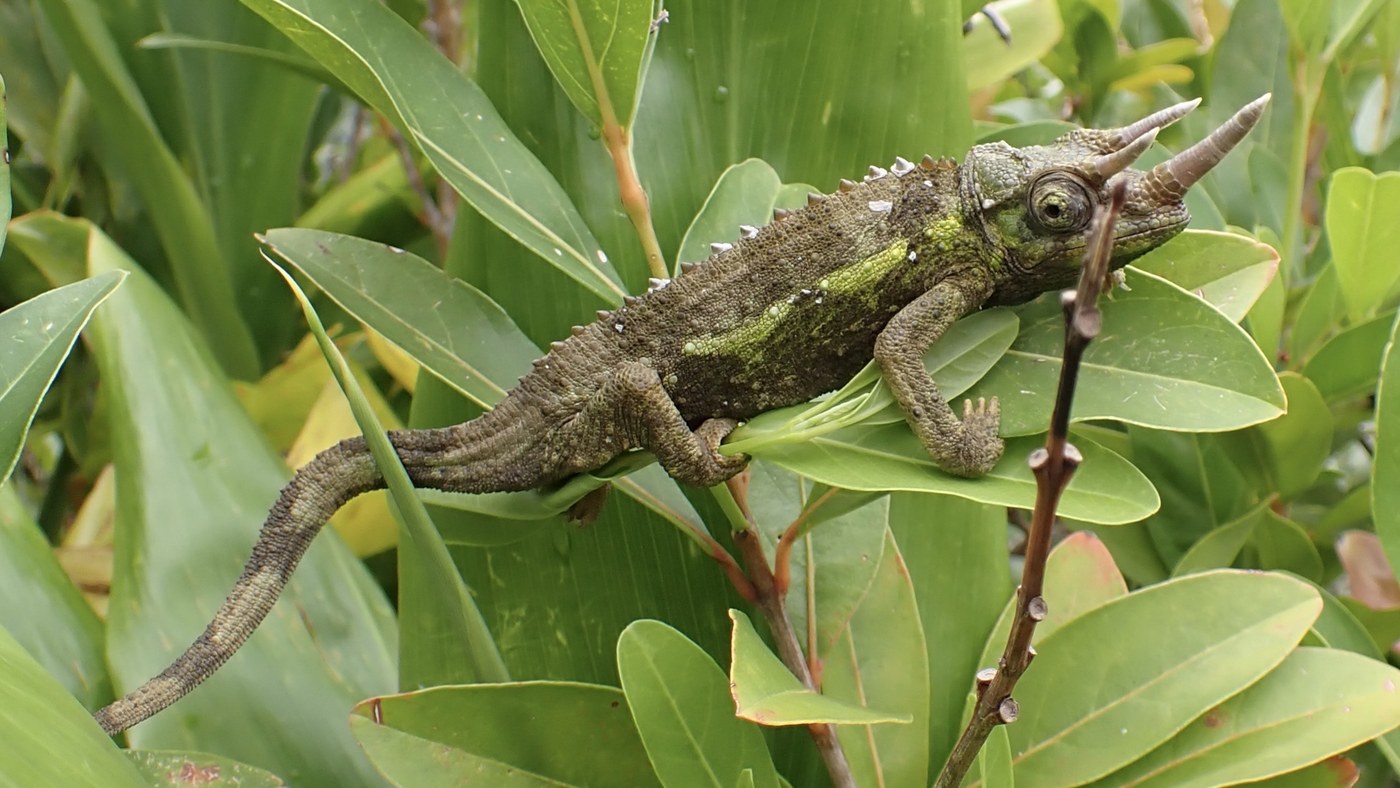
Three horns means male. No horns means female. That is the whole sexing method. The male carries one rostral horn on the snout plus two ocular horns above the eyes, the exact anatomy labeled in the specimen figure of the published threat assessment. The state's own species profile puts the other half plainly: females never grow horns. There is no ambiguous intermediate to puzzle over in the field.
It does not match its background
It does not change color to match its background, and the research that tested that is worth knowing. Color change in chameleons tracks social signaling, physiological state, and temperature, not the surface the animal happens to be sitting on. A study across 21 lineages of southern African dwarf chameleons tested the two competing explanations directly and found capacity for color change scaled with how conspicuous a species' social signals were, with no evidence at all for the camouflage explanation and no relationship to the variety of backgrounds the animals would need to match. The mechanism, worked out in the panther chameleon, is active tuning of a lattice of guanine nanocrystals in a surface layer of skin cells: a dense lattice reflects blue when the animal is calm, and loosening it releases yellows and reds when the animal is excited. A second, deeper layer of those cells reflects infrared and works as passive protection against solar heat. One honest caveat on scope: neither of those two studies was done on this species. What is documented for Jackson's chameleon specifically is the display behavior, and it fits the same picture.
Color tells you mood
What the color actually tells you here is mood. Both courtship and threat run through the same repertoire: color change, an inflated throat, and forelegs raised toward the other animal. A receptive female turns solid green. An unreceptive one shows stress coloring including large areas of black, hisses, and bites. Baseline is bright emerald green fading to yellowish on the underside. So a chameleon going dark and blotchy while you stand over it is not blending in with your shirt, it is telling you to leave.
The movement is diagnostic on its own
The state profile describes a distinctive slow rocking motion, and field work put numbers on it: these animals spend about 19.7 percent of their time moving, average 0.24 moves per minute, and travel at a mean speed of 0.052 meters per minute. That combination is rare enough among lizards that researchers proposed a third foraging category to hold it, the cruise forager, sitting between ambush and active hunting. Almost nothing else on a Hawaii property moves like this.
Size, and which measurement to trust
Males are generally described as 10 to 12 inches in total length, with the prehensile tail accounting for about half. That figure is honest but misleading, because so much of it is tail. Measured snout-to-vent length in Hawaii samples averages roughly 98 to 107 millimeters, about 4 inches, with a species maximum around 160 millimeters. If a lizard on your hedge looks like a foot long, most of that length is tail and horns.
A sex-size discrepancy
The sources disagree on which sex is larger. The state profile says females are a little shorter than males. Both measured datasets found adult females equal to or slightly longer than males in snout-to-vent length, and one field study found neither body length nor mass depended on sex at all. The most likely reconciliation is that the male's longer tail and horns read as extra length while the female carries the heavier body, 43.9 grams against 37.2 grams in the Maui sample.
The rest is pure chameleon
The rest of the body plan is pure chameleon and is unmistakable up close. Laterally compressed body, grasping feet built like pincers, a prehensile tail used as a fifth limb, eyes that swivel independently, and a projectile tongue that extends to about 1.5 body lengths and reaches prey in roughly 0.06 seconds. Large or hard prey gets handled differently: instead of the tongue strike, the animal approaches and takes it directly with the mouth.
The look-alike is another chameleon
The state names it. Veiled chameleon, Chamaeleo calyptratus, runs up to about four times larger, is usually more colorful, and carries a tall casque on the head like a shark fin instead of three horns. It is also an unwanted introduced species in Hawaii. A separate confusion worth clearing: green anole, the small green lizard often called an American chameleon, is not a chameleon at all.
Two scientific names
A note on the two scientific names, since you will see both. Current usage is Trioceros jacksonii xantholophus, the largest of the three recognized subspecies and the one established in Hawaii. Older papers and the state's own profile page still use Chamaeleo jacksonii, because Trioceros was treated as a subgenus until it was raised to full genus rank in 2009. Same animal.
What it is not
What this species is not, because the absences answer most of what people worry about. No source documents venom, a toxin, a medically significant bite, structural damage, wire or hose chewing, indoor droppings, or any species-specific disease transmission to people or pets. A cornered chameleon may hiss and nip. That is the extent of it.
Signs of Infestation
A slow green lizard, several meters up
A slow green lizard rocking along a branch in daylight, several meters up. Field observations put the average perch about 4.5 meters off the ground on branches around 2.4 centimeters thick. Combined with the movement rate, that is why residents in heavily populated areas often report seeing one or two a year and assume the population is tiny.
Survey at night, when they sleep out
At night they sleep out in the open on plants, and that is how you actually survey a property. In the Hawaii Island diet study, 28 of 34 animals were collected at night while sleeping on vegetation. A flashlight walk of hedges and low tree limbs after dark finds more chameleons in ten minutes than a week of daytime glances at the canopy.
Darkening and gaping is a stress display
Sudden darkening, black blotching, gaping, or hissing is a stress display aimed at you. It is not camouflage and it is not aggression toward the house. It means an animal that cannot outrun you is signaling at close range.
Habitat is the filter
Wet, shaded vegetation between roughly 100 and 1,000 meters elevation, trees and hedgerows, ordinary disturbed suburban planting. Dry open ground and high alpine terrain are not where these turn up.
Introduced landscaping does not help
Introduced landscaping does not make a property less of a problem, which is counterintuitive. Chameleons collected off non-native plants in mixed forest contained more native prey items than the ones taken off native plants. Sitting on an ornamental does not mean an animal is eating ornamental-associated pests.
No damage list, and that is a finding
Nothing on record describes gnawing, entry holes, nesting in structures, soiled attics, or any property damage mechanism for this species. There is no evidence trail to work backward from, because the harm happens off the property, to snails and insects, and is invisible from the house.
On Kauai or Lanai, one sighting
On Kauai or Lanai, a single sighting is the sign that matters. Hawaii's invasive species council states the species has not become established on either island and asks for sightings there, which makes one animal a reportable event rather than a curiosity. The published record disagrees: a peer-reviewed survey documents established populations on both islands since the mid-1990s. Report it either way, because the state's ask is what governs what you should do.
Prevention and When to Call a Pro
Start with which island
That determines the only action that matters. On Oahu, Maui, and Hawaii Island the species is established and the state says sightings do not need to be reported. On Kauai and Lanai it is not considered established, and sightings should be reported to 643-PEST at 808-643-7378 or through 643pest.org. Kauai's invasive species committee treats it as an active target, surveys reported sites, and removes confirmed target animals at no cost. Any unusual reptile on any island is worth reporting regardless.
There is nothing to seal
There is no exclusion work to do either. This is an arboreal lizard with no documented interest in structures. The usual prevention advice for structural pests, screening vents, closing gaps, managing moisture indoors, has no application to this species. Anyone selling you exclusion work for chameleons is selling you something else.
Read the legal rules exactly
The legal rules are what matter most, and they are worth reading exactly as written. Hawaii's Department of Land and Natural Resources maintains an injurious wildlife list under its administrative rules chapter 124, adopted under the state's conservation statute, and the listing covers all species in the chameleon family rather than this species alone. Rule 13-124-3(d) prohibits three specific things, and prohibits attempting them: releasing injurious wildlife into the wild, transporting them to islands or locations within the state where they are not already established and living in a wild state, and exporting any such species, or its dead body or parts, out of the state.
The plain-language summary differs
The state's plain-language summary is broader than the rule text, and both versions matter. The state invasive species program summarizes the same rule as making it illegal to transport these animals between islands or to commercially export them to the mainland. The rule text itself restricts transport to islands and locations where the species is not already established. If you are trying to work out what applies to you, read the rule's three prohibitions, and treat any interisland movement as something to clear with the agency first rather than something to reason about yourself.
On penalties, one figure
One figure circulates, and it traces to a single program page. The state invasive species profile states penalties can include a fine of up to $200,000 and a possible prison sentence, and one island committee page repeats that wording verbatim rather than confirming it independently. Treat it as a figure stated by the state invasive species program, not as a verified statutory maximum, and treat the underlying point, that these are enforceable prohibitions and not guidance, as solid.
Export is specifically closed
Export for the mainland pet trade is specifically closed, and the state explains why in its own words. The wildlife division may permit export of injurious wildlife for research, educational display, or personal use in very limited circumstances, but states that no permits will be issued for commercial use. Its stated reasoning is to avoid turning harmful organisms into commodities raised in Hawaii and exported into the mainland pet trade. It also notes it regularly receives requests to export Jackson's chameleon for mainland sale, pitched as helping the environment, and answers that the species is widespread enough that removing a small number of animals would not be a meaningful control benefit. That is a good thing to know before someone offers to solve your chameleon problem by shipping them.
Pet questions go to the state
Questions about keeping one as a pet go to the state. Chameleons appear on the agriculture department's restricted animal list, though the current part assignment and permit terms are not clear from the list document itself. Older secondary accounts describe the animals being sold in Hawaii pet stores. Treat the question as unsettled either way, and ask the Department of Agriculture and the Department of Land and Natural Resources. If you already have an animal you should not, the agriculture department runs an amnesty program that lets a person turn in an illegal animal without prosecution.
Do not move or release one
Do not move animals, and do not release one, because human transport is the entire dispersal story for this species. Chameleons did not swim between islands. Every population exists because people carried animals, first from Kenya and then from island to island. Releasing one is a specifically prohibited act, and carrying one to an island where the species is not established is the single most damaging thing a resident could do here.
No homeowner treatment exists
There is no homeowner treatment for this species, and that is a real contrast with coqui frog. For coqui, the state publishes a citric acid method a Big Island homeowner can buy and apply. Nothing equivalent exists for chameleons. The only published control research is a dose-finding study of acetaminophen, carried out on the model of the method resource managers use against brown tree snake on Guam, with a proposed field delivery that uses introduced snail shells as bait vessels. That is a method proposed for resource managers working in native habitat, not a consumer product and not a labeled use. Improvising it with over-the-counter medication is neither a lawful pesticide application nor safe around pets, children, and non-target wildlife.
Wash your hands after handling
If you handle one, wash your hands afterward. The federal health guidance here is general to reptiles rather than specific to this species: reptiles commonly carry Salmonella in their digestive tracts even when they look clean and healthy, so wash with soap and running water after any contact with a reptile or the things around it, and keep children under five, adults over 65, and anyone immunocompromised from handling reptiles. No source makes a species-level disease claim for Jackson's chameleon, and none should be assumed.
Who to Call, and When
On Kauai or Lanai, call 643-PEST before you call anyone else, because early detection there is a state-funded response and a single animal is the only stage at which removal accomplishes something. If a property adjoins native forest or conservation land, the right call is to the state or the land's resource managers rather than to a treatment provider, because control near endangered snail habitat is a permitted management activity involving exclosures and coordinated removal. Call a professional if numbers are past what hand removal can address, and be aware that observed densities at one Oahu site reached 45 animals per half acre. And if you have a few chameleons in a suburban yard with no native forest next door, the answer is straightforward: there is no registered homeowner control method, the animal is not a structural or health threat, and the obligations that actually apply to you are the legal ones.
Frequently Asked Questions
Do Jackson's chameleons change color to match their surroundings?
No, and this is the most common misconception about the animal. Color change in chameleons tracks social signaling, stress, and temperature, not the surface the animal is sitting on. When researchers tested the two competing explanations across 21 lineages of southern African dwarf chameleons, the capacity for color change scaled with how conspicuous each species' social signals were and showed no relationship to the range of backgrounds the animals would need to match. The paper reports no evidence for the camouflage explanation. The physical mechanism, worked out in the panther chameleon, is active tuning of a lattice of guanine nanocrystals in a surface skin layer: dense lattice reflects blue in a calm animal, and loosening it releases yellows and reds in an excited one, while a deeper layer reflects infrared as passive protection from solar heat. Neither of those studies was done on Jackson's chameleon specifically. What is documented for this species is that color change is part of both its courtship and its threat display, alongside an inflated throat and raised forelegs, and that a stressed animal goes blotchy black. So the color is telling you about the chameleon, not about the branch.
Are Jackson's chameleons dangerous to people or pets?
No. Nothing documents venom, a toxin, a medically significant bite, or any species-specific disease transmission from Jackson's chameleon to people or pets. A cornered animal may hiss and nip, and that is the whole risk profile. The one piece of health guidance worth following is general to all reptiles rather than specific to this one: federal health guidance notes reptiles commonly carry Salmonella in their digestive tracts even when they appear clean and healthy, so wash hands with soap and running water after any contact with a reptile or its environment, and keep young children, adults over 65, and immunocompromised people from handling reptiles.
Is it illegal to move a Jackson's chameleon between Hawaiian islands?
Treat it as illegal and clear anything else with the state first. Hawaii lists the entire chameleon family as injurious wildlife, and the governing rule prohibits three things: releasing injurious wildlife into the wild, transporting them to islands or locations within the state where they are not already established and living in a wild state, and exporting the species or its parts out of the state. The state invasive species program summarizes that rule more broadly, as making interisland transport and commercial export to the mainland illegal. Its stated penalties reach a fine of up to $200,000 and a possible prison sentence, a figure that comes from that program rather than from a verified statute. Separately, the wildlife division will not issue export permits for commercial use at all, specifically to keep an injurious species from becoming a Hawaii-raised commodity for the mainland pet trade.
How did chameleons end up in Hawaii in the first place?
In 1972 a licensed pet shop owner in Kaneohe on windward Oahu imported several dozen Jackson's chameleons from Kenya. The shipment arrived dehydrated and in poor condition and the animals were placed outdoors, which released them, and the peer-reviewed account describes that as the first and only known introduction in the state. The state's own profile calls the same event an intentional release. A later study reports additional deliberate releases in the early 1970s, hundreds of animals born in mainland pet stores and let go at numerous Hawaii localities by several people who wanted to build a wild stock to export back to the pet trade. All movement since then, island to island, has been by people rather than by the animals.
Do Jackson's chameleons actually harm native Hawaiian wildlife?
Yes, and it has been measured rather than assumed. For decades the species was thought harmless, and a well-known local herpetologist wrote in the 1990s that hundreds of hours of field observation showed nothing indicating harm to endemic invertebrates. Then in 2009 researchers examined chameleons taken from endangered tree snail habitat on Oahu and found the first conclusive evidence of an introduced reptile eating native Hawaiian animals: 11 native snails across four endemic genera, including four individuals of the Critically Endangered Oahu tree snail Achatinella mustelina, plus native insects in five genera including grasshoppers, case-bearing caterpillars, planthoppers, beetles, and dragonflies. Shells were swallowed whole and uncrushed. A follow-up study measured shell digestion, about 12.5 percent of shell mass per day, applied it to gut contents from 45 field-collected animals, and estimated that at that observed density, 45 chameleons per 2,000 square meters or half an acre, the group could consume 730 to 974 tree snails a year in that area. Given how slowly Hawaiian tree snails grow and reproduce, the authors judged that unsustainable even short term. On Maui, endemic invertebrates made up about a third of all prey items.
Do they eat native Hawaiian birds?
There is no documented case. One island committee page lists the species as a threat to native birds along with native insects, spiders, and snails, and native-range accounts of the animal's diet do include small birds among its prey, so the capability is real and limited mainly by gape size. But no record documents Jackson's chameleon preying on a Hawaiian bird. The only vertebrates recovered in Hawaii gut-content studies were two introduced skinks. The documented impact is on invertebrates, and it is severe.
Which islands have them, and should I report a sighting?
The state lists the species as established on Hawaii Island, Maui, and Oahu, where sightings do not need reporting, and as not established on Kauai or Lanai, where they should be reported to 643-PEST at 808-643-7378 or 643pest.org. Kauai's invasive species committee treats it as an active target and helped capture one animal in Lihue in 2013, presumed an escaped pet. Older published work makes broader claims, including established populations first documented on Lanai and Kauai in the mid-1990s and populations on all main islands. Follow the current state position, because that is what determines whether your sighting is useful to report, and know that the disagreement exists.
Aren't chameleons useful in the yard since they eat insects?
No, and the diet data is what settles it. In a Hawaii Island wet-forest study of 34 animals, researchers recovered 795 prey items from 48 taxa, with native insects forming the largest single dietary component and prey spanning most of the body-size range of the native invertebrate community. Stinging and chemically defended insects were eaten anyway. On Maui, endemic invertebrates were about a third of all prey items. And the detail that undercuts the pest-control argument entirely: chameleons collected off non-native plants contained more native prey than those taken off native plants, so an animal living in your ornamentals is not therefore eating ornamental pests. A generalist that eats roughly 23 items a day, whatever comes within tongue range, is not a targeted pest control service.
Sources
- Jackson's Chameleon invasive species profile: the 1972 introduction from Kenya and Tanzania released in Kaneohe, established populations on Hawaii Island, Maui and Oahu, the not-established status and report-it instruction for Kauai and Lanai, injurious wildlife listing under chapter 13-124, the stated penalty of up to $200,000 and possible imprisonment, the agriculture department amnesty program, the three-horned male and hornless female description, the slow rocking gait, the veiled chameleon look-alike, and the brown tree snake prey-base concern Hawaii Invasive Species Council, Hawaii Department of Land and Natural Resources
- Injurious Wildlife: the definition and Exhibit 5 listing covering all species in family Chamaeleonidae, the three prohibitions in rule 13-124-3(d) on release, transport to islands or locations where a species is not already established, and export from the state, and the policy of issuing no export permits for commercial use with the department's stated reasoning about the mainland pet trade Hawaii Department of Land and Natural Resources, Division of Forestry and Wildlife
- A reptilian smoking gun, first record of invasive Jackson's chameleon predation on native Hawaiian species, Biodiversity and Conservation 19:1437-1441: the 1972 Kaneohe pet shop introduction account, 11 native snails in four endemic genera including four Critically Endangered Achatinella mustelina, native insects in five genera, whole uncrushed shells, the 100 to 1,000 meter elevation band, the interisland transport prohibition since 1997, and the upslope range expansion concern with monitoring at 600 to 1,300 meters University of Hawaii Pacific Biosciences Research Center, with Bishop Museum and the Oahu Army Natural Resource Program
- Impact of an invasive predatory lizard on the endangered Hawaiian tree snail Achatinella mustelina, a threat assessment, Endangered Species Research 24:115-123: shell digestion at about 12.5 percent of mass per day, passage in 4 to 5 days when fed against 8 days when fasting, 8 snails recovered from 45 field-collected lizards, the estimate of 730 to 974 snails consumed per year per 2,000 square meters at a density of 45 chameleons, the one rostral and two ocular horn anatomy with the hornless female, the deliberate early-1970s release reports, and the count of remaining Achatinella species University of Hawaii at Manoa, Pacific Biosciences Research Center, published in Endangered Species Research
- Diet of the invasive lizard Chamaeleo jacksonii at a wet-forest site in Hawaii, Pacific Science 66(3):397-404: 795 dietary items from 48 taxa in 34 lizards, native insects as the largest dietary component, 28 of 34 animals collected at night while sleeping on vegetation, the finding that lizards on alien plants held more native prey than those on native plants, the maximum snout-to-vent length near 160 millimeters, and the modeling result that the species can physiologically colonize most non-alpine Hawaii habitat Bishop Museum, published in Pacific Science, hosted by the Hawaii Invasive Species Council
- Diet and conservation implications of an invasive chameleon in Hawaii, Biological Invasions 14(3):579-593: the Maui native dry forest sample in which endemic insects made up about one third of the diet, the finding that prey sizes span virtually the entire range of native Hawaiian arthropod diversity, and the assessment of high fecundity plus high population densities as a serious threat to Hawaiian fauna U.S. Geological Survey, with Bishop Museum and the Pacific Island Ecosystems Research Center
- Notes on reproduction of Jackson's chameleon from Hawaii, The Herpetological Bulletin 115: histological examination of 88 Oahu specimens, adult male mean snout-to-vent length 98.1 millimeters and adult female 107.1 millimeters, juvenile mean 48.9 millimeters, litter size averaging 12.2 with a range of 7 to 21, litter size increasing with female body size, smallest reproductive female at 94 millimeters, smallest mature male at 70 millimeters in Hawaii against 90 millimeters in Kenya, both sexes reproductively active in December and February, the authors' own statement that seasonality cannot be assessed from a two-month sample, and the compiled ranges of reported neonate counts and gestation lengths British Herpetological Society, with Whittier College and Bishop Museum
- Cruise foraging of invasive chameleon in Hawaii, Breviora 519:1-7: field video quantification of 27 Maui chameleons giving 19.7 percent time moving, 0.24 moves per minute, moving speed 0.33 and mean speed 0.052 meters per minute, mean perch height 4.5 meters on 2.4 centimeter perches, 1.85 feeding events per hour, mean male snout-to-vent length 106.5 millimeters at 37.2 grams against female 107.5 millimeters at 43.9 grams, no observed display events, and the classification of chameleons as cruise foragers distinct from ambush and active foragers Museum of Comparative Zoology at Harvard University and the University of Idaho, published in Breviora
- Invasion ecology and control feasibility of the Jackson chameleon in Hawaii, doctoral dissertation: variation in head size and horn length among Hawaiian islands and between native and introduced range with larger heads tracking low precipitation and hard prey and longer horns tracking the native range and fight success, description of a novel feeding mechanism distinct from standard chameleon lingual prehension, and the acetaminophen dose-finding work establishing the minimum lethal dose for control purposes, modeled on the brown tree snake control approach used on Guam, with proposed snail-shell bait delivery for resource managers University of Hawaii at Manoa, ScholarSpace
- Global Invasive Species Database species profile for Chamaeleo jacksonii: Hawaii abundance between 100 and 1,000 meters elevation with daytime temperatures of 21 to 32 degrees Celsius and nights of 10 to 20, hedgerow and disturbed habitat preference, the tongue extending to about 1.5 body lengths and reaching prey in roughly 0.06 seconds, direct mouth capture of large insects and snails, neonates of 52 to 55 millimeters with 23 to 25 millimeters of tail feeding from the day of birth, juveniles at 8 to 10 centimeters by five months, an observation of no apparent reproductive seasonality in Hawaii, and the injurious wildlife and interisland transport status IUCN Species Survival Commission, Invasive Species Specialist Group
- Chamaeleo jacksonii species account: the shared courtship and threat repertoire of color change, throat inflation and raised forelegs, the receptive female turning solid green against stress coloration with large black areas plus hissing and biting, gestation of about 190 days, neonates about 5.5 centimeters and 0.6 grams born one at a time onto a branch inside a membrane, re-mating after about 20 days, sexual maturity at 9 to 10 months, and longevity up to about 10 years Animal Diversity Web, University of Michigan Museum of Zoology
- Reptiles and Amphibians, Healthy Pets Healthy People: reptiles carrying Salmonella in their digestive tracts even when they appear clean and healthy, the hand-washing guidance after contact with a reptile or its environment, and the elevated risk for children under five, adults 65 and older, and immunocompromised people U.S. Centers for Disease Control and Prevention
- Selection for social signalling drives the evolution of chameleon color change, PLoS Biology 6(1):e25: the test of the camouflage explanation against the social signaling explanation across 21 lineages of southern African dwarf chameleons, the finding that capacity for color change tracks conspicuousness of social signals, and the explicit finding of no evidence for the crypsis explanation and no relationship to variation in environmental backgrounds Public Library of Science, work conducted at the University of Melbourne and Museums Victoria
- Photonic crystals cause active color change in chameleons, Nature Communications 6:6368: active tuning of a lattice of guanine nanocrystals in a superficial layer of dermal iridophores, a dense lattice reflecting blue in a calm animal against a loosened lattice reflecting yellows and reds in an excited one, and a second deeper iridophore layer reflecting infrared wavelengths as passive thermal protection University of Geneva, published in Nature Communications
- Compendium datasheet for Trioceros jacksonii: maturity reported at 9 months, a 6 to 7 month gestation before live birth of up to 51 young, females able to mate again as soon as 20 days after giving birth, the resulting potential for a high intrinsic population growth rate, and the statement that the species is established only in California and Hawaii CABI Digital Library
- Jackson's Chameleon target species page: the report-if-seen status for Kauai, free survey and removal of confirmed target animals, the 2013 capture of one chameleon in Lihue presumed to be an escaped pet, the claim that the species threatens native birds as well as native insects, spiders and snails, and the statement that these animals are primarily moved around Hawaii by people Kauai Invasive Species Committee
- Comparative reproductive biology of two sympatric tropical lizards, Amphibia-Reptilia: the Kenya field study recording an average litter size of 21.7 for this species with a range as wide as 6 to 57, parturition from mid-January into March, post-reproductive quiescence from January through March, and estimated age at sexual maturity of about 13.5 months for females and 16 months for males Amphibia-Reptilia, published for the Societas Europaea Herpetologica
- 643PEST statewide invasive species reporting network: the 643-PEST hotline at 808-643-7378 and the online reporting portal used for Jackson's chameleon sightings on Kauai and Lanai and for any unusual reptile sighting on any island Hawaii Invasive Species Council
Image Credits
- Image: Thomas Irvine via iNaturalist. CC BY 4.0.
License.