Seasonal Timeline
Green anole runs on a real seasonal cycle in both the Southeast and Hawaii, not a year-round pattern. Breeding runs roughly March or April through August or September, both in the native Southeast range and in Hawaii's introduced population, where researchers have found the same overall seasonal pattern as native mainland populations rather than the true year-round breeding some of Hawaii's fully tropical introduced species show. In the Southeast, cold weather pushes the species into brumation, a reptile dormancy, through the winter months.
This species has a real breeding season, and it holds in both the Southeast and Hawaii. Green anole breeds roughly from March or April through August or September. A published study of Hawaii's introduced population found the same overall seasonal reproductive pattern seen in native mainland populations, including a period of reduced activity in autumn shared with other introduced Hawaiian lizards, rather than the true year-round breeding some of Hawaii's other introduced species show. That sets it apart from the coqui frog, which calls essentially year-round in the same islands.
Winter works differently depending on which population you are looking at. In the native Southeast range, cold weather pushes green anole into brumation, a reptile dormancy state, through the winter months, with documented cold tolerance bottoming out around 33 degrees Fahrenheit and mortality once body temperature nears freezing. Hawaii's climate never forces that dormancy, which is one more reason the Hawaii population and the Southeast population, while the same species, do not behave identically year-round.
Day and night matter more than month-to-month for spotting one. This is a diurnal lizard. It forages, basks, and displays during daylight hours and is inactive and silent after dark, the reverse of the coqui frog, which calls after dark. A green anole seen at all is a daytime sighting.
Where They're Found
Green anole lives in two separate United States populations of the same species. Green anole is native to the southeastern United States, not introduced there, with a confirmed range covering East Texas, southeastern Oklahoma, southern Arkansas, Louisiana, Mississippi, Alabama, Georgia, Florida, South Carolina, North Carolina, and the southeastern edges of Tennessee and Virginia. Multiple state and university sources independently describe it as the single most commonly encountered lizard across that region's urban and suburban yards, and University of Florida Extension calls it Florida's only native anole. That native population, not the introduced one, is where most homeowners encounter this lizard.
The same species was also introduced to Hawaii, first documented on Oahu in 1950 after being initially misidentified as a closely related Cuban species. It is now established on Oahu, Kauai, Maui, Molokai, Lanai, and Hawaii Island, spread by the same general human-assisted transport pathway responsible for its other introduced populations worldwide, including islands in Japan, Guam, the Northern Mariana Islands, Palau, the Bahamas, and Anguilla, plus small populations in parts of Mexico and isolated sightings in Southern California dating back to at least 1993. None of those additional locations has a documented established, region-scale population the way Hawaii does, which leaves two regions in the United States: the Southeast for the native population and Hawaii for the introduced one.
Alaska carries no population and is straightforward to rule out. The species' native range reaches its cold-hardy northern edge in southeastern Virginia, southeastern Tennessee, and southeastern Oklahoma, surviving winter there through brumation with documented cold tolerance bottoming out around 33 degrees Fahrenheit and mortality near freezing. Nothing in Alaska's climate resembles that edge case, and no source places the species anywhere near it.
Within either region, the animal is simply wherever the plants and climbable surfaces are: trees, shrubs, vines, fences, walls, and foundation plantings immediately around a house, using adhesive toe pads to climb smooth vertical surfaces most lizards cannot manage. It occasionally wanders indoors through an open door or a gap around a window while chasing prey, but does not seek out indoor harborage the way a structural pest does.
Life Cycle
The life cycle here is a reptile's, not an insect's, and it stays simple. Egg to hatchling to sexually mature adult, with no larval or pupal stage and no metamorphosis. A female lays a single egg roughly every two weeks through a spring-to-late-summer breeding season and provides no care afterward. Season totals in the literature disagree, running from about 10 eggs up to 15 or 18. That is the entire developmental cycle.
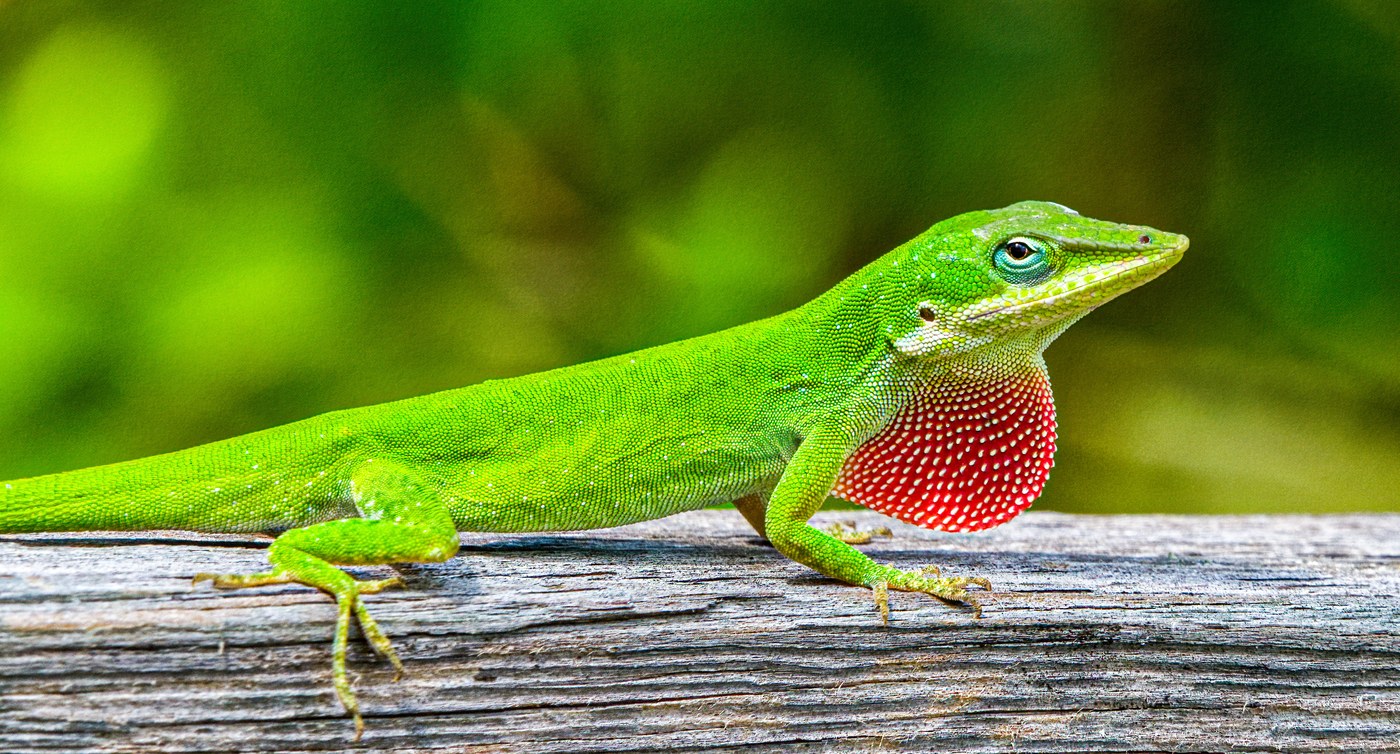
The territorial display is the behavior that generates the actual homeowner questions. A male flashing a pink dewlap and bobbing his head on a fence or plant looks, to someone unfamiliar with the behavior, like it might be directed at them. It is directed at other male anoles, or at a female during courtship. Nothing about this animal's life cycle or behavior involves aggression toward people or pets at any stage.

Egg
Hatchling
Adult
Territorial display
Identification
Size and shape first
Adults run roughly 5 to 8 inches long including the tail, with a slender body, a long pointed snout, and small ridges between the eyes and nostrils. Adhesive pads on the toes let it climb smooth vertical surfaces, walls, fences, and glass, that most yard lizards cannot manage.
Color is not fixed
Color is not a fixed identifier, and that is the whole reason this animal gets called a chameleon. An individual can shift between bright green, brown, and gray within seconds, driven by temperature, mood, and stress rather than an attempt to match the immediate background. A white or pale underside and lips, and often a thin turquoise ring around the eye, hold constant across every color phase.
Males and females differ visibly
Males are about 15 percent larger and carry a bright pink dewlap, a throat fan roughly three times the size of a female's when she shows one at all, extended during territorial and courtship display. Females and juveniles typically show a pale stripe running down the spine that most adult males lack.
It is not a chameleon
The actual physical tells are specific. True chameleons are a separate family native to Africa and Madagascar, with a stouter build, a tail that curls, and fused, opposable toes gripping like a mitten. Green anole has a slender head, a tail it cannot curl, and separated toes. The color-change mechanism differs too: true chameleons use specialized skin nanocrystals, while green anole's shift comes from three layers of pigment cells common to many reptiles.
Rule out the brown anole
The most reliable look-alike to rule out is the brown anole, an introduced Cuban species now common across much of the same range, including within Hawaii. Green anole always shows a pale or white chin regardless of its current color phase and never develops the mottled, patterned skin brown anole shows. The distinguishing rule that holds every time: brown anole is never green, so any lizard actually showing green coloring is a green anole, not a brown anole in a brown phase.
What it is not
What this animal is not, because the absences rule out most of what people worry about. No source documents a meaningful bite risk, venom, or disease-vector role for green anole. There is also no property-damage mechanism, no gnawing, no burrowing into structures, no nest-building in wall voids. It is an outdoor lizard that occasionally wanders in through an open door while chasing an insect, not a structural pest.
Signs of Infestation
A small lizard basking by day
A small green or brown lizard basking on a wall, fence, plant, or windowsill during the day is the ordinary sighting. This is a diurnal species, active and visible in daylight and inactive at night, so any sighting is, by definition, a daytime one.
The pink throat fan is a display
A male doing head-bobs and push-ups with a bright pink throat fan extended is a territorial or courtship display, not a warning sign. It is aimed at other male anoles or at a female nearby, and it is the single behavior most likely to prompt a homeowner call, almost always out of a misplaced concern rather than an actual problem.
No sound accompanies any of this
Green anole has no call or vocalization used in display; everything is visual. A lizard-like sound at night in the same yard is a different animal entirely, not this one.
No odor and no waste signature
None has been documented. There is nothing to smell or track for this species the way there would be for an actual structural pest.
Indoors only while chasing insects
Occasional indoor appearances happen while chasing insects through an open door or a gap around a window, not because the lizard is seeking shelter indoors. A single anole found inside is an incidental visitor, not evidence of an indoor population.
Prevention and When to Call a Pro
There is little to prevent
The honest starting point is that there is very little to prevent. No source documents green anole causing property damage, carrying a disease risk, or posing a meaningful bite risk. Coexistence, not control, is the accurate framing for both the native Southeast population and the introduced Hawaii population.
If you simply prefer fewer
If a homeowner still prefers fewer anoles immediately around the house, purely as a preference rather than a response to any actual risk, habitat modification is the only lever worth mentioning. Trimming dense foundation plantings and vine growth against the structure reduces climbable, shaded perch space right next to windows and doors, and sealing obvious gaps around windows, doors, and vent screens reduces incidental indoor wandering while the lizard pursues insects.
No repellent or trap exists
No published source describes a repellent, trap, or removal method, because none of them treat this species as a pest requiring one. Anything marketed as an anole repellent or trap should be read skeptically against that absence.
Regulatory status is a non-issue
Regulatory status is essentially a non-issue in both regions. Green anole is not listed among the species covered by Hawaii's injurious wildlife rule. That is consistent with a species established in Hawaii since 1950 that the state is not actively working to control, unlike some of Hawaii's other introduced wildlife. There is no threatened, endangered, or federally protected status attached to this animal in either region, and no permit or take restriction applies to ordinary habitat trimming around a home.
The general handling caution
The general reptile-handling caution that applies to any lizard still applies here, even though it is not specific to this species. Wash hands after handling any reptile or amphibian, and keep children under 5 from direct handling, per standard CDC guidance covering reptiles and amphibians as a group. This is generic reptile-handling advice, not a finding specific to green anole, and no source singles this species out for elevated risk relative to reptiles in general.
When to Call a Pest Control Professional
Realistically, the only legitimate reason is misidentification, not this species itself. If a homeowner is unsure whether what they are looking at is actually a green anole, a genuinely dangerous reptile, or if a dewlap display is being misread as aggression toward a child or pet, an inspection to confirm identification is a reasonable call. That is a reassurance visit, not a treatment, and it is the honest scope of professional involvement this species ever warrants.
Frequently Asked Questions
Is a green anole a chameleon?
No. It is called an American chameleon in the Southeast and in the pet trade because it changes color from green to brown, but true chameleons are a separate family native to Africa and Madagascar. Green anole has a slender head, a tail it cannot curl, and separated toes, all different from a true chameleon's stouter build, curling tail, and fused, mitten-like toes. The color-change mechanism differs too: true chameleons use specialized skin nanocrystals, while green anole relies on three layers of pigment cells common to many reptiles, triggered mainly by temperature, mood, and stress rather than active camouflage-matching.
Is a green anole dangerous to people or pets?
No. No source documents a meaningful bite risk, venom, or disease-vector role for this species. The only caution worth mentioning is the standard CDC guidance that applies to any reptile or amphibian: wash hands after handling one, and keep children under 5 from direct handling, because reptiles and amphibians as a group can carry Salmonella even when they look healthy. That is generic reptile advice, not a finding specific to green anole.
Why does the lizard on my fence keep bobbing its head and flashing a pink throat flap?
That is a male green anole's dewlap display. It serves two purposes: defending his territory against rival male anoles, and courting a nearby female during the spring-through-late-summer breeding season. It is not aggression directed at people or pets, no matter how close the display happens to a doorway or a patio.
Do I need pest control for green anoles in my yard?
No. Green anole is insectivorous and genuinely beneficial, spending most daylight hours eating flies, ants, small beetles, and other yard insects from a perch. No published source describes it as a pest requiring treatment, and none describes a repellent, trap, or removal method, because none of them treat it as a problem to solve.
How do I tell a green anole from a brown anole?
Check the chin and the color. Green anole always shows a pale or white chin regardless of whether its body is currently green or brown, and it never develops the mottled, patterned skin brown anole shows. The rule that holds every time: brown anole is never green, so any lizard actually showing green coloring is a green anole, not a brown anole in a brown phase. This matters everywhere green anole lives, since brown anole, an introduced Cuban species, is now common across much of the Southeast and also co-occurs with green anole in Hawaii.
Are the green anoles in Hawaii the same animal as the ones in the Southeast?
Same species, two different histories. Green anole is native to the southeastern United States, and a separate population was introduced to Hawaii, first documented on Oahu in 1950 after being initially misidentified as a closely related Cuban species. It is now established on Oahu, Kauai, Maui, Molokai, Lanai, and Hawaii Island. Both populations are harmless in exactly the same way, and a study of the Hawaii population found it follows the same overall seasonal breeding pattern as native mainland populations, rather than breeding year-round the way some of Hawaii's other introduced species do.
Sources
- Anoles: native green anole identification, size, "chameleon" naming, and competition with introduced brown anole University of Florida IFAS Extension, Gardening Solutions
- Florida's Introduced Reptiles: Brown Anole, including the green-versus-brown anole identification tells (white chin, never-green rule) University of Florida IFAS Extension (EDIS), publication UW486
- Florida's Introduced Reptiles: Veiled, Oustalet's, and Panther Chameleon, including the explicit green-anole-versus-true-chameleon physical distinction University of Florida IFAS Extension (EDIS)
- Reproduction in the Green Anole, Anolis carolinensis, from Hawaii: island-by-island Hawaii distribution and seasonal breeding pattern matching native mainland populations Current Herpetology, via BioOne (peer-reviewed journal)
- Reptiles and Amphibians: general Salmonella and hand-washing guidance applicable to any reptile, including green anole Centers for Disease Control and Prevention, Healthy Pets Healthy People
- Chapter 13-124 List of Species of Injurious Wildlife in Hawaii (Exhibit 5), reviewed for green anole's absence from the injurious wildlife list Hawaii Department of Land and Natural Resources
Image Credits
- Image: Adobe Stock, licensed.