Seasonal Timeline
Common Ravens are year-round residents wherever they are established, not seasonal arrivals. What shifts through the year is the nesting cycle and the livestock calendar, not whether the birds are present.
Common Ravens are year-round residents wherever they are established, not seasonal arrivals. What shifts through the year is the nesting…
Courtship and nest-building typically begin between January and March depending on latitude, and pairs produce one brood per year. Because a breeding pair holds and defends the same year-round home range once it is established, a nest site on a building ledge, transmission tower, or billboard is not a problem that resolves itself at the end of a season.
The livestock conflict window is tied to calving and lambing rather than to weather. Ravens prey on newborn lambs and calves during that period, which is why the federal depredation-permit mechanism is written around calving and lambing season specifically.
Outside of breeding, non-breeding juveniles and subadults form loose, mobile flocks that can number in the hundreds at a shared roost or a concentrated food source such as a landfill. Those flocks move; a defended breeding territory does not.
Alaska is the one region with a documented seasonal swing. Anchorage counts run from roughly 200 resident ravens in summer to more than 1,000 in winter, as birds concentrate in developed areas through the long winter darkness. Everywhere else, read the bird as a year-round resident.
Where They're Found
The Common Raven occupies every terrestrial biome in North America except tropical rainforest. Tundra, desert, coastline, grassland, coniferous and deciduous forest, and alpine cliff country all support the species, and it has increasingly moved into urban and suburban areas, nesting on transmission towers, billboards, bridges, and building ledges in place of natural cliff faces. There is no strong climate or moisture preference to work with here. The adaptability itself is the identifying trait.
The Common Raven is established across most of the United States, but not evenly. Alaska, the Pacific Northwest, California, the Mountain West, and the Southwest all hold established, year-round resident populations throughout. In the Midwest, the South Central states, and the Southeast the bird holds only specific parts of the area, and the distinction matters if you are trying to identify a bird in your own yard.
In the Midwest, the established range is a northern tier, not the whole region. Breeding is confirmed in northern Minnesota, in Wisconsin, where the range has been expanding south since the 1950s following a collapse in the late 1800s, and in Michigan's Upper Peninsula and northern Lower Peninsula. No published record confirms established populations in Ohio, Indiana, Illinois, Iowa, Missouri, or Kansas.
In the South Central region, the range is two separate pockets plus a mountain edge. There is a disjunct population in the Trans-Pecos and Big Bend high country and a second, geographically separate population in the Texas Panhandle. An Appalachian population reaches extreme southeastern Kentucky and the eastern Tennessee mountains along the North Carolina line, generally above 2,700 feet. No published record confirms established populations in Oklahoma, Arkansas, or Louisiana.
In the Southeast, the population runs along the Appalachian belt and stops there. Breeding birds occur from West Virginia and the Virginia Ridge-and-Valley and mountain region through extreme western North Carolina and extreme northwestern South Carolina into extreme northern Georgia, largely on exposed cliff faces. The species was extirpated from Alabama in the early 20th century and has not been confirmed to have recolonized it, and no published record places it in Florida or Mississippi at all. The Deep South coastal plain remains a documented gap even while the Appalachian population recovers. More broadly, the eastern population is described as reestablishing its former distribution after a near-extirpation from the eastern United States before 1900, so eastern range edges are moving.
Hawaii has no resident raven population. The Common Raven's status in Hawaii is rare or accidental: a small number of individual vagrant records exist, including a bird on Kure Atoll in February and March of 2014 that was accepted to the state checklist, but there is no breeding or resident population and the species has not been introduced there.
Life Cycle
The thing that separates this species from every other bird a pest professional deals with is cognition. A peer-reviewed review of tool use in ravens documents at least 10 distinct modes of tool use and tooling behavior, and ravens have performed planning and social-inference tasks in experimental settings that had previously been demonstrated mainly in great apes. Caching behavior is the clearest everyday example: ravens hide food, and they adjust how and where they hide it based on whether another raven can see them doing it. On top of that, ravens learn socially, watching and copying successful foraging and caching tactics from other ravens rather than each bird working it out alone. The practical consequence for a property owner is that a deterrent that depends on a bird being fooled has a short shelf life, and a food source that works once gets learned, remembered, and shared.
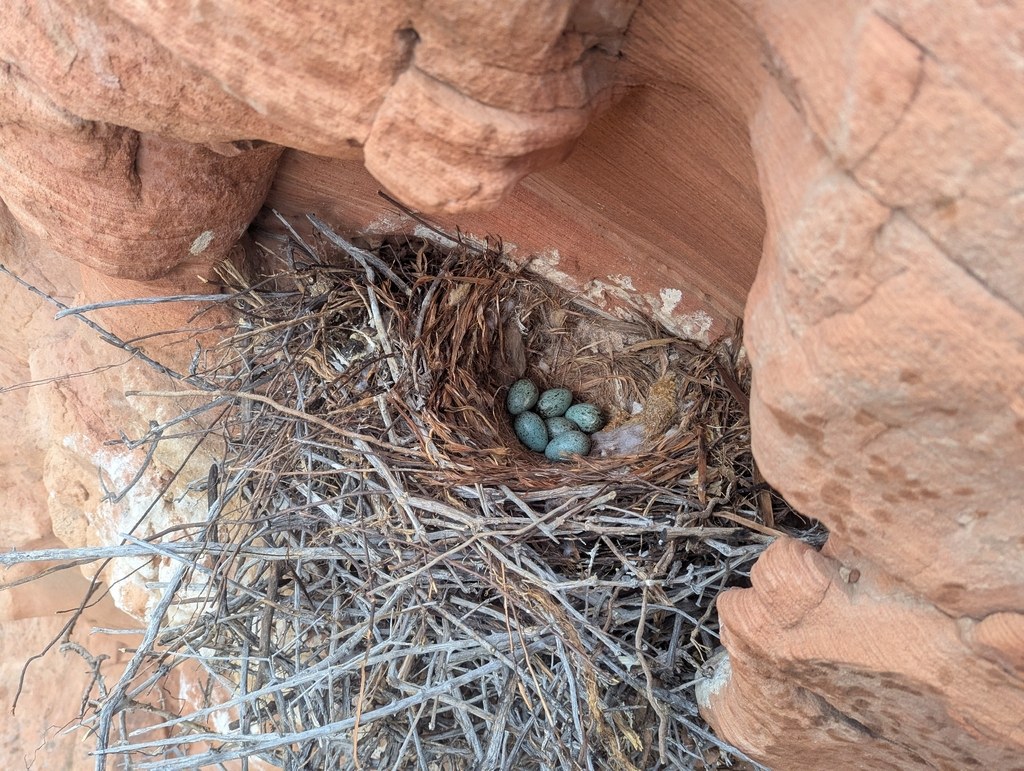
Egg2

Nestling
Juvenile
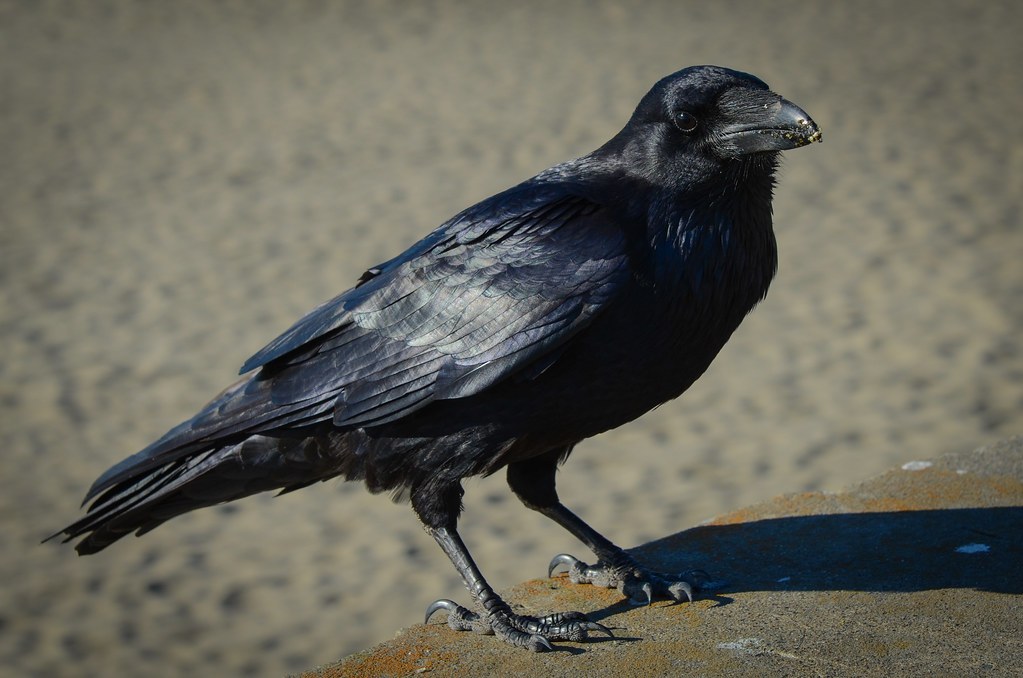
Adult
Identification
The tail is the fastest tell in flight
A raven's tail is wedge-shaped or diamond-shaped. An American Crow's tail fans out evenly. If you get one look at a black bird crossing an opening, look at the tail.
Size separates them on the ground
Ravens run 22 to 27 inches long with a wingspan reaching roughly 46 inches and a weight of 24 to 57 ounces, which makes them roughly 50 percent longer and up to 2.5 times heavier than an American Crow. They are one of the largest passerines in North America.
The bill
The bill is heavier and more curved than a crow's, noticeably so once you have seen both.
Shaggy throat hackles
Shaggy throat feathers, called hackles, are present on a raven and absent on a crow. They are visible on a perched bird at moderate range.
A purple-green sheen on black
All-black plumage with an iridescent purple-green sheen in good light.
Flight style differs
Flight style is different, not just faster or slower. Ravens soar and glide with infrequent flapping and show longer, more pointed wings with visibly separated primary feathers, the ones often called fingers. American Crows fly with a steady, businesslike wingbeat and much less soaring.
A second raven in South Central
In the South Central region, there is a second raven to rule out. The Chihuahuan Raven is a smaller raven at 18 to 20 inches that shares Trans-Pecos and Panhandle habitat. Its neck feathers are white at the base, but that is visible only when the wind ruffles them, so size and range are the more practical separators in the field.
Signs of Infestation
A large stick nest in an exposed spot
Cliff faces are the natural site, but transmission towers, billboards, bridges, and building ledges all get used, and a nest on a structure is the version most property owners encounter.
Perched near a food source
Adults perched on rooflines, power poles, or fences near a food source. Dumpsters, livestock pasture, and agricultural fields are the usual draws.
Bins pulled out and scattered
Garbage or food waste pulled out of bins and scattered. Ravens are opportunistic scavengers and human refuse is a documented part of the diet, so an unsecured dumpster or trash can is the most common attractant on a commercial property.
A depredation wound pattern
In livestock settings, a characteristic depredation wound pattern on newborn lambs and calves. The eyes, the soft tissue of the rear vent, the soles of the feet, and the navel are targeted, and extension literature reports the eye as the initial strike point in roughly 95 percent of documented cases. That pattern is what distinguishes bird depredation from a mammalian predator.
The call
A deep, harsh, croaking call, often written as gronk-gronk, which is clearly lower and rougher than an American Crow's higher-pitched caw. Ravens also have an unusually large vocal repertoire that includes knocks, rattles, and mimicked sounds, so an odd noise from a black bird is not evidence against a raven.
Loose flocks at a shared roost
A food source works the same way. Those are typically non-breeding juveniles and subadults, not a breeding colony.
No structural damage to the building itself
Ravens do not chew, burrow, or nest inside living space, so there is no gnawing, no tunneling, and no attic occupancy to look for. Fouling below a roost and raided garbage are the property complaints, not damaged wood or wiring.
Prevention and When to Call a Pro
Federal law comes first
Before anything else: the Common Raven is federally protected, and no removal, relocation, capture, killing, or active-nest disturbance is legal without a federal permit. The species is listed by name on the federal roster of birds protected under the Migratory Bird Treaty Act, codified at 50 CFR 10.13. It is a native North American species, not one of the introduced species that fall outside the Act's protection. Do not trap it, do not move it, do not shoot it, do not knock down or seal an active nest, and do not let a contractor do any of those things on your behalf.
Passive exclusion needs no permit
What you can legally do without a permit is passive exclusion and deterrence. Bird spikes or netting on ledges and structures being used as nest or roost sites are the standard approach, and they do not require a permit because they do not take a bird or disturb an active nest.
Cut the food subsidy
That is what is actually holding the birds there. Secure garbage and dumpster lids, remove accessible pet food and livestock feed, and reduce standing food waste. Ravens are omnivorous generalists whose diet includes carrion, small vertebrates, insects, eggs and nestlings of other birds, grain, fruit, and human refuse, and that flexibility is the direct mechanism behind raven numbers climbing near development. Habitat modification that removes the subsidy is the one intervention that does not depend on outsmarting the bird.
The livestock producer pathway
Livestock producers have a specific, narrow legal pathway. Producers experiencing documented calving or lambing depredation can apply for a federal depredation permit under 7 U.S.C. 8356, issued by the U.S. Fish and Wildlife Service. Congress created that mechanism for this exact problem. It is limited to the season, location, and number of birds named on the permit, and it carries mandatory reporting of any birds taken. It is a statutory exception with conditions attached, not a workaround, and it does not authorize anything before the permit is in hand.
An agency program often misread
One agency program often gets misread as permission, so here is what it actually is. In and near designated Mojave desert tortoise critical habitat in the Southwest and California, the U.S. Fish and Wildlife Service and the Bureau of Land Management run active raven population-management programs, implemented under a 2008 USFWS Environmental Assessment and a 2021 adaptive-management update. Those programs are deterrence-first, with lethal take only under a Federal Migratory Bird Depredation Permit when deterrence has failed. The purpose is protecting a federally threatened tortoise population from raven predation on hatchlings. It is a conservation program run by federal agencies under permit, and it confers nothing on a homeowner or a property manager.
On health risk, accurately
On health risk, the accurate version rather than the alarming one. Corvids as a family, including the Common Raven, are highly susceptible to West Nile Virus. Published mortality estimates for infected corvids run in the 50 to 100 percent range, the highest susceptibility of any bird family studied, and state wildlife-disease programs treat clusters of corvid deaths as an indicator of local West Nile Virus activity. That makes ravens a sentinel species for the virus. It does not make them an efficient route of transmission to people, which remains mosquitoes. The practical takeaway is to report dead corvids to your state wildlife or public health agency rather than handling them, and to take mosquito control seriously in an area where corvid die-offs are being reported.
Who to Call, and When
An active nest on your structure, a persistent roost fouling property, or documented predation on newborn livestock. In all three cases, contact your state wildlife agency or a permitted nuisance wildlife control professional rather than attempting removal yourself. Livestock producers specifically should be pointed at the U.S. Fish and Wildlife Service depredation-permit process rather than a general pest control call, because that is the only route that makes lawful removal possible.
Frequently Asked Questions
Is it illegal to kill or remove a raven?
Yes, without a federal permit. The Common Raven is protected under the Migratory Bird Treaty Act and appears on the federal list of protected species at 50 CFR 10.13. Removal, capture, killing, relocation, and active-nest disturbance are federal violations without a permit, and that applies to licensed operators as well as homeowners. Passive measures that do not take a bird or disturb an active nest, such as netting a ledge or securing garbage, are legal and are where any response should start.
Are ravens really as smart as people say?
Ravens are among the most cognitively sophisticated birds studied. A peer-reviewed review documents tool use in at least 10 distinct modes, and ravens have performed planning and social-inference tasks in experiments that had previously been demonstrated mainly in great apes. They also cache food and adjust how they hide it based on whether another raven can see them, and they learn foraging and caching tactics socially by watching other ravens. For a property owner, the useful implication is practical rather than trivia: deterrents that rely on fooling the bird tend to lose effectiveness, and a food source that pays off once gets learned and shared.
Why are ravens killing lambs and calves?
Ravens are opportunistic omnivores and documented predators of newborn livestock during calving and lambing season. The wound pattern is consistent: the eyes, the soft tissue of the rear vent, the soles of the feet, and the navel, with the eye reported as the initial strike point in roughly 95 percent of documented cases. The problem is significant enough that Congress wrote a dedicated federal permitting mechanism for it at 7 U.S.C. 8356, which lets the U.S. Fish and Wildlife Service issue depredation permits to affected livestock producers for the calving or lambing season.
Do ravens carry disease?
The documented concern with ravens and disease runs the other direction from what most people expect. Ravens and other corvids are highly susceptible to West Nile Virus, with published mortality estimates for infected corvids in the 50 to 100 percent range, the highest of any bird family studied. Because of that, wildlife-health agencies use corvid die-offs as a sentinel signal that the virus is active locally. The birds themselves are a poor direct transmission risk to humans compared with mosquitoes. Report dead corvids to your state wildlife or public health agency instead of handling them.
Why do wildlife agencies sometimes remove ravens in the desert?
In Mojave desert tortoise habitat, ravens are a documented predator of tortoise hatchlings, and the U.S. Fish and Wildlife Service and Bureau of Land Management run permitted, deterrence-first management programs to protect the federally threatened tortoise population. Lethal take happens only under a Federal Migratory Bird Depredation Permit and only after deterrence has failed. It is a conservation program aimed at a listed species, not general nuisance control, and it does not create any authority for a private property owner to remove ravens.
How do I tell a raven from a crow?
Look at the tail first. A raven's tail is wedge-shaped or diamond-shaped in flight, while an American Crow's fans out evenly. Ravens are also much larger, roughly 50 percent longer and up to 2.5 times heavier, with a heavier and more curved bill, shaggy throat feathers a crow does not have, and a soaring, gliding flight with infrequent flapping rather than a crow's steady wingbeat. The voice is a good confirmation: a deep, harsh croak versus a crow's higher-pitched caw. In the Trans-Pecos and Texas Panhandle, also consider the smaller Chihuahuan Raven, which runs 18 to 20 inches.
Sources
- Common Raven overview, life history, and identification: plumage, size, range, social structure, nesting, and vocalizations Cornell Lab of Ornithology, All About Birds
- How to Tell Crows and Ravens Apart by Sight and Sound: tail shape, size, bill, throat hackles, flight style, and voice Cornell Lab of Ornithology, All About Birds
- Common Raven (Corvus corax): breeding biology, incubation period, clutch size, nestling period, and broods per year Cornell Lab of Ornithology, Birds of the World
- Common Raven distribution: continental range, habitat breadth, and eastern range reestablishment Cornell Lab of Ornithology, Birds of the World
- Common Raven diet and foraging: omnivorous generalist diet including carrion, small vertebrates, eggs, grain, fruit, and human refuse Cornell Lab of Ornithology, Birds of the World
- Corvus corax species account: nest structure, egg description, and nest site selection Animal Diversity Web, University of Michigan Museum of Zoology
- Tool use and tooling in ravens (Corvus corax): a review and novel observations, documenting at least 10 modes of tool use Ethology, peer-reviewed, via Wiley Online Library
- Role of Corvids in Epidemiology of West Nile Virus in Southern California: corvid susceptibility, viremia, and mortality Journal of Medical Entomology, peer-reviewed, via Oxford Academic
- West Nile Virus: corvid susceptibility and the use of corvid mortality as an indicator of local virus activity Cornell Wildlife Health Lab, Cornell University College of Veterinary Medicine
- Managing Predation: raven depredation of newborn lambs and calves and the characteristic wound pattern Texas A&M AgriLife Extension Service and Texas Wildlife Services
- 50 CFR 10.13, List of Birds Protected by the Migratory Bird Treaty Act, including Corvus corax Electronic Code of Federal Regulations, U.S. Government Publishing Office
- Migratory Bird Treaty Act of 1918: scope of protection and prohibited activities U.S. Fish and Wildlife Service
- 7 U.S.C. 8356, Depredation permits for black vultures and common ravens: livestock producer permits for calving and lambing season Office of the Law Revision Counsel, United States Code
- Reduce Common Raven Predation on the Desert Tortoise, Environmental Assessment (2008): deterrence-first management with permitted lethal take U.S. Fish and Wildlife Service
- Depredation Permits, Common Raven Removal, Nevada, NEPA documents U.S. Fish and Wildlife Service
- Raven Management Plan: adaptive raven management in desert tortoise habitat Bureau of Land Management, U.S. Department of the Interior
- Common Raven breeding distribution in Minnesota: confirmed breeding range and southern range limit Minnesota Breeding Bird Atlas, Minnesota Department of Natural Resources
- Common Raven breeding distribution in Virginia: Ridge-and-Valley and mountain breeding population and cliff nesting Virginia Bird Atlas, Virginia Society of Ornithology
- Common Raven in Tennessee: eastern mountain distribution and historical extirpation from the Deep South Tennessee Wildlife Resources Agency
- Chihuahuan Raven species account: size, range, and separation from Common Raven in the Trans-Pecos and Texas Panhandle Texas Breeding Bird Atlas, Texas A&M University
- Common Raven, Corvus corax: Hawaii status as a non-breeding vagrant, with the Kure Atoll record Bishop Museum, Hawaii Biological Survey