Seasonal Timeline
Both species are active by day. The Mexican ground squirrel's hibernation habits are genuinely disputed among Texas researchers, with some studies reporting winter hibernation in the northern part of its range and others reporting year-round activity. The spotted ground squirrel is not thought to hibernate on a strict schedule, especially in the southern part of its range, though its activity drops off sharply in cold weather and it may separately go dormant during hot, dry stretches in summer.
Both species are active by day. The Mexican ground squirrel's hibernation habits are genuinely disputed among Texas researchers, with some…
The Mexican ground squirrel produces one litter a year. The spotted ground squirrel may produce two litters a year in the southern part of its range, which includes Texas.
Where They're Found
Both species are established across the South Central region. The Mexican ground squirrel is found along the Texas Gulf Coast and through western and central Texas, with its range reaching into southeastern New Mexico. The spotted ground squirrel is found across northwestern Oklahoma and the western half of Texas, including the Rio Grande Plains, and its range extends well into the Southwest, across most of New Mexico, the southeastern corner of Utah, and eastern Arizona. The spotted ground squirrel's range also reaches farther north, into the Nebraska sand hills, eastern Colorado, and western Kansas. Neither species has been found in Alaska or Hawaii; both are semi-arid grassland and desert-scrub specialists of the south-central and southwestern United States and northern Mexico, and no source places either one in a climate that different.
Life Cycle
Both species are placental mammals with live birth, not insects, so there is no larval or pupal stage. Where the two species' timing or numbers differ, both figures are given rather than averaged.

Mating
Gestation
Birth and litter
Juvenile development
Adult
Identification
Size is the fastest first sort
The Mexican ground squirrel runs 11 to 15 inches in total length and 7.7 to 14 ounces. The spotted ground squirrel is one of the smallest ground squirrels in North America, about 7.3 to 10 inches long and only 3.5 to 4.4 ounces, noticeably smaller even at a glance.
Spot pattern is the confirming detail
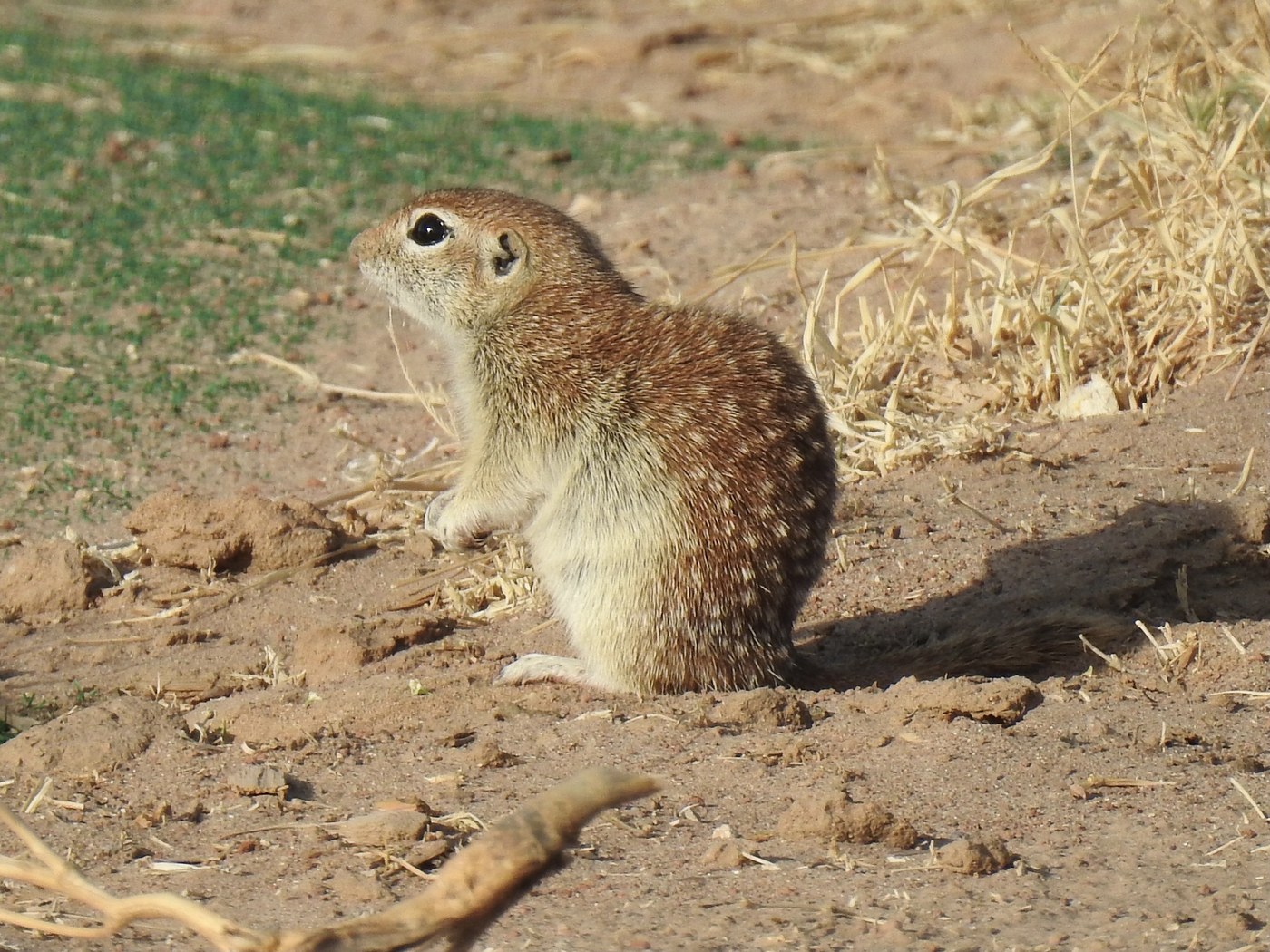
The Mexican ground squirrel carries nine straight, organized rows of squarish white spots running the length of its brown to olive-gray back, plus a white ring around each eye. The spotted ground squirrel's white spots are scattered and irregular, never arranged in rows, on a smoke-gray, light drab, or fawn-colored back, and can be faint on the shoulders.
Ears and tail
The Mexican ground squirrel has small, rounded ears and a flattened, moderately bushy, grayish-white and black tail less than half its total body length. The spotted ground squirrel has inconspicuous ears and a shorter tail, about a third of its total length, pinkish buff or cinnamon underneath and black at the very tip.
Burrow entrances are the same story for both
Neither species piles dirt at the burrow mouth the way many other burrowing rodents do. A 2 to 3 inch, unmounded hole with no visible spoil pile, often with a second entrance nearby, is a strong sign one of these two species (or a related ground squirrel) is present, even before the animal itself is seen.
The thirteen-lined ground squirrel
Commonly confused with the thirteen-lined ground squirrel (Ictidomys tridecemlineatus), a separate species with its own Midwest, Mountain West, and South Central range. That species combines solid stripes with rows of spots down the back; neither the Mexican nor the spotted ground squirrel has stripes at all.
The rock squirrel
Commonly confused with the rock squirrel (Otospermophilus variegatus), another separate species. The rock squirrel is much larger, 18 to 21 inches long, and sticks to rocky cliffs, boulders, and canyon walls rather than the flat grassy or brushy ground the Mexican and spotted ground squirrels prefer.
Signs of Infestation
Unmounded burrow entrances
They run 2 to 3 inches across.
Daytime sightings
Daytime sightings of a small, upright rodent near the burrow, in gardens, along fence lines, on golf courses, in cemeteries and parks, or on road shoulders. Both species are active by day, and the spotted ground squirrel in particular is most visible in early morning and late afternoon, retreating underground during peak midday heat.
Garden and landscape damage
Garden and landscape feeding damage, chewed flowers and vegetables, and disturbed newly planted seed beds.
Rural and agricultural signs
These are the ones that show on working land.
A shrill alarm whistle
It comes from the Mexican ground squirrel. No distinctive odor is associated with either species.
Prevention and When to Call a Pro
Let the grass grow
Both species prefer short grass. Allowing lawn or pasture grass to grow into denser, taller stands changes the habitat enough to discourage new burrows, and tilling or cultivating infested ground destroys existing burrow systems outright.
Time plantings around activity
Time plantings around peak activity. Putting in grain or garden seed as early as weather allows gives seedlings a head start past the vulnerable sprouting stage before the squirrels are fully active for the season.
Fence the high-value areas
Fence small, high-value areas. Sheet metal or half-inch hardware cloth, at least 18 inches tall with about 6 inches buried below grade, fully surrounding the protected bed, works for gardens and flower beds. This is a small-area method, not a whole-yard solution.
Trap a small population
Trap where the population is small. Cage traps or ordinary rat traps, baited with grain or oats and set near the burrow entrance, are a practical homeowner-scale option, especially in urban settings where a toxicant is not appropriate. An unbaited expanded-trigger trap placed directly in the animal's travel path also works.
Flooding a burrow
A few gallons of water can encourage the animal to relocate, a lower-cost non-lethal option where that is practical.
On trapping and relocation
Trapping ground squirrels is legal at any time in Texas, but if you plan to live-trap and relocate the animals rather than remove them, notify your local Texas Parks and Wildlife Department office first.
Call for chemical control
Call a licensed pest control operator for chemical control. Rodenticides effective against ground squirrels are restricted-use in many formulations and, per Texas A&M AgriLife guidance, may only be applied by a licensed operator or a properly licensed private applicator.
Call for burrow fumigation
Call a professional for burrow fumigation, and never attempt it near occupied structures. Fumigation requires a documented fumigation management plan and enough soil moisture to hold the gas in the burrow. It should never be used under or near buildings, because fumes can seep indoors and create a hazard to occupants.
When to escalate to a pro
Escalate to a licensed pest or wildlife control professional if burrowing is undermining a foundation, a dam, or an irrigation levee, or if the population is outpacing habitat modification, timing, and trapping efforts on its own.
Frequently Asked Questions
What's the difference between a Mexican ground squirrel and a spotted ground squirrel?
Size and spot pattern. The Mexican ground squirrel is larger, 11 to 15 inches long, with nine straight rows of white spots down its back. The spotted ground squirrel is one of North America's smallest ground squirrels, about 7 to 10 inches, with scattered white spots that are never arranged in rows.
Do the ground squirrels in Texas and Oklahoma carry the plague?
No source documents plague specifically in either the Mexican ground squirrel or the spotted ground squirrel. General guidance places plague mainly among ground squirrels in semi-arid upland forests and grasslands of the western United States, but that is a broad statement about the group, not species-specific evidence for either of these two animals.
Do Mexican ground squirrels hibernate?
It depends who you ask. Some Texas studies report hibernation in the northern part of the species' range, while other researchers report the species staying active year-round. Both findings are real and neither has settled the question.
Is it legal to trap ground squirrels on my property in Texas?
Yes, trapping is legal at any time. If you plan to live-trap and relocate the animals instead of removing them, notify your local Texas Parks and Wildlife Department office first.
Do these ground squirrels get inside the house?
No. Both species are exclusively outdoor burrowers. The damage they cause shows up in gardens, cropland, pastureland, and earthen dikes or irrigation ditches, not inside a building.
Sources
- Controlling Ground Squirrel Damage Texas A&M AgriLife Extension Service
- Ground Squirrel: Damage Controlling (L-1909) Texas A&M AgriLife Extension (Harris County)
- Mexican Ground Squirrel (Spermophilus mexicanus) Texas Parks and Wildlife Department
- Species account of the Rio Grande Ground Squirrel, Mammals of Texas Online Edition Texas Tech University Natural Science Research Laboratory
- Species account of the Spotted Ground Squirrel, Mammals of Texas Online Edition Texas Tech University Natural Science Research Laboratory
- Spermophilus mexicanus (Mexican ground squirrel) Animal Diversity Web, University of Michigan Museum of Zoology
- Spermophilus spilosoma (spotted ground squirrel) Animal Diversity Web, University of Michigan Museum of Zoology
- Ground squirrel range map data releases (Ictidomys mexicanus and Xerospermophilus spilosoma) U.S. Geological Survey
- How Plague Spreads U.S. Centers for Disease Control and Prevention
Image Credits
- Image: CK2AZ via iNaturalist. CC BY 4.0.
License.