Seasonal Timeline
There is no cane toad season in Hawaii. The stable tropical climate means activity, breeding, and encounters run year round rather than following a discrete calendar window, with noticeable upticks in activity and sightings after rain events. Toads are nocturnal, so the practical pattern on a property is a year round nighttime one.
The honest answer on seasonality is that there isn't one. Hawaii's stable tropical climate gives this species no meaningful peak or off season. Activity runs continuously through the year, and the only pattern worth planning around is that activity and encounters increase after rain events. Published research agrees on the underlying reason: cane toads breed year round in Hawaii rather than following the discrete wet-season breeding pattern seen in temperate parts of their invasive range, such as Australia.
That matters for how a homeowner should think about risk. On a mainland toad page, the pet safety advice attaches to a season or to a rain event. Here it attaches to every night of the year. Rain raises the odds of an encounter, it does not create the risk from nothing.
Two life cycle numbers come from University of Florida IFAS Extension's account of this same species rather than from Hawaii-specific field data: the roughly 48 hour egg stage and the 2 week to 2 month larval stage. They are general species biology and are treated as such rather than presented as measured Hawaii figures.
Where They're Found
In Hawaii, the species is established across the islands. It is not a marginal or occasional presence. A peer-reviewed radio-tracking study published in PLOS ONE describes cane toads as abundant and widely distributed across all three Hawaiian islands it surveyed.
Where the toads actually sit on a given property depends on which side of the island you are on, and that is the single most useful thing to know about finding them here. The same study found that in an otherwise arid volcanic landscape, toads depend heavily on moisture that people create. On the dry leeward side, populations concentrate almost entirely in artificially irrigated ground: golf courses, resort landscaping, and irrigated residential yards. Those irrigated properties function as oases. A behavioral study of Hawaiian cane toad populations notes that dispersal across the islands has stayed minimal since the 1930s introduction precisely because arid volcanic mountains separate the wet and dry sides of the islands, which leaves dry-side toads effectively confined to the watered patches. On the wetter windward side, toads spread out into market gardens, residential yards, and grassy areas around buildings, because the moisture is no longer the limiting factor.
The other finding from that radio-tracking work is the one that changes what a homeowner should expect. These toads are not wanderers. They returned to the same shelter site or one very close to it on about 70 percent of days, with a mean distance of only 11 meters between successive daytime retreats, even while covering an average of 116 meters of movement over the course of a night. In practice that means a toad on your property is very likely the same toad, using the same refuge, night after night. Finding and removing that refuge does more than chasing the animal does.
On a residential lot, the refuges to check are under patio furniture, in damp shaded corners, around ponds and pools, along irrigation lines, and near outdoor lighting, which draws in prey. Outdoor pet food and water bowls belong on that list too, because they are both a food source and a place to soak.
Diet is worth one note because Hawaii's version is unusual. Cane toads are generalists that eat nearly anything they can fit in their mouths, including beetles, ants, spiders, carrion, small vertebrates, garbage, and even smaller members of their own species. But the PLOS ONE study found insect abundance around artificial lights in Hawaii averaged only about 1.2 specimens per survey, roughly 2 percent of what the same surveys found around lights in the species' native tropical Australian range. Invasive cockroaches, especially the species drawn to houses and fruit trees, have become a primary Hawaii food source instead. Toads will also eat pet food directly.
No source places any established or reported cane toad population in Alaska, and the federal nonindigenous species distribution data for this species does not list Alaska at all. This is a tropical and subtropical animal that needs warmth and standing moisture, so the absence is expected rather than surprising.
Life Cycle
Year round breeding is what makes this species hard to get ahead of. In Hawaii's warm, largely aseasonal climate, breeding is continuous rather than tied to a single annual event, so there is no quiet stretch of the calendar when a property is reliably free of eggs, tadpoles, and new toadlets. Combine that with a clutch running into the tens of thousands of eggs and standing water becomes the control point that matters most on a property.
The stage a homeowner is most likely to underestimate is the smallest one. Newly metamorphosed toadlets are under half an inch, small enough to read as a harmless native frog somewhere else. In Hawaii there is no harmless native option, and a toadlet carries the same toxin an adult does. Small toads around a pond or a wet yard edge deserve the same distance from a curious dog that a large one does.
Egg2
Tadpole3

Toadlet
Adult
Identification
Size is the first cut, and it is a big one
Adults run 4 to 9 inches in body length, roughly 10 to 23 cm. Maui Invasive Species Committee describes typical Hawaii animals as up to about 6 inches, while the fuller published range for the species runs 4 to 9 inches. Weight figures differ by source and both are given rather than averaged: up to 4 pounds in Hawaii zoological sourcing, or up to 3.3 pounds per federal nonindigenous species data. A genuinely large toad in a Hawaii yard is most of the identification already.
Color is variable
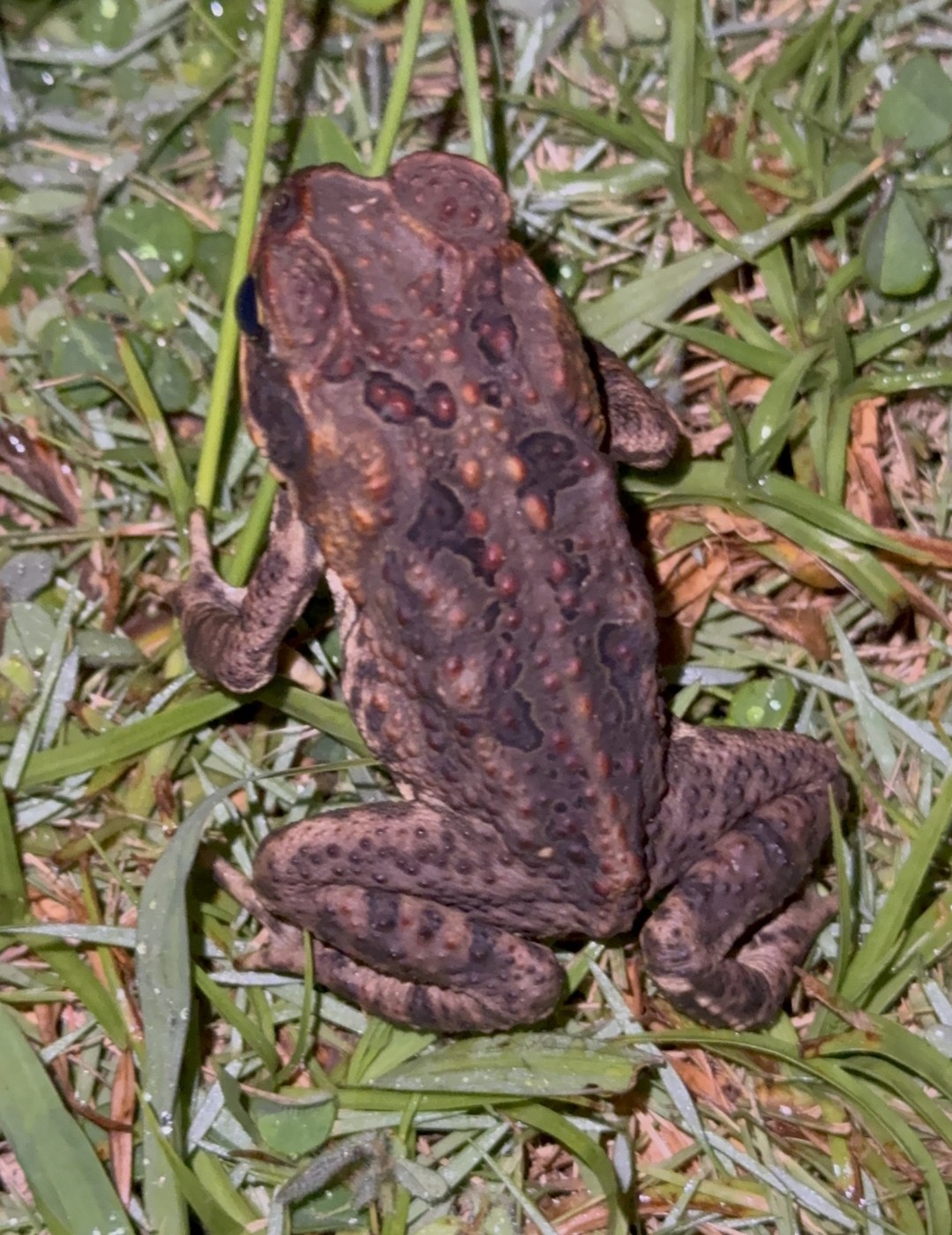
Grayish-brown to tan, reddish-brown, or olive, usually mottled with darker spots, with a paler underside carrying yellow undertones. The skin is dry and warty, and the head is broad and flat with a bony ridge above the eyes.
The parotoid glands
They are the mark to look for, and the reason to look from a distance. Very large, somewhat triangular poison glands sit on the shoulders behind the head and taper to a point. University of Florida IFAS Extension's identification guidance for this exact species treats this as the single most important visual field mark. The head is broad and flat, and a bony ridge runs above the eyes and across the snout. The Maui Invasive Species Committee describes ridges above the eyes, and UF/IFAS describes a ridge around the eyes and above the nose. What the head does not carry is a pair of knobs or crests on top, and that absence is what separates this animal from the crested native toads of the mainland. Identify the glands by eye and never touch them.
In Hawaii, nothing to confuse it with
In Hawaii there is nothing to confuse it with, which makes identification unusually easy here. Hawaii has no native amphibians, and no native or established toad species other than this one, so a toad in Hawaii is a cane toad. That no-native-amphibians point traces to a Hawaii publication citing the state Division of Forestry and Wildlife rather than to the agency directly, so treat it as the best available reading. On the mainland, cane toads are confused with native true toads such as the southern toad and oak toad, and with the eastern spadefoot, but none of those species occur in Hawaii.
The coqui frog is not this
The coqui frog is a different animal entirely, and the two are easy to tell apart. Coqui frog is the other invasive amphibian Hawaii residents hear about, and people sometimes lump the two together. Coqui is a small tree frog, up to about 2 inches, that lacks parotoid glands entirely. Cane toad is a ground-dwelling toad running 4 to 9 inches with the large triangular parotoid glands described above. Size, body shape, and where the animal is found all separate them without any close inspection.
It answers to several names
Names, because this animal answers to several. Cane toad is the primary common name. In Hawaii and Florida it is widely called the bufo toad, or just bufo, including within the state's own invasive species reporting network. Giant toad, marine toad, and giant marine toad are used interchangeably in Hawaii veterinary literature, and poloka is the Hawaiian-language name recorded in the federal nonindigenous species database. The scientific name is Rhinella marina, formerly classified as Bufo marinus, and the older name is still in active use in veterinary and toxicology writing, so you will see both.
Signs of Infestation
Seeing one is the sign
A large, 4 to 9 inch, grayish-brown to olive warty toad at night, or sheltering during the day near irrigated landscaping, a pond, a pool, or a damp shaded corner, is the primary evidence there is. This species is nocturnal, so daytime encounters usually mean you have found the refuge rather than the animal out hunting.
Egg strings in standing water
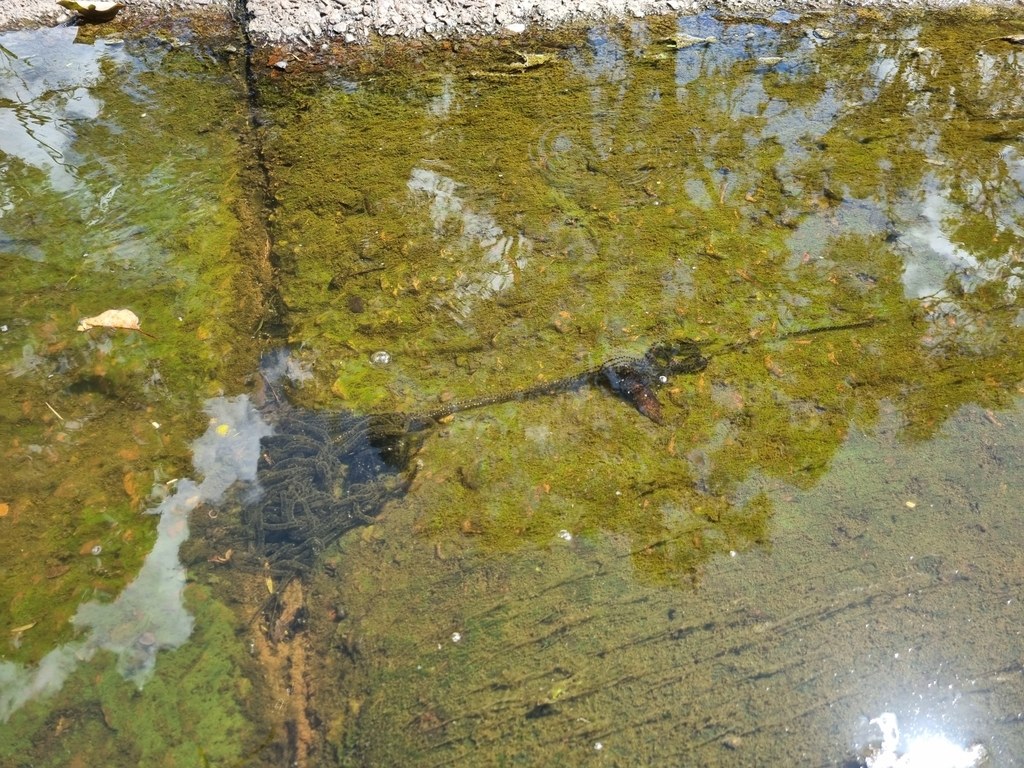
Long gelatinous strands, not clumped masses, in any still or slow-moving water on the property. On a residential lot that can mean an ornamental pond, an unmaintained pool, a water feature, or standing water in low ground.
Dense clusters of small black tadpoles
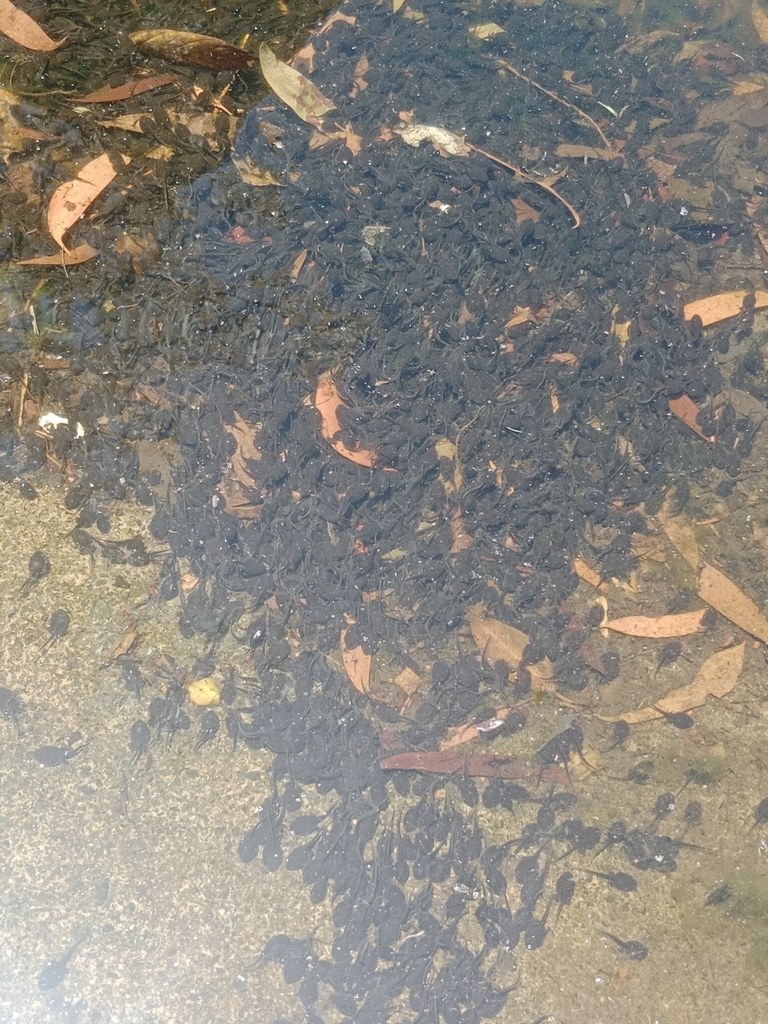
Cane toad tadpoles are solid black and aggregate in numbers, so a mass of small dark larvae in a pond or pool is a strong indicator.
Male calling at water sources
Adult males produce a low-pitched, persistent warbling or trilling call while attracting mates near water, documented for this species by University of Florida IFAS Extension. Dense populations can call through the night in residential areas. No Hawaii-specific figure for call volume complaints has been published.
No odor and no damage list
There is no odor to work backward from, and no damage checklist either. No source describes a distinctive smell as a detection method for this species, and none describes gnaw marks, entry holes, or any threat to foundations, wiring, or building materials. This is a strictly outdoor, ground-dwelling animal and it is not a structural pest. The absence is the finding. The risk from this species is toxicological, and a sighting is the entire body of evidence.
Prevention and When to Call a Pro
A pet exposure is a vet call
If a dog or cat mouths, bites, or paws at a toad, the first call is a veterinarian or an animal poison control line, not a pest control company. The signs to act on are sudden hypersalivation or drooling, severe head shaking, pawing at the mouth, and a foul odor around the mouth. Left untreated those can progress to incoordination, vomiting, diarrhea, increased respiration, and in severe cases blindness and convulsions. Per the University of Hawaii at Hilo clinical review, death from ventricular fibrillation has been documented within as little as 15 minutes of exposure in severe untreated cases. The trigger for urgency here is a pet exposure, not a toad sighting.
Flush the mouth, and the direction
The immediate home first aid step is to flush the animal's mouth with copious running water, and the direction matters. A garden hose is what the clinical source recommends. Point the muzzle downward so the contaminated water drains out of the mouth rather than being swallowed. Then get to a veterinarian immediately. There is no specific antidote for this poisoning. Treatment is supportive and professional, involving activated charcoal and a saline cathartic, ECG monitoring, intravenous fluids, and medication for arrhythmias or convulsions as needed, so a veterinary visit is not optional.
Keep the risk in proportion
The same University of Hawaii at Hilo source reports that mortality in untreated exposed dogs runs about 5 percent in Hawaii and Texas, compared with close to 100 percent in Florida, where the toxin is more potent. That difference is worth stating plainly rather than implying uniform severity across the species' whole United States range. It is not a reason to wait and see. It is the reason fast treatment changes the outcome, and the fatal cases in Hawaii are real.
Supervise pets after dark
This is the single most effective prevention step for a Hawaii household with dogs. These toads are nocturnal, and there is no off season in Hawaii, so the exposure window is every night of the year. Keep dogs leashed on evening and nighttime walks in areas where toads are active, and do not leave pets outdoors unsupervised after dark.
Water and pet food draw them in
Manage the two things that actually draw this species onto a property: water and pet food. In Hawaii, cane toads concentrate around artificially irrigated landscaping on the dry side of the islands, and around ponds, pools, and damp shaded refuges generally. Do not leave pet food or water bowls outside overnight. Toads are documented eating pet food directly and will also soak in water bowls during dry periods, which puts the animal exactly where the dog will be in the morning.
Cut the prey base and the shelter
Cut the prey base and remove daytime shelter. Turning off unnecessary outdoor lighting, or switching to insect-limiting bulbs, reduces the insects that draw toads in. Clearing debris piles and blocking access under air conditioning units, decks, and building edges removes the daytime refuges. This is general species guidance from University of Florida IFAS Extension rather than something independently tested on Hawaii populations. Take the refuge away and you take away the resident.
Never handle one bare-handed
This is a human safety point, separate from the pet risk above. The same secretion that poisons dogs irritates human eyes and any cuts on the skin on contact. University of Florida IFAS Extension states this for the species, and Hawaii sourcing independently describes burning of the eyes and hands and skin irritation from the same secretion. If hand removal is undertaken, use rubber gloves, or a plastic bag as an improvised glove, and wash thoroughly afterward while keeping hands away from the eyes and any open cuts.
Reporting sightings in Hawaii
Reporting sightings is encouraged in Hawaii, though it is not legally required. This is an invasive, non-native species, so Hawaii's posture toward it is removal-friendly rather than protective. Fewer restrictions is not the same as no interest, though. The state runs a 643-PEST invasive species reporting network with a companion site at 643pest.org, and cane toads are among the species the public reports through it. At the county level, Maui Invasive Species Committee notes there is currently no active organized cane toad control program in Maui County specifically and points residents to iNaturalist to submit sightings, which helps track where the species is spreading. None of that prohibits a homeowner from removing a toad. It means a sighting report is useful to the agencies tracking this animal.
Call for removal you will not do
Call a licensed nuisance wildlife control operator for removal you do not want to do yourself. There are two reasons rather than one. The bare-hand toxin exposure risk to people is the first. The second is that a professional is positioned to know current Hawaii county-level guidance on this species, which shifts over time and is not uniform across the islands.
A recurring toad is a water problem
A recurring toad presence is a water problem, not a toad problem. If toads keep reappearing and the property has an irrigation source, a pond, a pool, or standing water that has not been addressed, removal is a task that will simply repeat. The Hawaii radio-tracking data makes the point directly: these animals stay put, averaging only 11 meters between successive daytime refuges. Fix the attractant alongside any removal.
Frequently Asked Questions
Are cane toads dangerous to dogs in Hawaii?
Yes. Their parotoid gland secretions contain cardiotoxic bufotoxins, digitalis-like compounds that act on the heart the way a heart medication such as digoxin does. A dog that mouths or bites one can show hypersalivation, severe head shaking, pawing at the mouth, and vomiting, progressing in severe untreated cases to cardiac arrhythmia. A University of Hawaii at Hilo clinical review documented 33 canine and 2 feline poisoning cases at a single Hawaii veterinary practice, and reports that death from ventricular fibrillation has occurred within as little as 15 minutes of exposure in severe untreated cases. One point of calibration from the same source: untreated mortality in Hawaii runs about 5 percent, compared with close to 100 percent in Florida, where the toxin is more potent. That is a reason to get to a veterinarian quickly, not a reason to wait.
What do I do if my dog mouths or bites a cane toad?
Act immediately. Flush the dog's mouth with copious running water, using a garden hose if you have one, with the muzzle pointed downward so the water drains out of the mouth rather than being swallowed. Then get to a veterinarian right away, or call an animal poison control line. There is no specific antidote for this poisoning. Treatment is supportive, using activated charcoal and a saline cathartic, ECG monitoring, intravenous fluids, and medication for arrhythmias or convulsions, which is why the veterinary visit is not optional. Speed matters because the progression can be fast.
How did cane toads get to Hawaii?
They were brought in on purpose, and it did not work. In 1932 the Hawaii Sugar Planters Association released about 150 cane toads on Oahu, hoping they would control a beetle pest in the sugarcane fields. The association then bred them and distributed roughly 100,000 offspring across the Hawaiian Islands over 1933 and 1934. The toads did not control the beetles and instead established as a permanent, self-sustaining invasive species. Hawaii's program is also the direct precedent for Australia's cane toad introduction in 1935, which was undertaken for the same reason and failed the same way on a much larger scale.
Are cane toads native to Hawaii?
No. Hawaii has no native amphibians or native land reptiles at all. Every frog, toad, gecko, and lizard in the islands today, including the cane toad, is an introduced species. That point traces to a Hawaii publication citing the state Division of Forestry and Wildlife rather than to the agency directly, so treat it as the best available reading. The practical upshot for identification is useful either way. A toad in Hawaii is a cane toad, because there is no other toad species here to mistake it for.
Should I report a cane toad sighting in Hawaii?
Reporting is encouraged, but it is not legally required. Hawaii's statewide 643-PEST invasive species reporting network and its companion site at 643pest.org accept cane toad reports, and cane toads are among the species the public actively reports through it. At the county level, Maui Invasive Species Committee points residents to iNaturalist for the same purpose, noting that there is currently no active organized cane toad control program in Maui County specifically, so sighting records help track where the species is spreading. Because this is an invasive, non-native species, there is no protection standing in the way of removing one from your property. Reporting simply helps the agencies that are tracking it.
Sources
- Giant Marine Toad, Bufo marinus L., Poisoning in Hawaii: Symptoms and Treatment. Clinical review of 33 canine and 2 feline cases at a Hawaii veterinary practice, covering the bufagin, bufotoxin, and bufotenin mechanism and its digitalis-like cardiac action, the symptom progression, the documented death from ventricular fibrillation within as little as 15 minutes in severe untreated cases, the approximately 5 percent untreated mortality in Hawaii and Texas versus close to 100 percent in Florida, the mouth-flushing first aid instruction, and the supportive treatment protocol College of Agriculture, Forestry and Natural Resource Management, University of Hawaii at Hilo
- The Cane or Bufo Toad (Rhinella marina) in Florida, WEC387. Identification including the triangular parotoid glands, the absence of knobs or crests on top of the head, and the separate ridge running around the eyes and above the nose, life cycle stages and durations, clutch size, generalist diet, nocturnal behavior, the male call, human eye and skin irritation from the secretion, and general attractant-reduction and handling guidance University of Florida IFAS Extension, Department of Wildlife Ecology and Conservation
- Toads on Lava: Spatial Ecology and Habitat Use of Invasive Cane Toads (Rhinella marina) in Hawaii. Peer-reviewed radio-tracking study covering Hawaii-specific habitat use on the dry and wet sides of the islands, the roughly 70 percent same-or-nearby shelter reuse rate, the 11 meter mean distance between successive retreat sites, the 116 meter average nightly movement, and the finding that invasive cockroaches rather than flying insects form a primary Hawaii food source PLOS ONE
- Behavioural divergence during biological invasions: a study of cane toads (Rhinella marina) from contrasting environments in Hawaii. Peer-reviewed study covering the 1932 introduction and the roughly 100,000 offspring released across the islands in 1933 and 1934, and the finding that arid volcanic mountains separating the wet and dry sides of the islands have kept dispersal minimal since introduction PubMed Central, National Library of Medicine
- Cane Toad (Rhinella marina) species profile, Nonindigenous Aquatic Species Database. Established United States and territory distribution including Hawaii, the Hawaiian-language name poloka, and the weight figure of up to 1.5 kg U.S. Geological Survey
- Cane Toad. Hawaii-specific size and appearance description, the pet food and irrigated landscaping attractant guidance, the bare-hand handling caution, the note that no active organized control program currently exists in Maui County, and the recommendation that residents submit sightings to iNaturalist Maui Invasive Species Committee
- Report an Invasive Species. Hawaii's statewide 643-PEST invasive species reporting system and its companion reporting site at 643pest.org Hawaii Invasive Species Council, Hawaii Department of Land and Natural Resources