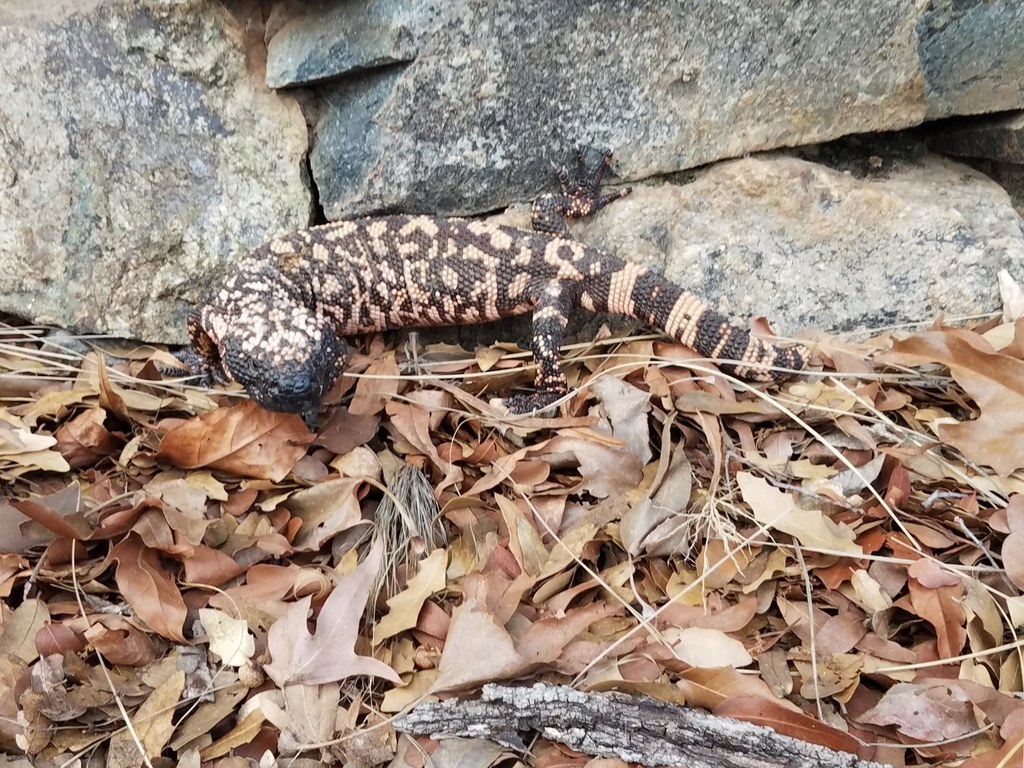
Seasonal Timeline
Most active from March through November, with the heaviest surface activity in spring and after summer monsoon rains; the animal spends late November through February in underground brumation and the great majority of the rest of its life underground as well.
Most active from March through November, with the heaviest surface activity in spring and after summer monsoon rains; the animal spends…
Everything about this species' visible calendar is shaped by how little time it actually spends above ground. Nevada's own wildlife agency and multiple university sources describe it spending somewhere between roughly 90 and 98 percent of its life underground, so most of the year it is simply not there to be seen at all. Brumation, a reptile's version of hibernation, runs from late November through February. Surface activity resumes in March and continues through November, with the clearest windows being cooler spring and fall mornings and the period during and immediately after a spring or summer rainstorm, when the animal is far more likely to be moving above ground.
Mating takes place in April and May. Males travel relatively long distances overland searching for females during this window, and when two males encounter each other, wrestling matches to pin one another have been documented. Eggs go into an underground cavity, and the reported timing does not agree between sources. The National Park Service at Saguaro puts egg laying in mid to late June, just before the start of the summer monsoon, while other published accounts place it from mid-July into mid-August. Sources differ on exactly how long incubation itself takes versus how long the eggs and hatchlings simply stay underground before emerging, and both figures matter: a roughly 130-day incubation period is cited by the National Park Service, while a University of Michigan zoological database gives an average of about 10 months from laying to emergence. Both agree hatchlings surface the following spring, typically around May.
Where They're Found
The Gila monster is a Southwest animal. Arizona, New Mexico, Nevada, and Utah are all confirmed range states. Arizona holds the bulk of the population and the highest density, with the U.S. Fish and Wildlife Service's own species profile and NatureServe both describing the core of the range as Arizona and the Mexican state of Sonora, extending into extreme southwestern Utah, southern Nevada, and southwestern New Mexico.
A fifth state carries a real, if marginal, population, and it is worth naming rather than leaving silent. Both the U.S. Fish and Wildlife Service and California's own state wildlife agency confirm a genuine, if sparse, population in extreme southeastern California along the Mojave Desert margin, concentrated in Inyo and San Bernardino counties. California's own agency reviewed 26 historical records with a handful more documented since. That is real range, but it is a thin edge-of-range presence at the far margin of the species rather than an established population on the scale of the four core Southwest states, where the animal is actually common.
South of the border, the range continues into Sonora and, per the Arizona-Sonora Desert Museum, into northern Sinaloa, Mexico.
Alaska and Hawaii are both confirmed absent. No source, current or historical, places the Gila monster in either state, which is unsurprising for a warm-desert species built around Sonoran, Mojave, and Chihuahuan Desert habitat.
Within its range, the animal keys in on rocky desert terrain rather than open flats. Desert scrub, desert grassland, and rocky canyons, buttes, and foothills are its preferred settings, with overwintering burrows typically dug into rocky slopes near lower-elevation washes and arroyos. It avoids agricultural land and riparian corridors, and its elevation range runs from near sea level in Sonora up to roughly 1,545 meters (5,070 feet) in southeastern Arizona and as high as 1,950 meters (about 6,400 feet) in parts of New Mexico.
Life Cycle
The tail is a fat reserve, not just a tail, and that single fact explains most of this animal's unusual feeding pattern. Three or four large meals across a spring season can supply enough stored energy to carry a Gila monster through months without eating again, drawn down from fat stored in the thick tail. That is also why sightings on a property are rarely a sign of an ongoing food source; a Gila monster passing through is very likely just passing through.
One more genuinely unusual fact worth knowing: this animal's venom is the basis for a real diabetes medication. A compound in Gila monster venom called exendin-4 was identified through venom research and became the basis for exenatide, marketed as Byetta and Bydureon, a working type 2 diabetes treatment. It has nothing to do with home safety, but it is the kind of detail that separates an actually-researched page from a generic one.

Egg
Hatchling
Juvenile
Adult2
Identification
The largest native US lizard
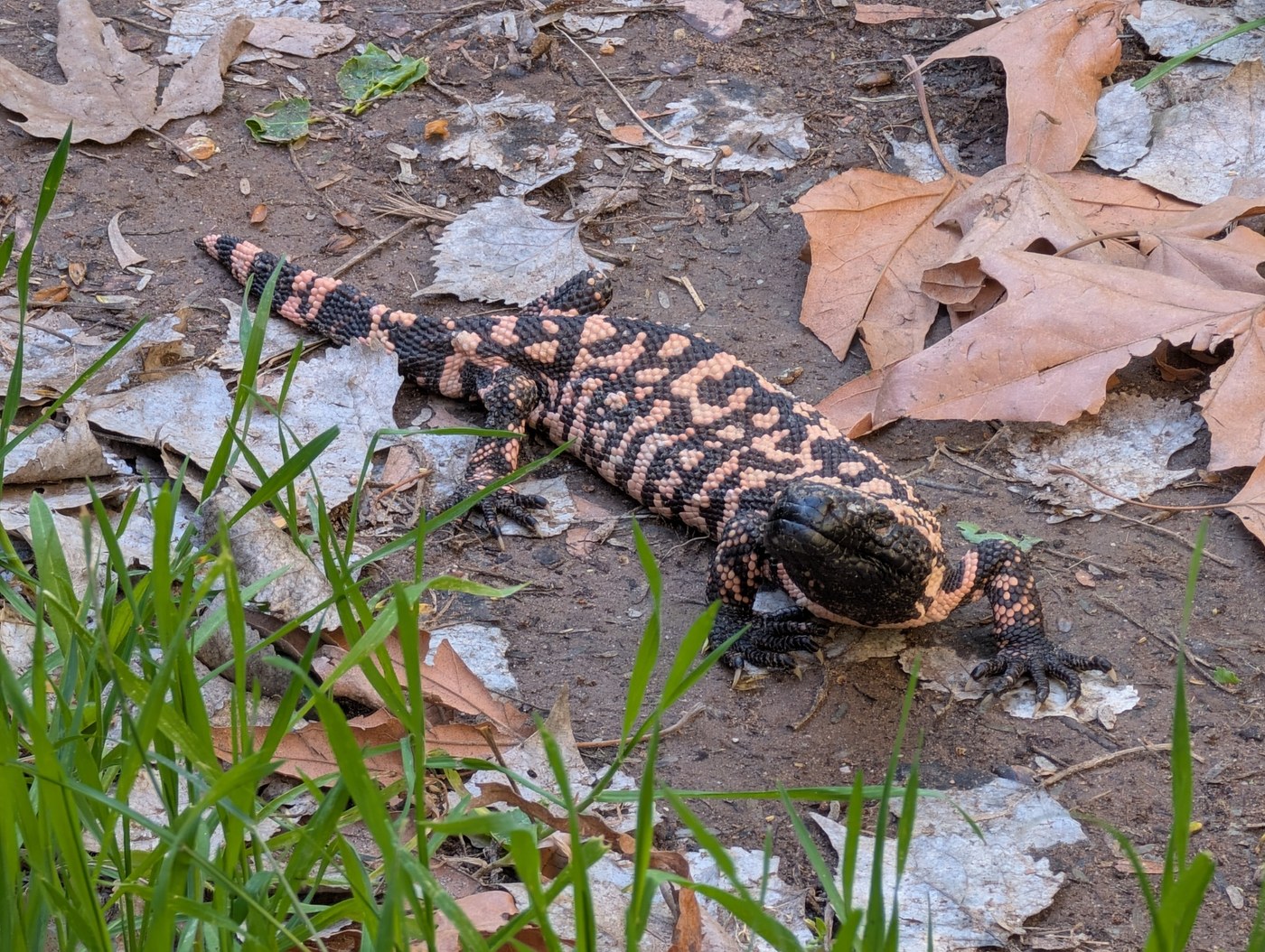
This is the largest lizard native to the United States, and the numbers are worth using precisely rather than rounding up. Adults reach roughly 20 to 22 inches in total length and weigh about 1.5 to 4 pounds. The body is heavy and stout, the head is large with small, beady eyes, the tail is short, thick, and rounded, and the legs are short and strong with long claws suited to digging.
The skin itself
The single most distinctive feature is the skin itself. The back, limbs, and tail are covered in bead-like scales called osteoderms, small bones embedded under the skin, giving a warty, armored texture unlike any other lizard native to the country. The color pattern is a reticulated (net-like) or banded arrangement of pink, orange, salmon, or yellow over a dark black or dark brown ground color, repeated on the belly as alternating dark and light bands.
Against the chuckwalla
Commonly confused with the chuckwalla, and California's own state wildlife agency states plainly that within this species' range, the chuckwalla is the only real look-alike. A chuckwalla is a large desert lizard that can carry similar coloring depending on location, but it lacks the Gila monster's bead-like scales entirely, has loose folds of baggy skin it uses to wedge itself into rock crevices for defense, and is herbivorous and non-venomous. Chuckwallas are turned in to Arizona wildlife officers as mistaken Gila monster reports often enough that it is a recognized, recurring mix-up in the field.
Hatchlings and the banded gecko
Hatchlings are sometimes confused with the western banded gecko, a much smaller and unrelated species. The National Park Service notes this specific mix-up at Saguaro National Park. The banded gecko is a small, thin-skinned lizard with no beaded osteoderms at all, easily distinguished on close inspection even though a young Gila monster's smaller size can invite the comparison at a glance.
Its closest relative
It is the only other venomous lizard native to North America. The Mexican beaded lizard occupies Mexico and parts of Central America; the Gila monster is the only one of the two that lives in the United States, per the National Park Service's own framing at Saguaro National Park.
Signs of Infestation
A sighting, and it is uncommon
A direct sighting is the most reliable sign, and it is genuinely uncommon. This species spends an estimated 90 to 98 percent or more of its life underground, so most of the year there is simply nothing to see. The clearest windows for a real sighting are spring and fall mornings, and any period during or right after a rainstorm, especially the summer monsoon.
A burrow at a rock outcrop
A burrow opening at the base of a rock outcrop, wash bank, or dense low desert vegetation. This species typically maintains two burrows across the year, one used through the winter brumation period and a separate one during the active season. A burrow entrance alone is not a reliable way to confirm the species without an actual sighting, since many desert animals dig similar-looking openings.
Basking in the cooler hours
Basking near a burrow entrance in the cooler part of the day. When above ground, this species is most often found sunning itself close to shelter rather than moving any real distance across open terrain.
Activity right after rain
Increased surface activity right after monsoon or spring rain. Rainfall reliably brings this species above ground more than almost any other single condition, which is also when most incidental sightings around a property actually happen.
Nothing to hear or smell
No audible or olfactory signs typical of everyday activity. A hiss may be produced if the animal is cornered, harassed, or handled, but this is a defensive reaction, not an ambient sign of its presence.
Prevention and When to Call a Pro
Never handle or corner one
Do not attempt to handle, pick up, corner, or agitate a Gila monster, under any circumstance. Nearly every documented bite is tied to someone trying to handle or capture the animal, not to an unprovoked attack during ordinary yard activity. The single most effective prevention step is simply never touching or cornering one.
Keep hands out of crevices
Keep hands and feet clear of rock crevices, dense low vegetation, and burrow openings in desert-adjacent yards, especially in spring and after monsoon rain, when surface activity is at its highest.
Supervise small pets at dusk
Supervise small pets, particularly dogs, near burrow entrances or rock piles at dusk and dawn, and pull a dog away immediately if it is fixated on or pawing at a burrow opening or a stationary lizard rather than simply walking past it.
If it turns up, let it move on
If one turns up on the property away from a structure, the correct response is to leave it alone and let it move on. These are wide-ranging, transient animals during the active season and typically do not linger once undisturbed.
Arizona's law is restrictive
The legal picture in Arizona is more restrictive than a general "check local rules" caveat, and it is worth stating precisely. Arizona Game and Fish Department regulations set no open season anywhere in the state on Heloderma suspectum, and Arizona Administrative Code separately classifies it as restricted live wildlife, meaning no one may capture, possess, or handle one without a specific Department permit. Nevada's own wildlife agency similarly lists the species as a Priority Species with State Protected status. Anyone in New Mexico or Utah should verify that state's own rule directly with its wildlife agency, since Arizona's specific statute cannot be assumed to apply identically elsewhere.
Never trap or relocate it
Never attempt to trap, remove, or relocate the animal yourself. Given the legal restriction above, the correct path for a nuisance situation, such as an animal that has settled under a shed, in a garage, or in a pool enclosure, is a licensed nuisance wildlife control operator or the relevant state wildlife agency's regional office, not a do-it-yourself trap.
A bite is a medical emergency
If an actual bite happens, treat it as a medical emergency, not a wait-and-see situation. If the lizard has not already released its grip, get it off as safely and quickly as possible, irrigate the wound with water, and keep the affected limb at or below heart level. Then call the Poison Help line at 1-800-222-1222 and go to the nearest emergency facility immediately. There is no antivenom, and treatment in the hospital is supportive: wound care, a check for broken or shed teeth left in the bite, and observation, per both the Arizona Poison and Drug Information Center and the Merck Manual's own professional reference on venomous lizard bites. A peer-reviewed review of 105 human Gila monster exposures reported to US poison centers over an 11-year span, including 70 Arizona cases, found most did not require hospital admission and recorded zero deaths, though a small number of cases did involve serious airway swelling requiring emergency airway management, which is why any bite still belongs in an emergency room rather than being treated at home.
State-regulated - verify locally
Frequently Asked Questions
Is it legal to own or capture a Gila monster in Arizona?
No. Arizona Game and Fish Department regulations set no open season on the species anywhere in the state, and Arizona Administrative Code classifies it as restricted live wildlife, meaning a specific Department permit is required to legally possess one.
What should I do if a Gila monster bites me?
Treat it as a medical emergency. If the lizard has not already released its grip, get it off safely, irrigate the wound with water, and keep the limb at or below heart level. Then call Poison Help at 1-800-222-1222 and go to the nearest emergency facility. There is no antivenom, but hospital-based supportive care is effective and serious outcomes are rare with prompt treatment.
Are Gila monsters aggressive toward people?
No. They are consistently described as shy and slow-moving, and documented bites are almost always tied to someone trying to handle, capture, or corner the animal, not to an unprovoked attack during normal yard activity.
What do Gila monsters eat, and how often?
Mostly eggs, small mammals, nestling birds, and other reptiles. They eat only a handful of large meals across an entire spring season and rely on fat stored in their tail the rest of the year, which is also why a sighting on a property rarely means an ongoing food source is present.
Why is Gila monster venom used in a diabetes medication?
A compound in the venom, exendin-4, became the basis for exenatide, a real type 2 diabetes medication marketed as Byetta and Bydureon, after researchers studying the venom identified its blood-sugar-regulating properties.
Sources
- Gila Monster (Heloderma suspectum) species account: size, color pattern, distinguishing features, range into Sonora and Sinaloa, diet, and activity calendar Arizona-Sonora Desert Museum
- Species Profile for Gila monster lizard (Heloderma suspectum): federal listing status (Not Listed) and confirmed state occurrence in Arizona, California, Nevada, New Mexico, and Utah U.S. Fish and Wildlife Service, Environmental Conservation Online System
- Gila Monster: size, hatchling size, egg-laying and incubation timing, habitat, diet, and the western banded gecko identification note National Park Service, Saguaro National Park
- Gila Monster: size, weight, clutch size, incubation, lifespan in the wild and in captivity San Diego Zoo Wildlife Alliance
- GILA MONSTER, Heloderma suspectum Cope 1869: size, identification, chuckwalla look-alike note, California range and county-level record count, burrow use and habitat California Department of Fish and Wildlife
- Gila Monster species page: weight, lifespan, and State Conservation Status (Priority Species, State Protected) Nevada Department of Wildlife
- Heloderma suspectum (Gila Monster): reproduction, diet, food habits, and behavior Animal Diversity Web, University of Michigan Museum of Zoology
- Climate and Dispersal Ability Limit Future Habitats for Gila Monsters in the Mojave Desert: age at sexual maturity and adult annual survival rate, citing Beck 1990, Beck 2005, and Smith et al. 2010 PMC/National Center for Biotechnology Information
- Heloderma suspectum species account: range extent, elevation range, and population trend NatureServe Explorer
- Gila Monster: bite symptoms, treatment protocol, no antivenom available, and the note that Arizona law protects the species from capture or handling Arizona Poison and Drug Information Center, University of Arizona College of Pharmacy
- Alligator, Crocodile, Iguana, and Venomous Lizard Bites: hospital treatment protocol, no antivenom available, and the recommendation against prophylactic antibiotics Merck Manual, Professional Edition
- Gila monster (Heloderma suspectum) envenomation: Descriptive analysis of calls to United States Poison Centers with focus on Arizona cases: 105 human exposures and 70 Arizona bite cases over an 11-year period, with zero deaths recorded Clinical Toxicology (peer-reviewed journal), via PubMed
- The monster whose bite saves lives: exendin-4 and its development into the diabetes medication exenatide (Byetta) Natural History Museum, London
- Reptile and Amphibian Regulations: no open season on Heloderma suspectum (Gila monster) in Arizona Arizona Game and Fish Department
- AZ - Exotic Wildlife - Article 4, Live Wildlife: summary of Arizona Administrative Code R12-4-406, restricted live wildlife and permit requirement Animal Legal & Historical Center, Michigan State University College of Law
- Legal Status of Wildlife (AZ1481J): Gila monster's protected status under Arizona Revised Statutes Title 17, overseen by the Arizona Game and Fish Department University of Arizona Cooperative Extension
- Heloderma suspectum (Gila Monster) species account, including state status field Natural Heritage New Mexico, University of New Mexico Biodiversity Collections