Seasonal Timeline
Colorado River toad is above ground mainly from May through September, and even inside that window its activity is triggered by monsoon rainfall rather than by the calendar. It is nocturnal, and it spends most of the rest of the year dormant underground in estivation, which is the heat and drought equivalent of hibernation.
Colorado River toad is above ground mainly from May through September, and even inside that window its activity is triggered by monsoon…
The thing to understand about this toad's calendar is that it is not really a calendar. Breeding is triggered by monsoon rainfall, and the breeding itself is explosive, meaning a short intense burst of calling, pairing, and egg-laying synchronized to a rain event rather than a season that spreads out over weeks. Californiaherps.com gives the outer window as May through September following summer rains. Within that, whether a given week produces any activity at all depends on whether it rained.
Two figures deserve a stated limitation rather than a confident number. The 2 to 12 day hatching range and the finer detail on monsoon breeding timing trace to search-level summary of a Pima County, Arizona field study rather than to the primary paper itself, so treat the day counts as the best available reading rather than settled. The broader picture around them is independently corroborated by californiaherps.com and is treated as solid: monsoon-triggered, explosive, and tadpole development finishing in under a month.
That sub-one-month development is not a curiosity, it is the whole strategy. Temporary desert rain pools frequently dry up before larvae can finish, so a short or light monsoon season can mean few or no successful broods that year and the population waits for the next one. A clutch of 7,500 to 8,000 eggs is what a boom-or-bust bet on unreliable rainfall looks like.
Where They're Found
The Colorado River toad's range sits entirely within the Southwest. Arizona is not merely part of the range, it is the core of it. The Arizona Game and Fish Department's own Wildlife Conservation Strategy species page states that more than 70 percent of the species' entire global breeding range, and more than 90 percent of the United States portion of it, lies within Arizona. Beyond that, the range covers the extreme southwestern corner of New Mexico and continues south through Sonora, Mexico into northern Sinaloa.
California is the part of this range that people get wrong, and the honest answer is more interesting than a yes or a no. There was a real California population, in the Imperial Valley and along the lower Colorado River, and it is gone. Californiaherps.com states that no Sonoran Desert toads have been found in California since 1955. The San Diego Natural History Museum's Herp Atlas describes the species as believed extirpated from Peninsular California, having formerly occurred in the Imperial Valley and along the Colorado River in both California and Baja California, and agricultural habitat conversion and pesticide use in the Imperial Valley are the causes given. NatureServe's status code for the California population is SH, meaning historical, with no verified sighting in more than 20 years. So California is a sourced part of this animal's history and is not a place to expect one now.
Alaska and Hawaii carry no population, trivially so given the biology. Every source places the species inside the Sonoran Desert region of the southwestern United States and northwestern Mexico. This is a monsoon-dependent desert specialist whose life cycle runs on burrows and temporary rain pools, and neither Alaska's subarctic climate nor Hawaii's oceanic tropical one supports any part of that.
Habitat is Sonoran desertscrub, desert flats, grassland, and low-elevation woodland, from sea level up to roughly 1,600 meters. The association that matters on a property is water. The species is strongly tied to permanent or temporary water sources, and the list of them includes the artificial kinds: springs, cattle tanks, irrigation ditches, canals, backyard ponds, and residential swimming pools. Between emergence events, toads shelter in cool damp places during the day, which on a house lot means under patio furniture, in garages, under air conditioner condensate drip areas, and inside pool skimmers.
Diet is the other distinctive piece. Adults are carnivorous and take snails, beetles, spiders, and grasshoppers, and they also take vertebrate prey including lizards, mice, and smaller toad species. Tadpoles are the opposite, feeding on algae and organic detritus in the rain pool they hatched in.
Life Cycle
One breeding event a year, and it does not happen on a schedule. No source describes multiple annual breeding cycles for this species. What there is instead is a single monsoon-triggered event, and if the monsoon is short or light, the year can produce few or no successful broods. Everything else in the cycle follows from that constraint. A clutch of 7,500 to 8,000 eggs, hatching in days rather than weeks, and metamorphosis in under a month are all adaptations to a nursery that may evaporate.
Why the estivation stage is the one that matters on a property. Nine to ten months underground means the animal is effectively absent for most of the year, and then present in numbers within hours of a rain event. That is the pattern behind the most common homeowner experience of this species, which is large toads appearing suddenly around a pool or pond after a monsoon storm, in a yard that showed no sign of them the week before. It is also why the pet-safety window described below is tied to rainfall rather than to a month.

Estivation
Breeding emergence
Egg-laying
Tadpole
Metamorph and juvenile
Adult
Identification
Size is the first cut and it is a big one
Snout-to-vent length runs 4 to 7.5 inches, and larger individuals occur. Animal Diversity Web gives a comparable overall range of 110 to 187 mm, and Natural Heritage New Mexico states plainly that this is the largest native toad in the United States at 18 cm. Californiaherps.com describes it as the largest native toad formerly found in California. Three independent sources agree this is one of the largest native toads on the continent, so a genuinely big toad in southern Arizona is most of the identification already.
The plainness is the point
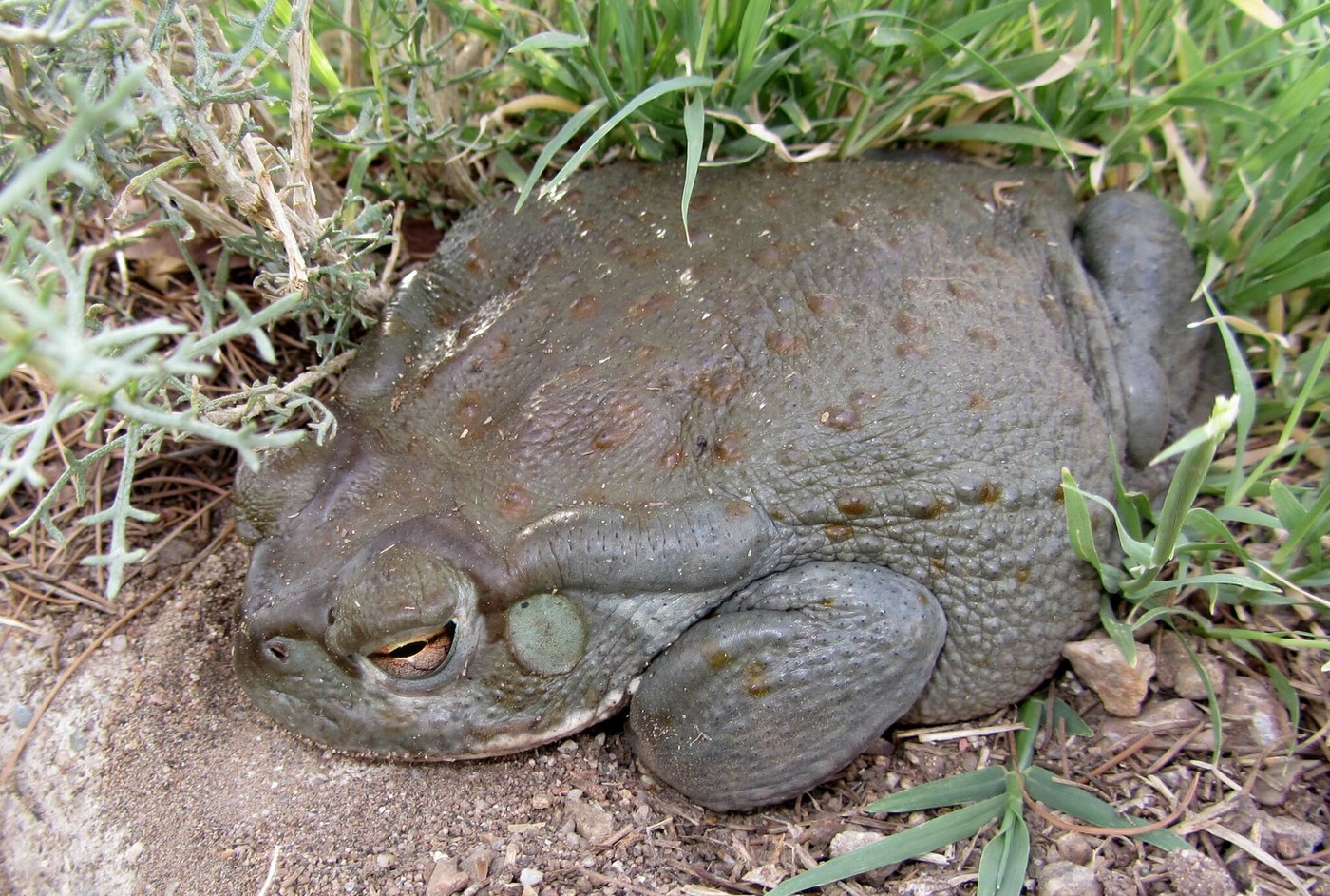
Color is plain, and the plainness is the point. The body is olive, dark brown, or dark gray with a paler throat, with no bold spotting or dorsal stripe. The skin is smooth and leathery relative to most toads.
The parotoid glands
They are the feature to look at, and the reason to look from a distance. Long, elongated glands run behind and above each eye. These are the primary toxin-secreting glands, so this is a structure to identify visually and never to touch.
The cream wart at the mouth
The cream colored wart at the corner of the mouth is the clincher. A distinctive white or cream wart sits at each mouth corner. Combined with prominent bony cranial crests on the head and enlarged warts on the hind legs, that mark separates this species from anything else sharing its range.
The look-alike is Woodhouse's toad
The look-alike that matters is Woodhouse's toad. Woodhouse's toad shares the elongated parotoid gland shape and overlaps in range across the Southwest, and the reliable tells are size and pattern. Woodhouse's toad is tan, brown, or yellowish with numerous small dark spots and usually a pale stripe down the middle of the back, and it tops out around 3 to 4 inches. Colorado River toad is plain olive to dark gray with no dorsal stripe and runs 4 to 7.5 inches or more. Woodhouse's toad also lacks the cream colored mouth-corner wart and the same degree of cranial crest development. This comparison comes from state wildlife agency descriptions of Woodhouse's toad rather than from a single primary source. The color and size distinction is consistent across three independent state agency accounts.
It answers to several names
Names, because this animal answers to several. Colorado River toad and Sonoran Desert toad are both in current use, with Sonoran Desert toad now the more common name in federal and Arizona state wildlife material and Colorado River toad the name more associated with the historical lower Colorado River population and with veterinary toxicology writing. The scientific name is Incilius alvarius, formerly classified as Bufo alvarius, and both names remain in active use. The U.S. Fish and Wildlife Service maintains species pages under each of them for the same animal.
Nicknames that are not agency names
Nicknames drawn from psychedelics coverage circulate for this species. They are not wildlife agency names.
Signs of Infestation
Appearing after a monsoon storm
Sudden appearance after a monsoon storm is the classic sign. Large toads showing up around a property within hours of a rain event, in a yard that showed nothing the week before, is the normal pattern for this species rather than an unusual one. That is what nine to ten months of estivation looks like from the surface.
Water features are where to look first
The species is strongly associated with permanent and temporary water, including the artificial kinds. Swimming pools, backyard ponds, cattle tanks, irrigation ditches, and canals are all documented settings.
Between storms, look for shelter
Between emergence events, look for daytime shelter rather than for the animal in the open. Cool damp locations are the refuges that matter: under patio furniture, in garages, under air conditioner condensate drip areas, and inside pool skimmers.
Visual identification is easy
Positive visual identification is unusually easy once a homeowner knows the marks. The size, the plain olive to dark gray color, and the long parotoid glands behind the eyes are enough, and none of it requires getting close.
The call is a poor detection method
Males produce a relatively weak, low pitched call during the breeding chorus after monsoon rains. This is not a loud attention-grabbing species the way some frogs are, so expect to see one rather than hear one.
No damage list, and that is a finding
There is no damage checklist here, and the absence is the finding. No source describes this species as a threat to foundations, wiring, or any building material. There are no gnaw marks, no entry holes, and no odor to work backward from. No olfactory sign is documented for this species at all. The risk from this species is toxicological and veterinary, and the sighting is the entire body of evidence.
Prevention and When to Call a Pro
Check your state rule first
Check your state and local wildlife regulations before capturing, moving, relocating, or handling this animal. That step comes before anything else here. The rules that govern this species vary by state and they change over time, and the two states with documented rules genuinely differ from each other. A licensed nuisance wildlife control operator or your state wildlife agency is the safer default than acting on your own reading of a general article. That is not a formality on this species, because one state in its range attaches a permit requirement to capture and possession outright.
Arizona, a collection framework
Arizona is the range core, and its framework is a licensed-collection one rather than a protection one. The Arizona Game and Fish Department's own Wildlife Conservation Strategy species page designates this species a Species of Greatest Conservation Need at Tier 2, and separately scores its federal or state legal status criterion as does not meet the criteria, which means the species is not currently listed as threatened or endangered in Arizona. Species of Greatest Conservation Need is a state wildlife action plan conservation-priority category, not a legal protection. On the collection side, Arizona Administrative Code classifies amphibians as restricted live wildlife, which means taking and possessing one live from the wild requires a valid Arizona hunting or fishing license plus a bag and possession limit established by Commission Order. A specific bag-limit figure circulates in secondary sources but does not appear in the department's own published regulations, so get the number from the department. This describes Arizona only.
New Mexico says the opposite
New Mexico is the reason the generic caveat above is not hedging, because its answer is the opposite of Arizona's. Natural Heritage New Mexico's species record classifies this species as Threatened under New Mexico's state wildlife protection scheme, where capturing, possessing, or transporting a state-listed Threatened or Endangered species without a valid New Mexico Scientific Collecting Permit is illegal. One limitation belongs with that claim rather than after it: the sources for it are a university biodiversity database and a herpetological society legal reference page, not the New Mexico Department of Game and Fish's own published list. Treat the listing as the best available reading and confirm it with the department before acting on it. This describes New Mexico only.
The 5-MeO-DMT question
It is a separate legal question from everything above, and conflating the two is the mistake to avoid. Everything in the three points above concerns wildlife law, which governs the live animal. Federal drug law governs the compound. 5-Methoxy-N,N-dimethyltryptamine, the psychoactive compound present in this species' secretions, was placed into Schedule I of the federal Controlled Substances Act effective January 19, 2011 by a Drug Enforcement Administration final rule published in the Federal Register. Schedule I status means federal law treats the substance as having no accepted medical use and applies the Controlled Substances Act's criminal sanctions and controls to its manufacture, distribution, dispensing, importation, exportation, and possession. Here is the hinge, stated plainly because it is the part people get wrong: complying with one body of law is not complying with the other. A person could be fully within a state's wildlife-collection rules for the live animal and still be committing a federal controlled-substance offense by extracting, possessing, or distributing the toad's secretions for their 5-MeO-DMT content. Two separate questions and two separate bodies of law, so there is no single answer to whether the toad is legal.
Never handle this toad
This applies above all to bare hands. This is a human safety point and it is separate from the pet risk below. The same bufotoxin secretions that poison dogs are also a hazard to people on contact, particularly through mucous membranes such as the eyes and mouth, or through a cut, or by handling the animal and then touching your face. If removal from a pool or a yard is genuinely necessary, use gloves and a container or a net rather than direct skin contact, or contact a wildlife control professional instead.
Manage the backyard water
Manage backyard water, because water is what brings the animal in. This species is drawn to standing and slow-moving water for both breeding and daytime refuge, and pools, ponds, cattle tanks, and irrigation features all qualify. Covering a pool when it is not in use, securing pond edges, and eliminating unnecessary standing water after monsoon rains all reduce the odds of a toad taking up residence.
Keep pets away, tied to rain
Keep pets away from likely toad locations, and tie the timing to rain rather than to a month. Given the poisoning risk documented below, this is the single most effective prevention step for a Southwest household with dogs. Supervise pets around pool areas, ponds, and damp shaded refuges during and immediately after monsoon rain events, and especially at night, which is when the toad is active and when adults are most likely to be above ground.
Reduce the insect attractants
Reducing insect attractants is a reasonable secondary step. Because this species is an opportunistic predator of invertebrates and small vertebrates, cutting back outdoor lighting that draws large numbers of insects and clearing yard debris that provides daytime shelter both work against it. No source quantifies that effect for this species specifically, so treat it as a general deterrent rather than a measured one.
A pet exposure is a vet call
If a pet shows signs of toad exposure, the first call is a veterinarian or the ASPCA Animal Poison Control Center at 888-426-4435, not a pest control company. Signs to act on are drooling, pawing at the face or mouth, and vomiting. The immediate home action, per both independent sources, is to flush the animal's mouth with running water for 5 to 10 minutes with the muzzle pointed downward so the water drains out the front of the mouth rather than being swallowed. Do not induce vomiting. The Merck Veterinary Manual states plainly that inducing vomiting is not recommended, because of the risk of rapid-onset neurological signs. Then get the animal to a veterinarian.
What the poisoning does
What the poisoning actually does, stated at the level the sourcing supports and no further. The parotoid glands and skin secrete bufotoxins, cardiotoxic and neurotoxic steroid compounds, as a defensive response when the toad is bitten, mouthed, or licked by a predator such as a dog. The Merck Veterinary Manual groups this species with cane toad as toads of sufficient size to carry potentially lethal amounts of toxin, and lists clinical signs including hypersalivation, gagging and retching, vomiting, weakness, cyanosis, difficulty breathing, and seizures, with hyperkalemia and cardiac arrhythmias in severe cases, describing the cardiac and central nervous system involvement as potentially life-threatening. Veterinary toxicology guidance drawing on Pet Poison Helpline and ASPCA Animal Poison Control Center material independently confirms the same mechanism and symptom picture for this species by name, describing initial drooling, pawing at the face, and vomiting progressing within 30 minutes to several hours to irregular heartbeat, tremors, seizures, and shock. Two things belong here for calibration. Neither source claims every exposure is fatal. Both frame death as a possible outcome of severe untreated cases rather than a certainty, and both are explicit that supportive veterinary care materially changes the outcome. There is no specific antidote, treatment is supportive, and Merck reserves digoxin-specific antibody fragments for severe refractory cardiac cases.
Keep the risk in proportion
This is a real and documented veterinary emergency inside this species' range, and it is not the same as the mild self-limiting reaction a smaller native toad produces. Merck and the veterinary toxicology literature single out this species alongside cane toad as the two North American toads capable of a genuinely life-threatening poisoning in a dog. The response to that is supervision after rain and a fast trip to a veterinarian if it happens, not panic about every toad in the Southwest.
Call for removal you will not do
Call a wildlife control professional for removal you do not want to do yourself. For a toad in a pool, a yard, or a living space that a homeowner does not want to handle, a licensed operator is the appropriate call, and there are two reasons rather than one. The bufotoxin handling risk to people is the first. The second is that handling and relocation rules for this species vary by state and change over time, so a licensed operator is positioned to know what currently applies where you are.
A recurring toad is a water problem
A recurring or unusually large toad presence is a water problem, not a toad problem. Repeat appearances tied to an uncontrolled water source point back to the attractant. Address that alongside any removal, or the removal is a task that repeats with the next storm.
Frequently Asked Questions
Is the Colorado River toad dangerous to touch?
It should not be handled bare-handed. The same bufotoxin secretions that poison dogs can irritate human mucous membranes, so contact with the eyes, mouth, or a cut, or handling the toad and then touching your face, is the exposure route to avoid. If removal is genuinely necessary, use gloves and a container or a net, or call a wildlife control professional. The far more serious real-world risk, though, is not to people. It is to a pet that bites or mouths the toad, which is a genuine veterinary emergency and is covered in the next answer.
What do I do if my dog bit or mouthed one of these toads?
Act immediately. Flush the dog's mouth with running water for 5 to 10 minutes with the muzzle pointed downward, so the water drains out the front of the mouth rather than being swallowed. Do not induce vomiting. The Merck Veterinary Manual states that inducing vomiting is not recommended because of the risk of rapid-onset neurological signs, and that thorough mouth flushing is the appropriate first aid. Then get to a veterinarian or call the ASPCA Animal Poison Control Center at 888-426-4435 right away. Speed matters because the progression is fast: initial drooling, pawing at the face, and vomiting can advance within 30 minutes to a few hours to irregular heartbeat, tremors, seizures, and shock. Two points of calibration are worth stating. There is no specific antidote and treatment is supportive, so a veterinary visit is not optional. And death is a possible outcome of severe untreated cases rather than a certain one, which is exactly why getting to care quickly changes the outcome.
Is it illegal to collect or touch these toads?
There are two entirely separate legal questions here and merging them is where people go wrong. The first is wildlife law, which governs the live animal and differs by state. Arizona classifies amphibians as restricted live wildlife, so taking and possessing one live from the wild requires a valid Arizona hunting or fishing license plus a bag and possession limit set by Commission Order. New Mexico is different: Natural Heritage New Mexico's record classifies the species as state Threatened, where capture, possession, or transport without a New Mexico Scientific Collecting Permit is illegal, though that listing traces to a university database and a herpetological society reference rather than to the state agency's own published list and is worth confirming directly. The second question is federal drug law, which governs the compound rather than the animal. 5-MeO-DMT, the psychoactive compound in this toad's secretions, has been a Schedule I controlled substance under the federal Controlled Substances Act since January 19, 2011. Those two bodies of law do not substitute for each other. Someone could be fully compliant with a state's wildlife-collection rules for the live toad and still commit a federal controlled-substance offense by extracting, possessing, or distributing its secretions for their 5-MeO-DMT content.
Are Colorado River toads endangered?
Not federally, and not in Arizona, where the great majority of the United States population lives. The Arizona Game and Fish Department designates the species a Species of Greatest Conservation Need at Tier 2, which is a state wildlife action plan conservation-priority category rather than a legal protection, and the same page scores its federal or state legal status criterion as does not meet the criteria. Status does vary by state. New Mexico classifies the species as state Threatened. California lists it as a Species of Special Concern, which is a state conservation-priority tracking designation and not a formal Endangered or Threatened listing, and that distinction is worth stating precisely because some secondary coverage gets it wrong. California is also the state where the species no longer occurs at all, having been extirpated there with the last verified sighting in 1955.
What does this toad eat?
More than you would expect from a toad. Adults are carnivorous and take snails, beetles, spiders, and grasshoppers like any toad, but they also take vertebrate prey including lizards, mice, and smaller toad species. Tadpoles feed at the other end of the food web entirely, on algae and organic detritus in the temporary rain pools where they hatched.
Sources
- Sonoran Desert Toad (Incilius alvarius) species page: current range across southern Arizona, extreme southwestern New Mexico, and Sonora into northern Sinaloa, habitat and elevation range, and the parallel species page maintained under the former name Bufo alvarius U.S. Fish and Wildlife Service
- Arizona Wildlife Conservation Strategy species page for Incilius alvarius: the Species of Greatest Conservation Need Tier 2 designation, the federal or state legal status score of does not meet the criteria, the finding that more than 70 percent of the global breeding range and more than 90 percent of the United States portion lies within Arizona, and the water-source and daytime-refuge habitat associations Arizona Game and Fish Department
- Arizona Administrative Code R12-4-406, Restricted Live Wildlife: amphibians classified as restricted live wildlife, requiring a valid Arizona hunting or fishing license and a Commission Order-established bag and possession limit to take and possess live wildlife from the wild Cornell Law School Legal Information Institute
- Species record for Incilius alvarius: New Mexico state Threatened classification, the Scientific Collecting Permit requirement for capture, possession, or transport, and the largest-native-toad size statement Natural Heritage New Mexico, University of New Mexico Biodiversity Collections
- Sonoran Desert Toad (Incilius alvarius): size range, color and distinguishing features including the cream colored mouth-corner wart, breeding window of May through September, clutch size, sub-one-month tadpole development, wild longevity estimate, California Species of Special Concern status, the 1955 last-verified California record, and the NatureServe SH historical status code for California californiaherps.com
- Herp Atlas species overview for Sonoran Desert Toad: the historical Imperial Valley and lower Colorado River population in California and Baja California, the finding that the species is believed extirpated from Peninsular California, and the agricultural conversion and pesticide causes given San Diego Natural History Museum
- Incilius alvarius species account: overall length range of 110 to 187 mm, adult diet including lizards, mice, and other toads, tadpole diet and size, nocturnal and largely aquatic behavior, solitary social structure, weak low-pitched call, and the 9.2 year average captive lifespan Animal Diversity Web, University of Michigan Museum of Zoology
- Toad Poisoning in Dogs and Cats: bufotoxin mechanism, the grouping of Incilius alvarius with cane toad as toads large enough to carry potentially lethal toxin amounts, clinical signs including hypersalivation, vomiting, cyanosis, dyspnea, seizures, hyperkalemia, and cardiac arrhythmias, the instruction not to induce vomiting, mouth lavage as first aid, supportive treatment with no specific antidote, and digoxin-specific antibody fragments for severe refractory cardiac cases Merck Veterinary Manual
- The Trouble with Toads: Getting to the Bottom of This Toxic Threat, the independent confirmation of toad poisoning mechanism and symptom picture in pets and the Animal Poison Control Center contact number 888-426-4435 ASPCA
- Schedules of Controlled Substances: Placement of 5-Methoxy-N,N-Dimethyltryptamine into Schedule I of the Controlled Substances Act, final rule effective January 19, 2011 U.S. Drug Enforcement Administration, via the Federal Register
Image Credits
- Image: Lon Brehmer via iNaturalist. CC BY 4.0.
License.