Seasonal Timeline
Corn snake is active from spring through fall across its range and spends the coldest months underground below the frost line, typically from around October to April. It may still emerge to bask on unusually warm winter days, and activity generally runs longer and stronger farther south in its range.
Corn snake is active from spring through fall across its range and spends the coldest months underground below the frost line, typically…
Mating happens mostly in spring, though it can extend into May or run year-round in the far southern part of the range. Females lay their eggs in late spring into early July, and those eggs hatch in late summer with no parental care. That timing puts small, unfamiliar, dull-colored hatchlings in leaf litter and debris piles during the same weeks homeowners are still working outside, which is part of why sightings and misidentifications tend to climb late in the season.
Sources disagree on whether this species is primarily nocturnal or primarily diurnal. One state wildlife agency describes it as largely nocturnal and frequently found on roads at night, while another account describes it as generally diurnal, shifting toward dawn-and-dusk activity in warmer weather and becoming more active the farther south you go in its range. Both stand as published rather than one being chosen as the single correct answer, since the disagreement itself is a documented finding.
Where They're Found
Corn snake is an outdoor species, not a structural invader the way a rodent or insect pest is, but it regularly turns up in a barn, shed, garage, or foundation area while hunting rodents. It favors pine-wiregrass flatwoods and sandhills, deciduous forest, rocky areas, fields, and grassy suburban land near homes and barns, sheltering under loose bark, in stump holes, in rodent burrows, and under scrap metal or debris. Old building sites with abundant tin roofing or sheet metal left on the ground are specifically documented as good places to find one, since the snake uses those surfaces to regulate its body temperature.
The core range runs as disjunct populations from southern New Jersey to the Florida Keys, west to the Mississippi River, with the highest concentrations in the Coastal Plain of the Southeast. That same range description also documents real, stable populations in Louisiana's Florida Parishes and along the lower Mississippi River, and a well-known disjunct population at the species' northern edge in the New Jersey Pine Barrens, specifically Burlington, Cumberland, and Ocean counties. Populations once called "corn snake" west of the Mississippi River are now classified as a separate species based on genetic research, so the corn snake's range does not extend into Texas or the rest of South Central beyond Louisiana.
Legal status varies sharply by state and is worth knowing before doing anything about a snake on your property. Louisiana and North Carolina treat corn snake as a stable, unprotected native species. New Jersey lists it as Endangered, the result of a 1979 threatened listing reclassified to endangered in 1984 due to habitat loss and illegal collecting, which makes collecting or possessing a wild corn snake there illegal.
No record places corn snake in Alaska or Hawaii. Alaska has no native snake species of any kind, and Hawaii has no native snakes either, with all snakes illegal to import, own, or transport there. Both regions are confirmed absent for this species.
Life Cycle
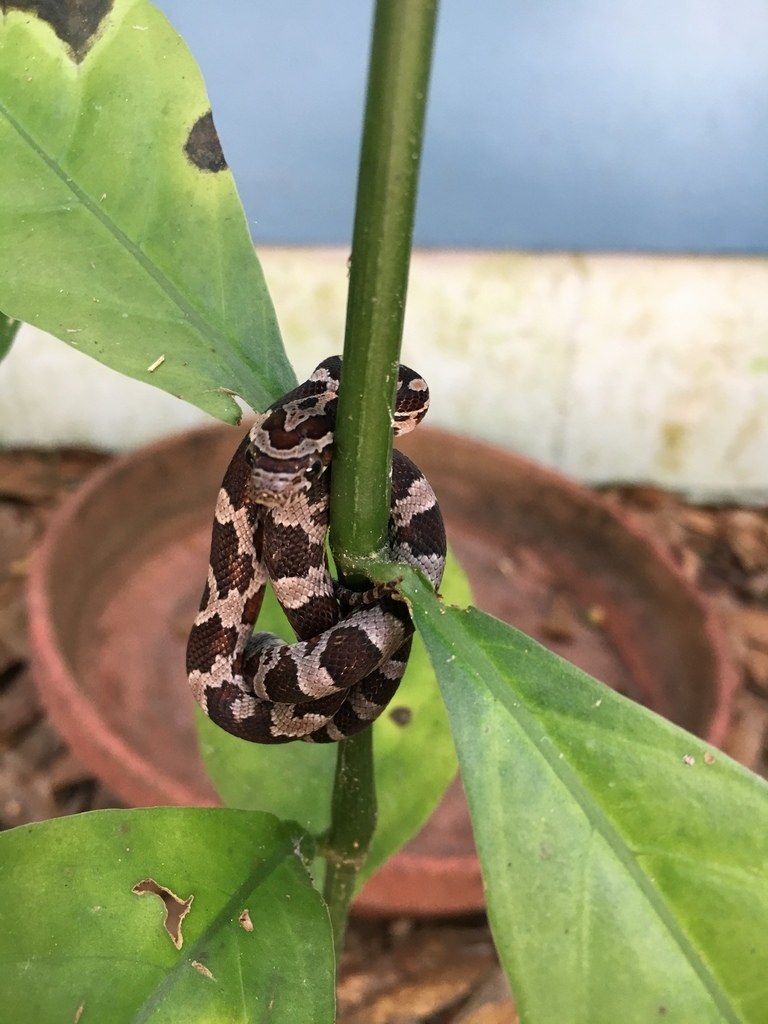
The reproductive calendar explains the late-summer sighting bump. Eggs hatch in late summer, which puts small, dull-colored, unfamiliar-looking young snakes in leaf litter and debris piles during the same weeks homeowners are still active outdoors. A hatchling's duller gray-brown coloring is less immediately distinctive than an adult's vivid red-orange pattern, which can make identification harder, not easier, at exactly the time of year sightings increase.

Egg
Hatchling2
Juvenile3
Adult
Identification
The blotches and the belly
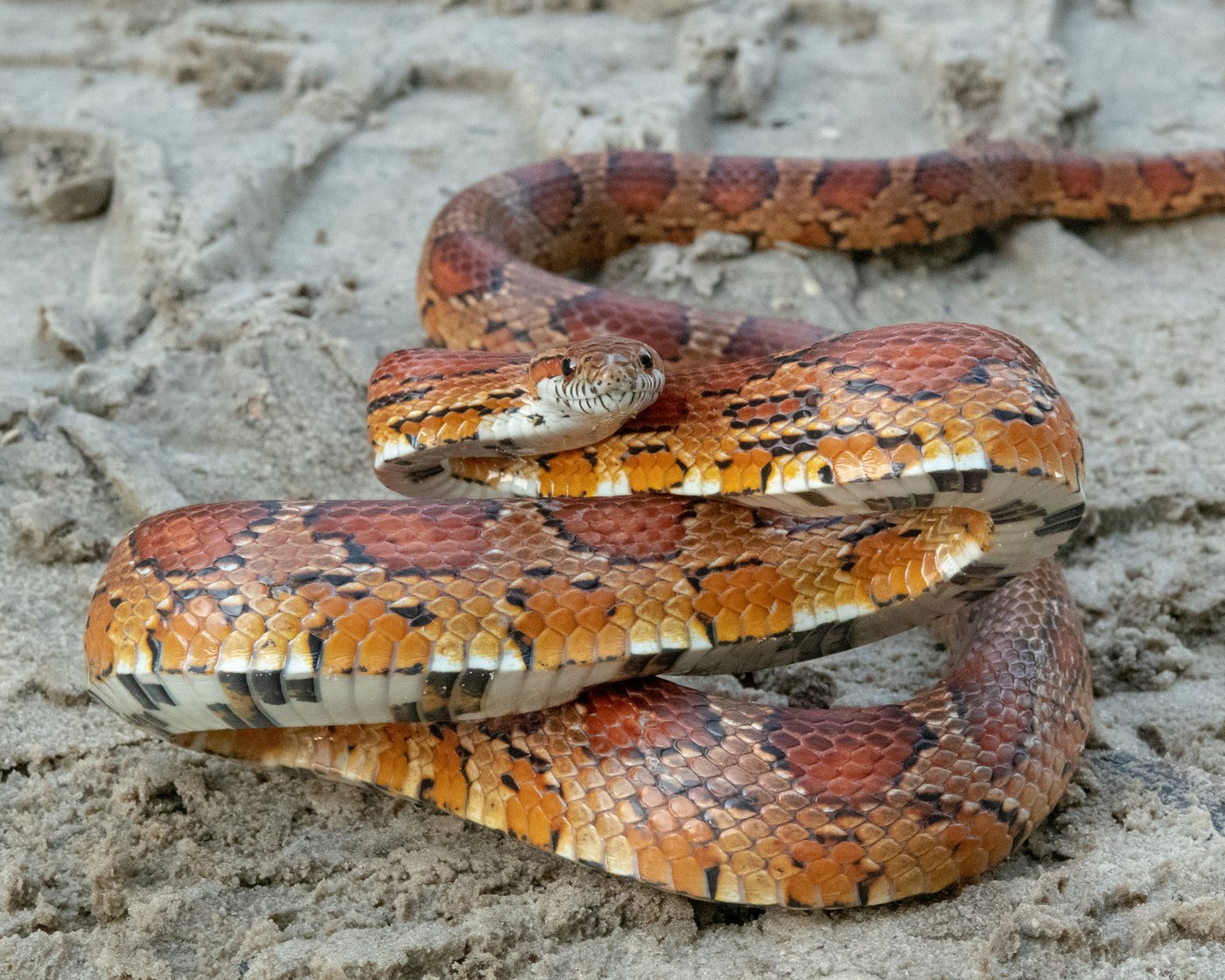
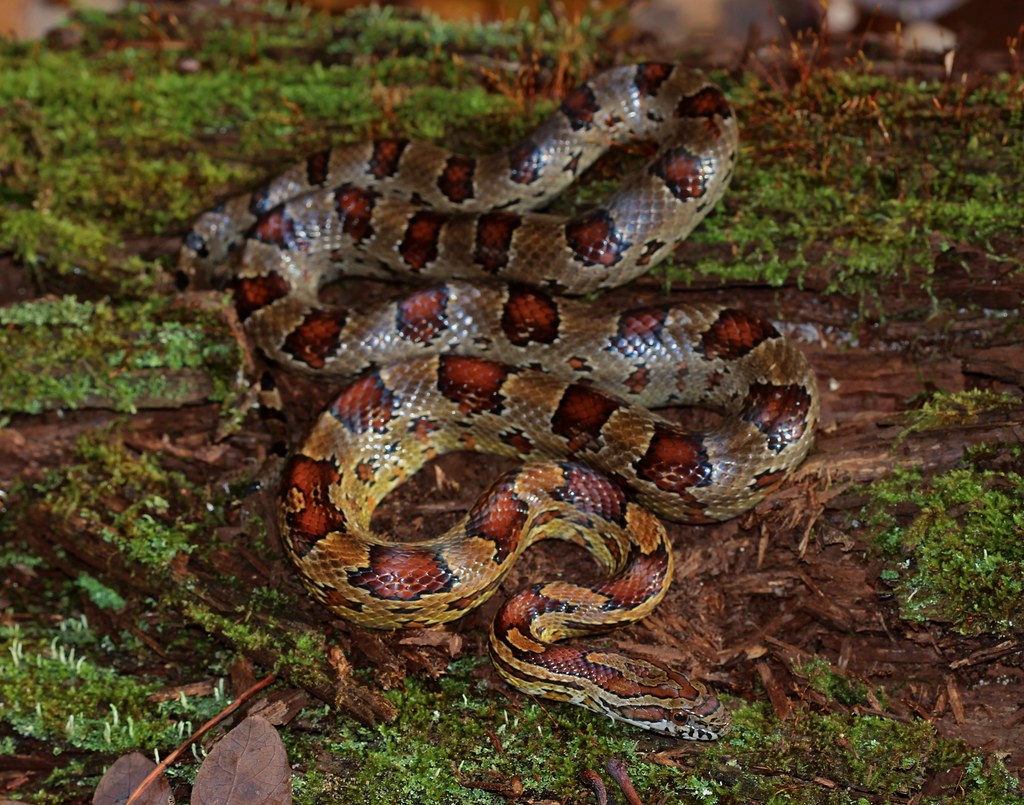
The blotch pattern and the belly are the two field marks that matter most. Ground color is orange, reddish, gray, or brownish, crossed by large reddish-brown blotches bordered in black down the back, with a smaller row of blotches on each side and a spear-point-shaped blotch usually on top of the head. The belly is boldly marked with a black-and-white checkerboard pattern, the single most reliable field mark for ruling out copperhead.
Scales, pupils, and build
All three separate this species from the venomous look-alike it gets mistaken for. Scales are glossy, almost iridescent, with weak keeling that is faint or absent in juveniles. Pupils are round, not the vertical, elliptical pupils a pit viper carries, and there is no heat-sensing pit between the eye and nostril. The body is relatively slender and shaped like a loaf of bread in cross-section, an adaptation that aids climbing, rather than the heavy, triangular-headed build of a venomous pit viper.
The copperhead confusion
Commonly confused with copperhead, and this is the misidentification that matters most in this species' range. The reliable distinctions are the pupil shape (round on corn snake, vertical and cat-like on copperhead), the head shape (narrow and in line with the body on corn snake, broad and triangular on copperhead), the blotch pattern and position (thick, square-ish blotches centered along the spine on corn snake versus an hourglass shape that is wide on the sides and narrow at the spine on copperhead, the opposite orientation), and the belly (black-and-white checkerboard on corn snake versus plain or lightly mottled on copperhead). Corn snake also tends to run more vividly red or orange than a copperhead's coppery-tan cast, though color alone should never be the deciding factor.
Defensive behavior adds confusion
Defensive behavior adds to the confusion rather than resolving it. When cornered, a corn snake will vibrate its tail against dry leaves or debris, strike repeatedly, and release a foul-smelling musk from glands at the base of the tail. The tail-vibration can sound like a rattlesnake's warning buzz even though the corn snake has no rattle at all. A buzzing sound in leaf litter is evidence of a startled, harmless snake bluffing, not proof of a dangerous one.
Where the name comes from
The name itself is a case of getting the story right. "Corn snake" most likely comes from the belly and blotch pattern resembling the color and pattern of Indian corn, according to the state wildlife agency that has studied the species longest, not from any connection to grain storage, silos, or diet. A popular folk theory ties the name to the snake hunting rodents around corn cribs, but that is not the documented origin, even though the rodent-control behavior itself is real.
Signs of Infestation
No structural damage
This species leaves no structural damage, the same as any harmless constrictor. Corn snake does not chew, burrow, or gnaw, and there is no droppings pattern, entry hole, or odor a homeowner can work from after the fact. The sign is the snake itself, seen or not seen, or a shed skin left behind.
Where you actually find one
Under loose bark, in stump holes, in rodent burrows, or under scrap metal and debris, rather than out in the open. Old building sites with tin roofing or sheet metal left on the ground are specifically documented as good places to encounter one, since the snake uses those surfaces for thermoregulation. Shed skins may turn up in the same shelter spots.
The audible sign is a bluff, not a threat
A rapid tail-vibration against dry leaves or debris is this species' own defensive display. Corn snake has no rattle, so a buzzing sound in the leaves is evidence of a startled corn snake, not a rattlesnake or any other genuinely dangerous species.
It usually means rodents
A corn snake around a structure usually means rodents are already there. Because rodents make up more than half its diet, its presence near a barn, shed, or foundation is frequently a byproduct of an existing mouse or rat population rather than an unrelated nuisance. If corn snakes keep turning up, it is worth checking what they are hunting.
Prevention and When to Call a Pro
Identification is the real step
Correct identification is the actual prevention step here, not exclusion. Because this species causes no structural damage and carries no venom, the goal is preventing an unnecessary kill, not preventing an infestation. Check the pupil shape, head shape, blotch pattern, and checkerboard belly described above before assuming copperhead.
Address the rodents
Address the rodent population and the snake's reason for being there goes with it. Corn snakes are drawn to a property specifically by rodent prey, not by stored grain, so reducing harborage and food sources for mice and rats is the long-term way to see fewer snakes around a barn, shed, or foundation.
Remove ground-level debris
Remove ground-level scrap metal and debris if fewer sightings around a structure is the goal. Sheet metal, tin roofing, and debris piles left on the ground are exactly the surfaces this species uses to regulate its body temperature. Clearing them from immediately around a foundation reduces shelter without needing to trap or relocate the snake.
Check your state rule first
Check your state's rules before trapping, relocating, or killing the snake, because the answer changes sharply by state. Louisiana and North Carolina treat corn snake as a stable, unprotected native species, while New Jersey lists it as Endangered, making collection or possession there illegal. Given that spread, the safer default everywhere is to check state and local wildlife regulations first and to use a licensed nuisance wildlife control operator rather than a DIY trap purchase.
Do not kill it by default
Do not kill the snake as a default response. It is a genuinely beneficial predator of the rodents already on the property, it is not dangerous, and unnecessary killing by frightened homeowners is documented as an ongoing pressure on wild populations alongside habitat loss and vehicle strikes.
When to Call a Wildlife Control Operator
The threshold here is identification confidence, not danger, in states where the species is legal to handle. If you cannot confidently rule out copperhead using the pupil, head-shape, blotch-pattern, and belly distinctions above, that uncertainty, not a real emergency, is the reason to call a licensed pest control or wildlife control professional to identify the snake rather than attempting to handle or kill it yourself. If the snake is found in a state such as New Jersey where corn snake is state-listed as endangered, contact the state wildlife agency rather than attempting removal at all.
Frequently Asked Questions
Why is it called a corn snake?
Its name most likely comes from its color and blotch pattern resembling Indian corn, not from any connection to its diet or to grain storage, according to the state wildlife agency that has studied the species longest. A popular folk theory ties the name to hunting rodents around corn cribs, but that is not the documented origin.
How can I tell a corn snake from a copperhead?
Check the pupils, head shape, and belly. A corn snake has round pupils, a narrow head in line with its body, and a black-and-white checkerboard belly. A copperhead has vertical, cat-like pupils, a broad triangular head, and an hourglass-shaped crossband pattern that is wide on the sides and narrow along the spine, the opposite of a corn snake's centered, square-ish blotches.
Are corn snakes venomous or dangerous?
No. Corn snakes have no fangs and no venom, and they kill prey exclusively by constriction. A defensive bite from a cornered snake can happen but causes no more than a minor scratch.
Is it legal to trap, relocate, or kill a corn snake on my property?
It depends entirely on the state. Louisiana and North Carolina treat it as a stable, unprotected native species, while New Jersey lists it as Endangered, making collection or possession there illegal. Check your state wildlife agency before doing anything, rather than assuming the rules are the same everywhere.
Should I be worried about finding a corn snake in my barn or shed?
No. It is a genuinely beneficial rodent predator, and its presence usually means rodents were already living there before the snake arrived. It poses no structural or health risk.
Sources
- Corn Snake, North Carolina Wildlife Profiles (identification, name origin, range, habitat, food, life cycle, lifespan, behavior, defensive display, signs) North Carolina Wildlife Resources Commission
- Pantherophis guttatus (Red corn snake) species account (physical description, development, reproduction, lifespan, behavior, food habits, predation, taxonomy) Animal Diversity Web, University of Michigan Museum of Zoology
- Red cornsnake species field guide entry (range, habitat, behavior, clutch size, population status in Louisiana) Louisiana Department of Wildlife and Fisheries
- Identifying Copperhead Snakes (HGIC 2907) - corn snake vs. copperhead comparison Clemson Cooperative Extension, Home & Garden Information Center
- Joint Corn Snake Study - corn snake listed as an endangered species in New Jersey New Jersey Pinelands Commission
- Corn snake species guide - endangered status and listing history Conserve Wildlife Foundation of New Jersey
- Copperheads and Similar Looking Harmless Species - Eastern Copperhead vs. Red Cornsnake comparison Virginia Herpetological Society
- Sounds Wild: No Snakes in Alaska Alaska Department of Fish and Game
- Snakes - Hawaii has no native snakes, all snakes illegal to possess Big Island Invasive Species Committee