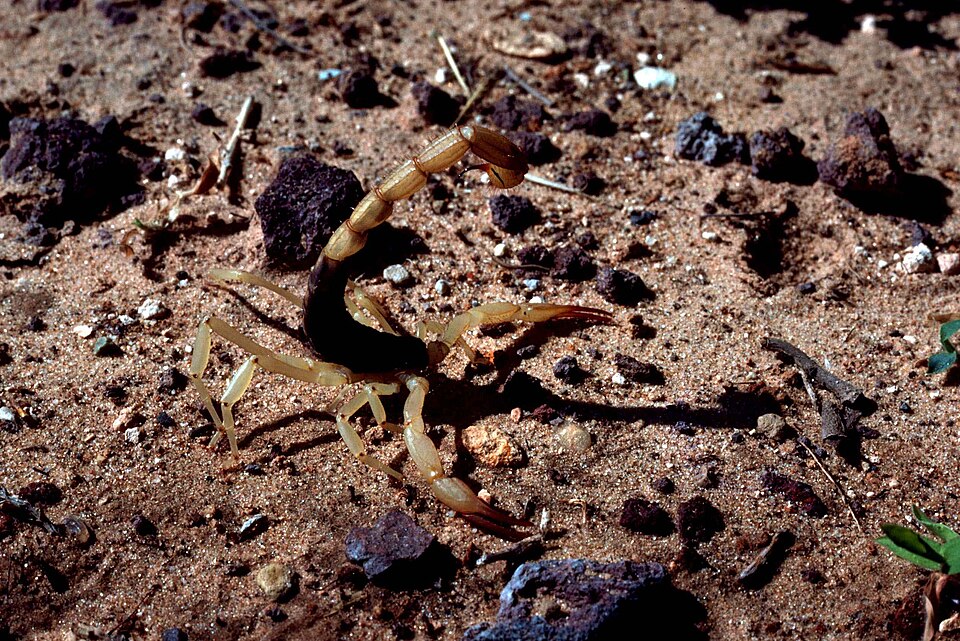
Seasonal Timeline
Southwest scorpions peak June through August, with shoulder activity in April, May, September and October, and go quiet November through March. South Central's striped bark scorpion peaks May through September, with shoulder activity in April and October, and the same November through March lull.
Southwest scorpions peak June through August, with shoulder activity in April, May, September and October, and go quiet November through…
Both species are nocturnal, with most movement occurring roughly 7pm to 11pm and again from 3am to sunrise. Hot weather pushes them toward people rather than away: heat and moisture stress outdoors drives the Arizona bark scorpion's warm-weather activity, and it pushes striped bark scorpions out of hot attics and into living space.
Where They're Found
Two regions matter here because two different species carry the medical story. The Arizona bark scorpion (Centruroides sculpturatus) is the Southwest's house-invading scorpion, chiefly Arizona, and it is the only one of roughly 30 scorpion species in that state able to climb smooth vertical surfaces like stucco and block walls, which is how it gets onto ceilings and drops into sinks, bathtubs and beds. The striped bark scorpion (Centruroides vittatus) covers South Central, chiefly Texas, and is likewise a non-burrowing climber commonly found in attics. Three other Southwest species share the same yards and get misread as dangerous because of size or nickname: the Arizona giant hairy scorpion (Hadrurus arizonensis), the largest scorpion in the US at over 5 inches, with venom no worse than a bee sting and a habit of preying on bark scorpions; the Arizona stripe-tailed scorpion (Paravaejovis spinigerus), also called the devil scorpion; and the yellow ground scorpion (Vaejovis confusus). All three are burrowers, not climbers, which is the practical tell against the bark scorpion in the same yard.
Life Cycle
Scorpions are arachnids, not insects, so there is no larval or pupal stage. Development is live birth followed by a series of nymphal molts to adulthood. A female may brood 13 to 47 young at a time in the striped bark scorpion, averaging 31, or roughly 25 to 35 young in the scorpions the University of Arizona covers more broadly.
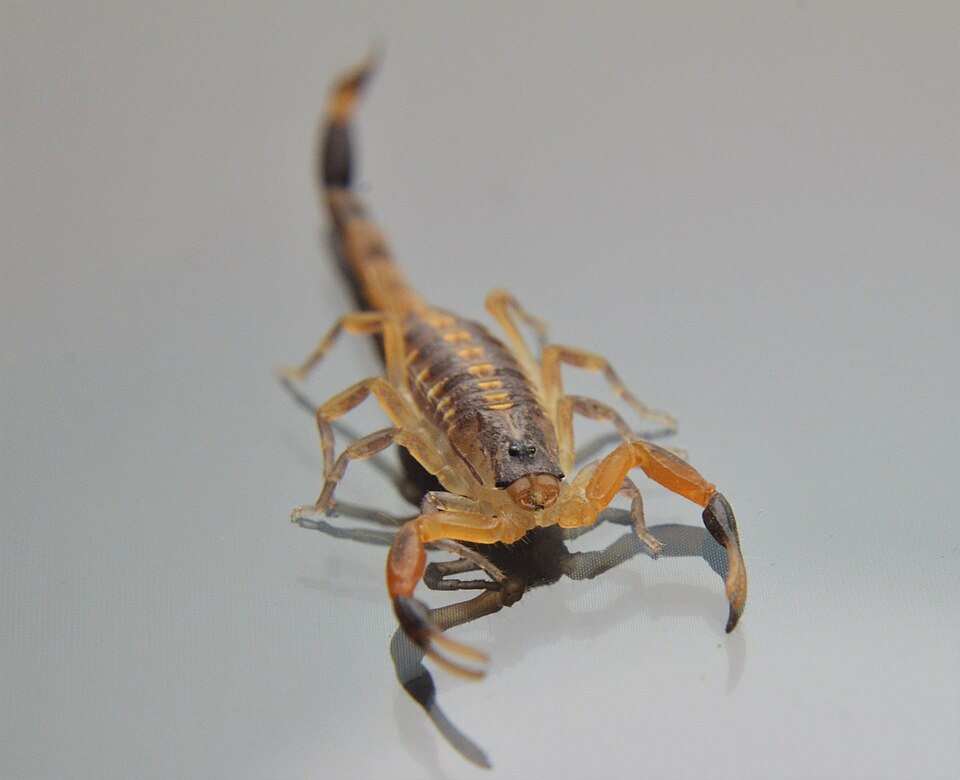
Gestation2
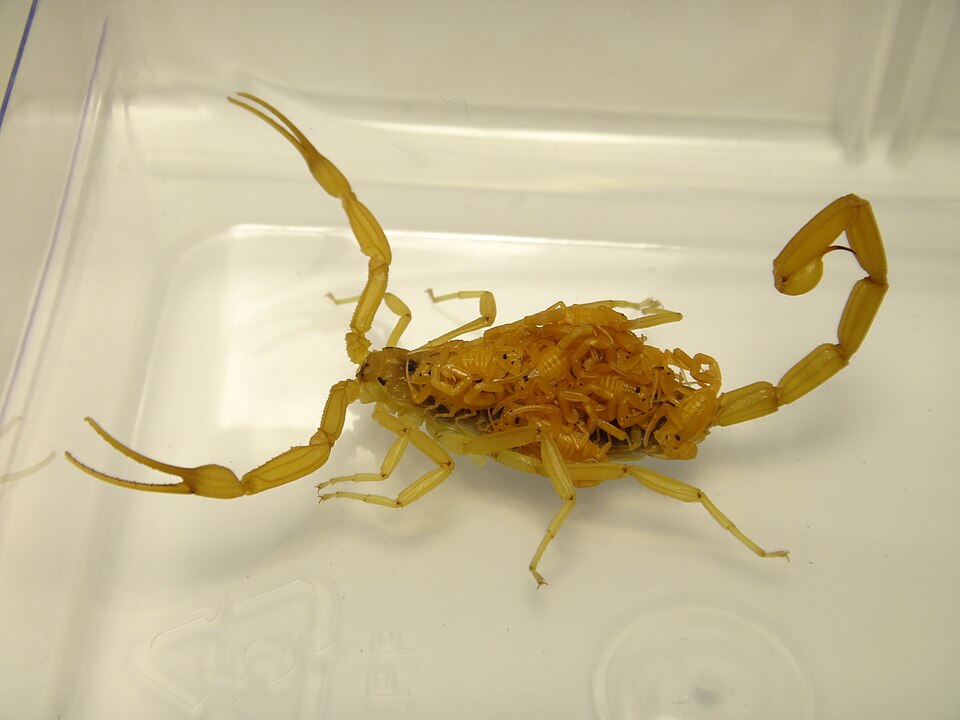
Birth / Newborn3
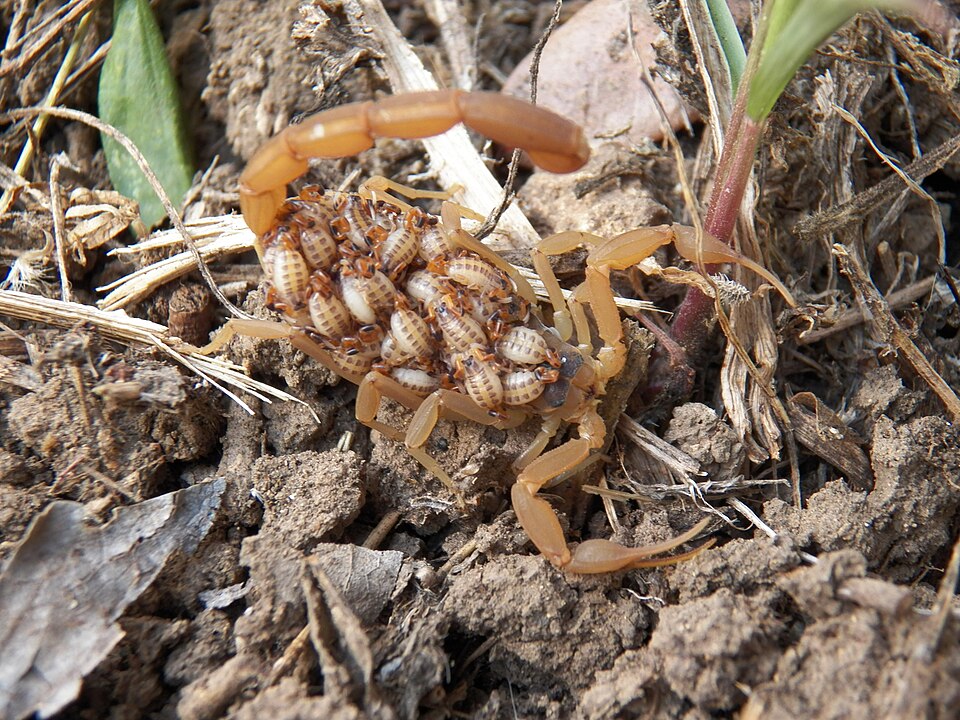
On the Mother's Back4
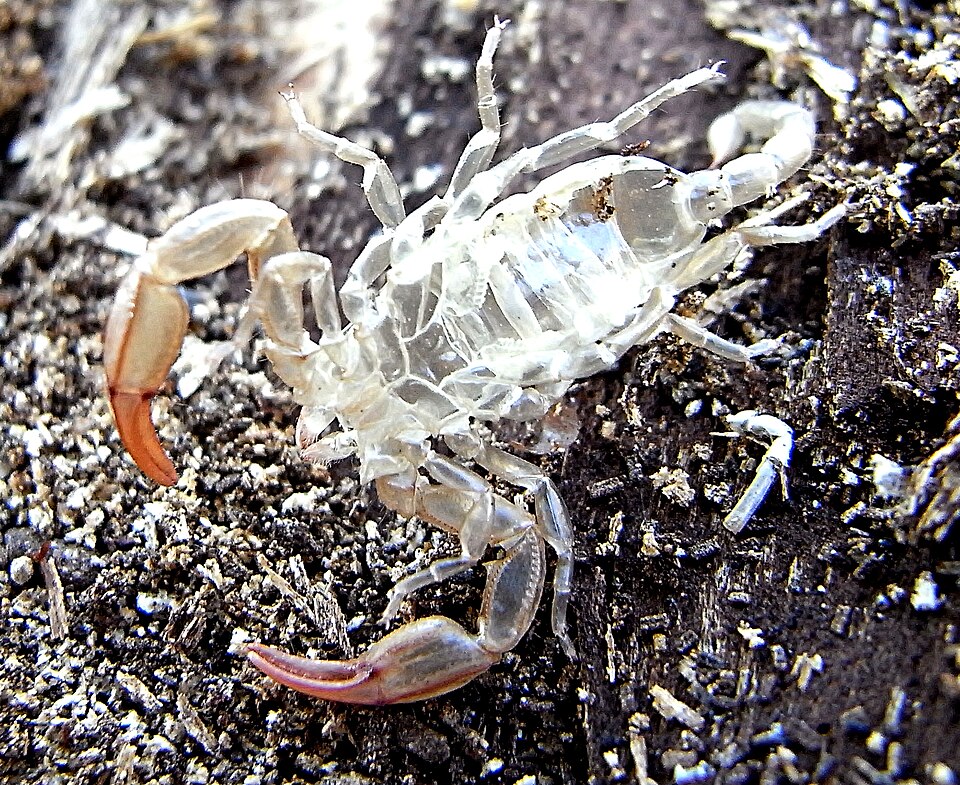
Juvenile Instars5
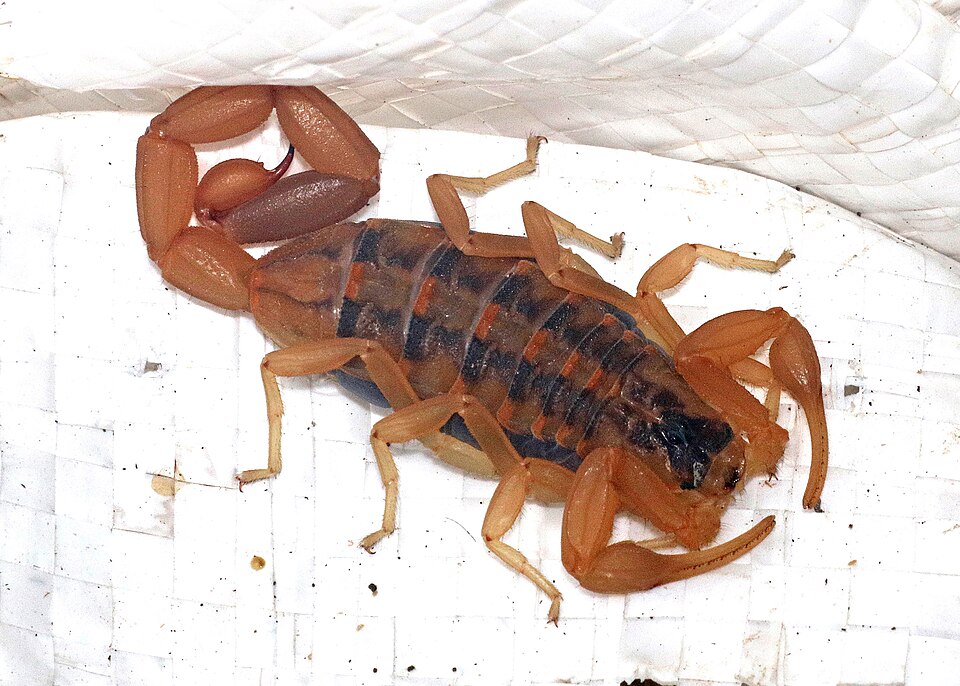
Adult6
Identification
Two species matter most
They look similar for a reason. Both the Arizona bark scorpion (Centruroides sculpturatus) and the striped bark scorpion (Centruroides vittatus) share the genus Centruroides and its signature build: notably slender, elongated pedipalps (the pincer-bearing arms) and a long, thin tail, compared to the thicker pedipalps of the non-Centruroides species sharing the same yards.
Size
The Arizona bark scorpion runs 2 to 3 inches as an adult in the University of Arizona's dedicated species publication, though the Arizona Poison and Drug Information Center gives a smaller figure of up to 1.5 inches at maturity, calling it the smallest dangerous scorpion. Both figures come from credible regional sources. The striped bark scorpion runs about 2 1/2 inches long as an adult.
Color
The Arizona bark scorpion is pale tan to darker with stripes or checkered patterning, described elsewhere as small and yellowish-brown. The striped bark scorpion is yellowish tan with two broad dark stripes down the back and a dark triangular mark above the eyes, though populations in the Big Bend area of Texas can be faintly marked or nearly pale. Immature striped bark scorpions are lighter, with the base of the pincers and the last tail segment dark brown or black.
Climbing is the tell that matters most
The Arizona bark scorpion is the best climber of roughly 30 scorpion species in Arizona and the only one able to scale smooth vertical surfaces such as stucco and block walls, which is how it reaches ceilings and drops into sinks, bathtubs and beds. The striped bark scorpion is also a non-burrowing climber, commonly found in attics. By contrast, the Arizona stripe-tailed scorpion and the yellow ground scorpion are burrowers, which is the practical way to tell them from the dangerous species in the same yard. On male striped bark scorpions, the tail runs longer than on females, a sex tell rather than a species one.
Commonly confused with a vinegaroon
The vinegaroon, or giant whip scorpion, is found in both Arizona and Texas and looks the part with its whip-like tail, but it is not a true scorpion and carries no venom at all. Its tail is a sensory organ, and it defends itself instead with an acetic-acid, vinegar-smelling spray from glands at the base of the tail.
The Arizona giant hairy scorpion
Commonly confused with the Arizona giant hairy scorpion. At over 5 inches, it is the largest scorpion in the US and gets mistaken for the dangerous one on size alone. The opposite is true. Its venom is mild, comparable to a bee sting, and it actually preys on smaller scorpions, including the Arizona bark scorpion.
Two names, one scorpion
Worth knowing if you read a medical source. Extension publications use the current name Centruroides sculpturatus for the Arizona bark scorpion. Clinical literature, including the NIH's own scorpion toxicity reference, often uses the older name Centruroides exilicauda for the same dangerous species. Both names point at the same scorpion. No university extension or federal source documents the exact taxonomic history behind the split, so treat that history as unsettled even though C. sculpturatus is the current name to use.
Risk is species-specific
Medical risk is species-specific, not a group trait. The Arizona bark scorpion is the only scorpion in the United States considered medically dangerous, a fact confirmed independently by University of Arizona extension, the Arizona Poison and Drug Information Center and the NIH's own clinical reference. Its sting can escalate from local pain and tingling to cranial and skeletal muscle symptoms in severe cases, and children are disproportionately affected. Antivenom exists and is FDA-approved for severe cases, most often in young children, with symptom resolution typically within about 4 hours of administration. Deaths are rare where medical care is available. One clinical source states no reported Arizona scorpion death since 1968, a single-source figure that has not been independently verified. The striped bark scorpion of Texas and the South Central region produces a sting that is very painful but, per two independent university extension sources, not considered dangerous to a healthy adult. That reassurance does not extend to children, older adults or anyone with a known sting allergy, since even a low-potency sting can produce a serious allergic reaction in a susceptible person.
Signs of Infestation
UV light is the best tool you have
UV light is the single most useful identification tool a homeowner has. All scorpions fluoresce a bright blue-green under a blacklight, a trait the University of Arizona recommends using for a nighttime sweep of the yard, foundation and patio, timed to the roughly 7pm to 11pm window when scorpions are most active.
Live specimens turning up under objects
Outdoors, that means rocks, boards, landscaping debris and woodpiles. Indoors, it means shoes, folded clothing and bedding.
One in the bed is a real pattern
A scorpion in the bed or bedroom is a documented pattern in Arizona, not a rare fluke. A peer-reviewed study of Arizona sting exposures found the bedroom was the single most common sting location, at 42.5 percent of cases, and that just over half of bedroom stings involved a scorpion actually found in the bed.
Nothing reliable to hear or smell
No source describes a characteristic sound or odor for a scorpion problem.
Prevention and When to Call a Pro
Pest-proofing beats spraying
Pest-proofing the structure beats perimeter spraying alone. Both the University of Arizona and Texas A&M AgriLife name exclusion, not chemical treatment, as the primary lever, with Texas A&M noting plainly that scorpions are difficult to control with insecticides alone.
Seal the building
Install tight-fitting weather-stripping and door sweeps, caulk roof eaves, pipe penetrations and wall cracks, keep window screens tightly fitted, and screen or plug weep holes in stone or brick veneer with coarse steel mesh, copper mesh or a nylon scouring pad. Skip steel wool. It rusts through and stops being a barrier, which is why the mesh above is the better fill.
Cap the hollow block walls
Cap hollow block wall construction specifically. University of Arizona research found scorpions preferred hollow block walls 95 percent of the time in the study cited, making stucco-capping or otherwise closing that construction a higher-value step than generic sealing.
Clean up the yard
Remove trash, logs, boards, stones, bricks and woodpiles from around the foundation. Keep grass mowed close to the structure and prune back bushes and branches that touch the building, since a climbing scorpion can use a branch as a path to the roof. Elevate garbage containers off the ground, and never bring firewood indoors unless it goes straight onto the fire.
Personal precautions matter
They matter as much as sealing, especially in Arizona bark scorpion country. Wear shoes, even indoors. Shake out shoes and clothing before putting them on, especially anything left outside. Pull back bed sheets and check under pillows where scorpions are known to turn up, since bark scorpions can cross a ceiling and drop into a bathtub, sink or crib. For an infant's crib specifically, standing the crib legs in glass mason jars and keeping curtains away from the crib blocks the scorpion's usual route in.
Run a UV sweep as prevention
Not just identification. Because scorpions fluoresce reliably and are most active outdoors in the evening, a systematic blacklight check of the yard, foundation and patio lets a homeowner physically remove scorpions before they reach the house.
Chemicals are a supplement
Chemical control is a supplement, not a substitute for sealing. Options range from naturally derived actives such as rosemary, cinnamon, clove, thyme, peppermint oil and pyrethrum, which break down faster and give shorter residual control, to synthetic actives such as permethrin, cyfluthrin, cypermethrin, lambda-cyhalothrin, deltamethrin, propoxur, carbaryl and bifenthrin, applied around the foundation and up to a foot above ground level, plus at doors and window eaves.
When a Sting Is an Emergency, Who to Call
The right call depends on which species you have. In Southwest/Arizona bark scorpion country, treat a sting on a young child, an older adult or anyone with a known sting allergy as an emergency room matter, not a wait-and-see one. Call poison control at 1-800-222-1222 first for any sting, and seek immediate care for severe pain, sweating, jerking of the arms and legs, vision problems or difficulty breathing. Young children may not be able to report a sting at all, so uncontrolled thrashing, restlessness, crying, drooling or abnormal eye movements are the trigger to act on.
In Texas, it is a pest-control call
In South Central/Texas striped bark scorpion country, the call is more often a pest-control call than a poison-control one. A professional exclusion and treatment visit is warranted once scorpions become a recurring indoor sighting, in an attic or wall void, rather than a single outdoor encounter, since control here is framed around sealing and habitat modification given the species' lower medical severity. That said, persistent pain, swelling or any breathing difficulty after any scorpion sting, regardless of species, is still a call-poison-control-or-seek-care trigger.
Property damage is not the issue
Property damage is not part of this picture. No source documents structural damage from scorpions. This is a personal-safety and nuisance pest indoors, not a structural one.
Frequently Asked Questions
Are all scorpions dangerous?
No. Of the scorpions in the United States, only the Arizona bark scorpion is considered medically dangerous to humans. The striped bark scorpion common in Texas and the South Central region causes a sting that is painful but not dangerous to a healthy adult.
Why do scorpions glow under a blacklight?
All scorpions fluoresce blue-green under ultraviolet light, a trait the University of Arizona recommends using as a practical nighttime detection tool around homes.
How long do scorpions live?
It varies by species. The striped bark scorpion lives about 4 years and the Arizona bark scorpion 5 to 7 years, though some scorpion species elsewhere in the world live 20 to 25 years.
What should I do if I'm stung by a scorpion?
Call poison control at 1-800-222-1222 first. Most healthy adults can be managed with over-the-counter pain medication, but severe pain, sweating, limb jerking, vision problems or difficulty breathing, especially in a child, warrant immediate medical care.
Do baby scorpions really ride on their mother's back?
Yes. After live birth, the young free themselves from a thin birth sac and climb onto the mother's back, staying there for about two weeks, through their first molt, before dispersing to live independently.
Is the thing in my yard with a whip-like tail a scorpion?
Probably not. That is likely a vinegaroon, also called a giant whip scorpion, found in both Arizona and Texas. It is not a true scorpion and has no venom at all. Its tail is a sensory organ, and it defends itself with a vinegar-smelling spray instead of a sting.
Sources
- Scorpions of the Desert Southwest United States / Living with and Managing Scorpions University of Arizona Cooperative Extension (ACIS)
- Scorpions, Publication E-362 Texas A&M AgriLife Extension Service
- Scorpions (Centruroides vittatus) Oklahoma State University Extension
- Scorpion Toxicity, StatPearls NIH National Library of Medicine / NCBI Bookshelf
Image Credits
- Image: Gary M. Stolz, US Fish and Wildlife Service, via Wikimedia Commons. Public domain.
- Image: Adrian Torres B., via Wikimedia Commons. Dedicated to the public domain under CC0.
License. - Image: David S. Flores, via Wikimedia Commons. Licensed CC BY-SA 3.0; this resized copy is offered under the same license.
License. - Image: JawnTEM, via Wikimedia Commons. Licensed CC BY-SA 3.0; this resized copy is offered under the same license.
License. - Image: Siga, via Wikimedia Commons. Licensed CC BY-SA 3.0; this resized copy is offered under the same license.
License. - Image: Alan Schmierer, via Wikimedia Commons. Dedicated to the public domain under CC0.
License.