Seasonal Timeline
Racers are strictly daytime animals, active from roughly March through November with the busiest stretch running from late April into early August. They are among the most visible snakes of high summer precisely because they hunt in the open, in daylight, at speed.
Racers are strictly daytime animals, active from roughly March through November with the busiest stretch running from late April into early…
The seasonal picture here comes from Missouri's state wildlife agency, which documents racers active March through November with the peak from late April to early August. That is a conventional snake calendar. What is not conventional is the daily one. Racers are diurnal, meaning they are active during daylight and not at night, and a 2014 peer-reviewed study looked specifically at the rare situational exceptions to that pattern and confirmed how strongly diurnal the species normally is. If you are seeing a snake move fast across open ground at midday, that is exactly when a racer works.
Egg laying falls in the middle of the season, mid-June through late July, in a hidden nest under a log or large rock, in a rotten stump, in sand, in a compost or sawdust pile, or in an abandoned mammal burrow. Racers sometimes use communal nest sites shared with other snakes, including other species, so a cache of snake eggs turned up by a shovel is not necessarily all one animal's clutch.
Winter is spent in rock crevices, rotting logs and stumps, mammal or crayfish burrows, and caves, sometimes shared with other snake species. It is worth knowing that human structures are on that list too. Stone walls, building foundations, abandoned wells, and cisterns are all documented overwintering sites, which is the practical reason to seal at ground level around outbuildings.
Where They're Found
This snake goes by an unusual number of names, and that is the first thing to sort out. Black racer, northern black racer, southern black racer, blue racer, eastern yellow-bellied racer, western yellow-bellied racer, and North American racer are all common names applied to one single species. The University of Florida IFAS Extension states it directly, describing black racers as a group of closely related subspecies that are similar in appearance and range across the eastern half of the United States. The Missouri Department of Conservation lists Eastern Racer, North American Racer, and Blue Racer as alternate names on one and the same species page.
The established range is broad, covering eight regions: Midwest, South Central, Southeast, Northeast, Mountain West, Pacific Northwest, California, and Southwest. Missouri's own state agency describes the species occurring nearly statewide there, and the range carries west into Oklahoma and Texas. The University of Florida IFAS Extension calls the southern black racer the quintessential black snake of the Southeast and one of the most commonly encountered snakes in Florida residential neighborhoods. The northern black racer is an established species in Vermont, and the same subspecies is Ohio's official state reptile. Montana's state field guide documents the eastern yellow-bellied racer as that state's established racer. West of the Sierra Nevada, the western yellow-bellied racer is found through most of northern and western California and north into Oregon and Washington.
The Southwest is included, and it is worth being precise about what that means, because it is not the same kind of presence as the rest. Montana's state field guide describes fringes and pockets of racer reaching into California, Nevada, Arizona, and New Mexico. That is genuinely a fringe and pocket distribution rather than the dense, continuous range the species holds east of the Rockies, and a Southwest homeowner should read it that way. The species is broadly tolerant of climate, turning up from arid grassland edges to humid Southeastern swamp margins, but it is generally absent from true desert.
Alaska and Hawaii carry no racers. No subspecies is documented in either state, and Hawaii has no native snake species of any kind.
Within that range, the habitat preference is consistent and easy to recognize. Racers favor open ground: grassland, prairie, pasture, old fields, glades, brushy areas, forest edges, and the margins of agricultural fields, all places where sharp eyesight and speed pay off. They also use light forest, swamp margins, and suburban yards and parks, and they climb readily into shrubs and small trees to raid bird nests.
Life Cycle
One clutch per year, and a name that misleads. Racers run a single spring mating and egg-laying cycle each year, so there is no second wave of young later in the season. The bigger thing to correct is the scientific name. Coluber constrictor carries the word constrictor, and racers do not constrict prey. They run it down with speed, seize it in the jaws, and either swallow it alive or, with larger prey, pin it against the ground and chew until it stops moving. Multiple sources make this correction independently, and it is worth knowing because the name gets repeated constantly and describes something the animal simply does not do.

Egg
Hatchling
Adult2
Identification
Solid color and a glossy finish
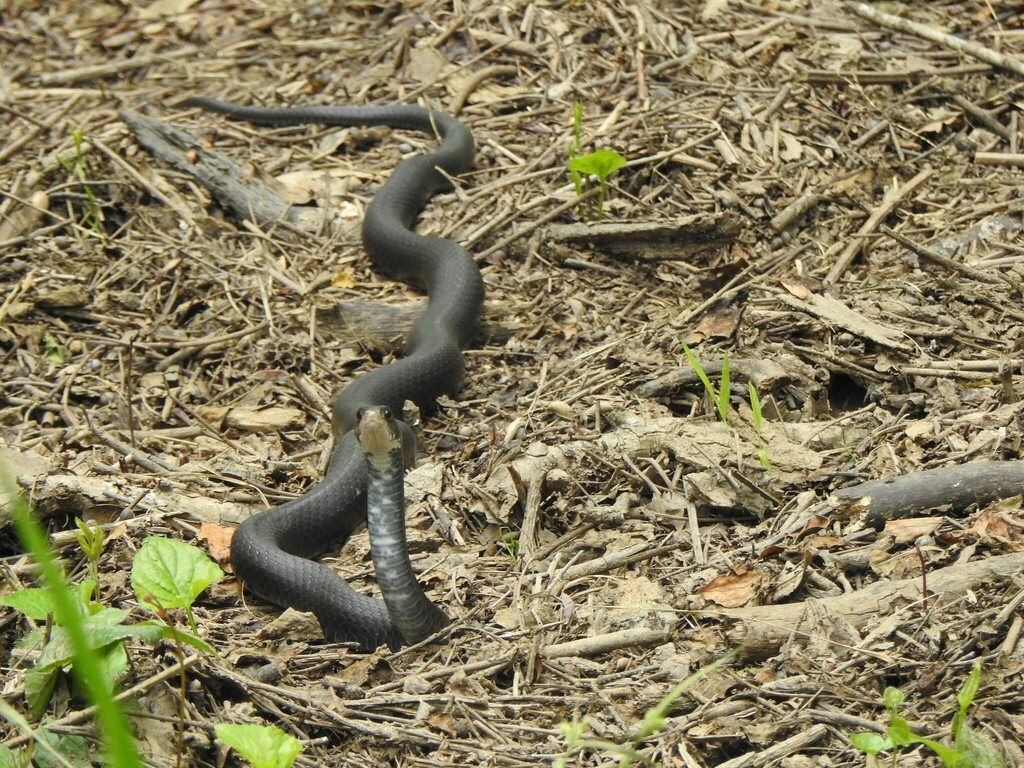
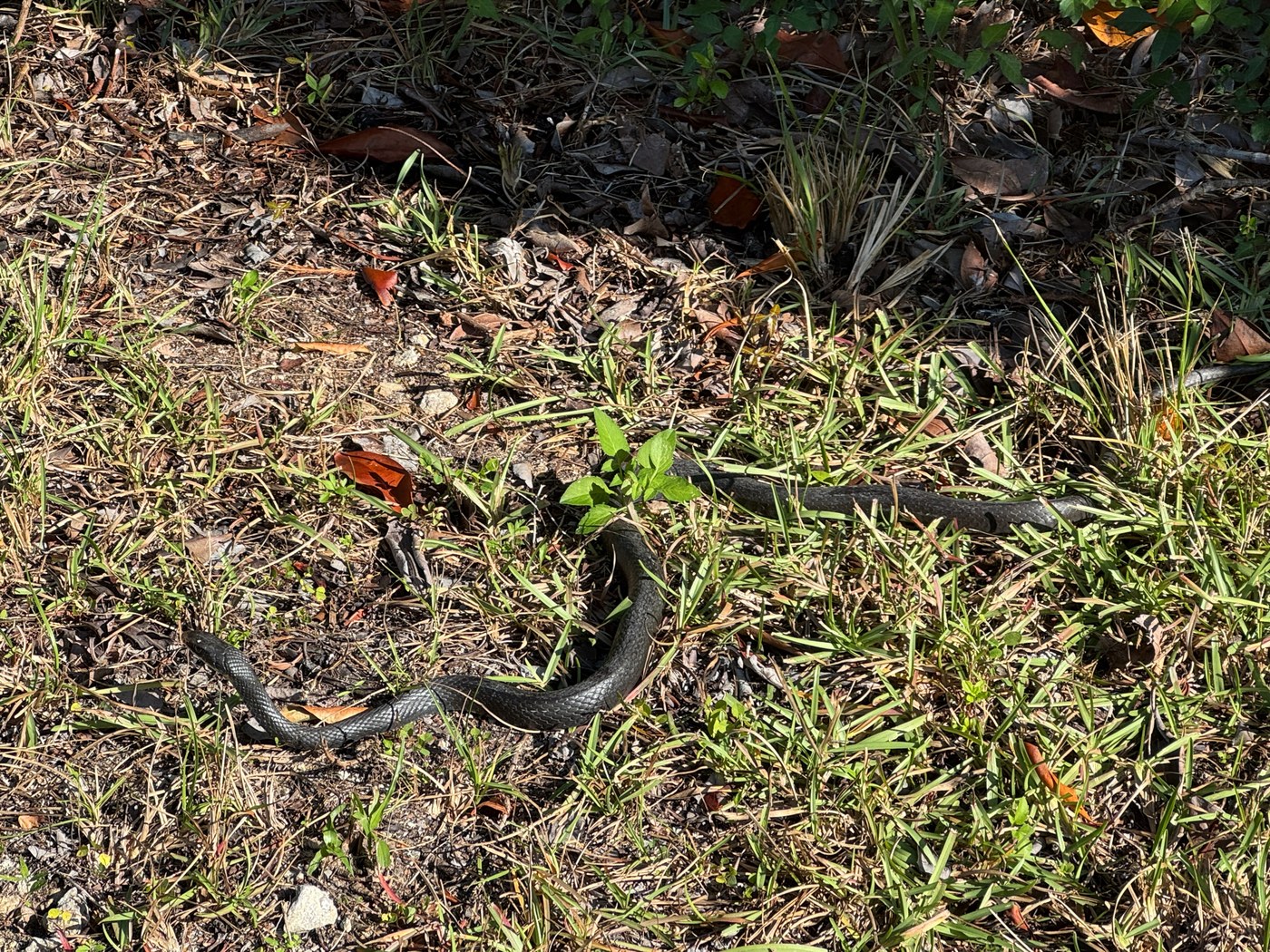
That is the starting point. An adult racer is one uniform color above with no pattern at all: glossy black, tan, olive, brown, gray, or blue, over a lighter white, cream, yellow, or pale blue-gray belly. The scales are smooth rather than keeled, meaning no raised ridge down the center of each scale, which gives the animal a satiny and sometimes iridescent sheen instead of a dull matte texture. Trying to match by color alone will not work across this range, because the color varies by region. Match the combination of solid color, smooth scales, and build.
Slender build, long tail, big eyes
The build is slender with a proportionately long tail, and the eyes are large and round. Round pupils matter on their own, because venomous pit vipers have vertical elliptical pupils instead. Adults typically run 23 to 60 inches depending on region, with occasional individuals well beyond that.
Periscoping is a good tell
Periscoping is the behavioral tell, and it is a good one. Racers raise the head well above grass or low vegetation to visually scan the area around them. It is a hunting posture from a visual, active-pursuit predator, and it is distinctive enough that regional herpetologists use it as a field identifier. Most snakes do not do this. If you see a snake holding its head up like a periscope over a lawn or field edge, that is a strong hint.
Juveniles look like another animal
Juveniles look like a different animal entirely, and one detail resolves it. Young racers carry a row of dark reddish-brown to gray blotches down the middle of the back on a lighter ground color, with speckling on the sides and belly, and that pattern fades out by about the third season. The giveaway is the tail: it stays uniformly colored even on a heavily blotched juvenile. A patterned body with a plain tail on a slender, small snake points at a young racer.
Against black ratsnake, count scales
Black ratsnake is the look-alike that matters most, and scales settle it. A black ratsnake has keeled scales, a raised ridge down the center of each one, giving a duller and less glossy look than a racer's smooth, satiny finish. Ratsnakes also typically show white flecking on the back and a strongly patterned white-and-black belly and chin, while an adult racer is uniform above and below apart from a lighter throat. Both animals are harmless, so getting this one wrong carries no risk beyond the naming.
Coachwhips, given away by the tail
Coachwhips are a different genus, and the tail gives them away. A coachwhip has a distinctive braided-looking tail pattern of alternating light and dark bands, which is where the name comes from, and racers have nothing like it. Coachwhips also tend to be larger and more heavily built toward the tail. Despite the shared reputation for speed, these are separate animals rather than regional versions of the same one.
The confusion with real stakes
The one confusion that carries real stakes is a juvenile racer against a pygmy rattlesnake. Both show a row of blotches down the middle of the back at that size, but the pygmy rattlesnake is venomous and the differences are not subtle once you know them. A juvenile racer is slender with a narrow head. A pygmy rattlesnake is much thicker-bodied with a blocky head, carries a dark cheek band running from the eye back to the jaw, and has a rattle if you can see the tail. The cheek band and the heavy build are the tells. If you cannot make that call confidently from a safe distance, do not handle the snake and get an identification from someone who can.
Four names, one snake
Black racer, blue racer, yellow-bellied racer, and North American racer are all this same snake. They are regional and subspecies names for one species. There is no separate animal to go look up under any of them.
Signs of Infestation
Seeing it is the sign
Seeing the snake is the sign, and usually the only one. There is no damage pattern to find with this species. No gnawing, no burrowing into structures, no droppings to identify, no chewed wiring. What you get is a direct sighting: a fast-moving, solid-colored snake crossing open grass, working a garden bed or brush pile, or basking on a driveway or walkway in daylight. Shed skins turn up occasionally in cover areas.
Daylight is part of the identification
Racers are active during the day and not at night. A fast snake in the open at midday fits this species. Something moving around a property after dark is a different animal.
A dry rattle that is not a rattler
A dry rattling sound that is not a rattlesnake, and the important caveat. A cornered or disturbed racer will sometimes vibrate its tail against dry leaves, and the noise it produces is easy to mistake for a rattle. The snake has no rattle at all and is harmless. That said, this is not a reason to walk toward a buzzing sound in rattlesnake country. Treat the sound as a reason to stop and look from a distance, not as something you have already identified.
A strong, foul musk, but only after contact
Racers release musk when they are captured or handled, not as a background odor around a property. A sudden sharp smell on your hands or on a dog that just grabbed something is a sign of recent contact with a snake, not a sign that snakes are living nearby.
Nothing to hear inside a structure
Racers do not nest indoors. If you are hearing activity in a wall, an attic, or a ceiling, this animal is not the cause.
Prevention and When to Call a Pro
The default is to leave it alone
That is a practical recommendation rather than a sentimental one. Racers are non-venomous and harmless to people and pets, and they are a genuine check on rodents. They also eat other snakes, including venomous species in some regions. Most encounters need no response at all: the snake is passing through and will move on. Removing racers from a property works against the outcome most homeowners actually want.
Take away the cover
If you want fewer encounters, take away the cover and the open hunting ground near the house. Keep grass mowed short, clear brush piles, get woodpiles up off bare ground and away from the foundation, and thin dense ground-level vegetation against the walls of the house. Racers hunt open ground and shelter in the mess at its edges, so this is the single most effective thing a homeowner can do.
Seal the ground-level gaps
Seal ground-level gaps at crawl spaces, sheds, garages, and outbuildings. This matters more here than it might seem, because racers overwinter in rock crevices, rotting stumps, and human structures including stone walls, building foundations, abandoned wells, and cisterns. Standard exclusion work at ground level is what keeps a snake from settling in against or under a building.
Manage rodents, with a tradeoff
Manage rodents around the property, but do it with the tradeoff in view. Fewer rodents means less reason for a racer to hunt near a structure. It is worth saying plainly that racers are themselves a natural rodent control, so wiping out the snake is not the goal and would be counterproductive.
Expect a defense if you corner one
Expect a vigorous defense if you corner one, and plan around it by not doing that. A racer that has room to flee will flee, and it is fast. A racer that is cornered, restrained, or picked up will bite repeatedly and hard, thrash violently, defecate on whoever is holding it, release a strong musk, and sometimes buzz its tail. None of that is medically significant. The bites are simple non-venomous punctures from a defensive strike, not a health risk. The behavior is dramatic enough to alarm people who expected a docile snake, which is exactly why it is worth knowing in advance. The way to avoid all of it is to not pick the animal up.
Check your state rule first
Trapping and relocation rules are set at the state level, so check before you act. Regulations covering the trapping or relocation of native wildlife vary from state to state and they change. Verify your own state and local wildlife regulations before trapping or relocating any snake. The safer default is a licensed nuisance wildlife control operator rather than buying a trap and handling it yourself.
When to Call a Wildlife Control Operator
Two situations. First, if a racer has actually established itself inside a structure, in a crawl space, garage, or wall void, rather than simply moving through the yard. Second, if you are not confident about what you are looking at, particularly a small blotched snake that could be a juvenile racer or could be a pygmy rattlesnake. In both cases a licensed nuisance wildlife control operator is the right call, and in the identification case that call is about closing the question rather than about the racer being a threat.
Frequently Asked Questions
Is a black racer or eastern racer venomous?
No. Eastern racers are completely non-venomous and harmless to people and pets. A bite from one is a simple defensive puncture wound with no venom involved, not a health risk. They will bite hard and repeatedly if cornered or handled, which surprises people, but the biting is a bluff-and-fight response rather than anything medically significant.
Are black racer and North American racer the same snake?
Yes. Black racer, northern black racer, southern black racer, eastern racer, blue racer, yellow-bellied racer, and North American racer are all common names for one single species, Coluber constrictor. Which name you hear depends on the region and the local subspecies. The University of Florida IFAS Extension describes black racers as a group of closely related subspecies ranging across the eastern half of the United States, and Missouri's state wildlife agency lists several of these names on one species page.
Why does this snake vibrate its tail like a rattlesnake?
It is a bluff. A cornered racer will sometimes vibrate its tail against dry leaves, and the sound that produces can pass for a rattle. The snake has no rattle and no venom. Do not take this as a reason to approach a buzzing sound, though. If you are in rattlesnake country, stop and look from a safe distance rather than assuming the sound is harmless.
What is the difference between a black racer and a black rat snake?
Look at the scales and the belly. A racer has smooth scales with a glossy, satiny sheen and is a uniform color above and below apart from a lighter throat. A black ratsnake has keeled scales, meaning each scale carries a raised ridge, giving a duller look, and it typically shows white flecking on the back and a strongly patterned white-and-black belly and chin. Both are harmless.
Do racers really eat other snakes?
Yes. Racers are genuine dietary generalists, broader than most non-venomous snakes. They are documented eating small rodents and other mammals up to small cottontail rabbits, frogs, toads, small turtles, lizards, birds' eggs, nestling and small adult birds, and other snakes, including venomous species in some regions. Juveniles also take soft-bodied insects and other small invertebrates.
Does a racer constrict its prey, like the name says?
No, and this is one of the more misleading names in North American snakes. Despite constrictor appearing in the scientific name, racers do not constrict. They run prey down with speed, seize it in the jaws, and either swallow it alive or, with something larger, pin it against the ground and chew until it is subdued. Multiple sources make this correction independently.
I found a small blotched snake. Is it a baby racer or a rattlesnake?
It could be either, so check the build and the head before you get close. A juvenile racer is slender with a narrow head, carries a row of dark blotches down the middle of the back that fades out by about its third season, and has a plain, uniformly colored tail even when the body is heavily patterned. A pygmy rattlesnake is venomous, much thicker-bodied, has a blocky head, and carries a dark cheek band running from the eye back to the jaw, plus a rattle. If you cannot make that call confidently from a distance, do not handle the snake and get an identification.
Will a racer get into my house?
It will not nest indoors and it causes no structural damage of any kind. There is a real reason to seal ground level anyway. Racers overwinter in rock crevices, rotting stumps, mammal burrows, and human structures including stone walls, building foundations, abandoned wells, and cisterns, so closing gaps at crawl spaces, sheds, garages, and outbuildings keeps one from settling in against the building. If a racer has actually taken up residence inside a structure rather than passing through the yard, call a licensed nuisance wildlife control operator.
Should I remove a racer from my yard?
There is usually no reason to. Racers are harmless and they are a real check on rodents, and they eat other snakes as well. If you simply want to see fewer of them, change the habitat instead: keep grass mowed short, clear brush piles, move woodpiles off bare ground and away from the house, and thin dense ground-level vegetation along the foundation. If you do want a snake physically removed, check your state and local wildlife regulations first, because trapping and relocation rules vary by state and change, and use a licensed nuisance wildlife control operator rather than a do-it-yourself trap.
Sources
- "Black Snakes": Identification and Ecology (WEC214/UW251): southern black racer identification, smooth versus keeled scales, look-alike species including juvenile pygmy rattlesnake, Southeast range, diet, and defensive behavior University of Florida IFAS Extension
- Eastern Yellow-Bellied Racer and Southern Black Racer: alternate common names, size and color, life cycle and clutch size, seasonal activity, overwintering sites, diet and the non-constricting feeding method, and similar species Missouri Department of Conservation
- North American Racer: Montana range for the eastern yellow-bellied racer and the documented fringe and pocket presence in California, Nevada, Arizona, and New Mexico Montana Field Guide, Montana Natural Heritage Program and Montana Fish, Wildlife and Parks
- Northern Black Racer: smooth scales, active foraging with the forepart of the body raised off the ground scanning for prey, diet including other snakes, birds, and small mammals, and defensive biting behavior Virginia Herpetological Society
Image Credits
- Image: benholloway via iNaturalist. CC BY-SA 4.0. This resized copy is offered under the same license.
- Image: Jill DeVito, PhD via GBIF. CC0 1.0.