Seasonal Timeline
Most active at dawn and dusk, willing to bite after dark. The western species overwinters as an adult and can wake for a blood meal during a warm spell as early as January or February, well before the season most people associate with mosquitoes.
Most active at dawn and dusk, willing to bite after dark. The western species overwinters as an adult and can wake for a blood meal during…
This genus splits by species. In the West, Anopheles freeborni has a documented peak and a documented winter-dormancy pattern. In the East, Midwest and South Central, Anopheles quadrimaculatus is active spring through as late as November, but no published seasonal calendar for it is as clear as the one for its western relative. No region-by-region seasonal breakdown was found for the genus.
Where They're Found
A malaria-competent Anopheles species is established in every region of the country, just not the same one everywhere. Anopheles quadrimaculatus, the common malaria mosquito, covers the East, Midwest, South Central and Southeast, historically the most important malaria vector in the eastern United States, with the highest density in the Southeast. Anopheles freeborni, the western malaria mosquito, covers California, the Pacific Northwest, the Mountain West and the Southwest, and was the primary vector in California's historical malaria epidemics.
Life Cycle
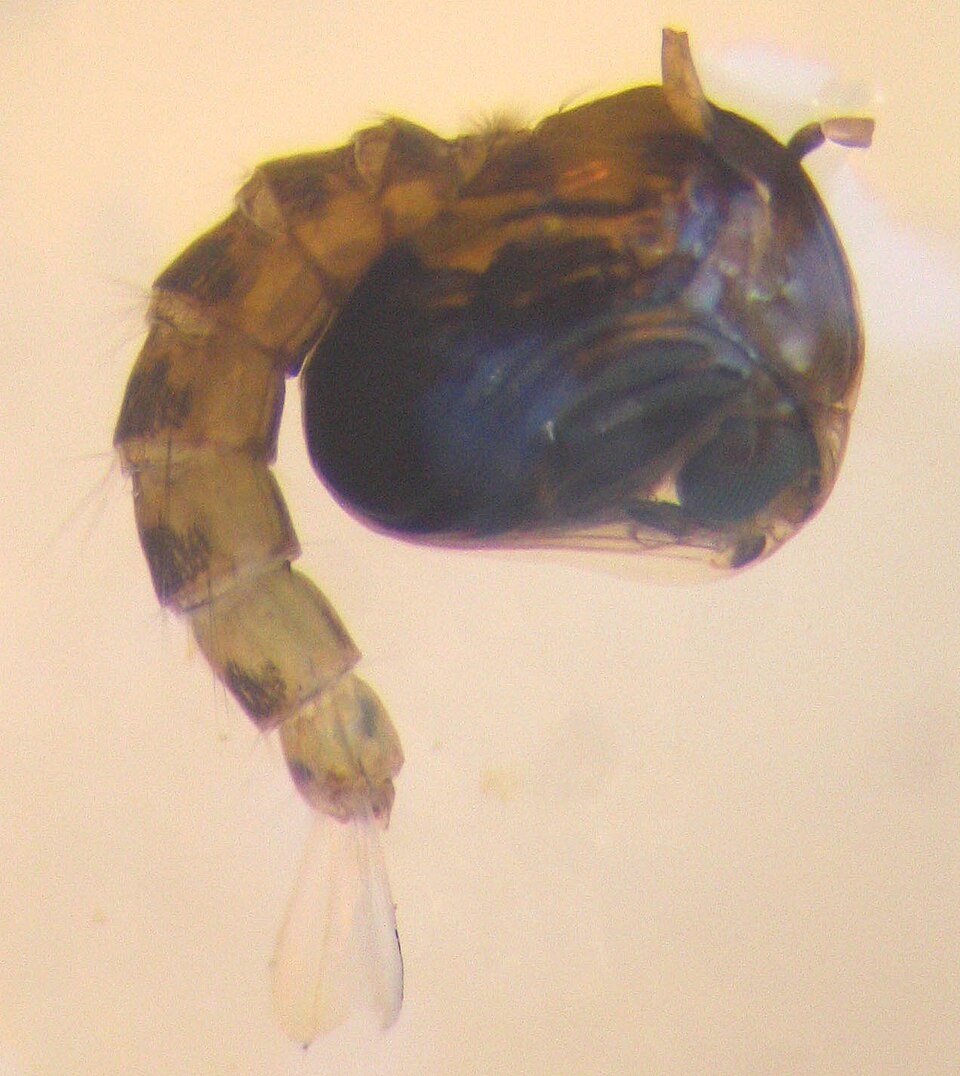
Egg to adult runs about two to four weeks depending on temperature, on the slower end for a mosquito. The one detail worth remembering: below about 54 degrees Fahrenheit, larvae simply sink and go dormant rather than dying, so a cold snap can look like a solved problem when it is actually a paused one.

Egg
Larva
Pupa2
Adult3
Identification
The resting angle
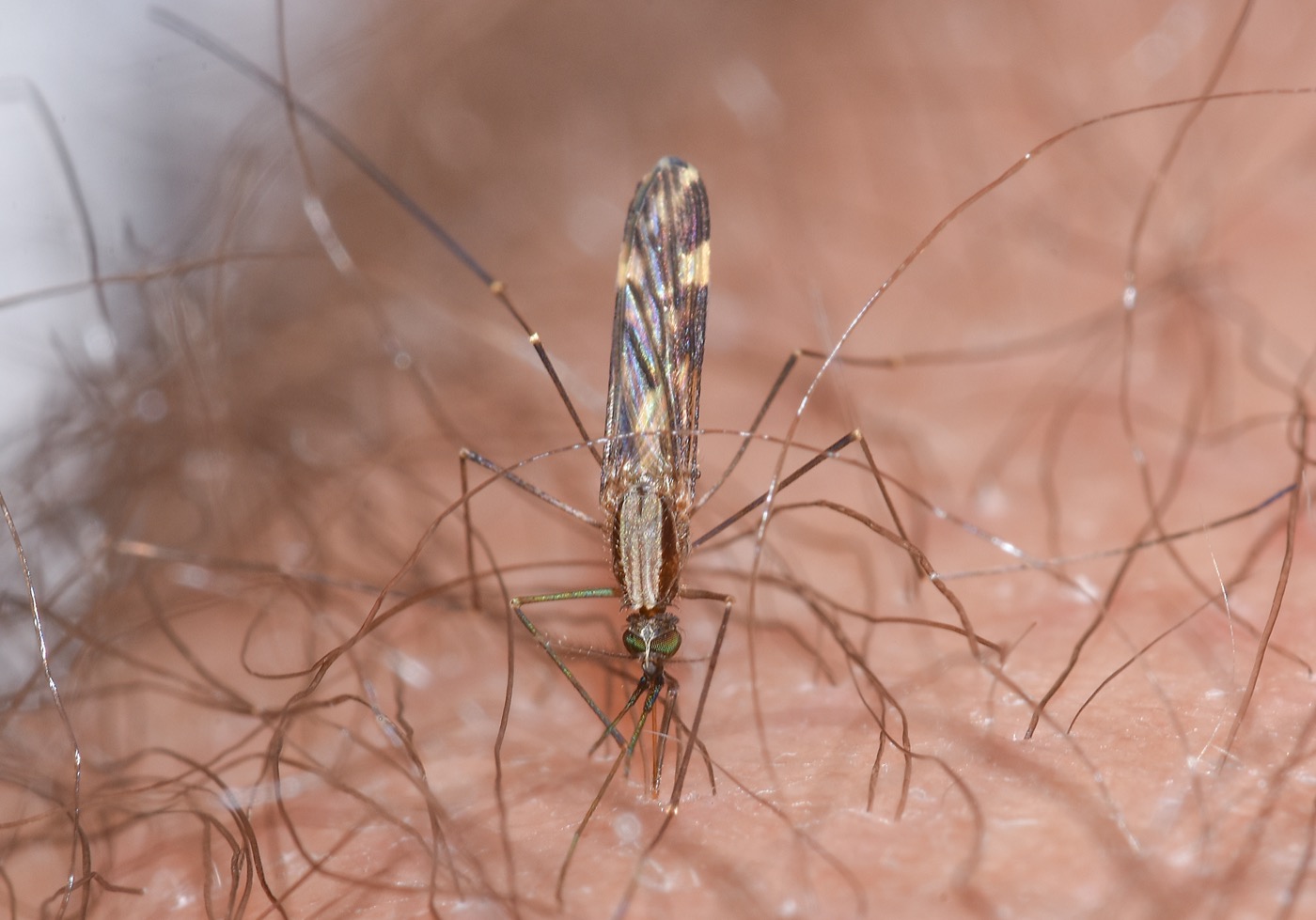
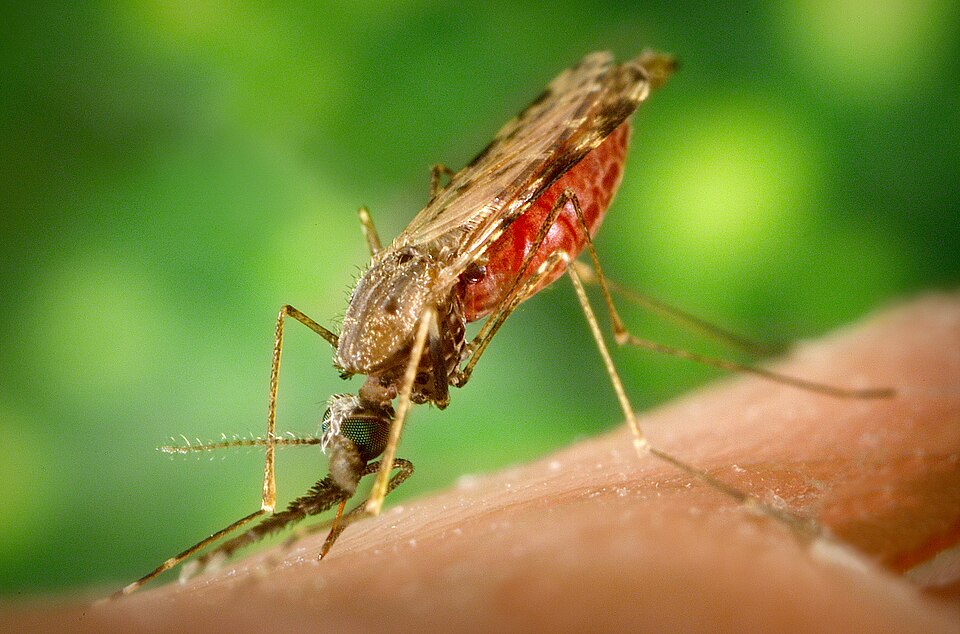
It is the strongest field mark any of the three mosquito genera has. Most mosquitoes hold the body roughly parallel to the surface. Anopheles instead rests at a steep, distinct angle, head down and abdomen pointed up and away, proboscis, head and body in a straight line.
Two named species matter
Anopheles quadrimaculatus, the common malaria mosquito, actually a group of at least five sibling species that cannot be told apart by eye, is a medium brown mosquito with dark abdominal markings and, on the wings, four small dark spots that give the species its name. Anopheles freeborni, the western malaria mosquito, is lighter brown overall.
Unusually long palps
Both carry unusually long palps, nearly as long as the proboscis itself, longer than the short palps on Culex or Aedes.
The larvae lie flat
In the water, the larvae confirm the genus with a matching tell: no rear breathing tube. They lie flat under the surface film instead of hanging at an angle the way Culex and Aedes larvae do.
No leg banding on either
Neither species shows the light-and-dark leg banding used to key out Culex or Aedes. That identification path simply does not apply to this genus.
Signs of Infestation
Look at clean water, not containers
Pond and marsh edges with emergent vegetation, slow-moving or stagnant irrigation ditches, rice-field margins, algae-covered pools, and grassy roadside ditches are where this genus breeds, not buckets or gutters.
Adults resting at an angle
Head down is the posture to look for.
When they bite
Dawn, dusk and after-dark biting is the pattern to watch for, consistent with both named US species.
A warm-spell burst in the West
In the West specifically, watch for a burst of biting activity during an unseasonably warm spell in January or February. That is overwintering Anopheles freeborni adults waking up for an early blood meal, not a sign of a new infestation.
Prevention and When to Call a Pro
Cut the vegetation and algae
Reduce vegetation and algae where larvae concentrate, in a pond, ditch or slow-moving water feature on the property. This genus's larvae favor clean, vegetated, often sunlit water, so clearing algal mats and dense emergent plants is a real control lever here in a way it is not for container-breeding species.
This is not a container job
This is not a container-dumping job. A homeowner near agricultural irrigation, a pond, or a marsh cannot simply drain the source the way they can a bucket, which makes this genus more of a call-a-professional-or-district situation than the other two.
Bti still applies to the larvae
Bti still applies to the larval stage the same way it does for Culex and Aedes, since Anopheles larvae feed on suspended algae and organic matter and the mechanism is the same stomach-poison action.
Screens, timing and repellents
Screens, timing around dawn and dusk, and standard repellents (DEET, picaridin, oil of lemon eucalyptus) apply here without any genus-specific change.
Call your vector control district
Call your county mosquito and vector control district for a water source you cannot personally drain: a pond edge, an irrigation ditch, or a neighboring field. Larval surveillance on shared water is their job, not a homeowner's.
Frequently Asked Questions
Do we still have malaria mosquitoes in the US?
Yes. The malaria-carrying genus, Anopheles, is present across the country, but endemic malaria transmission was eliminated in the early 1950s. Locally acquired cases are rare and occasional. The most recent was a 2023 outbreak of 10 cases across four states, the first in 20 years.
How can I tell if a mosquito is a malaria mosquito?
The clearest sign is how it rests. Anopheles mosquitoes hold their body at a steep angle, head down and abdomen up, while most other mosquitoes rest roughly parallel to the surface.
Where do malaria mosquitoes breed?
Unlike the container-breeding mosquitoes behind Zika and dengue, Anopheles larvae prefer clean, vegetated, often sunlit standing water: pond and marsh edges, irrigation ditches, and slow streams, not buckets or gutters.
Are malaria mosquitoes the same as the ones that spread West Nile virus?
No. Culex mosquitoes are the primary US West Nile vector. Whether Anopheles plays any real role in West Nile transmission is disputed between sources, and it is not considered a significant vector for that disease.
How far do malaria mosquitoes travel from where they hatch?
It depends on the species. The eastern Anopheles quadrimaculatus generally stays within about a mile of its breeding site, while the western Anopheles freeborni has been recorded dispersing up to 10 miles.
Sources
- Common Malaria Mosquito, Anopheles quadrimaculatus Say University of Florida IFAS Extension, EENY-491/IN791
- Anopheles quadrimaculatus, North American Malaria Mosquito LSU AgCenter, Publication P4013
- Life Cycle of Anopheles Mosquitoes Centers for Disease Control and Prevention
- CDC Operational Guidance for Investigating Locally Acquired Mosquito-Transmitted Malaria, United States, 2026 Centers for Disease Control and Prevention, MMWR Recommendations and Reports 75(1)
- Guide to Important Mosquitoes in California California Department of Public Health, Vector-Borne Disease Section
- Mosquitoes, AZ1221 University of Arizona Cooperative Extension, College of Agriculture and Life Sciences
Image Credits
- Image: NPMA. Used under NPMA member image license.
- Image: Steffen Dietzel, via Wikimedia Commons. Public domain.
- Image: James Gathany, CDC, Public Health Image Library, via Wikimedia Commons. Public domain.