Seasonal Timeline
These months are a swarm calendar, not an activity calendar. Feeding and foraging continue year round in California. Intensity still rises and falls with temperature and moisture, so it is not flat across the year, but it never stops. What happens once a year is the dispersal flight, and for this species that flight is tied to autumn rain, not spring warmth.
These months are a swarm calendar, not an activity calendar. Feeding and foraging continue year round in California. Intensity still rises…
This is the opposite trigger from the eastern species, and it is well corroborated. University of California Agriculture and Natural Resources states plainly that western subterranean termites produce reproductive swarms during calm sunny periods immediately following the first autumn rains, and that mature colonies across a broad region, especially the San Francisco Bay Area and parts of the Sacramento Valley, can swarm simultaneously en masse. A secondary spring flight also happens, mainly in southern California, the Sierra Nevada foothills, and the northern Sacramento Valley. So fall is the primary event and spring is the real but smaller second window. One nuance. UC's own general pest notes for California subterranean termites separately call a warm, sunny day after rain in spring the optimal swarming time. Read alone, that line could be mistaken for putting spring first. Read next to the species-specific source, the correct picture is fall as the dominant, most dramatic event for this species and spring as secondary, not the reverse. Both species need the same two ingredients, sun and recent rain. They are just keyed to opposite ends of the year. And as with the eastern species, the quiet months are not dormancy. Foraging continues year round in California, described as high but erratic through summer, especially after any rain.
Where They're Found
California and the Pacific Northwest, which matches this species' documented range well. The authoritative range statement places Reticulitermes hesperus along the entire Pacific Coast from southern California to British Columbia. One field identification sheet from the Los Angeles County Department of Agricultural Commissioner extends that range further inland, listing Idaho and Nevada alongside California, Oregon and Washington. That inland extension is a real, source-backed addition beyond those two core regions, but it comes from a single source, so treat California and the Pacific Northwest as the confirmed core and the Idaho and Nevada fringe as a secondary, less certain edge of the range. Oregon and Washington carry a split that matters. Oregon State University Extension notes that the western subterranean termite is more common east of the Cascade Mountains, while the Pacific dampwood termite, a much larger species with no soil requirement, dominates structural damage in the wetter areas west of the Cascades. That distinction does not change which region this pest belongs to, but it matters for which termite is actually eating a given house.
Life Cycle
This is a caste system, not a straightforward life cycle. Like all termites, this species goes through incomplete metamorphosis, so there is no pupal stage. Eggs hatch into an undifferentiated immature that sources still call a larva despite the lack of true larval metamorphosis. From there, individuals branch into workers, soldiers, or nymphs, and only the nymph path leads toward winged alates. Other individuals, called supplementary or neotenic reproductives, can step in to replace a king or queen that dies, keeping the colony going. Founding colonies grow slowly. At the end of its first year, a new colony may have grown to only about 75 individuals, and very few of the pairs that fly each year ever successfully found a colony that survives to maturity. A mature colony, by contrast, can run into the hundreds of thousands of individuals, and a single home's footprint can sit above several separate colonies at once. Once established, a queen can lay eggs at a rate the sources describe as sometimes thousands in a single day. Kings and queens can live a decade or more, while individual workers live one to several years. One more thing: recent genetic work has found that what gets called the western subterranean termite is technically a species complex, a group of several genetically distinct lineages rather than one uniform organism, some of which have not yet been formally named. It is a research detail more than a field-identification one.

Egg
Worker
Soldier
Swarmer
Mud Tube
Damage
Identification
Almost impossible to tell apart
The honest headline: this species and the eastern subterranean termite are almost impossible to tell apart by looks. Same genus, same caste appearance, same general size range. A size or color difference between the two species circulates on some websites, but it does not trace back to any university extension or federal source. If you need to know which one you have, the answer is range and swarm season, not what it looks like under a hand lens.
Wing venation names the genus
Wing venation is the tell that matters, and it separates this genus from other termites, not this species from its eastern cousin. Alate wings are brownish-gray with only a few hairs, and two dark, heavily sclerotized veins run along the base of the wing. That sparse-to-hairless wing surface is the same check used to rule out the Formosan subterranean termite, whose alate wings are covered in fine hairs.
Soldier head shape
It is the other genus-level tell. A rectangular, narrow, pale to light-brown head with no eyes and long, curved, toothless mandibles marks this as a Reticulitermes soldier, as opposed to the oval-headed soldier of a Formosan colony. A small gland opening called a fontanelle sits on the head of soldiers and alates, though it may be indistinct.
Sizes, for reference
Alates run about 0.38 to 0.4 inch (around 10 mm) including wings, workers about 0.18 inch (roughly 4.5 mm) and are often compared to a grain of rice, and no published source gives a soldier body length.
Termite or flying ant
Check the waist first: a termite is the same width end to end, an ant has an obvious pinch. Then the wings: a termite's four wings are all the same length and shape, an ant's front pair is noticeably longer. Then the antennae: straight and beaded on a termite, elbowed on an ant. California's own extension program frames this exact question, termite or ant, as one of the most common calls homeowners make.
Pacific dampwood termite
It is a very different-looking insect sharing the same region. Its reproductives can exceed an inch long including wings, roughly two and a half to three times the length of a western subterranean termite alate, and it needs no soil connection at all, infesting wet or damp wood directly. It is described as the largest termite species found in the Pacific Northwest.
Drywood termites in California
Drywood termites are a real possibility in California, less so in the Pacific Northwest. In California, drywood termites are most common in the south but also occur along the coast and in the Central Valley, and in the Pacific Northwest there is no evidence the species has become established. Either way, the distinguishing test is the same one used for other subterranean-versus-drywood comparisons: soil tube presence and the shape of any droppings, since drywood termites need no soil contact and nest directly in dry wood.
Two other genera, other schedules
Two other subterranean genera turn up in parts of this range and swarm on a different schedule entirely. Heterotermes aureus, the most destructive subterranean termite in the Sonoran Desert portion of southeastern California, flies in the early evening and is drawn to light. The Formosan subterranean termite, established in a small area near San Diego, also swarms at dusk under lights and has the hairy-winged tell noted above. A native relative, Reticulitermes tibialis, overlaps this species' range in parts of Nevada and Idaho, but no published source gives a specific field tell separating the two, so the two cannot reliably be told apart by eye.
Termites are social cockroaches
A true thing worth knowing: termites are taxonomically social cockroaches. They sit in the order Blattodea alongside cockroaches under current taxonomy, though some sources still use the older name Isoptera. It is the same reclassification that applies to every termite, not something specific to this species.
Signs of Infestation
Swarms of winged reproductives
Primarily in fall, after the first soaking rain. A swarm overhead does not automatically mean a house is infested, but winged termites emerging directly from the ground or from wood at the property is clear evidence of a mature colony nearby.
Shelter tubes
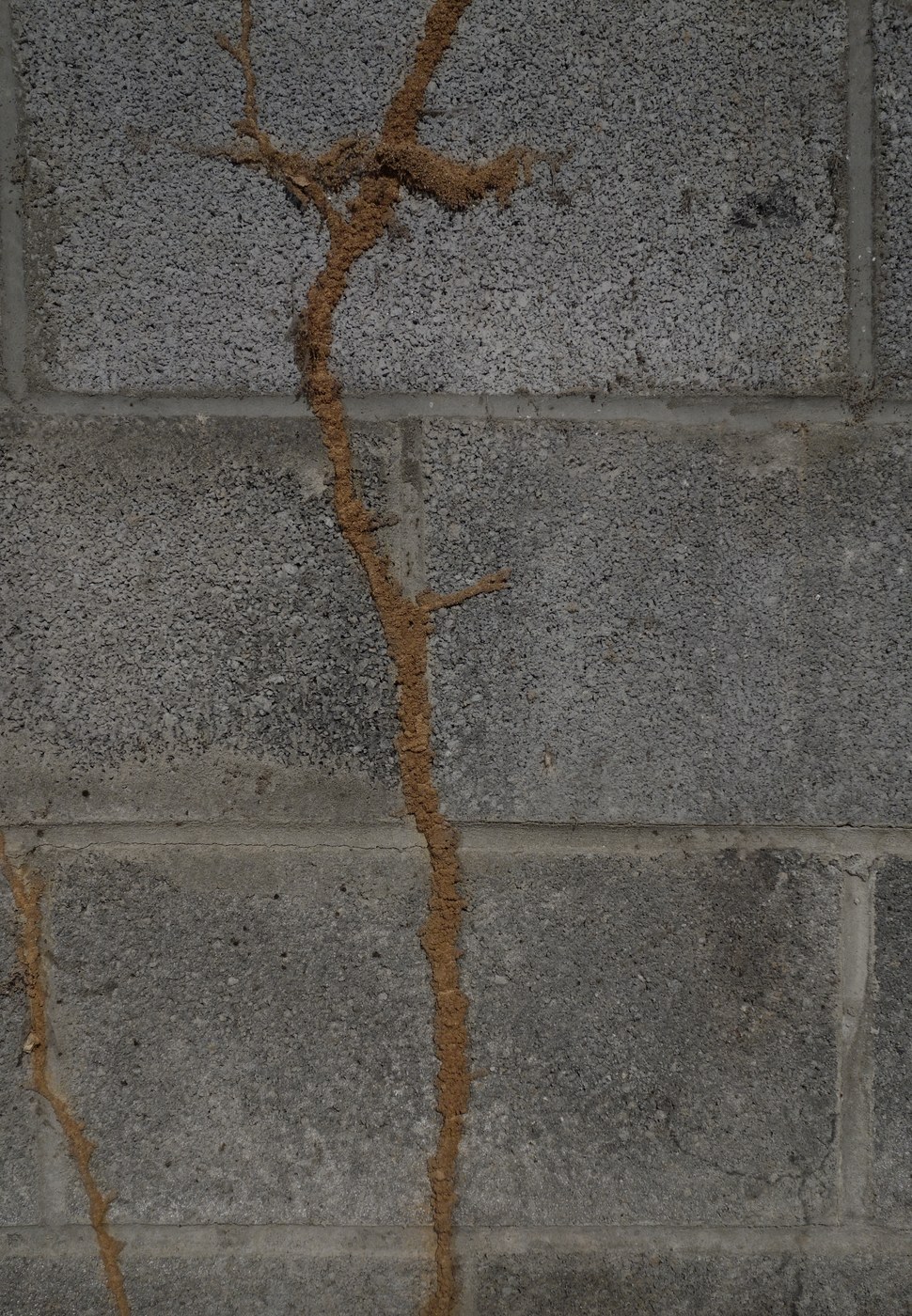
Shelter tubes, the most commonly seen evidence of an infestation. Built from saliva mixed with soil and bits of wood, and sometimes constructed right over a concrete foundation to bridge from soil to wood. Researchers describe four distinct types: working tubes connecting soil to wood, exploratory or migratory tubes that never reach wood, drop tubes running from wood back to soil, and swarm tubes built for reproductives to emerge from.
Darkening or blistering wood
Darkening or blistering of structural wood, typically thin at the surface and easily punctured with a knife or screwdriver, with the outer shell often left looking intact.
Workers visible in a broken tube
Live workers and soldiers visible if a tube is broken open.
Damage that follows the grain
Damage that follows the wood grain, hollowing the softer springwood and leaving the harder summerwood, a pattern distinctive enough on its own to positively identify subterranean termite activity rather than some other cause.
No reliable sound and no smell
No published source attributes any audible or odor-based sign to this species.
Prevention and When to Call a Pro
Keep a 12-inch barrier
Use smooth concrete, coarse sand, or other inorganic material between the soil surface and any structural wood under a building.
Ventilate and dry the substructure
Keep substructures ventilated and dry. Moisture is what draws this species into wood in the first place.
Remove wood piles and scrap
Remove wood piles, untreated fence posts, and buried scrap wood near the structure. They function as food and as a bridge for a colony even before it reaches the house.
Repair cracks and leaks at once
Repair foundation cracks, plumbing leaks, faulty grades, and exterior wood defects immediately. These are the entry points that let termites bypass any barrier that has been put in place.
Use resistant wood or footers
Use termite-resistant wood or concrete footers for any structural element that has to touch soil, and finish exterior wood with sealants or paint.
Watch stucco that runs to grade
Watch stucco siding that runs down to the ground. It can let termites travel unseen between the stucco and the foundation, a detail worth paying particular attention to in California.
Call for a tube or a swarm
Call a professional if a shelter tube shows up on an interior or exterior wall, or if thousands of flying insects suddenly appear in a bathroom or kitchen. Those are the two moments most homeowners actually notice a problem.
Inspect every three to five years
A standing inspection every three to five years is the baseline recommendation, regardless of whether anything looks wrong, especially for a home with any prior termite history.
This is not a DIY pest
This is not a do-it-yourself pest. Retail termite pesticides are not effective against an established colony, and in California all of the products that actually work are restricted to professional, licensed use.
No need to panic over a swarm
There is no need to panic over a swarm. A colony takes roughly a year to grow to only about 75 individuals and years more to mature, so an active infestation represents years of unseen growth rather than a sudden event. Note the exact location of any swarm for an inspector instead of rushing a decision.
Frequently Asked Questions
Are western subterranean termites the same as the termites found on the East Coast?
No, but they are close relatives. Both belong to the genus Reticulitermes and share the same general biology, caste system, and damage mechanism. Reticulitermes hesperus covers the Pacific Coast from southern California to British Columbia, while Reticulitermes flavipes covers the eastern half of North America. The one real, well-documented difference between them is swarm timing: the western species flies mainly in fall, right after the season's first rain, while the eastern species flies mainly in spring.
When do western subterranean termites swarm in California?
Primarily in the fall, on calm sunny days immediately after the first autumn rains, with mature colonies across the San Francisco Bay Area and parts of the Sacramento Valley sometimes swarming simultaneously in large numbers. A secondary, smaller spring flight also happens in parts of southern California, the Sierra Nevada foothills, and the northern Sacramento Valley.
If I see a termite swarm in my yard, does that mean my house is infested?
Not necessarily. A swarm overhead means colonies are active somewhere nearby, but only winged termites emerging directly from the ground or from wood at your own property confirms a mature colony is actually there. The right move is to note or photograph exactly where you saw it and pass that along to an inspector, not to panic.
How can I tell a termite swarmer from a flying ant?
Check the waist, wings, and antennae. Termites have a broad, uniform waist with no pinch, four wings of equal length, and straight, beaded antennae. Ants have a pinched waist, an unequal front and hind wing pair, and elbowed antennae.
Is a western subterranean termite really a different species from the eastern one, or basically the same bug?
Genetically they are different species in the same genus, but visually and behaviorally they are close enough that no reliable size or color difference between the two has been documented. The real differences are geographic (Pacific Coast versus the eastern half of the country) and seasonal (fall swarms versus spring swarms).
Are western subterranean termites dangerous to people or pets?
No. No published source documents any bite, sting, or disease risk from this species. The entire risk is structural damage to wood.
How big does a colony get, and how fast?
Slowly at first. A new colony may grow to only about 75 individuals by the end of its first year, and very few of the pairs that fly each year ever succeed in founding a colony that survives to maturity. A mature colony can reach hundreds of thousands of individuals, and a single home's footprint can sit above more than one colony at once.
Can I treat a termite problem myself?
Realistically, no. Do-it-yourself termite pesticides are not effective against an established colony, and in California the products that actually work are restricted to licensed professional use.
Do western subterranean termites do anything useful, or are they purely a pest?
In the wild, yes. Outside of structures, termites break down woody debris, return nutrients to the soil, and feed a range of predators, and their tunneling helps keep soil porous and healthy for plant growth. Western subterranean termites are native to California and were established there long before wooden structures were built on top of their colonies. The problem is entirely about where the colony happens to be foraging, not about the insect itself.
Sources
- Pest Notes: Subterranean and Other Termites, UC ANR Publication 7415 University of California Statewide Integrated Pest Management Program (UC IPM)
- Wood-infesting pests, Termite Pacific Northwest Pest Management Handbooks, Oregon State University Extension Service
- Native Subterranean Termites: Reticulitermes flavipes, R. virginicus, R. hageni, EENY-212 University of Florida IFAS Extension, Entomology and Nematology
- Western Subterranean Termite (Reticulitermes hesperus) field identification sheet Los Angeles County Department of Agricultural Commissioner/Weights & Measures
- Swarming Termites Looking for Love, Pests in the Urban Landscape blog University of California Agriculture and Natural Resources (UC ANR)
- Structural Termite Program Washington State University Entomology Extension
Image Credits
- Image: Adobe Stock, licensed.