Seasonal Timeline
The window below is a swarm calendar, not an activity calendar. A Formosan colony feeds continuously, day and night, year round, and does not pause outside these months. What you actually see once a year is the dispersal flight, and unlike the eastern subterranean termite, this species swarms at dusk instead of during the day.
The window below is a swarm calendar, not an activity calendar. A Formosan colony feeds continuously, day and night, year round, and does…
Watch the evening, not the afternoon. LSU AgCenter puts the Louisiana swarm window at late April through June, peaking in early to mid May, on warm, humid, windless evenings, and states plainly that unlike the native subterranean termites in the same state, which fly during the day, Formosan termites fly at dusk. FDACS gives a similar window for Florida, April through July, typically 8 to 10 p.m. on humid evenings with low wind, drawn to white and artificial lighting. UF/IFAS puts the Florida dispersal at early April to late June, shortly after sunset, peaking in May, with a single flight sometimes containing tens of thousands of individuals. A regional aside worth knowing. In Louisiana this peak falls close enough to Mother's Day that LSU AgCenter has written about the coincidence directly. It is an observed calendar overlap, not an old tradition, so treat it as a seasonal note rather than folklore. One more aside, offered as a curiosity and not a fact to build on. New Orleans area news outlets have repeatedly reported large Formosan swarms showing up as green blotches on weather radar under certain high pressure conditions. This has not been confirmed against a National Weather Service source, so treat it as a locally repeated curiosity, not a citable claim.
Where They're Found
Two U.S. regions: South Central and Southeast. This is one species, Coptotermes formosanus, and its established, high density core in the continental United States is the Gulf Coast, spreading out from Louisiana and Texas. Sources disagree on which detection actually came first, a 1957 record in Charleston, South Carolina versus a 1966 record in the Houston and Louisiana area both get repeated, and the conflict is unresolved. That is a historical footnote, not a reason to doubt the current range. Beyond the core two regions, South Carolina has established, documented populations around Charleston, Beaufort and Hilton Head, and parts of several nearby counties, and Georgia has isolated populations reported near Savannah. Formosan termites maintain documented, established populations in localized areas of Southern California. First formally recorded in La Mesa (San Diego County) in 1992 by University of California, Riverside entomologists, the species was re-detected in La Mesa in 2018 and subsequently confirmed in Canyon Lake (Riverside County, 2020), Rancho Santa Fe (San Diego County, 2021), and Highland Park (Los Angeles County, 2021). University of California Cooperative Extension (UC ANR) genetic analyses confirm at least three independent introduction events in Southern California. While semi-arid ambient conditions limit unassisted spread, heavily irrigated suburban landscapes provide the artificial moisture required for colony survival. Formosan termites are also established throughout all major islands of Hawaii, where they have functioned as the state's primary structural pest for over a century. However, Hawaii sits outside the eight continental regions. Formosan termites are not found in Alaska, as subarctic temperatures and frozen soil profiles present an absolute physiological barrier to subterranean termite survival.
Related Pests
Life Cycle
This is a caste system, not a life cycle, the same as any other Rhinotermitidae termite. Metamorphosis is incomplete: egg, then a pre-worker larval stage, then a branch into worker or a nymph line that eventually produces soldiers and alates. No Formosan specific source gives stage durations, and the Eastern Subterranean numbers do not carry over, because those are specific to that species. Time to maturity and colony size, with the disagreement left in. UF/IFAS states Formosan colonies reach reproductive capacity in 5 to 8 years, at the low end of the range documented for Eastern Subterranean colonies. On size, LSU AgCenter states a mature colony can contain over 1 million individuals and separately says colony size can run roughly ten times larger than a native subterranean termite colony, and Clemson HGIC states it is possible to have colonies with several million workers. No single peer reviewed figure for an exact colony count has been confirmed, so treat "over a million, sometimes several million, and roughly an order of magnitude bigger than a native colony" as the defensible summary rather than any one precise number. You may also see a specific daily wood consumption figure attached to this species. That number cannot be traced to a university or federal source, so it is left out rather than repeated as fact.

Egg
Larva
Worker1
Soldier1
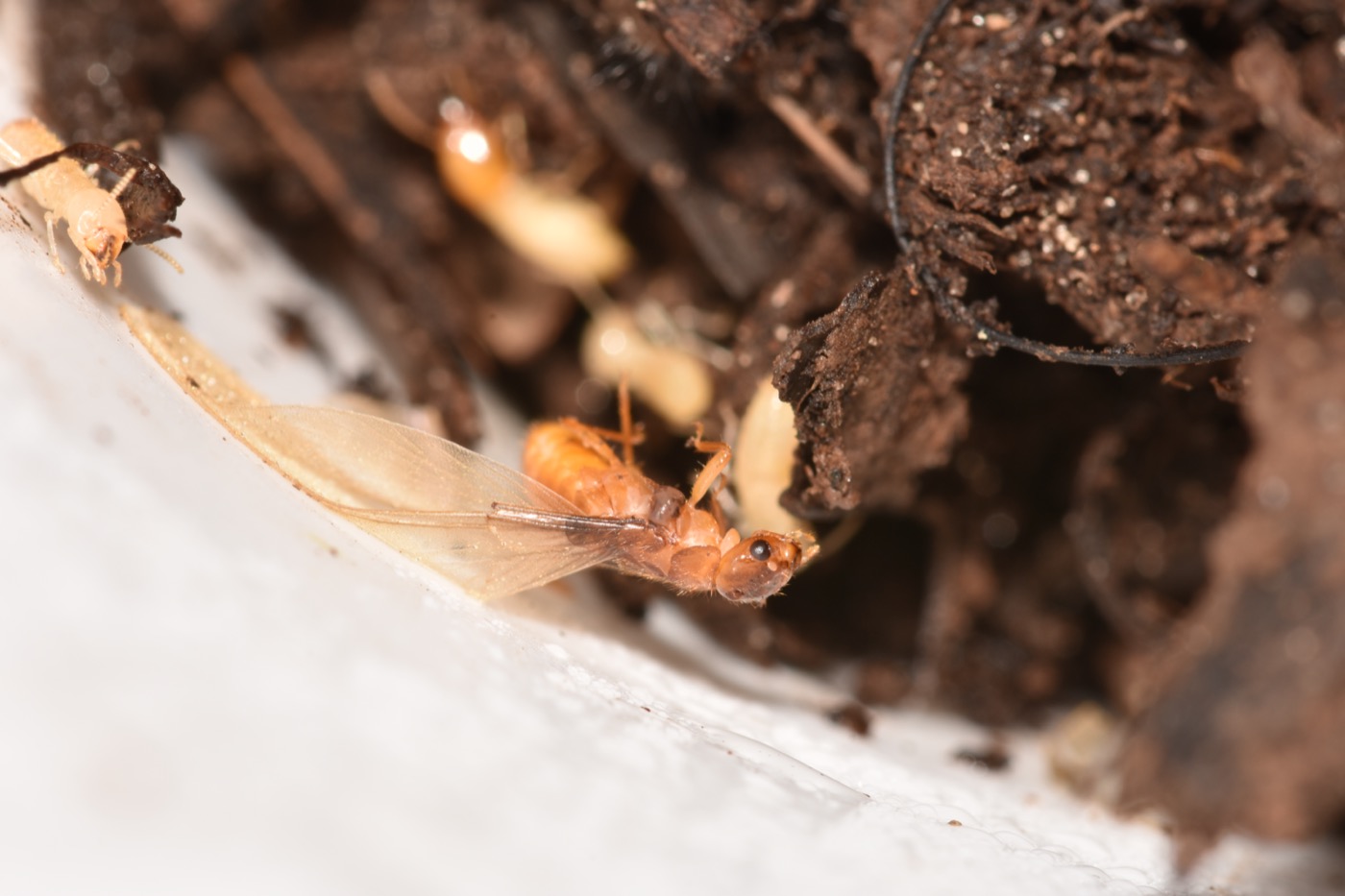
Alate (Swarmer)1
Carton Nest
Tree Damage
Identification
The cleanest lab tell is the wing
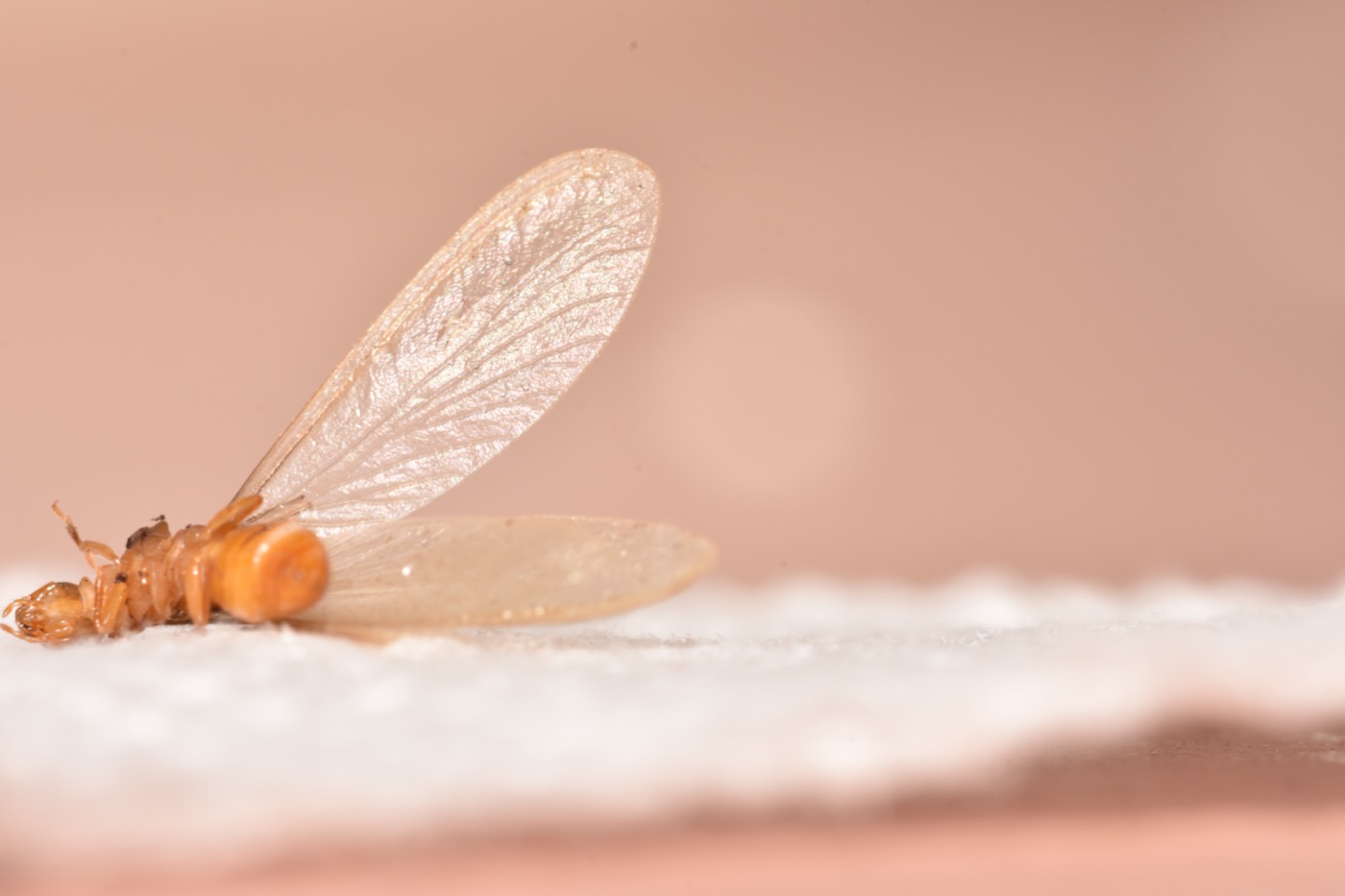
The single cleanest lab level tell is the wing. Formosan alate wings, including the membrane itself, are covered in small hairs. Eastern Subterranean alate wings are not hairy. If you can get a magnified look at a shed wing, this settles the identification by itself.
Then the soldier's head shape
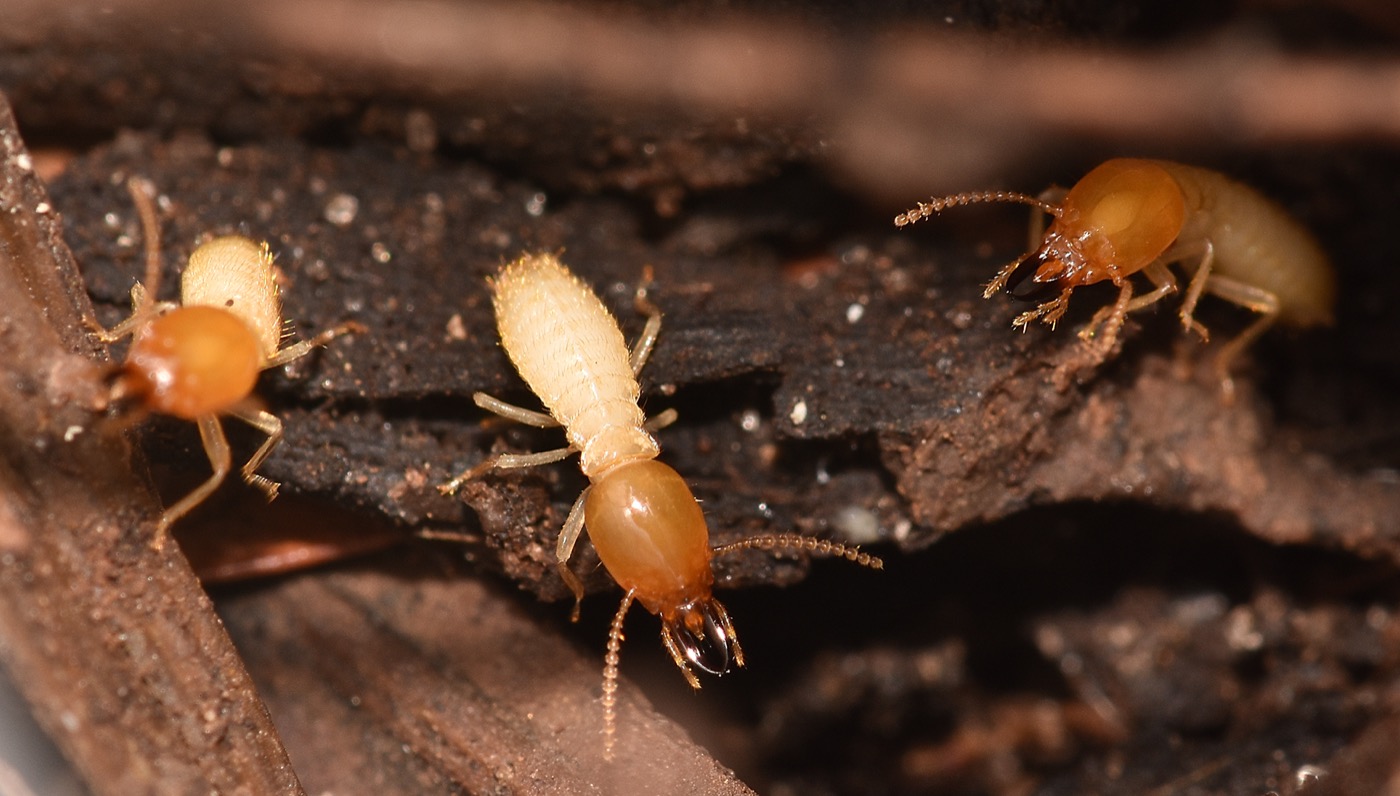
LSU AgCenter calls this the easiest way to tell the two species apart in the field: a Formosan soldier has a large, orange, teardrop shaped (oval) head, while an Eastern Subterranean soldier's head is rectangular.
Then how many soldiers you see
Formosan colonies run a much higher share of soldiers. UF/IFAS gives 10 to 15 percent of the colony, LSU AgCenter's own comparison page gives closer to one fourth, against roughly 1 to 2 percent for an Eastern Subterranean colony on both accounts. A pile of soldiers at a breach point, rather than a scarce few, points to Formosan.
Where "milk termite" comes from
The defensive "milk" behavior is a real, sourced tell, and it is where the folk name "milk termite" comes from. A threatened Formosan soldier exudes a white, glue like fluid from its head that can amount to close to half its wet body weight. A native soldier does not produce anything close to that amount.
Sizes and colors, by caste
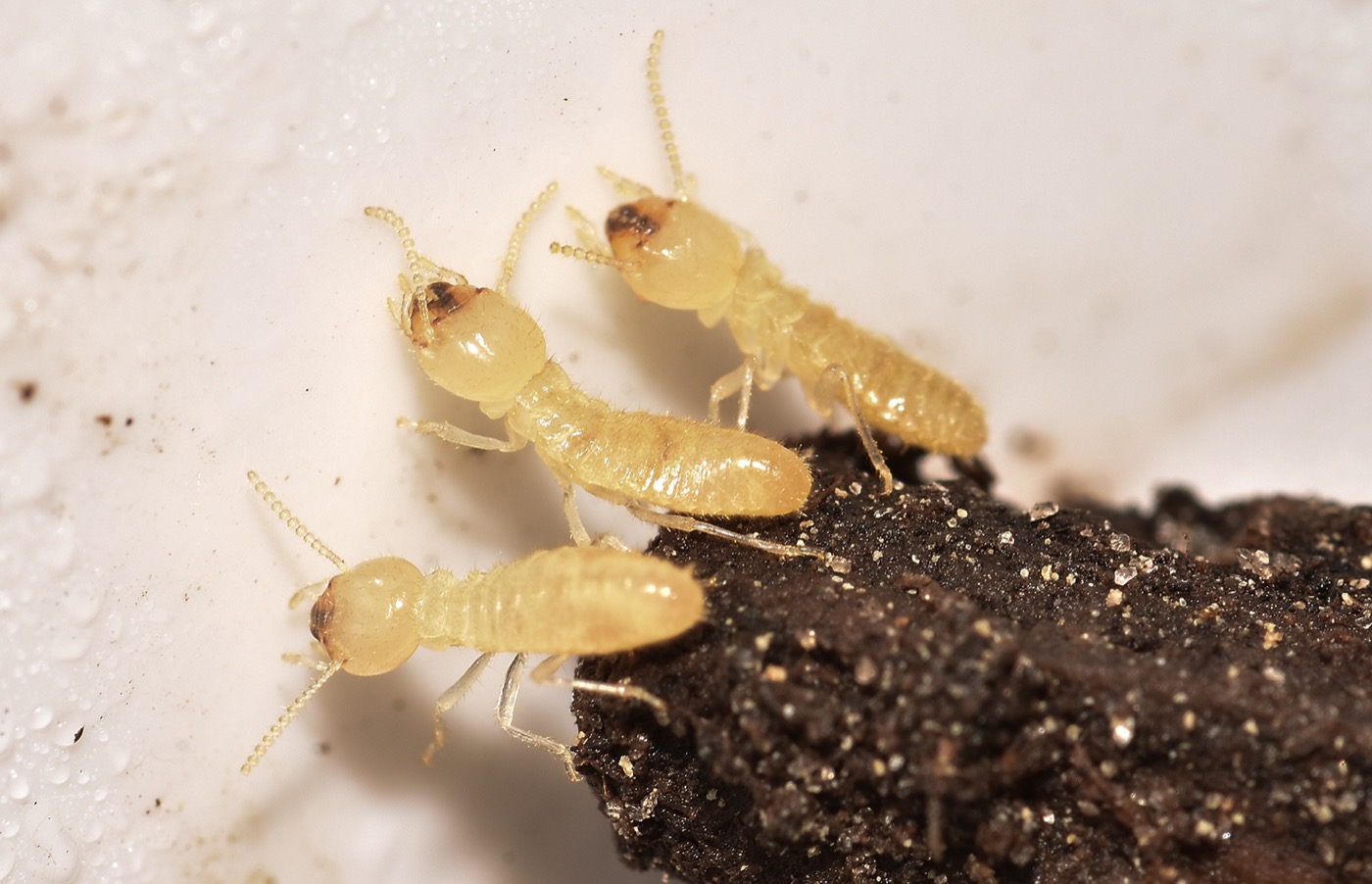
Reported as a range where sources disagree. Workers run about 3 to 4 millimeters and are white to cream colored. Soldiers run about 4 to 5 millimeters, with a pale, soft body and the brownish orange, teardrop shaped head described above. Alates run roughly 9 to 15 millimeters depending on the source, orange to light amber brown, with one state agency describing the color as golden brown.
Scientific name and unsettled family
Coptotermes formosanus Shiraki, order Blattodea, the same order as cockroaches. Most extension sources still place it in family Rhinotermitidae, but UF/IFAS's current entry lists the family as Heterotermitidae, formerly Rhinotermitidae, reflecting a recent reclassification that has not yet been adopted everywhere. Treat the family name as unsettled rather than picking one side as final.
"Super termite" has real numbers
"Super termite" is a real nickname with real numbers behind it, not just a scary adjective. LSU AgCenter states colony size can run roughly ten times larger than a native subterranean termite colony, and Texas A&M AgriLife Extension documents that Formosan termites feed on a wider range of cellulose than native species, including living plant material, whereas native subterranean termites feed only on spring growth. Those two facts, not the nickname alone, are the basis for calling this species more destructive per colony.
Against the eastern subterranean
Commonly confused with the Eastern Subterranean termite. In combination: hairy alate wings here versus hairless there, oval soldier head here versus rectangular there, soldiers running 10 to 25 percent of the colony here versus 1 to 2 percent there, and dusk swarm flights here versus daytime, post rain flights there.
Signs of Infestation
Large swarms at dusk, drawn to light
This is the clearest identification sign and the one that most directly separates this species from Eastern Subterranean at the swarm stage. FDACS notes that if a colony exists inside walls or an attic, residents may see several hundred to thousands of swarmers in the house at once as they chew through and break out to disperse. A handful of swarmers alone is not necessarily proof of an indoor colony.
A carton nest, if exposed
A papery, soil and wood pulp mass inside a wall void, attic space, or hollow tree. Keep this in proportion: Clemson HGIC's Charleston survey data found this pattern in only 6 percent of infested buildings surveyed, with the large majority still ground connected. Most infestations will show the same mud tube and damaged wood signs documented for Eastern Subterranean termites rather than an exposed carton nest.
A hollow-sounding healthy tree
A hollow sounding, otherwise healthy looking living tree near the structure. A Formosan specific sign with no documented Eastern Subterranean counterpart.
Wings and dead swarmers near lights
Discarded wings and dead swarmers near light sources in the evening, rather than the daytime window sill pattern documented for Eastern Subterranean termites.
No reliable sound, and no smell
No university, state, or federal source describes a homeowner audible sign specific to this species, and none attributes a distinctive odor to it or its damage.
Prevention and When to Call a Pro
Above-ground moisture too
Address above ground moisture, not just soil level moisture. Because a carton nest can sustain a colony without any soil contact as long as it has its own moisture supply, roof leaks, plumbing leaks inside walls, condensation, and poor attic ventilation matter more for this species than they do for a soil bound Eastern Subterranean colony. Fix leaks and improve attic ventilation specifically for this reason.
Ground-level exclusion still first
Standard ground level exclusion still applies, and still matters most. Wood to soil contact, foundation moisture management, mulch kept shallow and away from the foundation, and sealing gaps where utilities pass through the foundation are the same measures documented for Eastern Subterranean termites, and Clemson HGIC's survey data shows most Formosan infestations are still ground connected rather than aerial.
Tree health and hollow trees
Tree health and hollow tree removal is a Formosan specific measure with no real Eastern Subterranean counterpart. Because this species documents infesting and hollowing living trees, particularly ones already stressed or injured, prompt inspection and, where warranted, removal of hollowed or storm damaged trees near a structure removes both a food source and a possible above ground colony site close to the building.
Even less of a DIY pest
This is not a do it yourself pest, and arguably more so than Eastern Subterranean. FDACS's own consumer guidance recommends licensed pest control rather than homeowner treatment. Given the larger colony size and wider diet documented for this species, treat any confirmed Formosan infestation as higher stakes than a suspected native subterranean termite infestation.
Call for a dusk swarm indoors
Call a professional if you see a swarm at dusk, especially several hundred to thousands of winged termites indoors, from roughly April through July. FDACS states this volume and timing is a sign of an established indoor colony working to disperse.
Call for a papery carton mass
Also call if you find a papery, soil textured mass in a wall void, attic, or hollow section of a tree, a possible carton nest, or if a living tree near the structure sounds hollow when tapped or shows internal decay out of proportion to its outward health. The tree finding is worth a call to both an arborist and a pest control professional, since a hollowed tree is also a wind failure risk documented in peer reviewed forest surveys around New Orleans.
Frequently Asked Questions
What makes Formosan termites different from regular subterranean termites?
Colonies run roughly ten times larger than a native subterranean termite colony, soldiers make up 10 to 25 percent of the colony instead of 1 to 2 percent, they swarm at dusk instead of during the day, and, unusually for a subterranean species, they can sometimes build a self contained carton nest that survives above ground with no soil contact at all.
Can Formosan termites really eat a living tree?
Yes. Unlike most subterranean termites, they feed on the dead inner wood at the center of living trees and can hollow them out from the inside. This has been documented in peer reviewed forest surveys around New Orleans and Charleston, South Carolina, and has been tied to tree failures during hurricanes in New Orleans.
Does homeowners insurance cover Formosan termite damage?
No. Florida's Department of Agriculture and Consumer Services states plainly that homeowners insurance does not cover Formosan termite damage.
When and where do Formosan termites swarm?
Roughly late April through July, peaking in May, on warm and humid evenings around dusk, commonly 8 to 10 p.m., drawn to light. That is a direct contrast to native Eastern Subterranean termites, which typically swarm during the day.
Is the "$1 billion a year" Formosan termite damage figure real?
It is a widely repeated number, including on university pages, but it has a traceable, specific origin that rarely gets mentioned alongside it. In 1998, an analyst working for New Orleans area mosquito and termite control derived a repair to control cost ratio from New Orleans area budgets for Formosan termite damage specifically. In 2002, an entomologist applied that New Orleans, Formosan specific ratio to national, all species termite control spending data to build a national estimate, and did the same again in 2010 using updated numbers, this time on the record saying the resulting figure was probably a little high, since the ratio it depended on was calculated for Formosan termites specifically, not termites nationally. A separate widely quoted five billion dollar figure was built a different way entirely, an inflation adjustment of an older estimate, with the industry group involved later saying they picked the more conservative of two possible numbers to publish and that it then "became gospel." None of that means Formosan termites are not destructive. It means the specific dollar figure circulating online is a New Orleans number wearing a national label. Treat it as an order of magnitude, not a measurement.
Can Formosan termites bite people or make them sick?
No university, state, or federal source attributes any bite, sting, or disease risk to Formosan termites. They are treated in the literature purely as a structural and economic pest, not a health hazard. An explicit "no health risk" statement does appear on some pest control company pages, but not on any university or government page, so this answer rests on the absence of any contrary claim rather than on a direct university statement.
Sources
- Coptotermes formosanus, Formosan Subterranean Termite (Blattodea: Rhinotermitidae) LSU AgCenter
- Formosan subterranean termite, Coptotermes formosanus Shiraki (EENY121/IN278) University of Florida IFAS, Featured Creatures / EDIS
- Comparison of Native and Formosan Subterranean Termites: Biology, Ecology and Methods of Control LSU AgCenter
- Formosan Termite Consumer FAQ Florida Department of Agriculture and Consumer Services (FDACS)
- Formosan Subterranean Termites factsheet Clemson University Home & Garden Information Center (HGIC)
- Termites Texas A&M AgriLife Extension, Urban IPM
- Mother's Day is over, but termites missed the message LSU AgCenter
- Not just urban: The Formosan subterranean termite is invading forests in the Southeastern USA USDA Forest Service Treesearch (Biological Invasions)
Image Credits
- Image: NPMA. Used under NPMA member image license.