Seasonal Timeline
These months track the annual dispersal flight, the one time a year winged reproductives leave an established colony to pair off and start new ones. Unlike subterranean termites, drywood termites swarm during the day, on warm, sunny afternoons, not after dark.
These months track the annual dispersal flight, the one time a year winged reproductives leave an established colony to pair off and start…
Two regional nuances, neither of which changes those windows. UF/IFAS states that in southern California specifically, Incisitermes minor alates swarm from late September through November, which lines up with the Southern California peak above. The same source also notes that in Palm Springs, flights can start as early as May, with indoor swarms documented in April. Palm Springs and the desert interior run climatically closer to the hot, early Southwest pattern than to the coastal Southern California pattern, so a desert-adjacent California market is worth watching earlier than the coastal SoCal window implies. Separately, UF/IFAS reports that in Florida, documented flights have occurred in every month except December, with half of all flights falling in September, October or November. That is a wider window than the Southeast peak and shoulder months above, so treat late-summer or even off-season sightings in Florida as plausible rather than surprising.
Where They're Found
Drywood termites are established in California, the Southwest and the Southeast. Incisitermes minor, the western drywood termite, is native to coastal and lower-mountain Southern California, and UF/IFAS documents its range extending north into Oregon and Washington and east into central Arizona and Mexico. That Pacific Northwest edge is a real, documented part of the species' natural range rather than a stray introduction. UF/IFAS also lists isolated I. minor detections scattered nationwide, including Florida, Texas, Georgia and several northern states, almost all tied to infested furniture or lumber moved by people rather than an established breeding population, which is a different thing from an established range. In the Southwest, a second native species, Marginitermes hubbardi, turns up in southeastern California and desert Arizona. In the Southeast, the native Incisitermes snyderi, sometimes called the light southeastern drywood termite, is UF/IFAS's most widespread and most common native drywood species in Florida, and an invasive species, Cryptotermes brevis (the West Indian drywood termite), is established in Florida and other warm coastal cities, spread from structure to structure mainly by people moving already-infested furniture and salvaged wood rather than by natural flights. Texas A&M documents all three of Texas's drywood species, I. snyderi, Cryptotermes brevis and I. minor, with I. snyderi the most common there, which corroborates the Southwest range rather than adding a new one.
Life Cycle
No pupal stage, and no true worker caste, which is the biological reason colonies stay small. Metamorphosis is incomplete: egg, then an immature stage (pseudergate or nymph) that can develop for over a year across at least seven instars, then soldier, alate or a replacement reproductive. Unlike Reticulitermes, there is no separate, permanently sterile worker caste to point to. UF/IFAS gives a documented, year-by-year colony growth curve for the western drywood termite: at 2 years, a king, queen, one soldier and perhaps a dozen nymphs; at 5 years, about 20 soldiers and 500 nymphs; at 10 years, about 70 soldiers and 1,600 nymphs; at 15 years, about 120 soldiers and 2,600 nymphs. Colony size is the core contrast. UC IPM states drywood termite colonies are usually fewer than 1,000 individuals. Texas A&M gives a comparable range of roughly 2,000 to 2,500 individuals at maturity, though that runs higher than UC IPM's figure, so read it as directionally consistent rather than an exact settled number. Either way, a mature drywood colony runs in the hundreds to low thousands, against the hundreds of thousands to millions documented for a mature Eastern Subterranean or Formosan colony. That size gap is also why drywood damage tends to stay localized to one board or section of framing rather than spreading through a whole structure the way a large subterranean colony's damage can. As with subterranean termites, a drywood colony is perennial and continuously developing rather than producing discrete annual generations. The one annual event is the dispersal flight.

Egg
Immature (Pseudergate/Nymph)
Soldier
Alate (Swarmer)
Frass and Kickout Holes
Damage
Identification
Start with the frass, not the insect
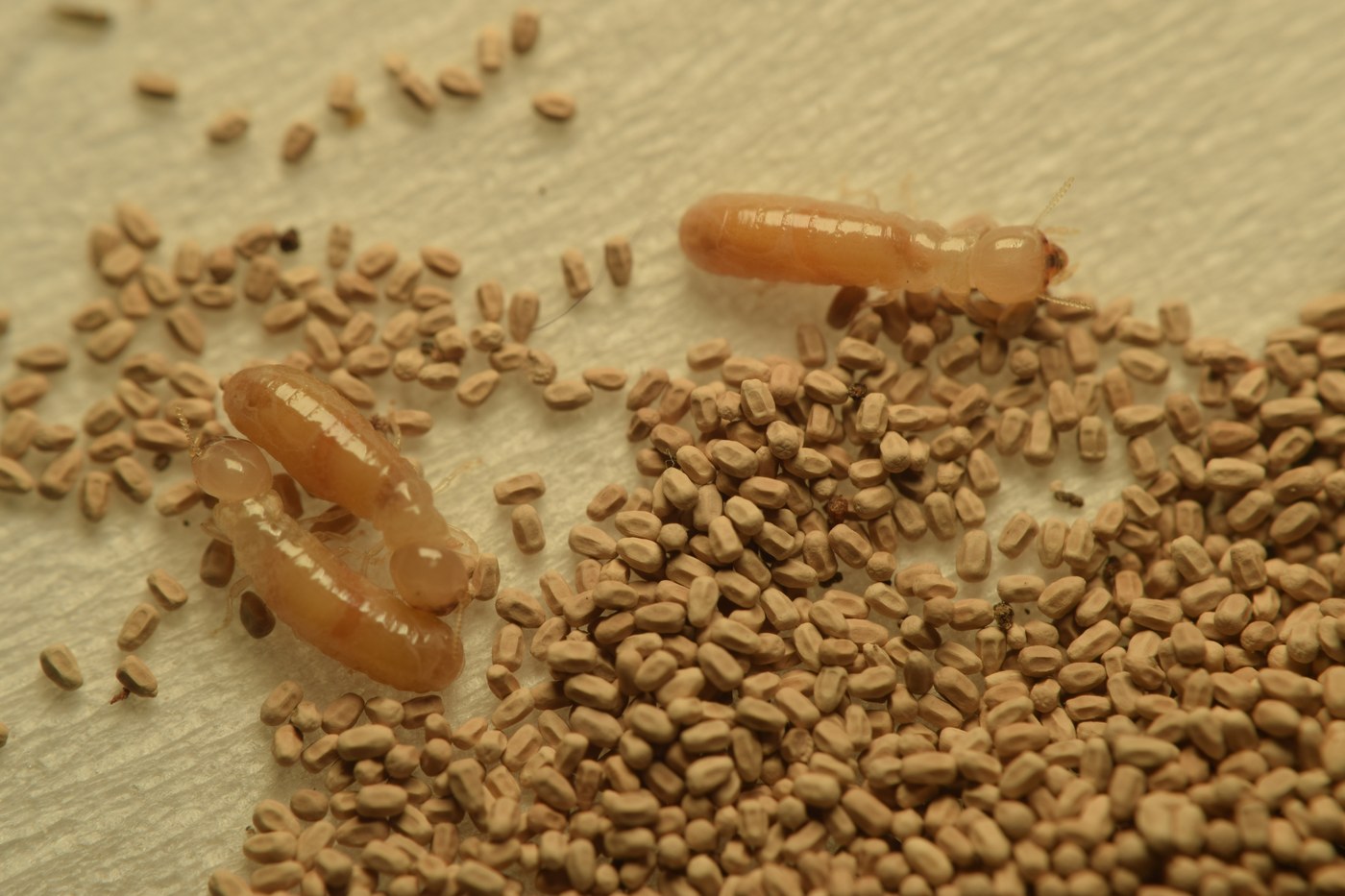
The single most diagnostic, most homeowner-visible sign of drywood termites is not a live termite at all, it is the fecal pellets, or frass, they eject. Six hexagonal sides, clear longitudinal ridges, dry and gritty to the touch, color ranging light brown to almost black depending on the wood, pushed out through kickout holes less than 2 millimeters across. There is no mud tube framing here at all, because drywood termites never touch soil and have no reason to build one.
One category, one dominant species
This is one behavioral category, told mainly through one dominant species. The western drywood termite, Incisitermes minor, is the species behind most of the published measurements, and the most economically significant drywood termite in the United States. In the Southwest, a second native species, Marginitermes hubbardi, occurs in southeastern California and desert Arizona. In the Southeast, the native Incisitermes snyderi is the most common drywood species, and the invasive Cryptotermes brevis, the West Indian drywood termite, is established in Florida and other warm coastal cities. Do not treat all of this as one interchangeable species. Treat I. minor as the anchor and the others as named regional variants.
There is no worker caste
No true worker caste is a real, sourced identification and biology point, not a technicality. The colony's labor, feeding, excavation, tending brood, is done by wingless pseudergates and wing-budded nymphs, either of which can still develop into a soldier, alate or replacement reproductive later on. Do not label anything in a drywood colony a permanent worker.
The soldier's antennal club
It is a genus-level tell worth checking under a hand lens. Incisitermes minor soldiers have an enlarged, club-like third antennal segment that is as long as or longer than segments four through six combined, alongside a large, reddish-brown, heavily sclerotized head and black mandibles with two teeth visible on the inner margin of the left mandible.
Pronotum against the head
Pronotum width versus the head, the fastest family-level split. A Kalotermitidae soldier, drywood or dampwood, has a pronotum equal to or wider than its head. A Rhinotermitidae soldier, the family covering subterranean termites, has a pronotum narrower than the head.
Sizes and colors, by caste
Alates run 11 to 12.5 millimeters including wings, with an orange-brown head and pronotum, a dark brown abdomen, and wings carrying a smoky tint. Soldiers run 8 to more than 12 millimeters, weighing as much as 20 to 25 milligrams. Immatures run roughly 6.5 to 9.5 millimeters, pale white to beige, and wingless.
Commonly confused with subterranean termites
A subterranean soldier's pronotum is narrower than its head, a drywood soldier's is equal to or wider. Subterranean colonies need soil contact and build mud tubes, and pack wet fecal material into their galleries. Drywood colonies never contact soil, build no tubes at all, and eject dry, hard, hexagonal pellets instead.
Commonly confused with dampwood termites
Dampwood species are larger overall and require wood with high moisture content, typically in cool, humid coastal or forest areas, the opposite habitat from drywood termites. Their fecal pellets are rounded at both ends and elongated, football-shaped, and lack the clear longitudinal ridges seen on drywood pellets.
Commonly confused with winged ants
The same tells apply as for subterranean termites: ants have a pinched waist, termites do not; ant front wings are longer than the hind pair, all four termite wings are the same length and shape; ant antennae are elbowed, termite antennae are straight and beaded. The drywood-specific refinement is color: an I. minor alate's orange-brown head and pronotum against a dark brown abdomen, with smoky wings, is a combination the general ant-versus-termite tells alone do not capture.
Taxonomy
Order Blattodea, family Kalotermitidae, the same order that includes cockroaches and subterranean termites.
Signs of Infestation
Fecal pellets, or frass
They are the sign to anchor on. Small, hard, six-sided pellets with longitudinal ridges, light brown to almost black, pushed out through pinhole kickout holes less than 2 millimeters across. The holes are often sealed with a plug of wet feces between ejections, so what you actually see may be a tiny dark spot rather than an open hole.
The activity test
Clean up the pellets around a kickout hole, then check back in a few days. If new pellets have appeared, the infestation is active. If not, it may be an old, vacated gallery.
Discarded wings, seen in daylight
Discarded wings and swarmers, seen in daylight. Look on windowsills or near light sources on warm, sunny days during the regional swarm window. Because these flights happen during the day, this is a different-looking version of the same shed-wing evidence documented for subterranean species.
Damage that looks intact from outside
Galleries run irregularly through sapwood and sometimes heartwood while the colony leaves a paper-thin outer shell in place. Wood can look and sound sound until it is probed, at which point the shell breaks easily to reveal galleries packed with dry frass.
No reliable sound, and no smell
No audible sign and no odor is documented for this species anywhere in the published literature.
Prevention and When to Call a Pro
Seal and paint the entry points
Seal and paint exposed wood at the entry points swarmers actually use. Drywood alates enter through small cracks, joints and exposed end-grain rather than through soil, so painting and caulking exterior trim, eaves and window and door frames closes off the entry points that matter for this species. This is a different mechanism from sealing soil-level foundation gaps, which is a subterranean-termite measure that does nothing against drywood termites.
Inspect used and salvaged wood
Inspect used furniture and salvaged or reclaimed lumber before bringing it indoors. The invasive West Indian drywood termite, Cryptotermes brevis, is specifically documented spreading structure to structure by people moving already-infested furniture and wood, a genuinely different transmission pathway from natural dispersal flights.
Borate treatments, not a guarantee
Preventive borate or surface treatments on new or accessible wood are a documented option, not a proven guarantee. UC IPM notes a real limitation: field-performance data for these products against drywood termites specifically in California is limited, even though simulated trials in Florida have shown some efficacy. Treat this as an option with an acknowledged evidence gap, not a substitute for inspection.
Screen the attic and vents
Screen attic and foundation vents as part of the general physical-barrier prevention category alongside resistant wood species.
Why this is not a DIY job
This is not a do-it-yourself job, and the reason is not squeamishness. Drywood termites are cryptic and hard for a homeowner to gauge alone, and UC IPM states plainly that do-it-yourself treatment is not recommended because the effective products are not sold for homeowner use. The real professional decision is not whether to treat, it is which treatment fits the infestation. A single, well-defined, accessible infestation can often be handled with a localized spot treatment, drilling and injecting termiticide directly into the wood, or simply removing and replacing the infested piece. A severe or widespread infestation, or one in inaccessible areas, calls for whole-structure fumigation, which treats the entire building and kills everything inside at the cost of being expensive and disruptive. Because drywood termites never contact soil, a soil-applied termiticide barrier targets a pathway this pest does not use at all. If a confirmed drywood infestation is quoted as a soil treatment, that is the wrong service, full stop. Get at least three structural inspection reports before deciding, and check a vendor's license status and complaint history with the state structural pest control board before signing anything.
Frequently Asked Questions
What do drywood termite droppings look like?
Small, hard, six-sided pellets with rounded ends, clear ridges running their length, and color ranging from light brown to almost black depending on the wood they came from. They are pushed out of tiny kickout holes less than 2 millimeters across, and this frass is the single most diagnostic sign of a drywood infestation.
Do drywood termites need contact with soil or moist ground like other termites?
No. Drywood termites live entirely inside the wood they eat, get all the water they need from that wood, and never need soil contact, which is also why they never build mud tubes.
Will a soil termiticide treatment get rid of drywood termites?
No. Soil-applied termiticide barriers target the soil-to-structure pathway that subterranean termites use to reach a building. Because drywood termites never touch soil, that pathway does not exist for this pest, and the professional standard for anything beyond a single, small, accessible infestation is whole-structure fumigation, not a soil treatment. A soil termiticide quote for a confirmed drywood infestation is the wrong service.
How big does a drywood termite colony actually get?
Much smaller than a subterranean colony. Sources put a mature colony at usually under 1,000 individuals to, at most, a couple thousand, against the hundreds of thousands to millions documented for a mature subterranean colony. That size gap is also why drywood damage tends to stay localized to one board or section of framing rather than spreading through an entire structure.
How can I tell if a drywood termite infestation is still active?
Clean up the fecal pellets around a kickout hole, then check back in a few days. If new pellets have appeared, the infestation is active. If none have appeared, it may be an old, vacated gallery.
Is a drywood termite the same as a regular termite worker caste?
No, and this is a real biological difference, not a naming quirk. Drywood termites have no true, permanently sterile worker caste. Their colony labor is done by wingless immatures called pseudergates and wing-budded immatures called nymphs, either of which can still develop into a soldier, an alate, or a replacement reproductive later on.
Sources
- Drywood Termites, Pest Notes, Publication 7440 University of California Statewide Integrated Pest Management Program (UC IPM)
- Western drywood termite, Incisitermes minor (Hagen) (EENY248/IN526) University of Florida IFAS, Featured Creatures / EDIS
- Drywood Termites, E-366 Texas A&M AgriLife Extension Service
- Termite Species Distribution in Florida and UF/IFAS Resources (IN1360) UF/IFAS, Ask IFAS
- West Indian Drywood Termite, Cryptotermes brevis (Walker) (EENY-079/IN236) University of Florida IFAS, Featured Creatures / EDIS
Image Credits
- Image: Adobe Stock, licensed.