Seasonal Timeline
Diurnal and active year round, with no true dormant season. Breeding runs once a year, typically in late spring, with young present in nests through mid-summer.
Diurnal and active year round, with no true dormant season. Breeding runs once a year, typically in late spring, with young present in…
Western gray squirrel breeds once a year, most sources describe mating in late spring, though a northeastern Oregon field study found females in estrus January through March and again in June, so some regional variation exists and is not fully resolved by a single study. Gestation runs about 43 days, and litters of 2 to 5 young, most commonly 3 to 5, are weaned at roughly 10 weeks. Eastern gray squirrel, the introduced species, is documented with up to two litters a year, while one litter a year is typical for western gray squirrel in the Pacific Northwest, a real biological difference between the native and introduced squirrels sharing the same neighborhoods.
Outside of breeding, this species does not follow a seasonal entry pattern into structures the way eastern gray squirrel and fox squirrel do, because it is not documented as a structural nuisance species at all. It is diurnal and active year round, most active in early morning and late afternoon, with no dormant season.
Where They're Found
Western gray squirrel ranges from north-central Washington south through western Oregon and California to northern Baja California, Mexico, plus a small, disjunct population in west-central Nevada. That Nevada population is the species' only foothold in the Southwest. Nevada's own wildlife agency classifies the species there as protected, describing it as uncommon and not hunted. This is a small, isolated population, not a claim of broad Southwest presence, and no record places the species in Arizona, New Mexico, or Utah.
In Washington, current distribution is now limited to three isolated areas: low to mid-elevation conifer forest on the eastern slopes of the North Cascades in Okanogan and Chelan counties, oak woodland and conifer forest in Klickitat and southern Yakima counties, and oak woodland and conifer forest at Joint Base Lewis-McChord in Pierce and Thurston counties. The species was listed as state threatened in 1993 and uplisted to state endangered in November 2023, a genuinely more serious classification than a routine regulatory caveat. It is not federally listed; a petition to list the Washington population under the federal Endangered Species Act was denied in 2003.
In Oregon, the species occurs throughout the Willamette Valley, southwest Oregon, the Columbia Gorge, the foothills of the western Cascades, and lower elevations of the eastern Cascades. Oregon classifies it as a vulnerable sensitive species statewide, sensitive specifically in the Willamette Valley, yet still allows hunting there with an open season. That is a real, sourced example of two states inside the same Pacific Northwest region managing the identical species two very different ways.
In California, the species is fairly common locally in mature conifer, hardwood, and mixed stands across the Klamath, Cascade, Transverse, Peninsular, and Sierra Nevada ranges, plus riparian stands in the Sacramento Valley. It is a game species there, huntable across most of its range, with hunting excluded only in southern California within most of the range of one of its three subspecies. No available data show a California-wide decline serious enough to warrant listing, and NatureServe ranks the species Apparently Secure to Secure statewide. One correction is worth stating directly: western gray squirrel is sometimes described as a California Species of Special Concern. That claim could not be confirmed. California's current official Special Animals List, the authoritative document for that designation, does not include this species or any of its three subspecies. The genuine California conservation concern that does hold up is narrower and local: documented displacement from specific urban areas, such as parts of the Los Angeles basin, by introduced fox squirrel and eastern gray squirrel, not a statewide special-status listing.
Across every region, this species depends on mature stands of mixed conifer and oak habitat, closely associated with oaks, and requires large trees, mast, and snags. It is not adapted to urban or suburban settings the way its introduced competitors are, and it is genuinely losing ground to those competitors, plus habitat loss, roadway mortality, and disease, in parts of its range.
Life Cycle
One litter a year, and a shy, forest-dependent adult, is the biological contrast that separates this squirrel from its introduced look-alikes. Eastern gray squirrel and fox squirrel, the two introduced species most often confused with this one, both tolerate urban and suburban settings and eastern gray squirrel can produce two litters a year when food is abundant. Western gray squirrel does neither. That difference in adaptability, not any difference in intelligence or aggression, is a documented part of why the introduced species are expanding while this native one is not.

Breeding
Nest
Juvenile
Adult2
Identification
Size and build
18 to 24 inches nose to tail tip, weighing 0.77 to 2.2 pounds. The largest tree squirrel native to the Pacific Northwest and to the Sierra Nevada and Central California range.
Color runs the opposite direction
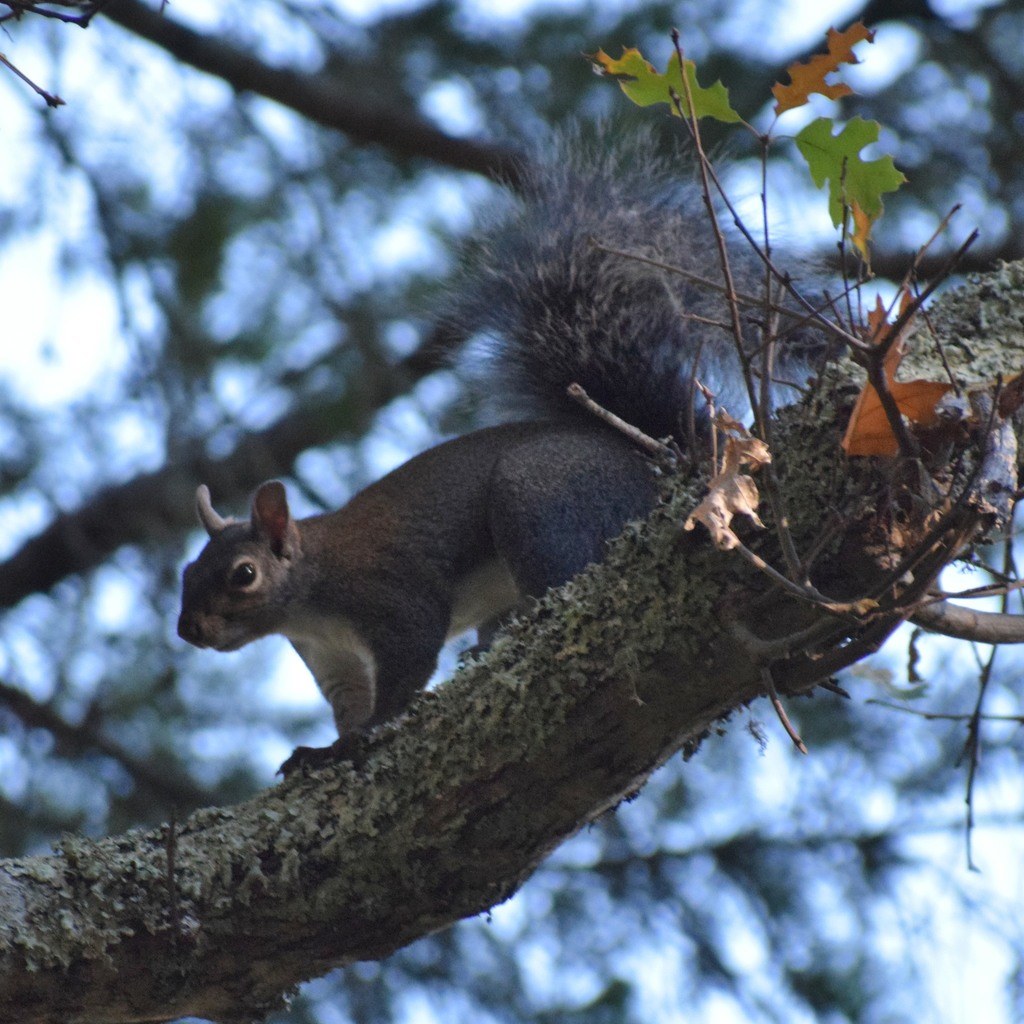
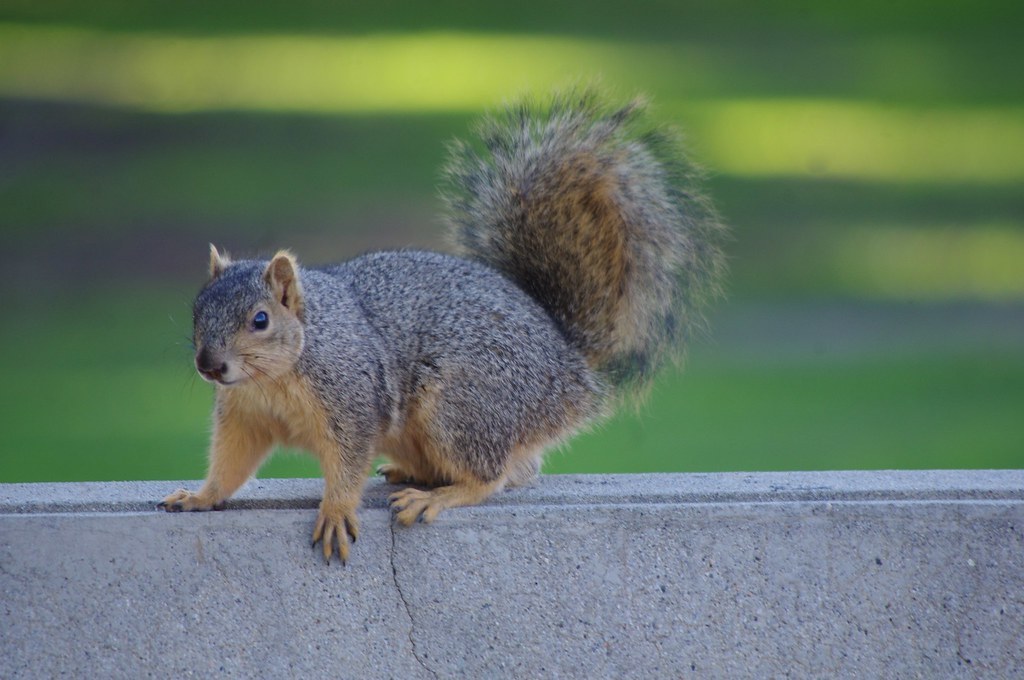
Color is the fastest tell, and it runs the opposite direction from the introduced squirrels it gets confused with. Washington's own wildlife agency states it directly: large size, a long bushy tail, and dark gray pelage lacking any brown on the body or tail distinguish this species from other squirrels in its range. The only exception is a possible small reddish-brown patch on the back of the ears in winter, visible only on close inspection. Introduced eastern gray squirrel, by contrast, commonly shows a reddish cast to its coat or is solid black.
A larger, heavily furred tail
The tail is proportionally larger and more heavily furred than either introduced look-alike, long and bushy with a white-frosted, salt-and-pepper edge.
Behavior is a genuine tell
Behavior is a genuine identification tell, not just a biology footnote. This species is shy around people. Disturbed, it runs up a tree and gives a hoarse chirping alarm call rather than tolerating close approach. Eastern gray squirrel and fox squirrel are both comfortable in yards, parks, and attics in a way this species is not.
Vocalization
A hoarse "chuff-chuff-chuff" barking sound, plus rough, coughing calls when alarmed, often paired with tail-flicking and foot-stamping.
Where the confusion actually matters
Washington's state wildlife agency states the confusion runs specifically toward the introduced eastern gray squirrel, increasingly common in Washington's urban areas. Because the two species carry opposite legal status in Washington, this identification question is a legal one before it is a curiosity, not the other way around.
Signs of Infestation
Gnaw holes about 2 inches across
Gnaw holes about 2 inches in diameter where a native tree squirrel, including this species, has chewed into a structure, per Washington's own wildlife agency guidance. That is distinctly smaller than the roughly baseball-sized holes chewed by the introduced eastern gray and fox squirrels.
A drey
A drey, a stick nest lined with shredded bark, grass, moss, and lichen, built in a tree fork or an enlarged, abandoned woodpecker cavity. This is the natural-habitat equivalent of a nest for this species and is not typically found inside a structure.
The hoarse chuffing bark
The hoarse "chuff-chuff-chuff" bark, plus tail-flicking and foot-stamping when alarmed.
Not a routine house invader
This species is not documented as a routine home-invading nuisance animal the way eastern gray squirrel and fox squirrel are. Treat the signs above as identification and property-tree signs rather than as signs of a structural invasion.
Prevention and When to Call a Pro
Washington, a flat prohibition
In Washington, this is not a "check local rules" situation, it is a flat prohibition. Washington's wildlife agency states plainly that this species is protected and cannot be hunted, trapped, or killed. It was listed as state threatened in 1993 and uplisted to state endangered in November 2023, a genuinely more serious classification. It is not federally listed; a petition to list the Washington population under the federal Endangered Species Act was reviewed and denied in 2003.
Oregon is materially lighter
In Oregon, the same species carries a materially different, lighter status despite sharing the Pacific Northwest region with Washington. Oregon classifies it as a vulnerable sensitive species statewide, and sensitive specifically in the Willamette Valley, but hunting is still legally allowed there with an open season, and harvest levels are not tracked. Two states, one region, two different rules for the identical animal.
California treats it as game
In California, this species is a huntable game animal across most of its range, not a protected one. Hunting is permitted within the range of two of its three subspecies, and excluded only in southern California within most of the range of the third. No available data show a California-wide population decline serious enough to warrant listing, and the species ranks Apparently Secure to Secure there. One claim needs correcting: western gray squirrel is sometimes described as a California Species of Special Concern, but California's current official list of special-status species does not include this species. The real, narrower California conservation concern is local displacement from specific urban areas by introduced squirrels, not a statewide special-status designation.
Nevada protects its population
In Nevada, the small, disjunct population is also protected. Nevada's wildlife agency classifies the species there as protected and describes it as uncommon and not hunted.
Confirm the species first
Never attempt DIY removal of any gray squirrel in this range without confirming which species is actually present first. The confusion runs specifically toward introduced eastern gray squirrel, and the two species carry opposite legal treatment in Washington. Use the color and behavior tells in the identification section, not size alone, and if there is genuine doubt, get the species confirmed before doing anything.
Removal sits inside hunting rules
Where removal is legally possible at all, in Oregon and California, it exists inside a regulated hunting framework, not a nuisance-wildlife trapping permission. Both require a license and an open season. A property owner with an actual conflict should contact the relevant state wildlife agency, Washington Department of Fish and Wildlife, Oregon Department of Fish and Wildlife, California Department of Fish and Wildlife, or Nevada Department of Wildlife depending on location, or a licensed nuisance wildlife control operator, rather than assuming a shelf-bought trap is legal.
The only sensible prevention step
The only prevention step that makes sense for an actual property situation is passive, not removal-based. This species is not documented as a structural-entry nuisance animal, so the practical action is to keep mature oaks and conifers standing rather than removing them. Large, mast-producing trees and connected canopy are this species' basic habitat requirement, and its populations are already declining from habitat loss across most of its range.
Competition is a real issue
Competition from introduced squirrels is a genuine, documented conservation issue, not just an identification footnote. Eastern gray squirrel, fox squirrel, California ground squirrel, and even wild turkeys are documented as expanding species competing with this one for food and habitat in parts of its range, contributing to local declines.
Who to Call, and When
In Washington, contact the state wildlife agency for any conflict involving this species; homeowner trapping or killing is not a legal option there regardless of the nuisance, and misidentifying an introduced squirrel as this species, or the reverse, carries real legal and conservation stakes. In Oregon and California, where limited regulated hunting exists, contact the state wildlife agency before assuming a nuisance-removal action is legal, since a hunting season is not the same as a nuisance-trapping permit. Everywhere in this range, a licensed nuisance wildlife control operator is the safer default over a shelf-bought trap.
Frequently Asked Questions
How do I tell a western gray squirrel apart from the common gray squirrel in my yard?
Color and behavior are the fastest tells. Western gray squirrel carries no brown coloring anywhere on its body or tail, aside from an occasional small reddish-brown patch on the back of the ears in winter visible only on close inspection. The introduced eastern gray squirrel, by contrast, commonly shows a reddish cast to its coat or is solid black. Western gray squirrel is also shy around people and sticks to oak and conifer woodland, while eastern gray squirrel is comfortable in yards, attics, and city parks.
Is the western gray squirrel actually protected, or is that just a rumor?
In Washington, yes, and it is a serious protection. The species was listed as state threatened in 1993 and uplisted to state endangered in November 2023, and it cannot legally be hunted, trapped, or killed there. In Oregon it is a sensitive species but is still legally hunted with a season. In California it is a game species across most of its range, with no current statewide special-concern listing confirmed. It is not listed under the federal Endangered Species Act anywhere.
Why is a native squirrel declining while the introduced gray squirrels in my neighborhood seem to be everywhere?
They are different species under real competitive pressure. Washington's own wildlife agency names habitat loss, fragmentation, disease, roadway mortality, and competition from expanding introduced species, including eastern gray squirrel and fox squirrel, as documented threats. The introduced species tolerate urban development far better, and eastern gray squirrel can produce two litters a year when food is abundant, an advantage this native species does not share.
Do western gray squirrels cause the same attic and wiring damage as other squirrels?
No. No credible source documents this species as a structural nuisance animal the way introduced eastern gray squirrel and fox squirrel are documented. It is a wild, forest-dependent species not well adapted to urban or suburban settings, and no electrical-wiring fire-risk data specific to this species was found.
What do western gray squirrels actually eat, and does it matter?
Acorns, conifer seeds, and other tree fruits and nuts, but also large quantities of underground fungi called truffles, which can make up more than half the diet in some California populations. That reliance on fungi is unusual among tree squirrels and matters ecologically: the squirrels disperse fungal spores that form beneficial relationships with tree roots, especially oaks, and they disperse oak acorns themselves by burying and not always recovering them.
Sources
- Periodic Status Review for the Western Gray Squirrel (2023) Washington Department of Fish and Wildlife
- Western gray squirrel (Sciurus griseus) species profile: status, regulations, distribution Washington Department of Fish and Wildlife
- Status of the Western Gray Squirrel (Sciurus griseus) in Washington (1993) Washington Department of Fish and Wildlife
- Living with wildlife: Tree squirrels (gnaw-hole size, exclusion guidance, legal status) Washington Department of Fish and Wildlife
- Endangered and Threatened Wildlife and Plants; 90-Day Finding for a Petition To List the Western Gray Squirrel as Endangered Rangewide (2004) U.S. Fish and Wildlife Service, via Federal Register
- Western Gray Squirrel life history account (California Wildlife Habitat Relationships System, M077) California Department of Fish and Wildlife
- Special Animals List (2023) California Department of Fish and Wildlife
- Diets of Native and Introduced Tree Squirrels in Washington (truffle-reliance findings) Washington Department of Fish and Wildlife / Journal of Wildlife Management
- Sciurus griseus (western gray squirrel) species account Animal Diversity Web, University of Michigan Museum of Zoology
Image Credits
- Image: photographer not named via iNaturalist. CC0 1.0.
- Image: Dave Hamster via Openverse. CC BY 2.0.
License.