Seasonal Timeline
Sliders are diurnal and active in the warm months, basking hardest through the middle of the morning, and they overwinter underwater in soft bottom mud, muskrat burrows, or simply sitting on the bottom. The behavior that puts one on a lawn or driveway is nesting, and that runs roughly April through July.
Sliders are diurnal and active in the warm months, basking hardest through the middle of the morning, and they overwinter underwater in…
Basking is the seasonal behavior worth understanding, because it is thermoregulation and it is measurable. A Florida Museum of Natural History study of yellow-bellied sliders at a north Florida sinkhole pond used temperature telemetry to show that an adult turtle sitting out on a log could raise its body temperature at least 10 degrees C above the near-surface water it had just left. That study identified thermoregulation as the primary function of basking from four separate behavioral lines: the way a basking turtle orients its body and extends its head, legs, and even the digits of its rear feet; the fact that a turtle will stay on a site after it falls into shade but will rarely climb out onto a spot that is already shaded; the way basking frequency and duration shift inversely as air and water temperature and sunshine decline; and the switch to submerged basking sites or floating in warm surface water once the water itself is warm enough.
Two findings from that work cut against what most people assume. Basking is not a daily requirement. Some individuals basked as many as five times in one day in good weather, while a considerable share of the same population did not bask at all that day. And the numbers move with water temperature rather than the calendar: atmospheric basking peaked at a daily mean water temperature of 28.5 degrees C, while aquatic basking increased as water temperature climbed toward 31.5 degrees C. Basking duration also scales with body size, so a large old female and a young turtle in the same pond are not on the same schedule.
Mating timing is genuinely disputed across sources. A university museum account gives a breeding season beginning in April and usually running through late October, extending into December in ideal weather. Virginia's state wildlife agency describes mating in spring, fall, and winter for the yellow-bellied slider and in any season but summer for the red-eared slider. Nesting is far more consistent across sources, April through July, and nest construction usually happens at dusk and at night.
Where They're Found
Eight regions carry this animal, and the native versus introduced status is different in each.
Native range: Southeast, South Central, and Midwest. The yellow-bellied slider is the Atlantic-slope native, with an indigenous range covering southeastern Virginia south through the Coastal Plains of the Carolinas, Georgia, northern Florida, and eastern Alabama. The red-eared slider's own indigenous range is the Mississippi River drainage system: broadly across the midwestern states, east as far as West Virginia with a disjunct relict population in southern Ohio, west to eastern New Mexico, and south below the Rio Grande into northeastern Mexico. A third subspecies, the Cumberland slider, occupies only eastern and northeastern Tennessee and the extreme southwestern corner of Virginia.
Introduced and established: Northeast, Southwest, California, Pacific Northwest, and Hawaii. The U.S. Geological Survey's nonindigenous species database describes reproducing, thriving red-eared slider populations in New York, New Jersey, and Pennsylvania, a well established and invasive population across much of northern and central Maryland, and animals surviving winters as far north as Cumberland and Kennebec Counties in Maine, though reproduction there is unconfirmed. Nonindigenous populations in western Texas, New Mexico, and Arizona appear established, with the Rio Grande drainage population in New Mexico described as probably invasive. In California and in Washington the species is not just established but explicitly called invasive, and in Washington it is named a potential threat to the western pond turtle, a declining species endemic to the Pacific states. Oregon is worth stating precisely, because the federal wording covers it in a shared sentence: USGS groups Oregon with California and Washington as well established in numerous localities, but reserves the phrase clearly invasive for the latter two. Oregon's own Department of Fish and Wildlife closes that gap independently, stating that the state has two native turtles, the western pond turtle and the western painted turtle, and naming the red-eared slider among the invasive, non-native turtles competing with them for food, habitat, and nesting sites. USGS notes that California's extensive network of manmade canals and irrigation ditches may be exactly what lets the species colonize new water so quickly.
Hawaii carries an established population. USGS states the red-eared slider is established in Hawaii, though it is unclear whether it is particularly invasive there. The specimen record behind that statement is specific: Kawainui Marsh and the Kaelepulu Stream drainage inland from Kailua on windward Oahu, collected in 1996, pathway recorded as released pet, status recorded as established, with the field note that hatchlings and juveniles are routinely observed. A second established Oahu record dates to 1997.
Two absences. Alaska is confirmed absent. Florida's state wildlife agency states plainly that the red-eared slider has been introduced via the pet trade to every state except Alaska, and no Alaska record appears in the federal nonindigenous occurrence data. The Mountain West is unconfirmed. USGS records that all red-eared sliders found in Colorado appear to be waifs from pet releases, which is why the standard reference on Colorado's herpetofauna does not list the species at all. Scattered released pets are not an established population, and no agency source confirms one in Colorado, Utah, Wyoming, Montana, Idaho, or Nevada. Treat the Mountain West as unconfirmed.
On the ground, the habitat point that matters is that manmade water counts. Sliders want quiet, sun-exposed water with soft substrate, aquatic plants, and abundant basking structure, typically about 2 to 3 feet deep. They occupy ponds, lakes, marshes, swamps, sloughs, oxbows, and slow rivers, and they occupy retention and stormwater ponds, irrigation ditches, canals, golf course water hazards, and city park ponds every bit as readily. They also tolerate brackish water. If there is a log, a stump, a rock, a dock edge, or an aerator pump breaking the surface, that is where the turtles will be.
Life Cycle
Clutch size is reported across a wide spread rather than as one number. Federal compiled data give 2 to 23 eggs per clutch with as many as five clutches a year. University of Florida IFAS Extension gives 5 to 20 eggs and up to three active nests per female per year. A university museum account gives an average of 6 to 11 with a 2 to 20 range and one to four clutches. A directly measured Virginia sample of 36 clutches gave 6 to 15 eggs, averaging 10.1, with 71 percent of females double-clutching in a season. The compiled ranges are wider than any single measured population because clutch size scales with female body size and varies by latitude.
Age at maturity splits hard by sex, and the male figure is unusually well established. A peer-reviewed Illinois study dissected male sliders and used the presence of sperm as the definitive test rather than relying on size alone, finding all males mature by 98 millimeters plastron length at 3 to 5 years, generally with foreclaws over 7 millimeters. Females take considerably longer: 5 to 8 years by one account, about 8 to 9 years in a measured Virginia refuge population where the smallest mature female was 204 millimeters plastron length against 94 millimeters for the smallest mature male.
One genuinely unusual demographic finding. Studies of wild sliders have failed to detect any increase in mortality with age. That is not a claim of immortality, it is a statement that within the observed lifespan this animal does not show the rising death rate with age that most vertebrates do.

Mating
Nesting Migration and Egg-Laying
Eggs and Incubation
Hatchling
Juvenile
Adult
Identification
The postorbital patch
It is the whole subspecies identification, and it is visible from a distance in good light. The red-eared slider carries a unique broad red or orange stripe, rarely yellow, behind each eye. The yellow-bellied slider carries a large yellow blotch behind the eye that joins the neck stripe, most evident in juveniles and females. The Cumberland slider, restricted to eastern Tennessee and the far southwestern corner of Virginia, has a narrower yellow stripe behind each eye plus fewer and wider stripes on the legs, neck, and head.
Use the real size numbers
Federal data give a carapace length of 125 to 289 millimeters, about 5 to over 11 inches. University of Florida IFAS Extension gives 3 to 11 inches and adds the detail that matters for sexing an animal: females are the larger sex, and males typically do not exceed 10 inches. Virginia's state wildlife agency gives a US maximum of 11.4 inches for the yellow-bellied slider and a typical 5 to 8 inches for the red-eared slider, with a record of 11 and 3/8 inches.
Shell and body
The carapace is olive to brown or dark green with yellow markings, weakly keeled down the midline, with a slightly serrated or toothed rear margin. The plastron is yellow, which is where the yellow-bellied subspecies gets its name, and develops dark blotches with age; a yellow-bellied slider usually carries two solid black spots on the rear plastron. The skin is dark green to black with fine yellow striping.
Mature males by their front claws
Mature males are told by their front claws, not their size alone. Male sliders develop dramatically elongated foreclaws used in courtship, measured in one peer-reviewed study at more than double the length of a similar-sized female's above 100 millimeters plastron length. Mature males also carry longer tails. This is the most reliable field sexing character on the animal.
An old slider can be unidentifiable
An old slider can be genuinely unidentifiable, and that is normal rather than a bad look at it. In all three subspecies the distinctive head and shell pattern can be obscured in older, melanistic males, and Virginia's state wildlife agency states old individuals may be completely black. UF IFAS describes the same fading of both shell and head markings with age. If you cannot find a red or yellow patch on a large dark turtle, you have not necessarily misidentified it.
Cooters are the other confusion
Cooters are the other pond turtle people confuse with this one. The slider's carapace is rounder than a cooter's, and cooters run larger, to about 13 inches. Both bask communally on logs in the same water, and in the eastern Florida panhandle even the cooter species hybridize among themselves, so UF IFAS's own advice in that overlap zone is to just call them cooters rather than force a species. The slider's postorbital patch remains the fastest separator.
Snapping turtle: behavior settles it
Snapping turtle is the comparison that actually matters, and behavior settles it before you get close. A turtle basking on a log is a slider or a cooter. A common snapping turtle rarely basks. If you do see the animal itself, the snapping turtle has a disproportionately large head it cannot withdraw into the shell, a small cross-shaped plastron that leaves the limbs exposed, and a long tail carrying a saw-toothed row of raised scales. A slider has none of that and can pull fully into a complete plastron. This distinction is the difference between an animal that is not a bite risk and one that is, so it is worth settling first.
They interbreed where they meet
The two subspecies interbreed where they meet, and intermediate animals are a documented outcome. In parts of the Southeast and Mid-Atlantic, released red-eared sliders and native yellow-bellied sliders produce intergrades with intermediate markings. An ambiguous eye patch in those areas may be exactly what it looks like. It is a conservation problem rather than an identification quirk.
Signs of Infestation
Several on a log, sliding off together
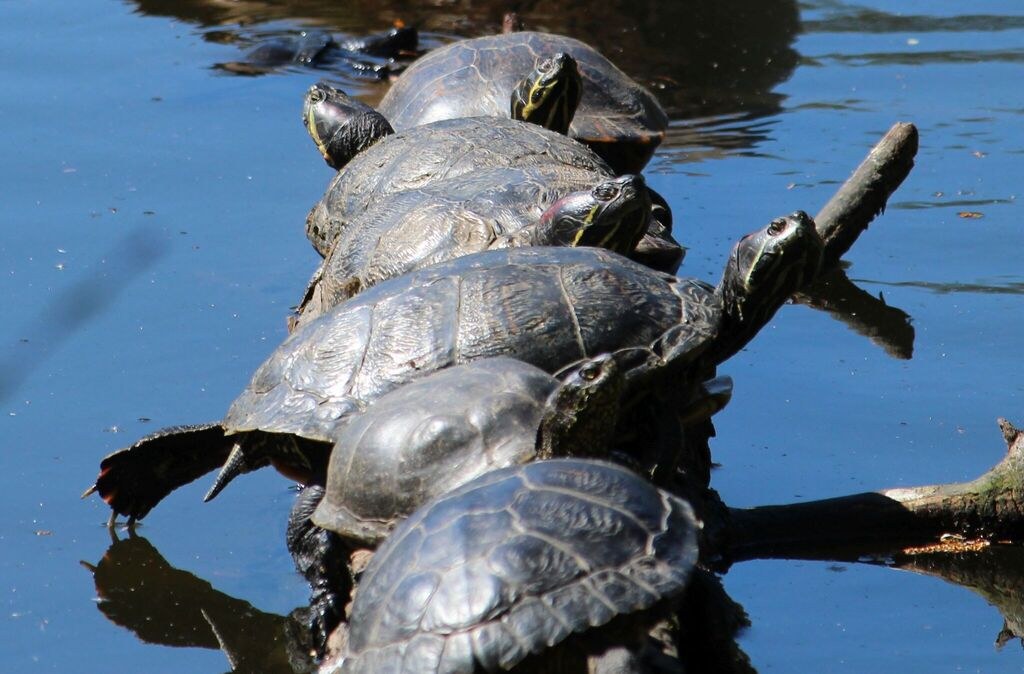
Turtles on a log, several at once, sliding off all together when you approach. That synchronized escape is where the name slider comes from, and it is the most reliable field sign for this species. Sliders are extremely wary and will drop into the water at the slightest provocation, often long before you get close enough to see the eye patch.
A stack of turtles
Sliders pile on top of each other when haul-out sites are scarce. Anything protruding from the water counts as a basking site: logs, stumps, rocks, bank edges, dock boards, and aerator pumps all get used.
The patch, readable through binoculars
A red or yellow patch behind the eye, readable through binoculars from the far bank. This is how you tell whether the turtles in a Southeast pond are native yellow-bellied sliders, introduced red-eared sliders, or a mixed population, which is a more interesting question than it sounds.
One crossing a lawn from April to July
A turtle crossing a lawn, driveway, or road between April and July. That is a nesting female, potentially 1,500 feet or more from the water she started at, and in one documented account over a mile. She is not lost.
Shallow abandoned digs next to a real nest
Female sliders often excavate one or more trial nests before committing to the actual one, which is a species-specific sign a homeowner can actually recognize.
No audible or olfactory signs
No published source describes a characteristic sound or smell for this species. Presence is a purely visual finding.
Not a sign: fewer stocked fish
What is not a sign: a decline in stocked pond fish. Adult sliders are largely herbivorous, and UF IFAS states directly that pond owners shoot these turtles on the belief they are eating out the fish, and that they are not. If the fish are disappearing, look elsewhere.
Prevention and When to Call a Pro
Never release a pet turtle
Never release an unwanted pet turtle into a pond, lake, canal, or creek. Nothing else matters more. Every serious problem attached to this species traces back to it: genetic swamping of native sliders, introduction of disease and parasites into wild turtle populations, competition with native turtles for food and basking sites, and in all three Southeast states researched here, a legal violation.
The genetic problem is real
It is specific, and it is the reason this species carries regulation at all. The U.S. Geological Survey states that the spread of red-eared sliders into southern states where the yellow-bellied slider is native has produced documented interbreeding between the two, compromising the genetic integrity of the native yellow-bellied slider. Florida's state wildlife agency states the same thing independently, listing hybridization and compromised genetic integrity of native yellow-bellied slider populations among the red-eared slider's threats. The Virginia Herpetological Society's account puts the sharpest version on the record: numerous Virginia populations are already made up of obvious crosses between the two subspecies, and the original Virginia yellow-bellied slider with its own color and pattern characteristics may not exist there after a few more decades except in isolated populations. A separate case exists outside the Southeast, where released red-eared sliders in New Mexico hybridize with the Big Bend slider.
Use the legal rehoming route
Use it instead. Florida runs an Exotic Pet Amnesty Program and a Request to Rehome process, and red-eared sliders there may only be rehomed to permitted individuals. Where a state has no amnesty program, a herpetological society, a licensed reptile rescue, a veterinarian, or the state wildlife agency is the right call. A pond is not.
Do not buy a hatchling
Understand why the small ones are the problem. Federal regulation 21 CFR 1240.62 has made it unlawful since 1975 to sell or distribute viable turtle eggs or live turtles with a carapace length under 4 inches, with narrow exceptions for research and education. The rule exists because small turtles are the ones children handle and mouth. The Centers for Disease Control and Prevention credits the ban with preventing an estimated 100,000 cases of turtle-associated salmonellosis in children per year, but the problem has come back: 15 multistate outbreaks occurred between 2006 and 2014, and in 2012 alone eight outbreaks produced 473 reported illnesses at an estimated 2.8 million dollars in medical costs. Among ill people whose turtle size was known, 88 percent had a turtle under 4 inches, meaning an illegally sold animal. CDC's guidance is blunt: do not buy turtles with shells less than 4 inches long, including from online retailers.
Why the 4 inch rule backfired
That 4 inch rule is also the reason released adult sliders exist in the first place. A coin-sized hatchling bought at a flea market grows into an 8 to 11 inch adult that can live 30 years. The gap between what someone thought they were buying and what they end up with is the mechanism behind nearly every released pet turtle in a public pond.
Treat any turtle as Salmonella
Treat any turtle, wild or pet, as a Salmonella source and wash afterward. Turtles of any size can carry it. One further finding comes from a single source: federal data record that turtle farming and ranching conditions for the pet trade are often extremely septic and that heavy antibiotic use at US turtle hatcheries has given rise to more antibiotic-resistant Salmonella strains. Treat that as documented rather than settled, and wash your hands either way.
Do not remove sliders for fish
Do not shoot or remove sliders to protect pond fish. University of Florida IFAS Extension addresses this head on: sliders are destroyed by pond owners who believe the turtles will eat all the fish, and they will not. Young sliders eat worms and insects; adults shift largely to plants. The same correction applies to cooters.
Take out the basking structure
If basking turtles are genuinely unwanted, take out the basking structure rather than the turtles. Sliders concentrate on logs, stumps, rocks, dock edges, and aerator pumps, and pile up when haul-out space is short. Removing structure changes the habitat rather than the animals. State the tradeoff honestly though: basking is thermoregulation, worth at least 10 degrees C of body temperature over the surrounding water, so stripping every haul-out site degrades the pond for native turtles too.
Leave a nesting female alone
She is on a short trip and will finish and go back to the water. Interfering with her achieves nothing except stressing the animal.
Verify your own state rule
Verify the rules for your own state before moving, keeping, or giving away any turtle, because these three Southeast states have three genuinely different regimes. In Florida, the red-eared slider is a Conditional species under Chapter 68-5 of the Florida Administrative Code and is listed as Invasive Nonnative. Animals held before July 1, 2007 may be kept without a permit, but Floridians may not acquire one as a pet after that date without a Conditional, Prohibited, and Nonnative Species Permit, which requires an indoor tank or an outdoor enclosure with a containment barrier secured at least 6 inches below ground, an inspection by an FWC Captive Wildlife officer for outdoor enclosures, and destruction of any eggs on a daily basis. Albino and amelanistic animals are exempt from the permit requirement. FWC Rule 68-5.001 prohibits releasing any non-native animal in Florida, and Florida Statute 379.231 makes it unlawful to release within the state any species not native to it. Native Florida sliders are separately protected, with a take limit of one per person per day from the wild and no commercial use.
South Carolina caps possession
South Carolina caps native turtle possession and criminalizes both nonnative release and native re-homing. Act 177, signed September 28, 2020, set personal possession limits of five yellow-bellied sliders and five common snapping turtles, subject to an aggregate limit of ten native turtles total. The same Act made it illegal to release or allow the escape of any nonnative wildlife in the state, a misdemeanor carrying penalties up to 2,500 dollars, where before there had been no restriction or penalty at all for most nonnative releases. State regulation goes further and prohibits selling, purchasing, trading, exchanging, bartering, exporting, shipping, transferring, or re-homing any native reptile or amphibian, with defined exceptions including sale of yellow-bellied and snapping turtles from certified aquaculture facilities and private ponds. Handing a native slider to a neighbor is a regulated transfer in South Carolina, not a favor.
Georgia caps it at ten
Georgia caps possession at ten and has a specific mechanism for the private-pond case. Possessing more than ten freshwater turtles of any combination requires a commercial turtle farming permit. There is no closed season for freshwater turtle harvest, but taking state or federally protected species is prohibited, and collecting native freshwater turtle eggs from the wild is unlawful. For exactly this situation, the state may issue a catch out authorization for private ponds that lets a licensed nuisance wildlife control operator remove native freshwater turtles above the normal limits. A nuisance wildlife control permit holder may capture, possess, or transport native freshwater turtles but may not hold them more than 72 hours. Releasing a captive wild animal is separately unlawful under Georgia code 27-5-7, and Georgia DNR's own public messaging is that it cannot emphasize enough how important it is to never release non-native species in the state.
Who to Call, and When
Call any time removal, relocation, or transfer off the property is under consideration, because all three states above regulate at least one of possession, transfer, or release and none of them permits an unrestricted do-it-yourself move. In Georgia specifically, a private pond with more turtles than the owner wants is precisely what the catch out authorization exists for, and it runs through a licensed operator rather than the homeowner. Call if the animal cannot be identified confidently, since a slider, a cooter, a snapping turtle, and in Gulf drainages an alligator snapping turtle can share one watershed and the last of those carries stronger protection in several states, which makes misidentification a legal question rather than only a biological one. And call, or contact the state wildlife agency, if a pet slider needs rehoming, since that is itself a permitted process in Florida and a regulated transfer in South Carolina. Rules vary by state and change over time, so verify locally rather than assuming any of the three examples above applies where you are.
State-regulated - verify locally
Frequently Asked Questions
Is it illegal to release my pet red-eared slider into a local pond?
In Florida, South Carolina, and Georgia, yes. Florida prohibits releasing any non-native animal under FWC Rule 68-5.001 and under Florida Statute 379.231. South Carolina's Act 177 made release or escape of any nonnative wildlife illegal, a misdemeanor with penalties up to 2,500 dollars. Georgia makes releasing a captive wild animal unlawful under state code 27-5-7. Rules vary by state, so verify locally, but there is no state where releasing a pet turtle is the right answer. Use a state amnesty or rehoming program, a herpetological society, or a licensed rescue instead.
What is the difference between a red-eared slider and a yellow-bellied slider?
The patch behind the eye. Red-eared sliders have a broad red or orange stripe; yellow-bellied sliders have a large yellow blotch that joins the neck stripe. In the Southeast the yellow-bellied is the native subspecies and the red-eared is an introduced pet-trade animal. Two complications are worth knowing. Where both occur they interbreed, so intermediate-looking intergrades are real and documented rather than a bad identification. And old males of either subspecies can darken to nearly solid black and lose the patch altogether.
Why do turtles stack on top of each other on a log?
Because basking is thermoregulation and haul-out space is limited, so they compete for it. Temperature telemetry on Florida sliders showed an adult basking turtle raising its body temperature at least 10 degrees C above the near-surface water it came out of. The same study found basking is not a daily requirement: some individuals basked five times in a day while much of the population did not bask at all that day.
Will the turtles in my pond eat all my fish?
No. University of Florida IFAS Extension addresses this directly, noting that sliders get shot by pond owners on this belief and that it is not accurate. Young sliders eat small worms and aquatic insects, and adults shift largely to plants. The same correction applies to cooters, the other common basking pond turtle.
Can I catch a slider from my pond and keep it as a pet?
It depends on the state, and it is more restricted than most people expect. South Carolina caps personal possession at five yellow-bellied sliders and ten native turtles in aggregate, and prohibits selling, trading, or even re-homing a native reptile except under defined exceptions. Georgia caps possession at ten freshwater turtles without a commercial permit. Florida limits the take of native sliders to one per person per day with no commercial use, and the non-native red-eared slider requires an FWC permit to possess at all. Check with your own state wildlife agency first.
Is the turtle in my yard a snapping turtle?
If you saw it basking on a log, almost certainly not. Sliders are habitual log-baskers that slide into the water when approached, and common snapping turtles rarely bask. On the animal itself, a snapping turtle has a very large head it cannot pull into the shell, a long tail with a saw-toothed ridge of raised scales, and a small cross-shaped bottom shell that leaves the limbs exposed. That distinction matters, because a slider is not a bite hazard while a snapping turtle handled on land is.
How long do pond sliders live?
Up to about 30 years in wild South Carolina populations, with a maximum recorded captive longevity of 41.3 years. Both figures carry a caveat from their own sources: wild lifespan data for this species are thin, and captive age claims are frequently exaggerated. One genuinely unusual finding is that studies of wild sliders have failed to detect any increase in mortality with age. The practical point for a would-be turtle owner is that a hatchling bought on impulse is a multi-decade commitment, which is exactly how so many end up released.
Sources
- Pond Slider (Trachemys scripta) species profile: size, three US subspecies and their markings, native range of each, state-by-state establishment status including Hawaii, means of introduction, interbreeding with the native yellow-bellied slider, hybridization with Trachemys gaigeae in New Mexico, disease and antibiotic-resistance notes, diet, and clutch size U.S. Geological Survey, Nonindigenous Aquatic Species Database
- Red-eared Slider (Trachemys scripta elegans) species profile: state-level nonindigenous occurrence table including Arizona records from 1962 to 2022 U.S. Geological Survey, Nonindigenous Aquatic Species Database
- Collection record 115770: Kawainui Marsh and Kaelepulu Stream drainage, windward Oahu, Hawaii, 1996, pathway released pet, status established, hatchlings and juveniles routinely observed U.S. Geological Survey, Nonindigenous Aquatic Species Database
- Report: Trachemys scripta, TSN 173819: order Testudines, family Emydidae, subfamily Deirochelyinae, and the three recognized North American subspecies Integrated Taxonomic Information System (ITIS)
- Red-Eared Slider (Trachemys scripta elegans): Invasive Nonnative status, Conditional species rules, permit and enclosure requirements including daily egg destruction, the every-state-except-Alaska introduction statement, and hybridization and disease threats to native yellow-bellied sliders Florida Fish and Wildlife Conservation Commission
- Regulations for Nonnative, Conditional and Prohibited Aquatic Species: the July 1, 2007 grandfather date, the personal-pet permit pathway, the 6 inch below-ground barrier requirement, and daily egg destruction Florida Fish and Wildlife Conservation Commission
- Freshwater Turtles: FWC Rule 68-5.001 prohibits the release of any non-native animal in Florida, and the interbreeding note for red-eared sliders Florida Fish and Wildlife Conservation Commission
- Florida Administrative Code Rule 68-5.004, Conditional Non-Native Species, subsection (3) non-native turtles: permit requirement, pre-2007 possession exception, the under-4-inch possession prohibition after July 1, 2008, and the albino and amelanistic exemption Florida Administrative Code, via Cornell Legal Information Institute
- Florida Statutes 379.231, Regulation of nonnative animals: unlawful to import for sale or use, or to release within the state, any species not native to Florida unless authorized Florida Legislature
- 2020 Year of the Turtle, Sliders: size and sexual size difference, male elongated foreclaws, melanistic phase, native versus non-native subspecies status in Florida, manmade habitat use, diurnal activity and basking, the ontogenetic diet shift and the pond-fish myth correction, the 1,500 foot nesting migration, trial nests, 5 to 20 eggs and up to 3 nests per year, and Florida's one-per-person-per-day take limit University of Florida IFAS Extension, Escambia County
- Year of the Turtle 2020, the Florida Cooters: cooter size and communal basking, the slider versus cooter shell distinction, elongated male foreclaws across both genera, and the repeated correction that these turtles do not eat stocked pond fish University of Florida IFAS Extension, Panhandle Outdoors
- Behavioral Ecology of Basking in the Yellow-bellied Turtle, Trachemys scripta scripta, Bulletin of the Florida Museum of Natural History 20(1): thermoregulation as the primary function of basking, telemetry showing at least 10 degrees C body temperature elevation over near-surface water, the 28.5 and 31.5 degree C water thresholds, the 08:00 start and 10:00 to 11:00 peak, and basking as a non-daily behavior scaling with body size Florida Museum of Natural History, University of Florida, peer-reviewed
- Yellow-Bellied Slider (Trachemys scripta scripta): maximum carapace length, shell and plastron description, melanism in old individuals, clutch of 10 to 12, hatchlings waiting in the nest for rain, mating season, and overwintering behavior Virginia Department of Wildlife Resources
- Red-eared slider (Trachemys scripta elegans): size range and record, the broad red postorbital stripe and its fading in females and hatchlings, melanism in males, communal basking and piling when haul-out sites are few, and wariness Virginia Department of Wildlife Resources
- Yellow-Bellied Slider species account, citing Mitchell and Pague 1990 and Gibbons and Greene 1990: measured clutch size and double-clutching rate, nesting dates, size and age at maturity, egg dimensions, juvenile growth rates, 30 year wild lifespan, and the intergrade and genetic-integrity assessment for Virginia's native yellow-bellied sliders Virginia Herpetological Society
- Turtles in Oregon: the state's two native turtles, the western pond turtle and western painted turtle, and the red-eared slider named among invasive non-native turtles competing with them for food, habitat, and nesting sites Oregon Department of Fish and Wildlife
- Pond Slider (Trachemys scripta): the three Tennessee subspecies and their drainage-level distribution, subspecies head markings, habitat preferences, pet-trade and food-trade collection pressure, and the origin of the name slider Tennessee Wildlife Resources Agency
- Trachemys scripta: subspecies ranges, habitat depth preference, breeding season, age at maturity by sex, clutches per year and clutch size, nesting migrations over 1.6 kilometers, 60 to 95 day incubation, and wild and captive lifespan with the data-quality caveat Animal Diversity Web, University of Michigan Museum of Zoology
- Maturational Changes in Male Slider Turtles (Trachemys scripta) from Illinois, Herpetological Conservation and Biology 3(2): male maturity at 98 millimeters plastron length and 3 to 5 years, foreclaw length over 7 millimeters, and male foreclaws more than double those of similar-sized females Readel et al., 2008, peer-reviewed
- AnAge entry for Trachemys scripta: maximum captive longevity 41.3 years, up to 30 years in the wild, average 75 day incubation, average clutch of 13, and the finding that wild studies failed to detect an increase in mortality with age AnAge Database of Animal Ageing and Longevity, Human Ageing Genomic Resources
- Salmonella and Turtle Safety: the under-4-inch sale ban in effect since 1975 under the Public Health Service Act, its public health rationale, and the do-not-buy guidance U.S. Food and Drug Administration, Center for Veterinary Medicine
- 21 CFR 1240.62, Turtles intrastate and interstate requirements: the general prohibition on sale or distribution of viable turtle eggs and live turtles with a carapace length under 4 inches, promulgated 40 FR 22545 on May 23, 1975 U.S. Food and Drug Administration, via Cornell Legal Information Institute
- Turtle-Associated Salmonellosis, United States, 2006-2014, Emerging Infectious Diseases 22(7): fifteen multistate outbreaks, the estimated 100,000 childhood cases per year prevented by the ban, the 2012 figures of 473 illnesses and about 2.8 million dollars in medical costs, and the 88 percent of ill people whose implicated turtle was under 4 inches Centers for Disease Control and Prevention
- Notes from the Field: Four Multistate Outbreaks of Human Salmonella Infections Linked to Small Turtle Exposure, United States, 2015, MMWR 65(25): continued illegal small-turtle sales at discount stores, flea markets, and by street vendors despite the 1975 ban Centers for Disease Control and Prevention
- Act 177 Frequently Asked Questions: native turtle possession limits including five yellow-bellied sliders and an aggregate limit of ten, the temporary-exemption registration process, and the new illegality and penalty for release or escape of nonnative wildlife South Carolina Department of Natural Resources
- SCDNR Implementing New Regulations on Possession, Sale of native reptiles and amphibians, November 5, 2020: the full possession-limit table, the prohibition on sale, trade, transfer, and re-homing of native reptiles and amphibians, the certified aquaculture and private pond exception, and the new illegality of releasing any non-native wildlife South Carolina Department of Natural Resources
- South Carolina Code of Laws Section 50-15-70, Native turtles: unlawful acts and possession limits, listing yellow-bellied slider and common snapping turtle at five each under an aggregate limit of ten South Carolina Legislature, via Justia
- Frequently Asked Questions about Reptiles and Amphibians, citing Regulation 123-151.3(A): no native reptile or amphibian may be sold, purchased, traded, exchanged, bartered, exported, shipped, transferred, or re-homed except as provided South Carolina Department of Natural Resources
- Subject 391-4-16, Fresh-Water Turtle Regulations: the ten turtle possession limit and commercial turtle farming permit, the prohibition on collecting native freshwater turtle eggs from the wild, the 72 hour holding limit for nuisance wildlife control permit holders, and the catch out authorization for private ponds Georgia Rules and Regulations, Georgia Secretary of State
- Regulations: no more than ten freshwater turtles may be possessed without a commercial turtle permit Georgia Department of Natural Resources, Wildlife Resources Division
- Official Code of Georgia Annotated 27-5-7, Release or escape from captivity: unlawful to release from captivity any wild animal, or to handle one so as to cause its release or escape Georgia General Assembly, via Justia
- DNR Reminds Pet Owners: Tag, Register Wild Animal Reptiles: the agency statement that releasing animals into the wild is illegal and that it cannot emphasize enough how important it is to never release non-native species in Georgia Georgia Department of Natural Resources, Wildlife Resources Division
Image Credits
- Image: richyfourtytwo via iNaturalist. CC BY 4.0.