Seasonal Timeline
Javelina are active year-round across their range, with no dormancy and no migration. What changes through the year is the time of day rather than whether they are around. In hot weather they feed mostly at night and at dawn and dusk, running an estimated 4 to 6 hours of daily feeding. In cool winter months they shift to far more daytime activity, and feeding can stretch to 13 to 15 hours a day.
Javelina are active year-round across their range, with no dormancy and no migration. What changes through the year is the time of day…
Breeding does not give this animal a season either. Javelina are the only wild hoofed mammal in the Western Hemisphere with a year-round breeding season. There is no fixed rut and no single breeding month, though Arizona Game and Fish Department reports most young are born November through March, and Texas sources note a concentration in late spring and early fall. Gestation runs about 142 to 149 days, so with year-round breeding a female can produce more than one litter across a calendar year.
The practical result is that there is no month when a property owner can assume the problem has paused. A yard that looks quiet in July is usually just a yard where the herd is working after dark.
Bedding is the other pattern worth knowing. A herd uses the same bedding area for several days and then moves 200 to 800 yards to a new one. Texas Parks and Wildlife Department attributes part of that rotation to escaping flea buildup in the old site. If a herd has been bedding under a porch or deck and then seems to vanish, it has most likely rotated rather than left.
In the Southwest, damage peaks in the driest pre-monsoon months, when javelina range farther and dig harder for water and succulent roots, and it drops sharply in a wet monsoon year.
Where They're Found
The US range for javelina is three states and only three states: Arizona, New Mexico, and Texas. Every primary source states the same three, and none places a wild javelina population anywhere else in the country. That range splits across two regions: Arizona and New Mexico sit in the Southwest, and Texas sits in South Central.
Texas carries the single largest US population of the three, by aerial survey estimates holding more javelina than Arizona and New Mexico combined. Texas A&M AgriLife launched a five-year, state-funded javelina population study in 2025, which makes Texas an active present-day management concern rather than a range edge. Within Texas the animal concentrates in the South Texas brush country, the Trans-Pecos, and the Edwards Plateau.
Two absences are worth stating plainly. Nevada and Utah are also Southwest states, and no source places javelina in either one. Alaska and Hawaii are both confirmed absent as well. Javelina is a warm-desert specialist with no documented cold tolerance, and no historical introduction or escape record exists for Hawaii.
On the ground, javelina use desert washes, dense prickly pear and chaparral and scrub-oak thickets, rocky canyons with caves or hollows, oak-juniper woodlands on the Edwards Plateau, and Trans-Pecos desert grasslands. In Arizona they range from the desert floor up to about 7,000 feet, with typical habitat below 5,500 feet. Herd home ranges average somewhere around 550 to 800 acres, with Texas figures running 300 to 550 acres depending on population density and Arizona figures closer to 800, and neighboring herds overlapping at the edges by roughly 200 yards.
Javelina do not move into a structure the way a rodent or a bat does. This is an outdoor animal. What it will do is bed down in the cave-like space under a porch, a deck, a mobile home, or a crawl space, and return to that spot repeatedly until it is closed off.
Life Cycle
The weight figures differ by source, and the spread is more useful than an average. The general published range for an adult javelina is 30 to 60 pounds. Inside that range, Arizona Game and Fish Department cites males averaging around 65 pounds and females around 50, while Texas Parks and Wildlife Department cites a typical adult at 35 to 45 pounds with some individuals in the 50 to 60 pound range. Those are two state agencies measuring two different populations at opposite ends of the animal's US range, not a contradiction to resolve. The number that matters for identification is the floor and the ceiling, because the highest figure any of these sources cites for a javelina still sits below the low end of the feral hog range.
Breeding is continuous rather than generational. There is no seasonal generation count for this species the way there is for an insect. With a roughly 5 month gestation and no closed breeding window, a single female can carry more than one litter across a calendar year, which is why herd size on a given range tracks habitat quality more closely than it tracks the calendar.

Gestation
Newborn
Juvenile
Adult
Identification
A javelina is not a pig
That is real taxonomy rather than a technicality. Javelina belong to the family Tayassuidae, the peccaries, which is a separate family from Suidae, the family that contains true pigs and feral swine. Peccaries are a New World family and pigs are an Old World family. They are only distantly related, and they cannot produce fertile offspring together. Every other identification point follows from the fact that these are two different animals that happen to look alike from a distance.
Size settles the feral hog mix-up
Size settles most feral hog mix-ups on its own. Adults stand 18 to 20 inches at the shoulder, run about 3 feet long, and weigh 30 to 60 pounds. Feral swine run 75 to 250 pounds and up. If the animal is big enough to make you reconsider the size of your fence, it is not a javelina.
One color pattern, and that is the tell
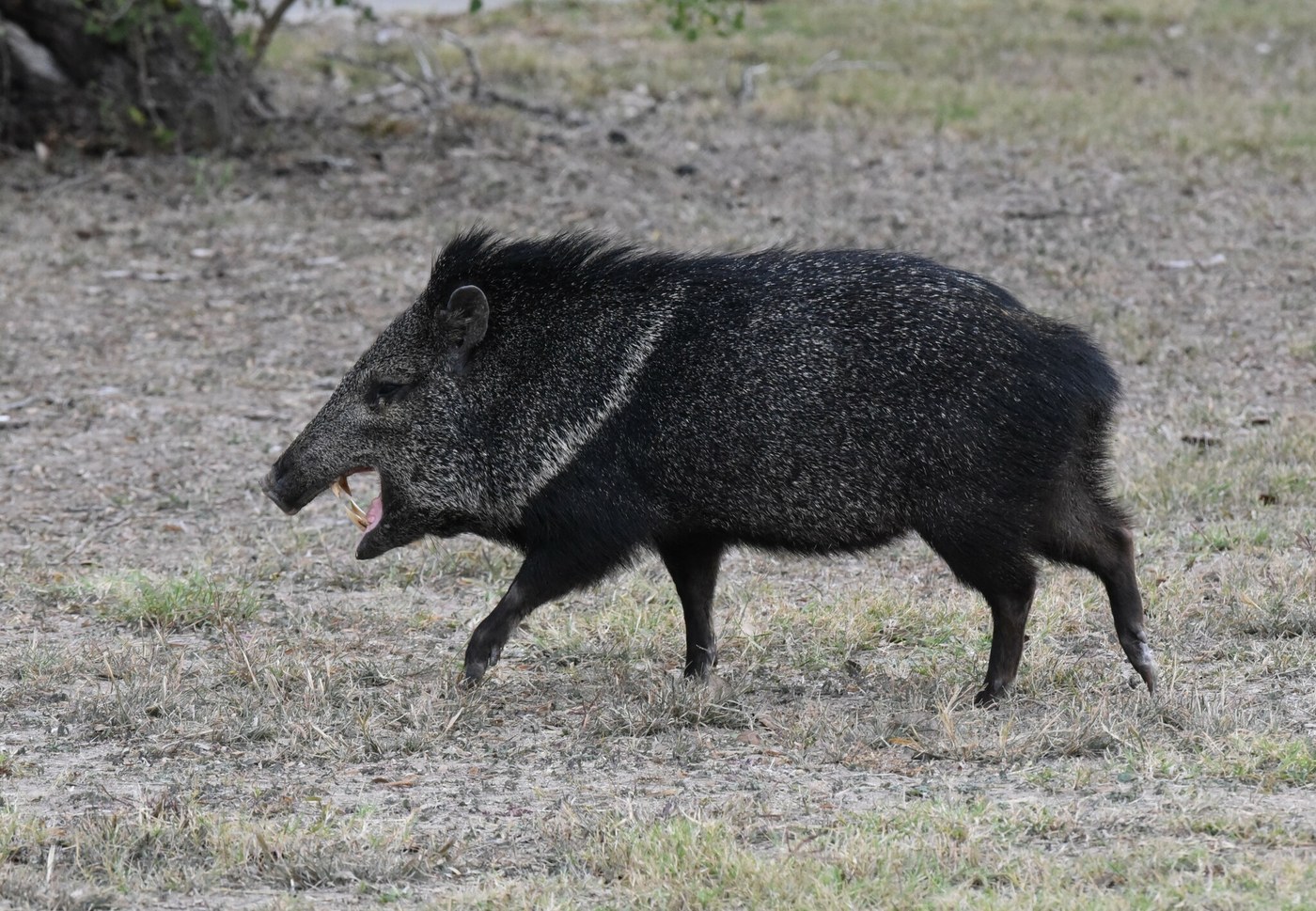
There is exactly one color pattern, and that is itself the tell. Coarse grizzled black-and-gray salt-and-pepper hair, with a lighter band of hair, the collar, running across the shoulders and neck. That collar is where the name collared peccary comes from. Feral swine come in white, black, brown, and red in almost any combination, frequently blotched or spotted. Wide color variation rules a javelina out.
No visible tail, and small rounded ears
A javelina's tail is a tuft of hair at most, and is usually not visible at all. Feral swine have a clearly visible tail and larger, longer, pointed ears. Snout shape backs this up: a javelina's is shorter and more concave, a feral hog's longer and more pointed.
The tusks are straight, not curved
Javelina have well-developed canine tusks built for slashing that run straight up and down, rather than the curving boar-style tusks a feral hog carries. This is also the feature behind the dog-injury risk.
A mane that stands up when alarmed
A dark dorsal mane that stands erect when the animal is alarmed. It runs from the head to the base of the tail and raises like a hackle, which makes the animal look considerably larger than it is. A javelina with its mane up is a javelina that has already noticed you.
You may smell the musk gland first
The musk gland is a physical feature you can often smell before you see the animal. It sits on the lower back, several inches above the tail, and puts out a strong skunk-like odor. It is not a rear-facing spray gland like a skunk's, and there is no spraying involved. The odor simply comes off the animal.
Details from tracks or a carcass
Less visible but genuinely diagnostic details, if you have tracks or a carcass to look at. The outer dewclaw is absent from the hind feet, so a javelina leaves three hoofed toes on the hind foot against a true pig's four. The stomach is three-chambered and non-ruminant, adapted to a fibrous cactus diet. There are fewer teeth than a true pig has, and females carry only two pairs of mammary glands, set low on the abdomen between the hind legs.
Signs of Infestation
Shallow digging, rarely 2 inches deep
Shallow digging, rarely more than 2 inches deep, is the single most useful sign. Javelina dig for roots, tubers, bulbs, and grubs just under the surface. Feral swine root deep and turn ground over wholesale. If the disturbance in a planting bed is broad and shallow rather than deep and churned, that points to javelina, and it points away from the far more expensive problem.
Torn-up planting beds
Ornamental cactus, succulents, and bulb beds take the worst of it. These are javelina's actual preferred foods rather than incidental targets, which is why landscaping choice matters so much.
Shredded prickly pear pads
Look for tooth marks and missing spines in a small radius. This is close to a signature. A javelina drags a pad along the ground with a forefoot to break off the largest spines, then holds it down and shreds it with its canine teeth. The damaged pads and the scattered broken spines usually sit within a few feet of each other.
Chewed irrigation hose and drip line
Javelina chew water lines going after moisture, and in dry habitat this is one of the more common ways a herd first announces itself on a residential property.
Cloven tracks, in pairs
Cloven pig-like tracks, roughly 1 to 1.5 inches, in pairs. They are slightly narrower and more delicate looking than a feral hog's track, and the missing hind dewclaw is the confirming detail if the print is clean enough to read.
Flattened bedding under cover
Flattened bedding areas under dense brush, porches, decks, sheds, and crawl spaces. A herd will reuse a bedding site for several days before rotating 200 to 800 yards away, so a flattened area that looks abandoned is often still in the rotation.
A rapid tooth-popping sound
A rapid tooth-popping or jaw-clacking sound, described as like two bones striking together about four times a second. This is an alarm and threat display, and it is specific enough to confirm the animal without seeing it. Grunts, growls, barks, and a low whoof round out the herd's vocabulary.
Skunk-like musk with no skunk
A strong, pungent, skunk-like musk odor with no skunk anywhere. Multiple independent sources describe javelina as an animal you smell before you see. The odor comes from the dorsal gland rather than a spray, and it intensifies when the animal is startled.
Prevention and When to Call a Pro
Never trap or relocate one
Do not attempt to trap, kill, or relocate a javelina yourself. This is the first item on the list for a legal reason, not a cautious one. Javelina is a regulated big game species in all three states where it occurs. Arizona Game and Fish Department states outright that it is unlawful to trap javelina, and that it is unlawful to injure or kill game animals unless rigorous provisions under the law have been met. New Mexico requires a draw-only javelina license with a limit of one and mandatory harvest reporting. Texas classifies javelina as a native big game species, harvestable only with the appropriate license in specified counties. Rules of this kind vary by state and by county and they change, so verify current state and local wildlife regulations before taking any action, and route the problem to your state wildlife agency or a licensed nuisance wildlife control operator rather than buying a trap.
The Texas contrast
It is worth stating plainly, because it is where this goes wrong most often. Texas treats feral hogs as unprotected free-ranging livestock a landowner may remove at will, and treats javelina as a native big game species with a license requirement and a mandatory harvest of the meat. A Texas landowner cannot treat a javelina the way they can treat a feral hog. Getting the identification right is the difference between a legal removal and an illegal one.
Relocation usually kills them
Relocation usually kills the animal even when a professional does it. Arizona Game and Fish Department describes removal of a problem javelina as a genuine last resort, contingent on documented severe or repeated property damage after attractant removal has already failed, and notes that relocated javelina frequently do not survive, because of unfamiliar terrain, separation from their own herd, or territorial conflict with a resident herd. Relocation is not the humane middle option it sounds like.
Never feed javelina
There is no circumstance that makes it acceptable. Wildlife agencies put this above every other prevention measure. Feeding, whether deliberate or through unsecured food, is the single largest cause of javelina losing their natural wariness and turning into a persistent and occasionally dangerous neighborhood problem. Arizona Game and Fish Department asks that illegal feeding be reported to the department directly, so a neighbor feeding a herd is something the agency wants to hear about.
Remove the food attractants
Remove food attractants specifically. Feed pets indoors, or put out only what they will finish in one sitting. Do not let birdseed accumulate on the ground, and consider fencing bird-feeding areas. Store birdseed, livestock feed, rodent bait, and pet food indoors. Pick up fallen fruit and nuts promptly. Secure garbage cans with locking lids or by strapping them to a fence, and put cans out the morning of pickup rather than the night before.
Remove the water too
Remove water attractants too, which matters more for javelina than for most wildlife. Javelina get most of their water from prickly pear, and a reliable water source in a dry yard is a strong draw. Keep pet bowls, pools, and ponds elevated out of reach or behind secure fencing, and repair leaking irrigation lines and hose bibs the animals chew for moisture.
Choose resistant landscaping
Choose javelina-resistant landscaping rather than guessing. University of Arizona Cooperative Extension publishes a survey-based javelina plant resistance rating guide, built on prior research plus directly reported herbivory from residents and businesses, that sorts plants into never-to-rarely damaged, sometimes damaged, and frequently damaged. Cacti, succulents, bulbs, tubers, and most tender new growth sit at the wrong end of that list.
Physical exclusion, with specs
For anything javelina do want, physical exclusion is the reliable fix, and the specifications are sourced. A solid block wall or well-maintained chain-link fence at least 4 feet tall, with a concrete footer buried 8 to 12 inches deep, since javelina will dig under an unprotected fence base. For a garden bed specifically, a single-strand electric fence set 8 to 10 inches above the ground works, though local ordinances should be checked before installing electric fencing.
Skirt the space under structures
Skirt or screen the cave-like spaces under structures. Porches, decks, mobile home undersides, and crawl spaces are all places a herd will bed down repeatedly once it finds them. Closing those gaps is ordinary exclusion work and it is one of the few javelina measures a homeowner can fully handle alone.
Leash dogs and fence the yard
Keep dogs leashed and yards fenced, and treat this as the top pet-safety measure. Dogs are the most common trigger for a defensive javelina response, for reasons covered in the next item. Arizona Game and Fish Department, University of Arizona Cooperative Extension, and Texas Parks and Wildlife Department all land on the same recommendation independently.
The dog conflict is the top risk
The dog conflict risk is the best-documented risk of the lot, and it deserves real weight. Arizona Game and Fish Department states directly that javelina may act defensively when they hear or smell a dog, and that dogs and javelina can seriously hurt or kill each other. The department's Tucson region has described dog encounters as the second most common catalyst in aggressive javelina encounters, behind only illegal feeding, and noted that puncture wounds from javelina canine teeth can cause severe injury. Texas Parks and Wildlife Department corroborates the same pattern independently from the Texas side, reporting that many dogs have been crippled or killed trying to attack javelina. The mechanism is not aggression for its own sake. Dogs resemble coyotes, one of javelina's natural predators, so the javelina defends itself or its young. University of Arizona Cooperative Extension separately documents javelina attacks on leashed dogs in cases where the animal had been previously fed by well-meaning homeowners and had lost its natural wariness.
Risk to people is real but rare
The charging javelina story has a specific explanation. Arizona Game and Fish Department calls human-javelina conflict rare overall, and Texas Parks and Wildlife Department calls aggressive encounters with humans very, very rare, with both agencies attributing most human bite incidents to illegal feeding rather than to chance encounters. The apparent charging is largely an artifact of eyesight. Javelina see poorly, with Arizona Game and Fish Department noting difficulty recognizing objects beyond about 100 yards, and they compensate with keen smell and hearing. When a herd is alarmed, individuals scatter in every direction rather than retreating together, so one animal often ends up running toward a person by chance. Give a startled herd room and a clear direction to leave.
Rabies, kept in proportion
Rabies is documented in javelina but is uncommon, and it should be kept in proportion. Javelina are not classified nationally as a primary rabies vector the way raccoons, skunks, foxes, and bats are. Arizona Game and Fish Department confirms javelina can catch rabies and describes the symptom picture, which runs either toward foaming at the mouth and erratic hyperactive behavior or toward fearful, lethargic, or paralyzed behavior. A CDC report documents a lab-confirmed case in Arizona after a javelina bit a hunter, which the agency called the first documented report of rabies in a javelina, and noted that javelina bites most often happen in a hunting context rather than in a random encounter. Anyone bitten should seek immediate medical attention, and the animal will need to be captured or killed and tested. Some sources also note that javelina can carry canine distemper, which is transmissible to pet dogs, though that is a single-source observation rather than an established clinical finding.
Call for repeat bedding or a bite
Call a professional or your state wildlife agency for any repeat bedding under a structure, any bite or injury to a person or a pet, or any animal behaving abnormally. Repeated bedding under a porch or crawl space means the herd has added your property to its rotation and closing the gap needs to happen while the space is empty. A bite is a medical question first and a wildlife question second. And an animal showing the behavior changes described above needs an agency response, not a homeowner one.
Call before handling the animal
Call before doing anything that involves handling, confining, or removing the animal. Given the game species classification in all three range states, the practical threshold for calling is lower than it is for most wildlife. If the fix involves a trap, a firearm, or moving the animal anywhere, it is a call to make rather than a project to start.
Frequently Asked Questions
Is a javelina the same thing as a wild pig or feral hog?
No, and this is not a technicality. Javelina belong to Tayassuidae, the peccary family, which is entirely separate from Suidae, the family that contains true pigs and feral hogs. Peccaries are a New World family and pigs are an Old World family, and they are only distantly related. The clearest field tells: javelina weigh 30 to 60 pounds against a feral hog's 75 to 250 pounds and up, have no visible tail, have small rounded ears, and come in exactly one color pattern, a grizzled black and gray coat with a pale collar. Feral hogs have a clearly visible tail, larger pointed ears, and highly variable coloring.
Why do javelina go after dogs specifically?
Because a dog reads as a predator. Dogs resemble coyotes, one of javelina's natural predators, so a javelina that hears or smells a dog reacts defensively, especially if it is protecting young or has been fed by people and lost its normal wariness. Arizona Game and Fish Department and Texas Parks and Wildlife Department independently identify dog encounters as a leading cause of javelina attack incidents, with Arizona ranking it second only to illegal feeding, and both note the injuries to dogs are frequently serious. Javelina tusks are straight slashing canines, and the resulting puncture wounds can be severe. Keeping dogs leashed and yards fenced is the most effective pet-safety measure available to a homeowner in javelina range.
Why does a javelina smell so bad?
Javelina carry a musk gland on the lower back, several inches above the tail, that produces a strong skunk-like odor. It is not a spray gland and there is no spraying involved. Herd members stand side by side or face to rear and rub the gland's scent onto each other, which is how individuals tell their own herd-mates from strangers, and they rub the same scent onto rocks and tree stumps to mark territory boundaries. The smell gets stronger when the animal is startled or alarmed, which is why people often smell a herd before they ever see one.
Can I trap or relocate a javelina causing problems in my yard?
In most cases, no. Javelina is a regulated big game species in Arizona, New Mexico, and Texas, and Arizona law specifically makes it unlawful to trap them. New Mexico issues a draw-only javelina license with mandatory harvest reporting, and Texas requires the appropriate license in specified counties. Rules vary by state and by county and they change, so verify current state and local regulations before doing anything. Even when a wildlife agency removes a problem animal itself as a last resort, relocated javelina frequently do not survive, because of unfamiliar terrain, separation from the herd, or conflict with an established resident herd. Contact your state wildlife agency or a licensed nuisance wildlife control operator rather than attempting removal yourself.
What do javelina eat, and why are they digging up my cactus garden?
Javelina are omnivores with an unusually cactus-heavy diet. Texas Parks and Wildlife Department reports that prickly pear alone makes up more than half the diet on most ranges, and in dry habitat it is also their main water source, since the pads and fruit hold a lot of moisture. They eat the pads spines and all, dragging a pad along the ground with a forefoot to knock off the largest spines before shredding it with their canine teeth. The rest of the diet fills in with mesquite beans, sotol, lechuguilla, agave, acorns and other mast, wild grapes, ground cherries, desert gourds, green plants, grasses, and some insects, grubs, and occasional carrion. That cactus diet is low in overall nutrients, which is why they supplement so broadly, and it is exactly why an ornamental cactus and succulent bed reads to a javelina as a food plot.
How can I tell whether javelina or feral hogs dug up my yard?
Depth. Javelina dig for roots, tubers, and grubs just beneath the surface and rarely go deeper than a couple of inches, so the damage is broad and shallow. Feral swine root deep and turn ground over wholesale. Two other tells help: javelina damage clusters around cactus, succulents, bulbs, and tender new growth rather than spreading across open lawn or pasture, and shredded prickly pear pads with tooth marks and broken-off spines nearby are close to a javelina signature. Tracks confirm it if the print is clean, since a javelina track is roughly 1 to 1.5 inches and slightly narrower and more delicate than a feral hog's.
How many javelina live in a herd, and are they always in a group?
Javelina are highly social and live in family herds, often called squadrons or sounders, of roughly 5 to 30 or more animals depending on habitat quality, with one documented Sonoran Desert herd reaching 53. Solitary javelina are the exception rather than the rule. There is no single dominant leader the way a wolf pack has one, though separate male and female dominance hierarchies exist within a herd based on age, body size, and, for males, tusk size, and any herd member can sound an alarm. Practically, this means one javelina on a camera at night usually is not one javelina on the property.
Sources
- Living with Javelina: big game classification, the unlawful-to-trap rule, removal as a last resort, feeding and water attractant removal, fencing specifications, dog conflict risk, and rabies symptoms Arizona Game and Fish Department
- Javelina species profile: size, coloration, poor eyesight and keen smell and hearing, habitat and elevation range, and lifespan Arizona Game and Fish Department
- Javelinas, Introducing Mammals to Young Naturalists: prickly pear feeding technique, herd structure and scent marking, bedding rotation, first-year survival, and dog conflict Texas Parks and Wildlife Department
- Javelina in Trans-Pecos West Texas Habitat: Texas range, habitat use, home range size, and herd behavior Texas Parks and Wildlife Department
- Game Animals, Collared Peccary or Javelina: native big game classification in Texas and license requirements Texas Parks and Wildlife Department
- Species account of the Collared Peccary, Mammals of Texas Online Edition: gestation length, birth weight, litter size, and age at sexual maturity Texas Tech University Natural Science Research Laboratory
- Feral Hogs vs. Javelina: side-by-side identification of size, tail, ears, coloration, and snout, and the legal contrast between game species and unprotected feral hogs Texas A&M AgriLife Extension, Coping with Feral Hogs
- Texas A&M AgriLife Fills Critical Knowledge Gaps On Javelina: the five-year Texas population study Texas A&M AgriLife
- What is a Javelina?: peccary family distinction, musk gland and odor, and herd terminology Texas A&M University-Kingsville
- Javelina Plant Resistance Ratings: survey-based landscaping guide sorting plants by how often javelina damage them University of Arizona Cooperative Extension
- Preventing Dangerous Interactions with Wildlife (az1481d): javelina attacks on leashed dogs and the role of prior feeding University of Arizona Cooperative Extension
- Epidemiologic Notes and Reports: Rabies in a Javelina, Arizona, MMWR: the lab-confirmed case and its hunting-context bite circumstances Centers for Disease Control and Prevention
- Licenses and Permits: the draw-only javelina license, bag limit, and mandatory harvest reporting New Mexico Department of Game and Fish
Image Credits
- Image: Cody Stricker via iNaturalist. CC BY 4.0.
License.