Seasonal Timeline
House sparrows do not migrate and stay active in occupied territory year-round. Nesting activity concentrates from early spring, commonly starting in early April, through late summer, as pairs raise 2 to 4 broods (occasionally up to 5) in a season.
House sparrows do not migrate and stay active in occupied territory year-round. Nesting activity concentrates from early spring, commonly…
No regional seasonality data specific to this species was found. The nesting-season window above is sourced from university extension and Cornell Lab research.
Where They're Found
House sparrows are almost entirely tied to human structures and human-altered landscapes. This is not a wild-forest or open-grassland species in practice within its US range. Look for them nesting in building eaves, HVAC and dryer or bathroom exhaust vents, storefront and roadside signage letters, streetlights, gas-station roofs and canopies, the overhanging fixtures that hold traffic signals, gutters, soffits, rafters, ledges, and any nest box intended for another species. Cornell Lab's own overview describes house sparrows nesting in building holes and structures such as streetlights, gas-station roofs, and signs, which matches exactly the pattern homeowners and commercial property owners run into.
House sparrows are highly social and colonial rather than territorial the way many native songbirds are. They commonly nest in loose colonies close to people and defend only the immediate nest cavity, not a wider territory. No particular climate or moisture requirement drives their habitat choice. They track human settlement and food availability, which is consistent with an established range across nearly the entire continental United States.
Alaska: house sparrows are confirmed absent as an established population in Alaska. Range sources place the species across essentially all of North America except Alaska and far northern Canada, and a more detailed account documents only isolated occurrence records in the state, five individual sightings in Ketchikan and a single bird on St. Lawrence Island in 1993, describing these as isolated vagrants rather than an established population, with the nearest real population roughly 1,500 miles away. There is no established Alaska population to manage.
Hawaii: house sparrows are confirmed present and established in Hawaii. The species was documented reaching Oahu in 1871, when 9 individuals were shipped there from New Zealand, and the nominate subspecies has been established in the islands ever since.
Life Cycle
Brood counts and clutch size are given as ranges because sources vary: 2 to 4 broods per year is most commonly cited, with some sources noting up to 5 broods possible under good conditions, and clutch size is cited across a 3 to 9 egg range depending on the source.

Egg
Nestling
Fledgling
Adult
Signs of Activity
Identification
Size
5.9 to 6.7 inches (15 to 17 cm) long, wingspan 7.5 to 9.8 inches (19 to 25 cm), weighing roughly 0.95 to 1.1 ounces. University extension research independently confirms a corroborating figure of 5 to 6.5 inches long, weighing less than an ounce.
Males
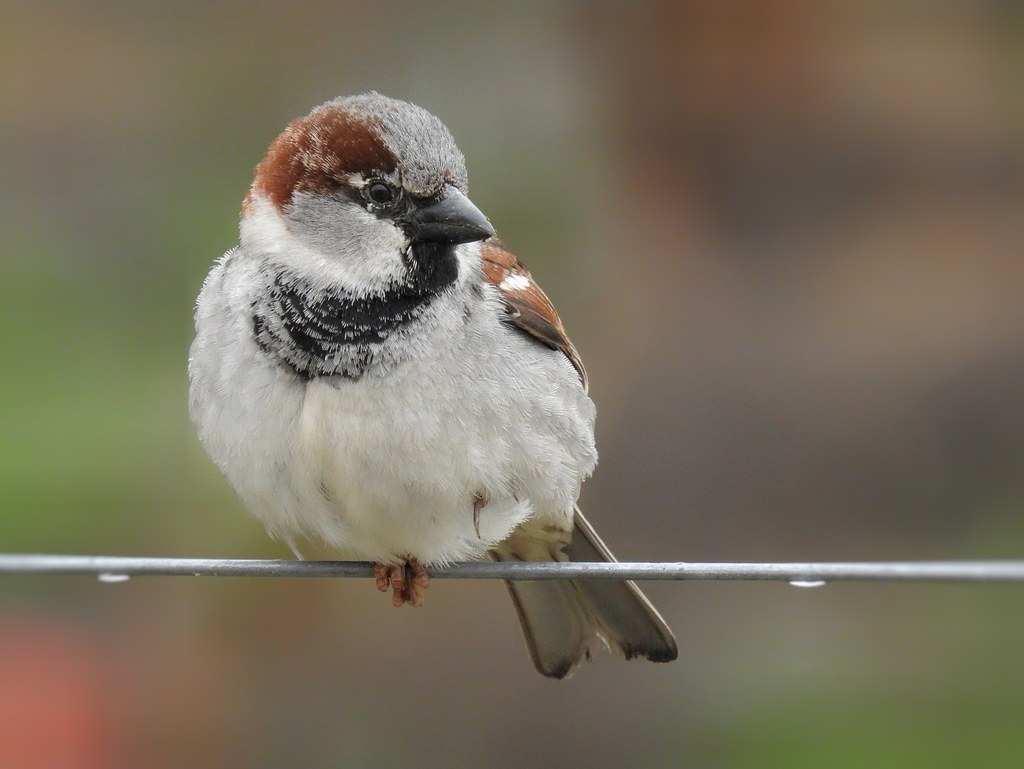
Males show a gray crown, white cheeks, a black throat bib, and a chestnut or rufous nape, with a streaked brown-and-black back. The black bib flanked by white spots is the single fastest field mark on a male.
Females and juveniles
They are plain buffy-brown.
Chunkier than American sparrows
House sparrows are chunkier and fuller in the chest than most American sparrows, with a larger, rounded head, a shorter tail, and a stouter, more triangular seed-cracking bill.
Commonly confused with the house finch
The fastest tell: any red or orange on the bird rules out house sparrow entirely, since male house finches show red on the face, breast, and rump, while male house sparrows never show red at all. Female house finches show blurry brown streaking across a whitish breast and belly, while female house sparrows are plain and unstreaked, buffy-brown. Bill shape is a secondary tell: the house sparrow's bill is thicker and more triangular, the house finch's is slightly curved.
A second, higher-stakes look-alike risk
Native, federally protected American sparrows can superficially resemble a female or juvenile house sparrow at a glance. Because misidentifying a protected native sparrow before removing its nest is still a federal violation, confirm a black-bibbed male or a confirmed active house sparrow colony before treating a nest as unprotected.
Signs of Infestation
Messy, globular nests
They are built of grasses and string.
Accumulated droppings
Accumulated droppings staining ledges, signage, and pavement below a roost or active nest site, along with nesting material spilling out of vents, gutters, or wall and roof openings.
A sharp, repetitive cheep
That call is one of the giveaways. Loose colonies produce a persistent, chattering chorus of these calls near an active nesting site, distinct from the quieter, more melodic songs of many native songbirds.
No species-specific odor
None is documented beyond the general smell any heavy, long-established dropping accumulation can produce.
Prevention and When to Call a Pro
Before anything else
Confirm the bird is actually a house sparrow, not a native, federally protected sparrow species, before removing any nest, eggs, or bird. Misidentifying a protected species is still a legal violation, even if the removal was intended for an unprotected house sparrow.
Seal before nesting season
Seal and screen entry points before nesting season. Check and cover dryer, bathroom, and HVAC exhaust vents, gaps in eaves and soffits, gaps behind signage letters and light fixtures, and any gap around gutters or rafters before nesting activity begins each spring.
Size nest box holes to exclude
If putting up nest boxes for native cavity-nesters, size the entrance to exclude house sparrows. A 1 to 1.25 inch entrance hole admits smaller native cavity-nesting birds while keeping house sparrows out.
Nest disruption is legal here
Nest disruption during construction is a legal, low-cost option specific to this unprotected species. If a house sparrow nest is found early, before eggs are present, the nesting material can be removed repeatedly, every few days, to discourage the pair from continuing at that site. This kind of repeated disruption would be illegal for a protected native species, but is legal here because the species is not MBTA-protected.
Reduce food at farm sites
Reduce food sources at commercial and agricultural sites. House sparrows readily exploit livestock feed and discarded food, so securing feed storage and cleaning up spilled grain reduces the draw that sustains larger urban and farm-adjacent colonies.
On reporting sightings
No state wildlife agency was found actively soliciting house sparrow sighting reports the way some invasive-species programs do for other species. Standard removal and prevention advice applies, but check current state and local rules before any large-scale trapping or removal effort, since regulations can still vary and change.
When to Call a Pest Control Professional
Because house sparrows are not federally protected, DIY nest and egg removal are legally permitted once the bird is correctly identified. Bring in a licensed pest or wildlife control professional when the nest or colony is inside a hard-to-access or high-volume structure such as commercial signage, an HVAC system, or a cluster of vents where repeated DIY disruption is not practical, when a large established colony has taken hold rather than a single new nest, when nest material has already packed into an electrical fixture, sign, or vent system and needs to be cleared without damage, or any time there is real uncertainty about identification.
Frequently Asked Questions
Are house sparrows protected by law?
No. House sparrows are one of only three US bird species, along with European starlings and rock pigeons, not covered by the Migratory Bird Treaty Act, because they were introduced by humans rather than being native migratory birds.
Can I legally remove a house sparrow nest myself?
Yes, for a confirmed house sparrow. The species is not federally protected, so nests, eggs, and birds can be removed without a federal permit. Misidentifying a native, protected sparrow as a house sparrow before removing its nest is still a federal violation, so correct identification matters.
Why are house sparrows considered a problem for other birds?
They aggressively compete for and take over nest cavities used by native cavity-nesting songbirds. Nationwide nest-monitoring data shows house sparrows are the predominant cause of nest-site takeovers in bluebirds and a significant factor for tree swallows and purple martins, sometimes destroying eggs or killing nestlings and incubating adults in the process.
How did house sparrows get to the United States?
They were deliberately introduced to Brooklyn, New York starting in 1851, with releases in 1852 and 1853 successfully establishing the species. They reached the Pacific coast by the 1870s through additional introductions in San Francisco and Salt Lake City and were breeding coast to coast by 1910.
How do I tell a house sparrow apart from a house finch?
Look for red. Male house finches show red on the face, breast, and rump, while male house sparrows never show any red, instead having a gray crown and a black throat bib. Female house finches have blurry brown streaking on the breast, while female house sparrows are plain, unstreaked buffy-brown.
Sources
- House Sparrow Identification Cornell Lab of Ornithology, All About Birds
- House Sparrow Overview Cornell Lab of Ornithology, All About Birds
- House Sparrow Life History Cornell Lab of Ornithology, All About Birds
- Urban Pest Birds: Controlling Damage (G2024) University of Nebraska-Lincoln Extension
- House Sparrow Pesticide Environmental Stewardship (wildlife damage management)
- Managing House Sparrows and European Starlings NestWatch, Cornell Lab of Ornithology
- House Sparrow Virginia Department of Wildlife Resources
- Service Publishes Final List of Non-Native Bird Species U.S. Fish & Wildlife Service
Image Credits
- Image: Esteban Poveda via iNaturalist. CC BY 4.0.
License.