Seasonal Timeline
This species runs on one clock almost everywhere. Females gather into maternity colonies in spring, the colony peaks through the heat of summer, and that is when the noise, the odor, and the calls all arrive at once.
This species runs on one clock almost everywhere. Females gather into maternity colonies in spring, the colony peaks through the heat of…
This species runs on one seasonal driver, not two competing ones. Pregnant females congregate into maternity colonies in buildings, behind chimneys, under bridges, and in tree hollows, caves, and mines. Pups are born from May through early July, fly within 3 to 4 weeks, and are weaned in July and August, after which the nursery colony breaks up. Every regional peak in the table above is that same event, shifted a few weeks by climate.
What actually changes from region to region is who else is in the attic. In California, the Southwest, and South Central, big brown bat frequently shares structures with the migratory Mexican free-tailed bat. In the Northeast and the Midwest, it has largely replaced the little brown bat that used to dominate. That distinction matters more than it sounds, because a migratory species and a year-round resident do not present the same exclusion options in the same month.
Big brown bat is not a long-distance migrator. It hibernates locally, generally from around the first frost, and northern populations may stay in hibernation from September through May. Notably, big brown bats in the northeastern US are documented flying during warm winter spells rather than staying continuously dormant, so a bat sighting in January is not automatically an escaped pet or a sick animal.
The practical consequence of all of this: the summer months when a colony is most obvious are also the months when it is least appropriate to seal it out. See the prevention section below.
Where They're Found
This is a structural bat, which is the whole reason it appears in a pest library at all. Big brown bats enter buildings at the roof edge and roof valleys, at eaves, at the apex of a gable, through chimneys, through attic and roof vents, at dormers, and through siding. They also roost on the outside of buildings, behind shutters, wherever siding and edge boards are not properly joined, lapped, or sealed, and occasionally on porches and patios, in garages, and behind shingles and gutters. Structures with significant sun exposure are especially attractive.
Do not assume an opening is too small. Exclusion work has to address gaps and openings measured in fractions of an inch, not inches. Sourced guidance for this work puts the working threshold at gaps around 1/4 by 3/4 inch and holes about 5/8 inch wide, and the smaller Myotis bats, including little brown bat, can use an opening no wider than 3/8 inch, roughly the width of a dime. Assuming a gap is too narrow to matter is one of the most common and most costly mistakes homeowners make here.
Away from buildings, colonies use tree hollows, caves, mines, bridges, and similar dark retreats. Big brown bats are colonial, which separates them from the solitary tree-roosting species such as eastern red, silver-haired, and hoary bats. Those solitary species normally roost in foliage or under bark and usually turn up in a building only as migratory transients passing through.
Big brown bat is broadly distributed across the lower 48 and is one of the more common structural bat species in North America. It is not a factor in Alaska, and Hawaii's only native bat is a separate, taxonomically distinct species.
Related Pests
Life Cycle
One litter a year, and the timing is set by an unusual piece of biology. Bats generally mate in fall and winter, but the female stores sperm through the winter and ovulation and fertilization do not occur until spring. That is delayed fertilization, which is a different mechanism from the delayed implantation seen in bears and some other mammals, and it is why births cluster so tightly into a May through early July window across a huge geographic range. That tight, predictable window is exactly what makes the exclusion timing rule below workable.

Pup
Juvenile
Adult
Signs of Activity
Identification
The honest starting point
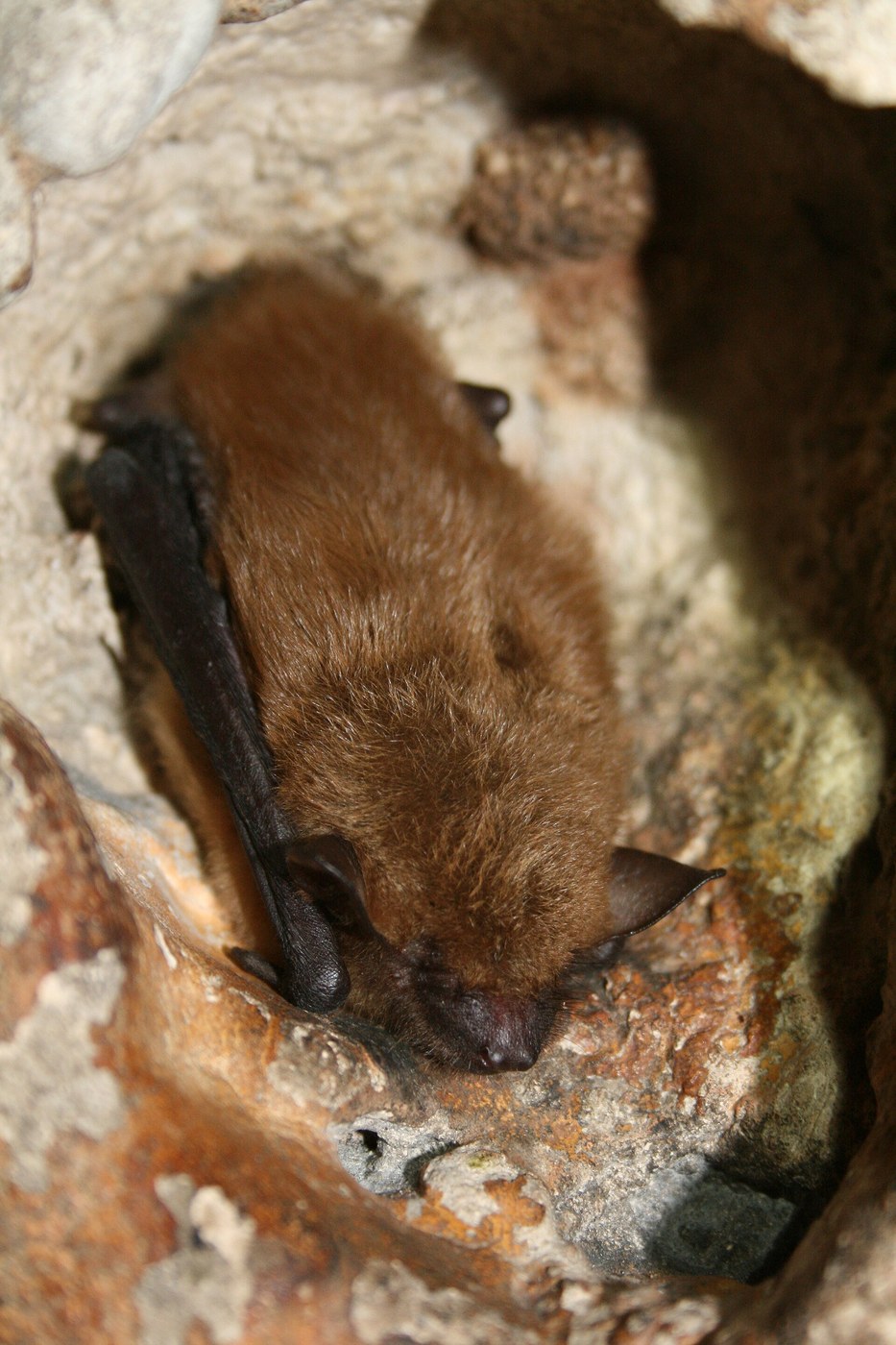
This is not a species most people identify by looking at it. Bats in a structure are seen briefly, at dusk, in poor light, if they are seen at all. The reliable identification for a homeowner is the droppings and the roost signs, not a description of the animal.
Which bat to expect has changed
The single most useful identification fact for this species is which bat you should expect, and that has genuinely changed. Little brown bat (Myotis lucifugus) was for decades the default assumption for a bat in an attic across the Northeast and the Midwest. White-nose syndrome, a fungal disease, has collapsed little brown bat populations across the Great Lakes states and much of the Northeast. Big brown bat has not declined the same way, and it is now the dominant structural bat in exactly the regions where older guidance still assumes otherwise. The differentiator here is range and prevalence, not a physical tell, and no published visual comparison distinguishes the two reliably in the field.
The only mammal that truly flies
Bats are the only mammals capable of true, sustained flight. Most North American bats, this species included, navigate and hunt by echolocation, using sound pitched above the range of human hearing. They also produce audible sounds used to communicate with each other, which is part of why an occupied attic gets noisy.
Colonial, not solitary
That distinction is diagnostic. Big brown bats congregate in colonies, which is why a structural infestation is usually a group rather than an individual. The solitary species, eastern red bat, silver-haired bat, and hoary bat, typically roost in tree foliage or under bark and normally show up in a building only as migratory transients. A colony in an attic is far more likely to be this species or a similar colonial bat than a solitary one.
Legal status varies by species
Not every bat species carries the same legal status, so identification has legal consequences. Northern long-eared bat and Indiana bat are federally listed as endangered. Big brown bat is not federally listed. State-level protection is a separate question and varies, since some states name bats specifically in statute while others protect them only by interpretation, as nongame wildlife or as indigenous state mammals. That is one more reason to have a licensed operator confirm what is actually roosting in your structure before anyone touches it.
Signs of Infestation
Guano is the confirming sign
It is genuinely distinguishable from rodent droppings. Bat droppings are segmented and elongated, and they are friable: crush one and it crumbles to powder, revealing shiny, undigested insect fragments. Rodent droppings taper at the ends, are not segmented, are harder and more fibrous, and do not turn powdery when crushed. Guano accumulates on attic floors, in wall recesses, and on the ground outside the house, especially near a large colony.
Crystallized urine deposits
Bat urine crystallizes at room temperature. Over time it builds into visible whitish coatings, and with a large, long-established colony it can form hard stalactite and stalagmite-like formations on beams and chimney walls. Over long periods, crystallization can expand and separate wood fibers, causing mild wood deterioration.
Staining and spotting outside the building
Bats urinate and defecate as they leave a roost, so entry and exit points get marked from below. Look for spotting on siding, windows, patio furniture, and cars parked underneath.
Rub marks at the hole itself
Repeated passage of oily fur and body secretions leaves a smooth, polished, slightly sticky discoloration, yellow-brown to blackish-brown, along walls, under loose woodwork, and around entry points. A rub mark is the difference between a hole and an actively used hole, and it is what an exclusion job is built around.
A pungent, musty, acrid odor
Decomposing excrement from a large or long-established colony can be detected from outside the building and gets worse in damp weather. For this species, smell is a primary detection method rather than a secondary one. It is often the first thing that prompts the call.
Noise, with an important caveat
Vocalizations, grooming, scratching, crawling, and climbing sounds come from attics, eaves, walls, and between floors, and they are loudest on hot days and around dusk and dawn as bats leave and return. But sound alone does not confirm bats. Rustling in a chimney can be birds or raccoons, and scratching or thumping in an attic or wall can be rats, mice, or squirrels. Guano confirms it. Noise only raises the question.
What you will not find
The absence is useful in itself. Bats do not gnaw or chew structures the way rodents do, and they do not damage gardens or landscaping. The property risk here is accumulation, not destruction: guano filling wall, floor, and ceiling voids, a slip hazard on floors, steps, and ladders, contaminants entering air ducts near a roost, and in extreme cases enough weight to compromise a ceiling.
Prevention and When to Call a Pro
Eviction and exclusion is the standard
Eviction and exclusion is the gold standard, and it is described that way for a reason. It is not merely the humane option or the legally safest one. It is also the more effective one. The method is to locate every active and potential opening, identified by rub marks, guano, or odor, seal all of them except the actively used holes, and fit those with a one-way door or check valve so bats can leave but cannot get back in. Once the colony is out, the last openings get closed. That is the whole job, and done properly it holds, because the openings a colony needs are gone rather than merely defended.
Timing is the biggest variable
Timing is the single most important variable, and there is a specific window when this work should not happen at all. Standard professional guidance is not to attempt eviction or exclusion between roughly May 15 and August 15. The reason is mechanical, not bureaucratic. A one-way device installed during the maternity season lets the adult females out but leaves flightless pups trapped inside, and a mother separated from her trapped young may try to reach them by flying into the home's living space. Trapped pups searching for an exit raise the same risk from the other direction. This is a widely used professional standard rather than one state's statute, and actual state law can set different specific dates. Neighboring states genuinely differ on this. Confirm current dates with your state wildlife agency or a licensed nuisance wildlife control operator before any sealing work begins.
What to do in maternity season
There is still something legitimate to do during the maternity window. Full exclusion is off the table, but the correct interim strategy is to seal every unused opening while leaving the active holes open, and to concentrate effort on sealing gaps between the roost area and the actual living space of the home. That protects the household without trapping anything. This is a job for a licensed operator, not a weekend project, and it is the answer to the very common question of whether you simply have to wait and do nothing.
A second timing constraint
The maternity season is not the only timing constraint. Eviction should also be avoided during winter hibernation in structures that bats actually use for hibernating. Outside both windows, one-way doors need to stay in place for at least 3 to 5 days, and longer in poor weather, before the final openings are sealed. Pulling the devices early leaves bats inside.
Never handle a bat bare-handed
Separately from the timing question, never handle a bat with bare hands. Big brown bat is a designated rabies vector species, and that is a health rule that applies year-round, in every region, regardless of season. Nationally, bats account for the largest single share of reported wildlife rabies cases, 35 percent, ahead of raccoons, skunks, and foxes. Two pieces of context belong right next to that number, because without them it reads as more alarming than it is. Fewer than 1 percent of all bats carry rabies. That rate rises to nearly 3 percent among bats that have had abnormal contact with people or animals, meaning bats found on the ground or behaving unusually. The relevant risk category is not any bat. It is a bat that is behaving abnormally or that made contact. If a bat has to be handled, it is handled with leather gloves and a container, never with bare hands.
The three-part exposure test
There is a specific three-part test for whether a potential rabies exposure occurred, and it exists because a bat bite is not always visible on human skin. Treat it as a potential exposure if anyone in the building was awakened to find a bat flying in their room, if a bat was found in a room with an unattended child whether the child was sleeping or not, or if a bat was found in a room with someone unable to say for certain whether they had been bitten. Any one of those three is a call to your county or state health department, not a judgment call to make at home.
One bat inside the house
If you find a single bat inside your home. Close doors to confine it to one room if you can, and reduce hiding places. Do not touch it bare-handed. If any of the three exposure scenarios above apply, do not release the bat: capture it carefully without damaging its head, using a wide-mouthed container or tube, keep it cool but not frozen, and deliver it to your county health department for testing.
Release works differently for bats
Release, if there was genuinely no exposure, works differently for bats than for other wildlife. A bat with no bite risk and no possible human exposure can be released outdoors on the same property, on a tree at least 5 feet above the ground. What it should not be is moved to a different property. There is no benefit in doing so, and a bat can simply fly back if it chooses. Distance-based relocation, the idea that carrying an animal several miles away solves anything, does not apply to a species that flies. Translocation is not recommended for bats.
Bat houses complement exclusion
Bat houses are a real complement to exclusion, though not a substitute for it. Installing a bat house a few months to a year before a planned exclusion gives the colony time to find and adopt the alternative roost. Research shows bat houses can be successfully occupied during and after an eviction when they are placed near the original roost. It is a genuinely good outcome: the bats keep working through your insects, just not from inside your attic.
The materials that actually hold
Latex, butyl, and acrylic caulk last about 5 years, while silicone-based elastomeric caulk lasts indefinitely. Flashing handles joints such as a roof-to-chimney seam. Quarter-inch hardware cloth or knitted wire mesh handles soffit vents and gaps. Self-expanding foam handles larger openings and has to be applied carefully so it does not lift siding or shingles. A chimney flue needs a properly fitted spark arrester or pest screen that is not permanently attached, and it has to be checked against your local fire code.
What does not work, and is not legal
What does not work, and what is not legal. Frightening devices are not effective on bats. No toxicant is registered for bat control at all. Shooting is impractical and illegal in many states. Trapping is not recommended, and it is not endorsed by Bat Conservation International, because eviction and exclusion is less complicated, less time-consuming, more effective, and requires no handling of bats at all.
Guano cleanup is its own hazard
It is not a rabies question. Accumulated guano and the soil around it can carry Histoplasma capsulatum, the fungus responsible for histoplasmosis, a lung infection contracted by inhaling airborne spores when contaminated material is disturbed. That means old deposits should not be disturbed unnecessarily, should be dampened first to cut airborne dust, and require a NIOSH-certified respirator capable of filtering particles as small as 2 microns, or a self-contained breathing apparatus, for anyone entering a contaminated roost. Add sealed disposal and disinfection with a diluted bleach solution and it is clear this is a professional cleanup job, not a shop vacuum and a dust mask on a Saturday.
Who to Call, and When
Call for any active or suspected colony in a living structure, at any time of year, and especially if you discover it during the maternity window, because that is exactly when DIY sealing traps and kills pups and creates a legal problem on top of a wildlife one. Call for any lone bat found inside the home, and call your health department first if any of the three exposure scenarios apply. Call for any guano accumulation large enough to need cleaning out. And keep your pets current on rabies vaccination, since a rabid bat can transmit the disease to pets and livestock, even though transmission from bats to terrestrial mammals appears to be uncommon.
Frequently Asked Questions
Why can't I just seal up the hole the bats are using right now?
If it is roughly mid-May through mid-August, sealing an active entry can trap flightless young bats inside while the mother is still coming and going. She may then try to reach them by flying into your living space instead. Standard professional guidance is not to attempt full exclusion during that window, and in many states doing it anyway creates a legal problem as well. A licensed operator can still seal your unused entries and focus on keeping bats out of your living space until the window closes, then complete the exclusion properly.
Is the bat in my attic dangerous?
Directly, rarely. Bats are the leading wildlife rabies vector species nationally, accounting for 35 percent of reported wildlife cases, but fewer than 1 percent of all bats actually carry rabies, and the rate rises to about 3 percent only among bats that have had abnormal contact with people or animals. A colony roosting in an attic and interacting with nobody is a very different situation from a bat found loose in a bedroom. Any bat that made contact with a person, or that was found in a room with a sleeping adult or an unattended child, has to be treated as a possible exposure and reported to your health department.
What is that smell coming from my attic?
With a bat colony, it is almost always accumulated guano and crystallized urine. The odor is pungent, musty, and acrid, it can often be detected from outside the building, and it gets worse in damp weather. Beyond the smell, a large accumulation is a histoplasmosis exposure risk when it is disturbed, so it needs to be cleaned out by someone using proper respiratory protection rather than swept up casually.
If bats are excluded from my house, can they be released somewhere else?
No, and the reason is specific to bats. A bat can simply fly back, so moving it to a different property accomplishes nothing, and translocation is not recommended. If a single bat is captured indoors and there was genuinely no bite and no possible human exposure, it can be released on the same property, on a tree at least 5 feet off the ground. For a colony, the correct method is exclusion with a one-way door, not capture and relocation.
I keep reading about little brown bats. Is that what I have?
In much of the Northeast and the Midwest, probably not anymore. White-nose syndrome, a fungal disease, has collapsed little brown bat populations across the Great Lakes states and much of the Northeast. Big brown bat has not declined the same way and is now the more common bat actually found in structures across those regions, even though a lot of older content and folk knowledge still assumes little brown bat. The practical difference is small for exclusion work, which is the same either way, but it matters for identification and for anyone reading guidance written for a population that is largely gone.
Sources
- Bats (identification, legal status, biology, damage identification, prevention and control methods, handling) Internet Center for Wildlife Damage Management (University of Nebraska-Lincoln / USDA APHIS Wildlife Services)
- Rabies in the United States: Protecting Public Health Centers for Disease Control and Prevention
- Histoplasmosis Centers for Disease Control and Prevention
- Big Brown Bat (Species of Greatest Conservation Need fact sheet) Connecticut Department of Energy and Environmental Protection, Wildlife Division
- Big Brown Bat Florida Fish and Wildlife Conservation Commission
Image Credits
- Image: U.S. Fish and Wildlife Service Headquarters via Wikimedia Commons. Public domain.