Seasonal Timeline
Colonies form in spring, peak through the heat of summer when flightless pups are in the roost, and disperse in late summer ahead of a fall move to hibernation sites. The months a colony is most obvious are the months exclusion work must not happen.
Colonies form in spring, peak through the heat of summer when flightless pups are in the roost, and disperse in late summer ahead of a fall…
One clock, shifted by climate, and one very large exception. Females gather into maternity colonies in spring, one pup per female is born, and the nursery colony breaks up after weaning. Hibernation runs roughly September through spring in caves, mines, and similar stable, cool underground sites held around 35 to 54 degrees Fahrenheit. Like big brown bat, this species can fly during warm winter spells rather than staying continuously dormant, so a bat seen in January is not automatically a sick animal.
What actually changes region to region is not the calendar. It is how hard white-nose syndrome has hit. The Northeast is where the disease was first detected and where the population collapse is the most severe and the best documented. The Midwest follows closely, with colonies collapsing from roughly 2010 to 2012 onward, and big brown bat has since become the bat more commonly found in many of those same attics. Mountain West, Pacific Northwest, South Central, and Southwest currently carry less severe documented impact, though the disease continues to spread. No published Alaska source reports white-nose detection for this species.
Alaska is a genuine part of the range rather than an edge case. The Alaska Department of Fish and Game describes this as the state's most common and most likely only regularly documented resident bat, roosting in the karst cave systems of Southeast Alaska and in human structures, and managed there as an unclassified game species. The short summer darkness window at that latitude compresses the nightly foraging time available.
Two regions have a thinner seasonal record. California rests on the federal occurrence record rather than on region-specific seasonal detail, and the same thinner sourcing applies to South Central. Both are confirmed presence with a less complete seasonal picture, not regions where the summer maternity pattern has been separately documented in detail.
Where They're Found
This is a structural bat, which is the whole reason it appears in a pest library. Maternity and day roosts go into attics, barns, bat houses, behind shutters, under siding, and comparable cavity spaces, while winter hibernation happens in caves, mines, and similar underground sites. Day roosts, night roosts, nursery roosts, and winter hibernacula are four different places serving four different functions across one year, which is why a structure can look busy in July and empty in January without anything having been solved.
Do not assume an opening is too small. The smaller Myotis bats, this species among them, can use an opening no wider than about three eighths of an inch, roughly the width of a dime. That is a tighter tolerance than the larger big brown bat, and it means gap-sealing thoroughness matters more here, not less.
Away from buildings, the species favors mountainous and riparian forest across the western part of its range, running from xeric scrub through aspen meadows to Pacific Northwest coniferous rainforest, and it forages over lakes, ponds, sloughs, and slow-moving streams and rivers throughout. It is documented from sea level to at least 7,500 feet.
Range, and why it spans nine regions. The U.S. Fish and Wildlife Service's own occurrence database lists this species as currently known or believed to occur in essentially every state except Hawaii, and the agency's species narrative describes a range running from the Alaska and Canada boreal forests south through most of the contiguous United States and into central Mexico. Bat Conservation International and the peer-reviewed range literature independently place the southwestern boundary at southern California, northern Arizona, and northern New Mexico. That is the basis for the nine regions listed here.
Present is not the same as abundant, and density is not uniform. Kentucky's wildlife agency describes the species as largely absent from the southern Great Plains and much of the southeastern Coastal Plain even while listing it as present statewide, and the National Wildlife Federation notes historical absence from parts of southern California, the Great Plains, Florida, and coastal North Carolina and Virginia. Treat South Central and parts of the Southeast and Southwest as a genuine but patchier presence than the Northeast and Midwest core range. Alaska is confirmed established. Hawaii is a confirmed absence rather than an omission: no published source places this species there, and Hawaii's only native bat is a separate and taxonomically distinct species.
Related Pests
Life Cycle
One pup a year, and a lifespan that does not match the animal's size. A single pup per female per year is corroborated across three independent sources, and it is a genuinely slow reproductive rate for a small mammal. Set against that, this is one of the longest-lived small mammals on Earth relative to body size. The commonly cited wild lifespan is 6 to 7 years, but a banded wild individual was documented at 31 years in Massachusetts, and Alaska's wildlife agency separately cites a banded animal in the Yukon living to 34. Two independent state wildlife agencies putting a 31 to 34 year wild record against a 6 to 7 year average is a strong, specific finding rather than a folk claim.
Those two facts belong together. A species that replaces itself one pup at a time, over a very long individual life, recovers slowly from a mass mortality event. That is the biology underneath the population figures.

Mating
Pup
Juvenile
Adult
Signs of Activity
Identification
The honest starting point
This is not a species most people identify by looking at it. A bat in a structure is seen briefly, at dusk, in poor light, if it is seen at all. What a homeowner actually identifies is guano, staining, and roost signs. The physical description matters most to whoever is called out to confirm what is in the building, and with this species confirming the identification has real legal consequences.
Small, glossy, and measurable
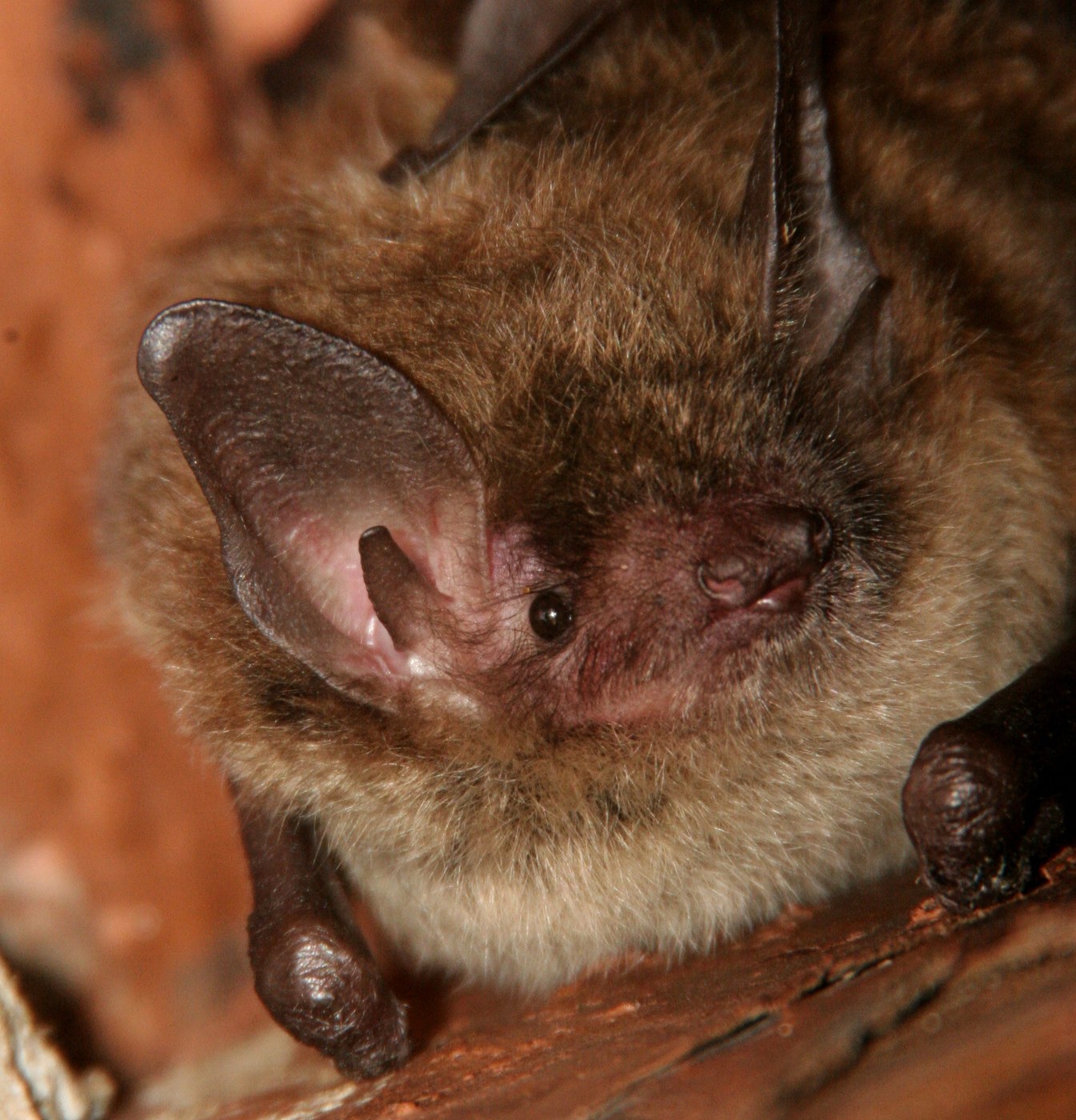
Small, glossy, and with a genuinely usable set of measurements. Body length from nose to tail runs 3.1 to 3.7 inches, forearm 1.4 to 1.6 inches, and weight 0.19 to 0.44 ounce, at its lowest in spring right after hibernation. Wingspan is reported at 8.7 to 10.6 inches, with three state wildlife agencies independently giving a practical range of 8 to 11 inches. Females run larger than males on average. Fur ranges from pale tan or reddish to dark brown and is glossy on the back, with a paler and less glossy light gray-brown to buffy belly that usually contrasts sharply with the back. Snout and ears are dark brown to blackish.
Three tells, all hand checks
Three physical tells, and each one is a hand check rather than a driveway observation. The tragus, the fleshy flap in front of the ear opening, is short, blunt-tipped, slightly curved, and rounded rather than sharply pointed. The calcar, the cartilage spur at the ankle that supports the edge of the tail membrane, has no keel. And the hairs on the toes are unusually long, extending past the tips of the claws. Those three details are what a licensed operator uses to confirm the species, and that confirmation is not academic.
Two look-alikes are endangered
Two of the look-alikes are federally endangered, which turns a misidentification into a legal problem rather than a cosmetic one. The U.S. Fish and Wildlife Service's own species page states that the Indiana bat (Myotis sodalis, federally endangered) resembles the little brown bat, and gives the tell: the Indiana bat has a keeled calcar where this species does not, along with a duller and flatter coat, a lighter nose, and hind-foot hairs that stop at the claws rather than extending past them. The northern long-eared bat (Myotis septentrionalis, also federally endangered) is separated by longer ears, a longer and pointed tragus, larger wing area, and a longer tail, per New York's Natural Heritage Program and corroborated by a peer-reviewed field identification key. In the Southwest there is a third look-alike without the same legal stakes: the Arizona myotis (Myotis occultus), described by that same key as similar in appearance with overlapping measurements. In parts of this range, assuming it is just a little brown bat can be both wrong and legally consequential.
Which bat to expect has changed
The single most useful identification fact is which bat you should now expect, and that has genuinely changed. Across the Great Lakes states and much of the Northeast, this species was the default assumption for decades. White-nose syndrome collapsed those populations, and big brown bat is now the bat more commonly found in structures across those same regions. The differentiator there is prevalence rather than a physical tell. It cuts the other way too: because this species historically formed some of the largest maternity colonies of any North American structural bat, hundreds to thousands of animals in a single roost, an unusually large colony is a real reason to suspect this species specifically rather than defaulting to big brown bat.
Colonial, nocturnal, and echolocating
This is one of the most social bat species in North America. Males and females largely separate through the summer, with females rearing pups in maternity colonies and males roosting more solitarily, and they reunite for fall. Bats are the only mammals capable of true, sustained flight, and they navigate and hunt using echolocation pitched above human hearing, alongside audible calls used to communicate with each other. That social chatter is part of why an occupied attic gets noisy.
Signs of Infestation
Guano is the confirming sign
It is distinguishable from rodent droppings. Bat droppings are segmented and elongated, and they are friable. Crush one and it crumbles to powder, revealing shiny, undigested insect fragments. Rodent droppings taper at the ends, are not segmented, are harder and more fibrous, and do not turn powdery. Droppings are not reliably told apart between bat species, so guano confirms bats rather than confirming which bat.
Crystallized urine deposits
Bat urine crystallizes and builds into whitish coatings over time. In a large, long-established colony it can form hard stalactite and stalagmite-like formations on beams and chimney interiors.
Staining and rub marks at the entry
Exterior staining and rub marks at the entry itself. Bats mark the outside of a structure below the openings they use, and repeated passage of oily fur leaves a smooth, polished, oily discoloration around an active hole. That distinction between an opening and an actively used opening is what the whole exclusion method is built on.
A pungent, musty odor
It comes from accumulated guano and urine, it gets worse in damp weather, and it scales with how large and how long-established the colony is. It is frequently the thing that prompts the first call.
Colony size can be startling
Colony size is itself a sign, and for this species it can be startling. Historically documented maternity colonies of this species run into the hundreds and thousands of individuals in a single structure, among the largest of any North American structural bat. A homeowner finding an unusually large colony rather than a handful of animals has a real reason to suspect this species specifically, even in regions where big brown bat has become more common overall.
Noise, with an important caveat
Vocalizations, scratching, and crawling sounds come from attics and wall voids and are most noticeable at dusk and dawn as bats leave and return. Sound alone does not confirm bats. Rustling and scratching in an attic or chimney can just as easily be birds, raccoons, rats, mice, or squirrels. Guano confirms it. Noise only raises the question.
What you will not find
The absence is useful in itself. Bats do not gnaw or chew structures the way rodents do, and they do not damage gardens or landscaping. The property risk is accumulation rather than destruction: guano filling voids, creating slip hazards, and in extreme cases adding enough weight to compromise a ceiling.
A brief note on bat ectoparasites
The mites, ticks, fleas, and bat bugs associated with a roost rarely attack people or pets and die off once a colony has been excluded. It is a real thing, not a common one, and it is not on the order of the rabies and histoplasmosis concerns.
Prevention and When to Call a Pro
Never handle a bat bare-handed
Never handle a bat with bare hands. This rule comes first, and it holds regardless of season, region, or anything else. Bats are a designated rabies vector species, and Centers for Disease Control and Prevention data attributes the single largest share of reported United States wildlife rabies cases, 35 percent, to bats as a group, ahead of raccoons, skunks, and foxes. That figure is reported for bats collectively rather than broken out by species. No bare-handed contact, no home capture and release. If a bat has to be handled at all, it is handled with leather gloves and a container by someone qualified to do it.
The three-part exposure test
There is a specific three-part test for whether a rabies exposure occurred, and it exists because a bat bite is not always visible on human skin. Treat it as a possible exposure if a bat was found flying in a room where someone was sleeping, if a bat was found in a room with an unattended child, or if a bat was found in a room with someone who cannot say for certain whether they were bitten. Any one of those is a call to your county or state health department rather than a judgment call to make at home. In those cases the bat is not released, it is delivered for testing.
Eviction and exclusion is the fix
Eviction and exclusion is the correct method, and it is the only one that works permanently. Locate every active and potential opening, identified by rub marks, guano, or odor. Seal all of them except the actively used holes, and fit those with a one-way door or check valve so bats can leave but cannot return. Leave the devices in place at least 3 to 5 days before the last openings are sealed. Pulling them early leaves bats inside.
Timing is the biggest variable
Timing is the most important variable, and there is no single national date. Exclusion must not happen during the local bat maternity season, because sealing an active entry then traps flightless pups inside, and a mother separated from her young may try to reach them by flying into the home's living space. State and regional guidance clusters around a June through mid-August core window, but the actual dates are set state by state and neighboring states genuinely differ. Florida's wildlife agency sets a statewide maternity season of April 15 through August 14 covering all of the state's resident bat species. Virginia's current nuisance wildlife permit conditions set it at May 1 through August 15. North Carolina's wildlife agency sets its own exclusion moratorium at May 1 through July 31, and Maine restricts exclusion from unoccupied buildings during the maternity season it defines as June and July. Those are cited examples of the real variation, not a national rule. Confirm the current window for your address with your state wildlife agency or a licensed nuisance wildlife control operator before any sealing work is scheduled.
What to do in maternity season
There is still legitimate work to do inside the maternity window. Full exclusion is off the table, and there are no do-it-yourself exclusion instructions for that period, because there is no safe version of the work. What is available is sealing every unused opening while leaving the active ones alone, and concentrating effort on closing the gaps between the roost space and the home's actual living space. That protects the household without trapping anything. Separately, avoid disturbing structures the bats use for winter hibernation.
It is not federally listed
This species is not currently listed as threatened or endangered under the federal Endangered Species Act, and it is worth being precise about that. The U.S. Fish and Wildlife Service's own species database gives the current federal listing status in one word: under review. The Service completed a species status assessment in 2021, its own 2022 public guidance stated the little brown bat review was scheduled for completion in fiscal year 2023, that deadline has passed without a decision, and industry regulatory tracking now describes the species as expected to be evaluated for listing in 2026. So: review pending, no federal listing decision made, one expected sometime in 2026. That is a genuinely different statement from either it is basically endangered or it is fine and unprotected, and both of those are common and wrong.
No listing is not no protection
No federal listing does not mean no protection, and two states prove it directly. Georgia's state wildlife agency biodiversity portal carries this species at State Rank S1 and states plainly that it is listed as endangered in the state of Georgia. Massachusetts's wildlife agency spotlight page lists the species' Massachusetts conservation status as Endangered directly alongside a federal conservation status of not listed. That same split between state and federal status turns up nationally. Other states carry their own listings for this species as well. Check your own state before anyone touches a colony.
Confirm the species first
If the identification is uncertain, get it confirmed before any exclusion work begins. This caution matters more for this species than for most bats. Indiana bat and northern long-eared bat are both federally endangered, both are documented look-alikes for this species specifically, and the tells that separate them are hand checks: a keeled calcar for Indiana bat, a longer pointed tragus and longer ears for northern long-eared bat. Sealing up or disturbing a roost that actually holds one of those two is a different legal situation entirely, potentially an unpermitted disturbance of a federally protected species. In any region where those species also occur, professional identification comes before the work, not after it.
The scale of the decline
The decline is the reason this species gets handled carefully. White-nose syndrome is caused by a cold-loving fungus believed introduced from Europe or Asia and first documented in a New York cave in the mid-2000s. It grows on the skin of hibernating bats and disrupts hibernation, waking them far more often than normal until they burn through limited fat reserves and die of starvation or dehydration before spring. The National Park Service states this species declined by more than 90 percent across the eastern United States by 2018, and the U.S. Geological Survey reports a peer-reviewed study drawing on more than 200 sites across 27 states and two Canadian provinces finding the disease killed over 90 percent of little brown bat populations in fewer than 10 years. Other figures exist and describe different scopes rather than contradicting that one: a Rutgers-led genetics study puts the decline at about 78 percent, and individually monitored New York colonies have recorded site-specific declines of 88 and 99 percent. The best supported range-wide figure is the greater than 90 percent number, from the two strongest sources.
Real reason for hope
There is real, current, peer-reviewed reason for hope, and it should not be overstated either. Independent research groups have found early genetic evidence that surviving populations are evolving resistance. A University of Michigan-led genome study found genetic differences between bats killed by the disease and survivors, tied to genes governing hibernation arousal, fat metabolism, and echolocation, and a separate Rutgers-led study of colonies in New York, New Jersey, and Vermont reached the same conclusion independently. A 2025 peer-reviewed synthesis states it carefully: some populations show promising indicators of adaptation, but it is still too early to conclude whether that will enable long-term persistence. The disease is not solved. The population is also not simply flatlining.
Seal for the smallest gap
The average gap is not the one that matters. Caulk closes the fine gaps and flashing handles roof and chimney joints. Quarter-inch hardware cloth handles soffit vents. Self-expanding foam handles larger openings and needs care so it does not lift siding or shingles. A chimney needs a properly fitted, code-compliant spark arrester or pest screen. Because the smaller Myotis bats can use an opening as narrow as three eighths of an inch, thoroughness matters more on this species than on the larger big brown bat.
Bat houses complement exclusion
Bat houses are a complement to exclusion, not a substitute for it. Installed months ahead of a planned exclusion, a bat house gives displaced animals time to find and adopt an alternative roost. Given the colony sizes this species has historically reached, a bat house program here may need to accommodate more animals than a typical big brown bat colony would require.
What does not work, and is not legal
What does not work, and what is not legal. Frightening devices are not effective on bats. Naphthalene is the only EPA-registered indoor repellent, its efficacy is limited, and prolonged inhalation is a human health hazard in its own right. No toxicant is registered for bat control at all. Shooting is impractical and illegal in many states. Trapping is not recommended and is not endorsed by Bat Conservation International, because exclusion is simpler, faster, more effective, and requires no handling of bats.
One bat inside the house
If you find a single bat inside your home. Confine it to one room if you can, and do not touch it bare-handed. If any of the three exposure scenarios above apply, do not release it, and contact your health department. If there was genuinely no bite and no possible exposure, it can be released outdoors on the same property, on a tree at least 5 feet off the ground. What it should not be is carried to a different property. Distance-based relocation does not work on an animal that flies, and translocation is not recommended for bats.
Guano cleanup is its own hazard
Guano cleanup is a separate hazard from rabies. The Centers for Disease Control and Prevention confirms histoplasmosis as a fungal lung disease contracted by inhaling spores of Histoplasma capsulatum from soil and material contaminated with bat or bird droppings. That makes any accumulation large enough to need clearing out a professional, respirator-protected job with controlled handling and sealed disposal, rather than a shop vacuum and a dust mask on a Saturday.
Who to Call, and When
Call a licensed wildlife control professional for any active or suspected colony in a living structure, at any time of year, and especially during the local maternity window, because that is exactly when sealing traps and kills pups and creates a legal problem on top of a wildlife one. Call whenever the species identification is uncertain in a region that also hosts Indiana bat or northern long-eared bat, because that call is about avoiding an unpermitted disturbance of a federally protected species rather than just about safe handling. Call your health department first for any lone bat found inside where one of the three exposure scenarios applies. Call before any guano cleanup large enough to need clearing out. And keep pets current on rabies vaccination.
Frequently Asked Questions
Are little brown bats basically gone because of white-nose syndrome?
Not everywhere, and not permanently. Populations in the Northeast and Midwest have declined by more than 90 percent since the disease arrived, one of the most severe wildlife disease collapses recorded in North America, and the National Park Service and a peer-reviewed study reported by the U.S. Geological Survey independently put the figure above 90 percent. But the species remains present across most of its very large range, from Alaska through the Southwest and into the Southeast, and recent genetic research from two independent university-led teams shows some surviving colonies are evolving real resistance to the fungus. A 2025 peer-reviewed synthesis is careful about it: promising indicators of adaptation, but too early to conclude the species is out of trouble.
Is the little brown bat an endangered species?
Not federally, at least not yet, and the precise answer matters. The U.S. Fish and Wildlife Service's own species database currently gives the federal listing status as under review. The Service completed a species status assessment in 2021 and originally scheduled the review's completion for fiscal year 2023, that date passed without a decision, and the species is now expected to be evaluated for listing in 2026. Separately from all of that, several states carry their own listings. Georgia's wildlife agency states the species is listed as endangered in Georgia, and Massachusetts lists its state conservation status as Endangered while noting the federal status as not listed. So the accurate statement is no federal listing today, a pending federal decision, and real state-level protection in specific states.
Why can't I just seal up the bat entry hole in my attic right now?
Because if it is inside the local maternity season, sealing an active entry traps flightless pups inside, and the mother may then try to reach them by flying into your living space. The window generally runs June through mid-August, but the dates are set state by state and they genuinely differ. Florida's runs April 15 through August 14, Virginia's runs May 1 through August 15, North Carolina's moratorium runs May 1 through July 31, and Maine restricts exclusion during June and July. A licensed operator can still seal your unused entries and keep bats out of your living space during that window, then finish the exclusion properly once it passes. Confirm your own state's current dates with the wildlife agency before anything gets sealed.
How do I know if it is actually a little brown bat and not some other species?
By checks that realistically happen in the hand rather than from a driveway. Little brown bats have a short, blunt-tipped, rounded tragus, the flap in front of the ear opening, and no keel on the calcar, the cartilage spur at the ankle. Their toe hairs extend past the tips of the claws. Two federally endangered look-alikes differ on exactly those points: the Indiana bat has a keeled calcar and toe hairs that stop at the claws, and the northern long-eared bat has longer ears and a longer, pointed tragus. In the Southwest, the Arizona myotis is another close match on measurements. If there is any doubt, especially where those federally protected species also occur, get a professional identification before disturbing the roost.
How long do little brown bats live?
Typically 6 to 7 years in the wild, but this is one of the longest-lived small mammals on record for its body size. A banded wild individual was documented at 31 years old in Massachusetts, and Alaska's wildlife agency cites a banded animal in the Yukon reaching 34. Two separate state wildlife agencies documenting records in that range, against a typical 6 to 7 years, is what makes the figure credible. That long life sits alongside a slow reproductive rate of one pup per female per year, and together those two facts explain why recovering from a mass die-off takes this species so long.
Is the bat in my attic dangerous?
Through casual proximity, rarely, but the handling rule is absolute. Bats as a group account for the single largest share of reported United States wildlife rabies cases, 35 percent per Centers for Disease Control and Prevention data, ahead of raccoons, skunks, and foxes. Never handle one with bare hands. Treat it as a possible exposure, needing a call to your health department, if a bat was found flying in a room where someone was sleeping, in a room with an unattended child, or in a room with anyone who cannot say for certain they were not bitten. Separately, accumulated guano carries a histoplasmosis risk when it is disturbed, which is a cleanup hazard rather than a bat contact hazard and is the reason large accumulations need professional respiratory protection.
Sources
- Bats (identification, legal status, biology, damage identification, prevention and control methods, handling) Internet Center for Wildlife Damage Management (University of Nebraska-Lincoln / USDA APHIS Wildlife Services)
- Species Profile for Little brown bat (Myotis lucifugus) U.S. Fish and Wildlife Service, Environmental Conservation Online System
- Indiana Bat (Myotis sodalis): states that the species resembles the little brown bat, and gives the keeled calcar, coat, nose, and hind-foot hair distinctions U.S. Fish and Wildlife Service
- Northern Long-eared Bat species guide: longer ears, longer pointed tragus, larger wing area, and longer tail as the distinctions from little brown bat New York Natural Heritage Program
- What Is White-nose Syndrome: disease mechanism and the greater than 90 percent decline across the eastern United States by 2018 National Park Service
- White-Nose Syndrome Killed Over 90% of Three North American Bat Species, reporting a peer-reviewed Conservation Biology study covering more than 200 sites across 27 states and two Canadian provinces U.S. Geological Survey
- Little Brown Bat (Myotis lucifugus): Alaska occurrence and status as the state's most common resident bat, karst cave roosting, size, and the 34-year banded longevity record Alaska Department of Fish and Game
- Species spotlight: Little brown bat, giving Massachusetts conservation status of Endangered alongside a federal status of not listed, plus litter size and the 31-year wild longevity record Massachusetts Department of Fish and Game
- Myotis lucifugus species profile: State Rank S1 and formal state-endangered listing in Georgia Georgia Department of Natural Resources, Georgia Biodiversity Portal
- Little Brown Bat: size corroboration and the documented absence from the southern Great Plains and much of the southeastern Coastal Plain Kentucky Department of Fish and Wildlife Resources
- Living With Bats: the statewide bat maternity season of April 15 through August 14, during which exclusion is restricted Florida Fish and Wildlife Conservation Commission
- Bats: the June and July maternity season restriction on excluding bats from unoccupied buildings Maine Department of Inland Fisheries and Wildlife
- Rabies in the United States: Protecting Public Health Centers for Disease Control and Prevention
- Histoplasmosis Centers for Disease Control and Prevention
Image Credits
- Image: Adobe Stock, licensed.