Seasonal Timeline
Armadillo activity tracks soil temperature and the insects living in it. Digging is heaviest from late spring through late summer in most of the range, and it runs considerably longer in the South Central region, where the species has been established the longest.
Armadillo activity tracks soil temperature and the insects living in it. Digging is heaviest from late spring through late summer in most…
One biological limit explains all three regional stories. Armadillos do not tolerate freezing temperatures, and that is the main reason they have not moved farther north than they have. As winter arrives, food becomes scarce and frozen ground prevents digging, and because armadillos are unable to hibernate, an animal caught in sustained cold will either freeze or starve. Everything about the regional picture below follows from that one fact.
The South Central region, and Texas in particular, is long-established core range. That is why its active season runs longer and flatter than either other region rather than peaking sharply in midsummer. The Midwest is the opposite case, an active and ongoing northward expansion rather than an established, region-wide presence. Armadillo activity there is limited to the southern half of the region, Missouri, southern Kansas, and southern Illinois and Indiana, and is still largely absent from the northern tier.
The Southeast peak window above is well documented, but it is a Florida-centric population that is also expanding north into Virginia and Kentucky. Northern-tier Southeast states may therefore see a shorter active season than the window suggests. In every region, digging intensifies with rainfall and irrigation, since damp soil is both easier to work and better stocked with grubs and earthworms.
Where They're Found
Armadillo range runs from Texas into southeast New Mexico, through Oklahoma, southeast Kansas, Missouri, Arkansas, Louisiana, and Mississippi, across the Southeast to Florida, and it has pushed north in recent decades into Tennessee, Kentucky, southern Illinois and Indiana, southeastern Nebraska, and up the Atlantic side into North Carolina and southwestern Virginia. The map is drawn to the state level: it shows that advancing front but leaves the deeper Midwest unshaded, since there is no established population in Iowa, Ohio, Michigan, Wisconsin, Minnesota, or the Dakotas, and it lights only southeastern New Mexico rather than the wider Southwest. That northward movement is the reason armadillos are a new call in some places and a routine one in others.
The habitat preference is specific enough to be useful. Armadillos favor dense, shady cover such as brush, woodlands, and forest, and areas next to creeks and rivers. They want sandy or loamy soil that is loose and porous, with cracks, crevices, and rocks suitable for burrowing. Burrows run 7 to 8 inches in diameter and up to 15 feet long, placed under rocks or brush piles, around stumps, or in terraces near brush and dense woodland. A single armadillo often maintains several dens in one area, which is why removing one burrow rarely ends the activity.
Around a structure, armadillos burrow under foundations, concrete slabs, driveways, and pools rather than nesting inside living space. They do not den in attics, chimneys, or wall voids. Armadillos are not found in Alaska or Hawaii, and in Alaska's case the same freeze intolerance that limits the mainland range rules it out regardless of how far the expansion eventually reaches.
Life Cycle
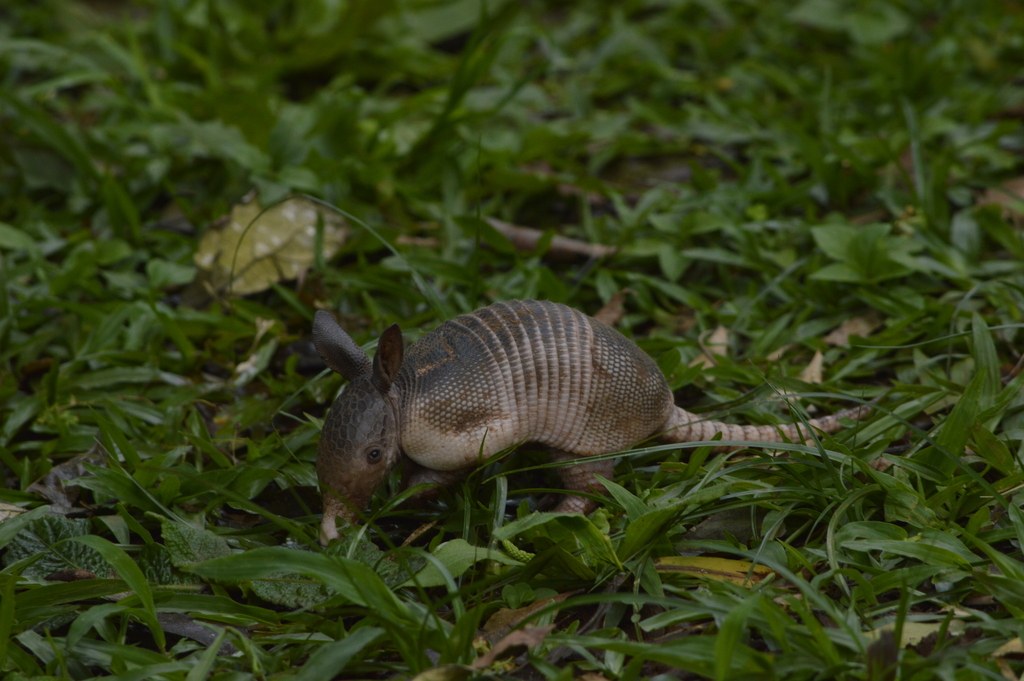
One litter a year, four identical young, every time. A female produces exactly one litter per year, and that litter is always four genetically identical young of the same sex, because one fertilized egg splits into four. Births concentrate in March and April after a gestation of about 150 days, and young are weaned at 3 to 4 months, so the animals digging in a lawn in midsummer may well be a family group working the same yard rather than several unrelated visitors.

Mating and Gestation
Birth
Juvenile2
Adult
Identification
The armor settles it immediately
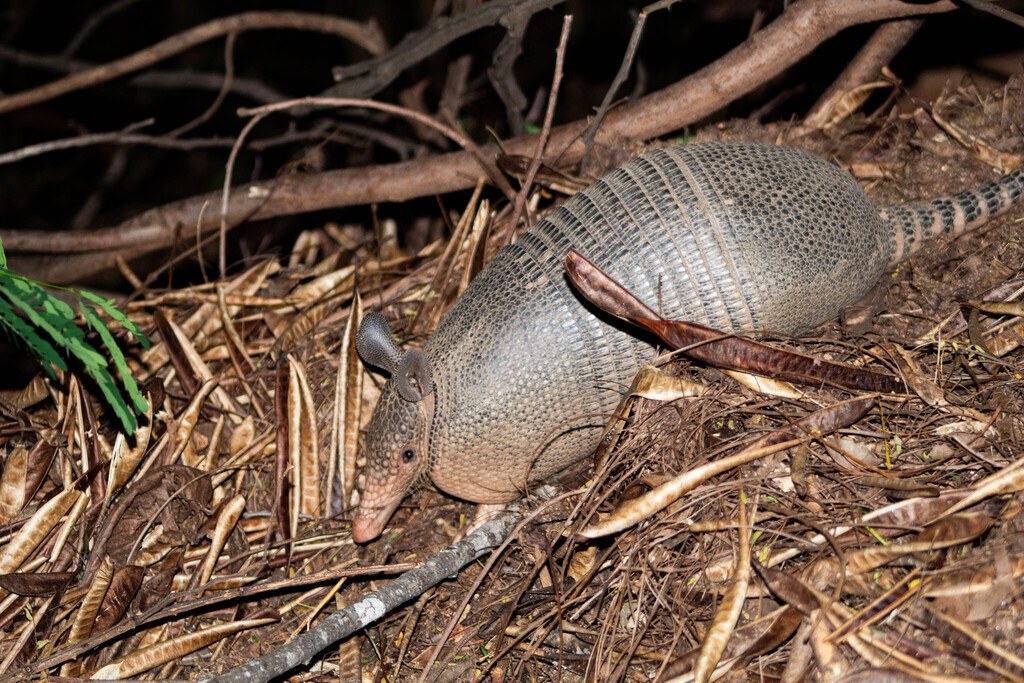
A horny armored shell over the head, body, and tail, with nine movable rings between the shoulder and hip shields and a long tapering tail encased in 12 separate bony rings. Nothing else in North America looks like it.
Size and build
About the size of an opossum, 8 to 17 pounds. Small head with a long, narrow, pig-like snout.
The mouth is unusual and worth knowing
Armadillos have no canine or incisor teeth at all. They carry 7 to 9 peg-like cheek teeth on each side of the upper and lower jaw, and lacking front teeth, they chew larger prey with those molars.
Tracks: three toes and sharp claws
Tracks show three forward toe prints with sharp claw marks. That is the most reliable sign when the animal itself is not around.
The real problem is the damage
The one real identification problem is not the animal, it is the damage. Turf damage from armadillos can be difficult to distinguish from damage by raccoons. If all you have is a torn-up lawn and no sighting, treat the species as unconfirmed rather than assuming. The digging pattern in the signs section below narrows it, but it does not always settle it.
Poor eyesight, strong nose
Armadillos rely on smell to locate prey under the soil and use a sticky tongue to capture insects and swallow them whole. That is why an armadillo will keep working a yard while a person stands nearby, and why the animal often seems oblivious rather than wary.
Signs of Infestation
Shallow cone-shaped holes in the lawn
They run 1 to 3 inches deep and 3 to 5 inches wide. This is the single most characteristic sign of armadillo activity. The holes are dug in search of food, not as shelter, and they usually appear overnight because armadillos work from dusk through early morning.
Burrow entrances, and their size
Burrow entrances 7 to 8 inches in diameter, typically near rock piles, brush, stumps, or a dense woodland edge. Burrows may run up to 15 feet, and one animal often keeps several dens in the same area.
Burrowing under slabs and pools
Burrowing under foundations, concrete slabs, driveways, and pools. This is the sign that matters most, because it is a structural problem rather than a cosmetic one.
Uprooted ornamentals
Uprooted flowers and other ornamental vegetation, disturbed while the animal roots through soft, worked soil for insects.
Turf damage that mimics raccoons
Extensive turf damage that can be hard to separate from raccoon damage. That is a documented identification problem rather than a hedge, so a wrecked lawn on its own is not proof of which animal did it.
Noise, and more of it than you would expect
Low grunting sounds while feeding, or from a mother calling to her young, and a wheezy grunt from the young themselves. Armadillos also travel noisily through brush and leaf litter while foraging, focused entirely on food, loud enough that deer hunters in the Ozarks have mistaken one for a trophy buck moving through cover.
Prevention and When to Call a Pro
Start with the reframe
It changes what you actually fix. More than 90 percent of an armadillo's diet is insects, especially larvae, plus earthworms, scorpions, spiders, and other invertebrates. An armadillo is not attacking the lawn. It is eating what lives under it. Your lawn is the diner, not the target. That means the underlying grub and insect population is the real attractant, and reducing it with a soil insecticide applied per label directions can reduce foraging activity. Follow the label to limit harm to non-target animals, and keep the goal realistic: eliminating every insect in the soil is neither practical nor good for the lawn or the wildlife around it.
Habitat modification comes first
Habitat modification is the practical first step. Armadillos prefer to dig burrows where there is cover, so clearing brush, brush piles, and other ground cover near a structure discourages them from establishing a den against it. That is the highest-value change most homeowners can make without buying anything.
Exclusion, with a real spec
Exclusion works for a defined area, and the specification is specific. A fence at least 3 feet high, buried 12 to 18 inches into the ground and deeper in sandy soil, with the above-ground portion slanted outward at a 40-degree angle, can keep armadillos out of a particular garden or yard area. Both halves of that spec matter, because armadillos burrow and climb. For an isolated garden specifically, a single-strand electric fence 3 to 4 inches off the ground can also be effective, though it needs careful placement in any yard where children play.
What does not work
No frightening device is known to control armadillos effectively. No repellent is registered for armadillo control. No toxicant is registered or available for armadillo control either. Anything sold on those three premises is not going to solve the problem.
Protect poultry with housing
Armadillos occasionally eat poultry eggs. Proper housing or fencing handles it. This is a minor and occasional risk rather than a serious predation problem.
Never handle one bare-handed
Never handle an armadillo with bare hands, and avoid contact with its blood or fluids. Two health considerations sit behind that one rule. In the southern United States, some armadillos are naturally infected with the bacteria that cause leprosy, also called Hansen's disease, and it may be possible for the animals to spread it to people. The risk is very low, and most people who come into contact with armadillos are unlikely to get leprosy. Whether humans can contract it from armadillos at all is genuinely debatable: a few cases among Texas armadillo handlers appear connected to many years of catching, handling, skinning, and eating the animals, and a widely accepted hypothesis is that the bacterium lives in soil in certain regions, especially Louisiana and coastal Texas, with armadillos and people possibly picking it up independently from that same environmental source rather than from each other. Separately, armadillos can carry the parasite responsible for Chagas disease, which is normally transmitted to people through the bite of a triatomine insect rather than through contact with the animal itself. Neither risk is a reason for alarm. Both are reasons to keep your hands off.
Less regulated, not unregulated
Armadillo is far less regulated than most wildlife, and that still does not mean no rules apply. Armadillos are unprotected in most states, which is the baseline. Two real caveats sit inside that baseline. In some states it may be illegal to use artificial lights to help shoot armadillos at night, and local regulations on discharging a firearm may prohibit the method outright where you live. Some states also restrict the size and placement of certain body-gripping traps, particularly in suburban areas, and some restraint devices are illegal outright. Those methods exist and they are more restricted than the word unprotected suggests, so check your state and local rules before going down that road, or hand the work to a professional.
Relocation is not the answer
Relocating an armadillo usually is not practical, and moving one to a different property is not recommended. If it is legal in your state at all, a transported armadillo should be released into suitable habitat at least 24 miles away, and even then the approach carries several problems and is generally not a good idea.
Keep the problem in perspective
Keep the scale of the problem in perspective. Armadillo damage is usually localized and is far more often a nuisance than a real economic loss. That is a reason to respond in proportion, not a reason to ignore burrowing that is undermining something structural.
Who to Call, and When
Call for any burrowing under a foundation, driveway, pool, or other structure, since undermined ground is a different problem from cosmetic lawn damage. Call before attempting any trapping or shooting, to confirm local firearm-discharge, trap-type, and artificial-light rules, even though armadillo carries no special protected status in most states. And call if an armadillo needs to be physically removed from a property, rather than handling the animal yourself.
Frequently Asked Questions
What is leaving small, cone-shaped holes in my lawn overnight?
Most likely an armadillo, though a raccoon is possible, since the two can leave similar-looking turf damage. Armadillo holes are typically shallow, 1 to 3 inches deep and 3 to 5 inches wide, dug while the animal searches for grubs and earthworms. Armadillos are active mainly from dusk through early morning, which is why the damage tends to show up overnight.
Why are we suddenly seeing armadillos in an area that never had them?
Armadillo range has been extending northward in recent times, and parts of the Midwest and the northern edge of the Southeast are an active expansion frontier right now rather than an established, year-round population. The reason they have not moved farther north is straightforward: armadillos cannot tolerate freezing temperatures and cannot hibernate, so frozen ground and scarce winter food still set the limit.
Is it true that armadillos always have identical quadruplets?
Yes, and it is one of the more unusual facts in mammal biology. A female produces exactly one litter per year, always four young, always genetically identical, and always the same sex. A single fertilized egg divides into four separate, identical eggs, and each one grows into a young animal that looks like a miniature adult at birth.
Can I catch leprosy from an armadillo?
The risk is very low. Some armadillos in the southern United States do carry the bacteria that cause leprosy, and it may be possible for the disease to spread to people, but most people who come into contact with armadillos are unlikely to get it. Whether transmission from the animal happens at all is debatable, and one widely accepted hypothesis is that the bacterium lives in soil in certain regions, especially Louisiana and coastal Texas, with armadillos and people possibly acquiring it independently from that source. The safest approach either way is simple: do not handle an armadillo with bare hands, and avoid contact with its blood or fluids.
Is it legal for me to trap or shoot an armadillo on my property?
In most states, yes, since armadillos are unprotected almost everywhere. Check your local rules first anyway. Some areas restrict discharging firearms, some restrict using artificial lights to shoot at night, and some restrict the size and placement of certain traps or ban particular restraint devices outright. Armadillos face far fewer restrictions than most wildlife, but unprotected does not mean that no rules apply.
Sources
- Armadillos (identification, physical description, legal status, species range, voices and sounds, tracks and signs) and Armadillo Biology (reproduction, denning cover, behavior, habitat, food habits) Internet Center for Wildlife Damage Management (University of Nebraska-Lincoln / USDA APHIS Wildlife Services)
- Armadillo Damage Identification, Armadillo Damage Prevention and Control Methods, and Armadillo Handling Internet Center for Wildlife Damage Management (University of Nebraska-Lincoln / USDA APHIS Wildlife Services)
- Armadillos in Missouri: Techniques to Prevent and Control Damage (Publication G9456) University of Missouri Extension
- About Leprosy (Hansen's Disease) Centers for Disease Control and Prevention