Seasonal Timeline
Fire ants are active whenever the surface soil sits between about 70 and 95 degrees F, which across the Deep South means most of the year. Activity is bimodal, with a spring rise and a second fall rise, and a midsummer dip that is not a break. Above 95 degrees F the workers move deeper into the soil during the day and forage after dark instead.
Fire ants are active whenever the surface soil sits between about 70 and 95 degrees F, which across the Deep South means most of the year.…
The July and August dip is not the ants leaving. It is the ants going underground by day. Foraging shifts to evening and night in high summer, which is exactly why a homeowner who treats at two in the afternoon in July is treating an empty mound. The winter months are not dormancy either, and in deep south Texas and Louisiana fire ants stay active year round. The counterintuitive part is the timing of treatment. Texas A&M recommends broadcasting bait between late August and mid October, not in spring when you first notice the mounds. The ants are still foraging, the weather is easier to predict, and the bait works through the winter. Baits with insect growth regulators applied in late summer produce their maximum suppression the following spring.
Where They're Found
Fire ants are established across the Southeast and South Central states and in parts of California. The authoritative current map is not a range map, it is a federal quarantine. USDA APHIS lists more than 367 million acres of quarantined area across Alabama, Arkansas, California, Florida, Georgia, Louisiana, Mississippi, North Carolina, Oklahoma, South Carolina, Tennessee, Texas and Virginia, plus Puerto Rico. Virginia and Tennessee surprise most people, and Virginia's own state quarantine has been expanded four times, most recently in May 2025. The quarantine also contracts. In August 2025 APHIS removed Doña Ana County, New Mexico, which was the last quarantined county in that state, so no Arizona or New Mexico county is currently under federal quarantine. Two things set the limits, and only one of them is obvious. Cold sets the northern edge. A USDA Agricultural Research Service model built on daily soil temperatures from 4,537 weather stations predicts fire ants moving another 50 to 100 miles north in Oklahoma and Arkansas and continuing into Virginia, Maryland and Delaware. Dryness sets the western edge, and the same model applies an annual precipitation limit marking where arid conditions block colony growth in land that is not irrigated. UC Riverside puts it in observed terms: in California, fire ants have not been found in non irrigated country except near lakes, wetlands and creeks. Irrigation defeats the dryness, which is why California has fire ants at all. They arrived in nursery stock and orchard soil and they live in watered landscape. The infested acreage has gone from more than 275 million to 320 million to more than 367 million across three federal and university sources spanning about twenty years, and that progression says more than any single number. The origin is a single introduction from South America at Mobile, Alabama, or possibly Pensacola, Florida, sometime between 1933 and 1945, probably in soil used as ship ballast.
Life Cycle
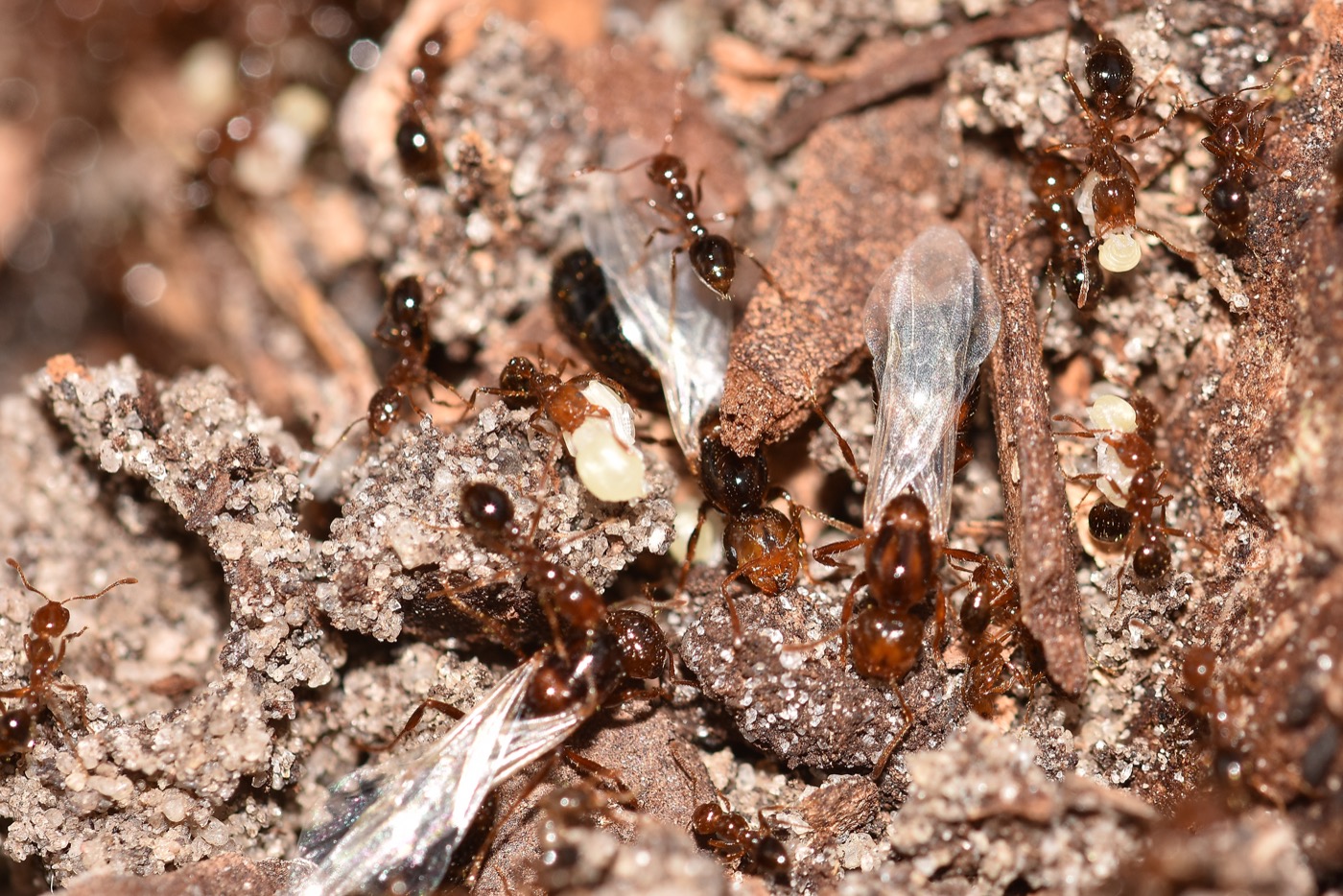
Fire ants spread by flying, and that changes what treatment can achieve. A colony sends out six to eight mating flights a year, mostly spring and fall, of up to 4,500 winged ants each, usually within a day or two of rain and usually between midday and late afternoon. Newly mated females fly two to three miles before landing. Almost all of them die, close to 99.9 percent, but enough survive that a treated yard reinfests from the neighborhood rather than from inside itself. This is the opposite of the odorous house ant, which spreads mostly by walking, and it is why community wide programs beat lot by lot treatment. It is also the origin of the call every pool owner makes in April and again in September, when thousands of winged ants end up trapped on the water. A mature colony holds somewhere between 80,000 and 500,000 workers, and sources differ by lineage rather than by measurement, so treat the range as the answer. By six months a founding colony is several thousand strong and the mound is visible in the lawn.

Egg
Larva
Pupa
Adult1
Identification
Two waist nodes, clubbed antenna
Two nodes on the waist, and a ten segmented antenna ending in a two segmented club. Those two characters together are the identification. NC State puts it in one line for turf: fire ants are the only ants in North Carolina turf with two bumps between the thorax and abdomen. The odorous house ant has one flattened node hidden under the abdomen, twelve antennal segments and no club at all. That is the cleanest possible contrast between the two ants and it takes one look through a hand lens.
Several worker sizes in one nest
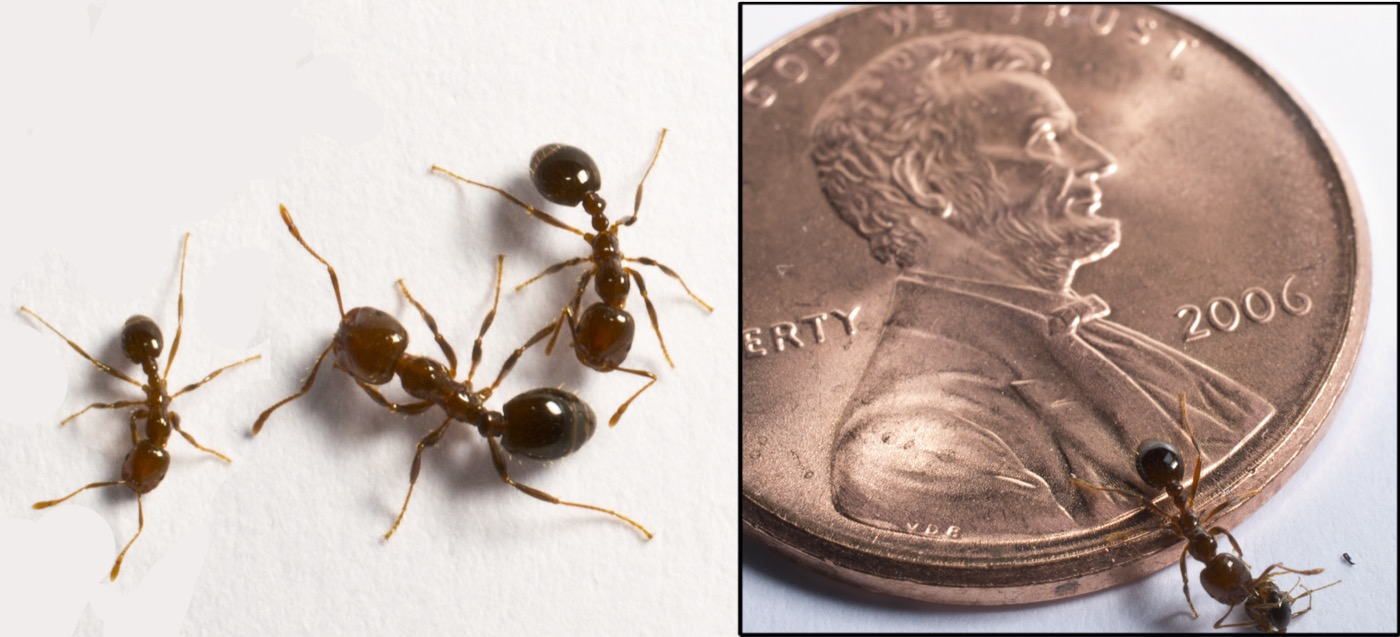
Several different sizes of worker in the same nest. Fire ant workers are polymorphic, running roughly 1/16 to 1/4 inch, and a single mound contains minims, minors, medias and majors. Do not print one number in your head. The spread is the point. A trail of ants that are all exactly the same size is not a fire ant, and that single check rules out odorous house ants, Argentine ants and little black ants on sight.
Reddish brown, dark rear segment
The color is reddish brown with a darker, nearly black rear segment, and there is a visible stinger at the tip. Useful, but do not lean on it. The University of Tennessee is explicit that color is not a reliable way to separate the red imported fire ant from the black imported fire ant or the hybrid between them. Researchers confirm those in the lab with cuticular hydrocarbon profiling and molecular techniques, not with a color chart. All three are covered by the same federal quarantine and treated the same way, so for a homeowner the distinction rarely changes anything.
The behavior test beats all of it
It needs no magnifier. Texas A&M's own key says so: if the ants are aggressive, at least three millimeters long, and they rapidly run up any object placed into their nest, they are probably fire ants, and if they try to bite and sting the object it is a good bet. Hundreds of workers boil out and climb vertical surfaces within seconds. No other common ant behaves this way. Use a stick, not a finger.
Native look-alikes, some on your side
The native look-alikes are the ones that matter, and some of them are on your side. The tropical fire ant, the southern fire ant and the desert fire ant are all native, all sting, and all get called fire ants. The best single tell is the head: tropical fire ant colonies contain workers with square, oversized heads for milling seeds, and the red imported fire ant has no worker with a head that far out of proportion. Getting this right matters because native fire ants compete with the imported one and help hold it back. A positive identification really does need a specimen, which is one of the better reasons to have someone look rather than guess.
Red harvester ant mounds
Red harvester ant nests are the mound comparison people need, and the difference is the opening. Fire ant mounds are domed with no central hole. Other mound building ants in the same yards generally do have an obvious entrance. If you are looking at a mound with a clear hole in the middle, look harder before you treat it.
There is no crush-and-sniff test
That test does not work on this ant. The odorous house ant really does have a diagnostic smell. No extension source attributes any odor to the red imported fire ant, crushed or otherwise, and anyone who picks one up to check is going to get stung instead.
Signs of Infestation
A dome mound with no hole on top
A dome shaped mound in open sunny ground, with no hole in the top. Turf, pasture, fields, school yards, athletic fields, golf courses and parks. Roughly 18 inches is the working figure for both height and width, and sources report the two interchangeably, so treat it as an order of magnitude rather than a measurement. Color and texture just match the local soil. The absence of a central opening is the single most useful visual check.
Mounds appearing after rain
Mounds appearing almost overnight after a soaking rain. Colonies living deep in the soil push new mounds up to the surface, and mating flights happen within a day or two of rain, so newly mated queens are founding nests at the same moment. This is why a homeowner who treated last month sees fresh mounds after a storm and concludes the treatment failed.
Mounds hard against heat holding hardscape
Driveway and sidewalk edges, patio slabs, foundations and electrical boxes all absorb and re-radiate heat, and fire ants use that. A nest cavity under a patio slab or concrete walkway can undermine it badly enough that the slab drops.
Hundreds running up a wall at once
Hundreds of ants running up vertical surfaces within seconds of a disturbance. Grass blades, sticks, boots, legs. They move up a leg at about 1.6 centimeters per second and they begin stinging 10 to 20 seconds after they get on you, nearly all at once, because they are responding to the same alarm signal.
White specks on a broken open mound
Eggs, larvae and pupae, carried up into the warm surface layer. APHIS lists this as an identification sign in its own right.
A ring of white blisters, a day later
A circular cluster of white blisters on skin, showing up a day or two after the fact. Often this is the first sign anyone notices, and it is close to unique.
Winged ants trapped on a pool
Thousands of winged ants trapped on a swimming pool surface, in spring or fall, usually a day or two after rain.
Damage to mowers and combines
Damage to mowers, lawn equipment and combines. Sometimes the evidence is a chipped blade rather than an ant.
Electrical equipment failing
It fails for no obvious reason. Air conditioners, traffic signal boxes, pump housings, utility enclosures. There are two separate mechanisms here and most write-ups only mention one. The ants chew wire insulation, and they haul soil into the housing, which causes corrosion and shorting on its own.
Prevention and When to Call a Pro
The honest part comes first
Start with the honest part, because it changes every decision after it. You cannot exclude fire ants and you cannot permanently remove them. UF/IFAS says no control method, with the possible exception of biological control agents, will permanently eliminate ants from an area, and that populations may even resurge higher after treatment stops. UGA says chemical control lasts only as long as the insecticide or until new colonies move in from untreated land, and that an infestation can be expected to return to its original level eventually. Anyone promising permanent elimination is selling. What is achievable is suppression, on an ongoing basis, and 80 to 90 percent suppression is what correctly applied bait actually delivers.
Treat the yard, not the mound
About 80 percent of people do the opposite, according to Texas A&M's own survey. Mound by mound treatment is labor intensive, easy to over-apply, and fails for reasons that have nothing to do with the product: the nests you did not find survive, the area reinfests from next door, and deep dwelling colonies push up new mounds after the next rain. For most homeowners, broadcasting across the whole yard is both cheaper and more effective.
The Two-Step Method, step one
The Two-Step Method is the published answer, and step one is broadcast bait. The bait is defatted corn grit coated in soybean oil with an active ingredient in it. Workers carry it home and share it, and the queen either dies or stops laying. Broadcast once or twice a year at about 1 to 1.5 pounds of product per acre, which works out to roughly 30 granules per square foot, using a hand held or push spreader with at least a 1/8 inch opening. Do not mix it with fertilizer or seed. Crisscrossing swaths are fine and skipping every other swath is fine too, because the ants forage up to 100 yards. Mississippi State's homeowner version is three times a year, pegged to Easter, the Fourth of July and Labor Day so people remember.
Three things decide if bait works
Three things decide whether the bait works, and they are all technique, not brand. Clemson found baits reduce populations by 85 to 95 percent in most research trials regardless of brand or active ingredient, so the variable is you. First, apply when the ants are foraging. Put a pinch of bait next to a mound and see whether they find it within 30 minutes to an hour. In summer that means evening or night. Second, use fresh bait, preferably from an unopened container. If the soybean oil goes rancid the ants will not pick it up, and bait is also spoiled by cigarette smoke and by being stored near gasoline or insecticides. A half used bag from last year sitting next to the gas can in the garage is already a dud. Third, keep it dry. Texas A&M says no rain expected for 24 to 48 hours, Clemson says a 12 hour window. Take the conservative one.
Step two, and the wait between
Step two is individual mound treatment, and the wait between the steps is the part people skip. Give it somewhere between three days and ten days after baiting before you treat mounds. Treat too soon and you kill the foragers before they have carried the bait home, which defeats step one. Then treat only the mounds that actually matter, near doors, play areas and walkways. Step two is sometimes not needed at all. Whichever product form you use, dust, drench, granule with a gallon or two of water on top, or injectable aerosol, two mechanical rules govern it: the product only kills on contact so it has to reach the ants, and disturbing the mound while you work makes the colony relocate instead of die. Treat on a cool sunny morning when the ants are near the surface.
When Two-Step is the wrong call
Two-Step is not always the right call, and the extension sources genuinely disagree. Texas A&M and UGA recommend broadcasting first in fully infested areas, at about five or more mounds per quarter acre. UF/IFAS argues that broadcast baiting can be counterproductive where native ants are still present, because it knocks those back too, and recommends individual mound treatment instead. The reconciling number is mound density. Below roughly 20 to 30 mounds per acre with native competitors around, treat mounds one at a time. Above that, broadcast.
Some ants are working for you
Some of the ants in your yard are working for you. Native tropical fire ants, little black ants, big-headed ants and Forelius ants all compete with imported fire ants for food and nesting space, and UGA's position is that preserving them is currently the best biological control available. Blanket spraying a yard kills the more sensitive natives first and hands the ground to the fire ants. Judicious use of insecticide is the actual recommendation, not maximum coverage.
Do not buy or move the problem
Do not buy the problem, and do not move it. Under the federal Imported Fire Ant Quarantine, in force since 1958 under 7 CFR Part 301, Subpart P, six categories of article cannot leave a quarantined county without a certificate issued after inspection: fire ant queens and reproducing colonies, soil on its own or attached to anything else, baled hay and baled straw stored in direct contact with the ground, plants and sod with roots and soil attached, used soil moving equipment with any loose soil still on it, and anything else an inspector flags as a risk after notifying the owner. Potting soil still in its original commercial container is exempt, and so are houseplants kept indoors and not for sale. A pickup bed of yard dirt is not exempt. Nor is a landscaper's mini excavator, which is exactly why used equipment is on the list. If you are buying sod, nursery stock or hay that came out of a quarantined county, it was supposed to be inspected and treated before it shipped. If you are moving out of one, contact your state plant health director or state plant regulatory official for the certificate. Individual states run their own quarantines on top of the federal one governing movement within the state.
Do the boring things first
Where people and pets actually spend time, do the boring things. Do not stand on mounds. Teach children and visitors what a mound looks like. Wear boots or tuck pant legs into socks when you are working in infested ground. Insect repellent on clothing and footwear temporarily discourages foraging ants. Around electrical gear, hand the job to an electrician or a licensed pest control operator. UGA is explicit that the specialized products and training it takes are not sold at retail. Their work is to seal the sensitive uninsulated components after treatment, particularly the plastic housings holding switch, relay and breaker contacts, and to spray long residual products around the housing rather than into the circuitry.
When to Call a Pest Control Professional
Any one of these is enough. Someone in the household is at high risk of a mass stinging incident, meaning an infant, an elderly or bed bound person, or anyone with limited mobility or awareness. Serious indoor stinging incidents involving immobile people are documented in the medical literature, not anecdotal, and this is the strongest reason on the list. Anyone in the household has ever had a systemic reaction to a sting. Mounds are in or around electrical equipment, an air conditioner pad or a utility housing, where UGA says plainly that an electrician or a licensed pest control operator should do the work, and where some of the correct products are not sold at retail. Mound density is above about 200 per acre, where stepping on one becomes almost unavoidable and one bait pass will not reach them all. You baited correctly and correctly timed and nothing happened within the expected two to four weeks. The property is an athletic field, school yard or playground, where control needs to start six to eight weeks before use. Or an entire colony has moved indoors into a wall void, rafters or behind an appliance, which typically happens during flooding or a hard drought.
Sometimes the answer is nothing
And sometimes the answer is to do nothing. UGA states outright that the goal is to prevent the problems caused by unacceptably large numbers of fire ants, not to remove every ant from the ecosystem, and that in areas where these ants are not causing problems, doing nothing is certainly one option. Very few companies in this industry will put that in writing. It is still true.
Frequently Asked Questions
Why can't I find the hole in a fire ant mound?
Because there isn't one. A fire ant mound has no central opening. The ants enter and leave through underground tunnels that radiate out from the nest and surface some distance away, sometimes well away. Texas A&M, UF/IFAS and the University of Tennessee all state it independently, and it is one of the most reliable ways to tell a fire ant mound from another ant's nest. The mound itself is a nursery and a solar collector, not a doorway. It is also why a treatment poured on the visible dome misses the foragers entirely.
Do fire ants bite or sting?
Both, in that order, and only the sting matters. The ant grips the skin with its jaws to get leverage and pinch the skin up, then arches its abdomen underneath and drives the stinger in. Then it can pivot around its own head and sting again, several times, leaving a ring of sting sites. So the circular pattern people notice is usually one ant, not several. The bite is just the grip. The stinger itself is a modified egg laying structure, repurposed, which is why workers have one and males do not.
Why does a fire ant sting turn into a white blister?
About 95 percent of fire ant venom is an alkaloid that is toxic to cells. It kills tissue at the sting site, your own white blood cells arrive to clean up the dead cells, and the accumulation of those cells is the blister. It is sterile, meaning there is nothing infectious in it, and it usually shows up 24 to 48 hours after the sting. No other US ant is known to produce this reaction. Two things follow from the mechanism. If you get the ants off before they sting, no venom goes in and no blister forms. Once the venom is in, the blister forms regardless of what you put on it, and the real risk is infection from scratching it open, so leave it alone. Separately, the venom also carries a small protein fraction that does nothing at all to most people. That protein is the entire allergic risk, which is how everybody gets blisters and only some people react badly.
How dangerous is a fire ant sting, really?
For most people it hurts, blisters and clears up. The real danger is anaphylaxis, a severe allergic reaction to the protein fraction of the venom, and it is genuinely serious. Published estimates of how often it happens vary widely, and the document most often cited actually gives three different figures in the same publication, so a single percentage would mislead. UGA notes that compared with deaths from bee and wasp stings, relatively few deaths from fire ant stings have been documented. What matters more than a number is knowing the symptoms. Call 911 immediately for severe chest pain, difficulty breathing or shortness of breath, serious or spreading swelling, slurred speech, dizziness or faintness, severe sweating, nausea, or any loss of consciousness after a sting. The other real danger is volume. High numbers of stings can cause severe medical reactions even in people with no allergy at all, which is why infants, elderly or bed bound people, and anyone with limited mobility need supervision around infested ground. If anyone in the household has had a systemic reaction, see an allergist, carry epinephrine, and ask about venom immunotherapy.
How do I get ants off me once they are on?
Rub them off briskly, by hand or with a cloth. Do not try to rinse them off. Because they anchor themselves with their jaws before stinging, running water from a hose or jumping into a pool does not dislodge them. Speed matters more than technique: ants that climb onto a leg start stinging within 10 to 20 seconds, and they do it nearly simultaneously.
Do grits kill fire ants?
No, and the reason is worth knowing. The theory is that the ants eat the grits, the grits swell, and the ants burst. Fire ants can only ingest liquids. Worker ants have sieve plates in their mouths that physically block food particles. Only the fourth and last larval stage can process solid food at all, and it does it by regurgitating digestive enzymes onto the food to liquefy it first, then passing the liquid back. Extension programs at Georgia, Florida, Mississippi State and Texas A&M all reach the same conclusion. Leave the grits in the cabinet. That same mechanism is why real baits are oil on grit, because the ants are collecting the soybean oil, not the grit, and why baits have to work slowly enough for the food to reach the queen before the workers die.
Does boiling water work?
Partly, and this is the one folk remedy with real support. Two to three gallons of near boiling water eliminates somewhere between about 20 percent and 60 percent of the mounds it is poured on. It works best on a cool sunny morning in spring, when the colony is sitting near the surface. It kills whatever plants it touches and carries a serious scald risk, so carry it carefully. The important half is the failure mode: when it does not kill the queen, the colony simply moves. UF/IFAS generalizes that point across all home treatments, most of which just disturb the mound or kill enough ants to make the colony relocate. That is the whole explanation for the mound that comes back three feet over.
What about the other home remedies?
Here is the honest audit. Debunked with university sources: club soda does nothing but drown a few ants, and UF/IFAS notes the myth circulates with a false attribution to a University of Georgia extension figure who never said it. Shoveling one mound onto another so the colonies fight does not work, because multi-queen colonies are not territorial and will simply merge, so you may end up with a bigger problem. Soap solutions and wood ashes are supposed to strip the ants' protective wax layer, which UGA calls undocumented and UF calls untrue. Molasses, aspartame, baking soda, vinegar and plaster of Paris are all listed as ineffective or best avoided. Diatomaceous earth and boric acid products kill ants but have not been consistently shown to kill whole colonies. Retail parasitic nematodes do not sustain themselves after release and mostly just make the colony move. Electrocution grids kill workers and leave the queen and brood untouched, and sound, vibration, microwave and explosive devices are marketed without scientific evaluation. UGA goes as far as saying deceptive claims about fire ant control devices should be reported to the state attorney general or the Federal Trade Commission. Works, but do not do it: gasoline, diesel and other petroleum products. UGA concedes outright that these do kill some colonies. The objection is not efficacy. They are dangerously flammable, they kill the surrounding plants, and they contaminate soil and groundwater, which is why every source strongly discourages them. Same for battery acid, bleach, ammonia and cleaning products. No evidence either way: cinnamon, coffee grounds, cornmeal, Epsom salt, essential oils, and the specific dish soap drench. No university extension or federal source addresses these, in either direction. Rather than repeat what circulates online, the honest answer is that nobody knows. One natural active does have support: d-limonene, the oil from citrus peel, is toxic to fire ants and three extension programs say so, though like hot water it has little lasting effect.
Is it illegal to move soil or plants out of a fire ant area?
It is regulated, which is not quite the same thing. Under the federal Imported Fire Ant Quarantine, in force since May 1958, soil, plants and sod with roots and soil attached, baled hay and straw stored in contact with the ground, used soil moving equipment, and live queens and colonies cannot be moved out of a quarantined county without a certificate issued after inspection by a state or federal official. Potting soil in its original commercial container is exempt, as are indoor houseplants not for sale. The quarantined area, plus Puerto Rico, covers more than 367 million acres. Most people have never heard of any of this, which is worth knowing if you are buying sod or having soil delivered.
I killed the mound and it came back. What happened?
Most likely the colony moved rather than died. A queen needs only about half a dozen workers to restart, and a disturbed colony can rebuild several hundred feet away almost overnight. Knocking mounds down repeatedly reliably makes colonies relocate. This is worth contrasting with the odorous house ant. That species comes back because spraying splits a multi-queen colony into several by budding. Fire ants come back because you disturbed them and they walked. The homeowner experience is identical, the cause is different, and so is the fix. For fire ants the fix is bait that gets carried home before anything visible happens, and not disturbing the mound while you treat it. There is a third possibility too. Colonies live deeper in the soil than the mound suggests, and a colony that was out of reach of a surface treatment will push a new mound up after the next soaking rain.
What happens to fire ants in a flood?
The colony leaves the mound and floats. Workers link together into a living raft that carries the queen and brood on the surface until it hits dry ground, where the colony rebuilds. Rafting colonies are highly defensive and dangerous to anything that touches them, so after flooding, treat floating clumps of debris with care. Migrating colonies on the move during dry spells are dangerous for the same reason.
Sources
- Imported Fire Ants USDA Animal and Plant Health Inspection Service
- Texas Imported Fire Ant Research and Management Project: Biology and the Two-Step Method Texas A&M AgriLife Extension Service
- Managing Imported Fire Ants in Urban Areas, Bulletin B1191 University of Georgia Extension
- Red Imported Fire Ant, Solenopsis invicta Buren, EENY-195 UF/IFAS Extension, Department of Entomology and Nematology
- Sustainable Fire Ant Control UF/IFAS Extension, Solutions for Your Life
- Fire Ant Management In The Home Lawn, HGIC 2501 Clemson Cooperative Extension Home & Garden Information Center
Image Credits
- Image: NPMA. Used under NPMA member image license.