Seasonal Timeline
Workers forage anywhere from roughly 42 to 95 degrees F, day and night, with no distinct peak. That means March through October across most of the country and close to year round in Florida and Southern California. The date that actually matters is February, because that is when the ants become active again and when baits should already be out.
Workers forage anywhere from roughly 42 to 95 degrees F, day and night, with no distinct peak. That means March through October across most…
The off months are not dormant months. In winter the scattered subcolonies pull together into a few overwintering nests. They are still there. In spring those nests start budding again, and by summer the yard is full of nests instead of a few. That is the whole explanation for the spring invasion homeowners report, and it is also why Washington State University recommends setting baited stations as early as February. Waiting until you see trails in May means treating a colony that has already split itself back out. The Mountain West belongs in the range too, on the strength of Utah State University’s own management fact sheet. The Midwest and Northeast pattern is the closest guide there.
Where They're Found
This ant shows up across most of the country, and Utah State University's own management fact sheet now calls it an emerging pest ant in Utah. It is a particularly common complaint in the Pacific Northwest. Extension sources will not rank it against other ants, but they will tell you it has the widest geographic range and the greatest ecological tolerance of any ant in North America. It is native, and it turns up in bogs, beaches, pastures, forests and kitchens. One nuance worth knowing on the California coast and the Gulf South: where Argentine ants are established they push other ants out, so "sugar ants" in those areas are statistically more likely to be Argentine ants than these.
Life Cycle
The colony arithmetic is why killing the ants you can see does nothing. In undisturbed woods this species runs about 100 workers with a single queen. The same species in a subdivision runs to tens or hundreds of thousands of workers with hundreds of egg-laying queens, spread across a main nest and many satellite nests that trade food, workers and brood along shared trails. Sources put the numbers differently. Utah State says 15 to 30 workers in natural colonies, tens of thousands in urban ones, hundreds of thousands in supercolonies. A 2023 study of urban colonies collected fragments holding a few thousand workers and a few hundred queens, and those were only fragments. Another extension source puts urban colonies at several thousand workers with many queens. Nobody agrees on a headline number, and the range itself is the point. There are 4 to 5 generations a year.

Egg
Larva
Prepupa
Pupa
Adult2
Identification
Crush one and smell it
Crush one between your finger and thumb and smell it. This is the fastest identification in household pest control and it takes two seconds. The smell is real, it comes from the anal glands, and there is no smell at all from an untouched trail. Blue cheese is the honest description. Rotten coconut is the one you will read everywhere else, and pine shows up in the University of Kentucky literature. If instead you get a stale, musty smell, you are holding an Argentine ant, which is a different problem.
Every worker is the same size
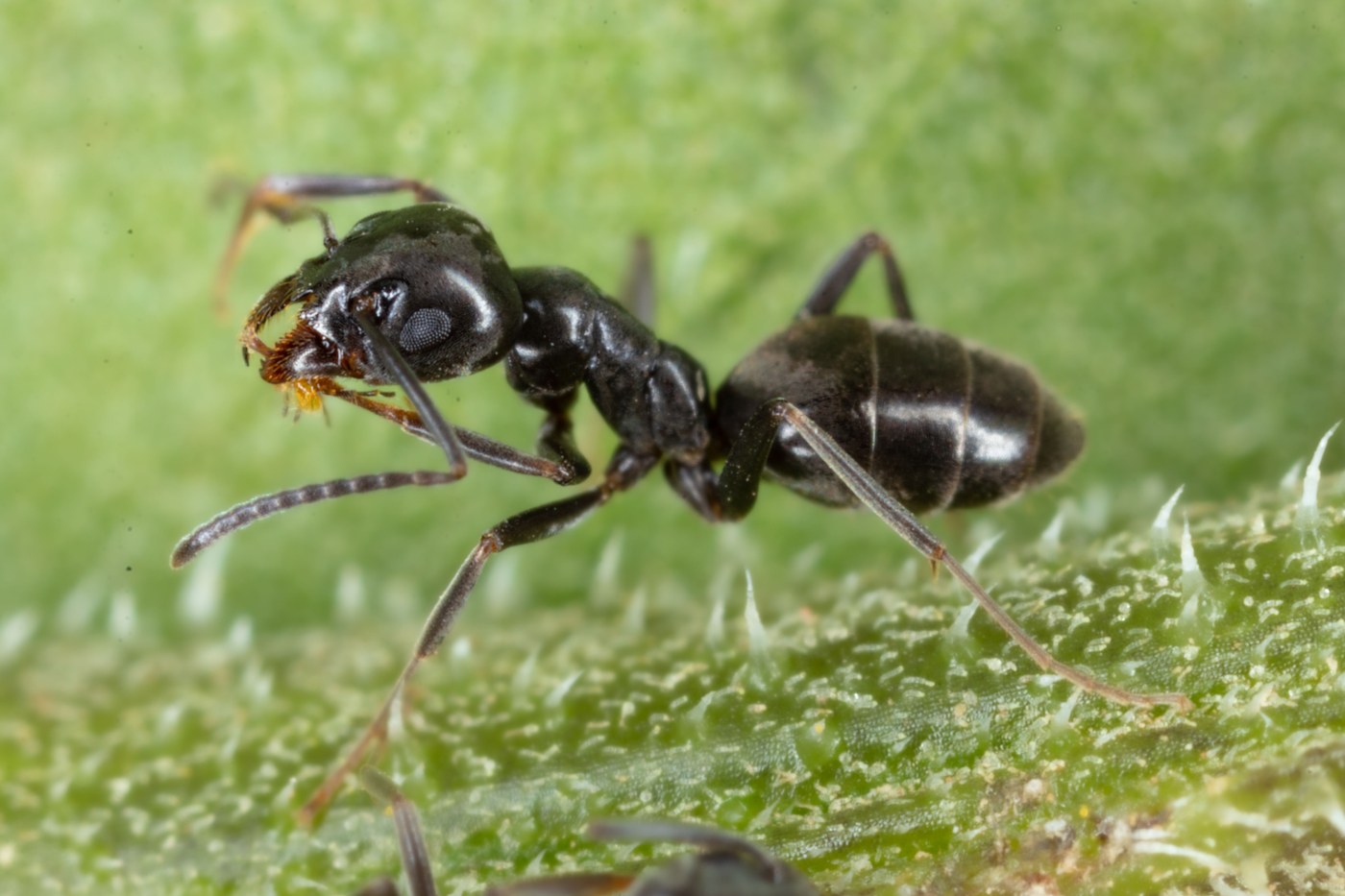
Workers are 1/16 to 1/8 inch, uniform brown to black, and every single one is the same size. No banding, no two-tone body, no big and small workers in the same trail. Fire ants and carpenter ants have workers of visibly different sizes, so a trail of identical small dark ants rules both out immediately.
The waist, viewed from the side
The waist is the diagnostic, and you have to look from the side. Between the thorax and the abdomen most ants carry one or two visible bumps called nodes. This species has one, it is flattened like a button, and it is tucked up under the abdomen where you cannot see it from above. The University of Kentucky calls the absence of a visible node or knob the most accurate diagnostic difference for this ant. Under magnification, two more: 12 antennal segments with no club at the tip, and a slit-shaped anal opening with no ring of hairs around it.
Pavement ant
Slightly bigger at 3/16 inch, and it has two obvious nodes plus fine grooves running across the head and thorax, where this ant has a smooth head and one hidden node. Two easier tells: pavement ants push out little piles of displaced soil along driveway edges, garage slabs and patio seams, and a crushed pavement ant gives off no coconut or blue cheese smell. It also matters for treatment. Pavement ants are readily controlled with most baits. Odorous house ants are not.
Argentine ant
The hardest one, because it also has a single node. The difference is the shape: the Argentine node stands upright and pointed, this one is flattened and hidden. In practice you use the crush test. Argentine ants smell stale and musty, not like blue cheese. Range helps too. Argentine ants displace other species where they are established, so in coastal California and the Gulf South, the odds tilt their way.
Pharaoh ant and little black ant
Pharaoh ants have two nodes and are yellow, honey-colored or orange rather than brown-black, and they take fats and proteins as readily as sweets. That last part matters for baiting, though sources do not fully agree on how far it goes: Utah State University says odorous house ants do not like fat-based foods, while Penn State Extension records them feeding on dead insects and grease. A grease bait a pharaoh ant will strip clean may draw much less interest from an odorous house ant colony, so a sweet bait is the safer first choice rather than the only one that can work. Little black ants are about half the size, shiny black rather than matte, move noticeably slower, and their 12-segment antennae end in a distinct 3-segment club where this species has no club.
Winged ants indoors are not termite swarmers
This species produces winged reproductives in spring and summer, and a swarm indoors sends people straight to the worst conclusion. Three checks settle it. Ants have a pinched waist and termites are the same width end to end. An ant's front wings are longer than its hind wings and a termite's four wings are all the same size. Ant antennae are elbowed and termite antennae are straight.
Signs of Infestation
Single-file trails that hug edges
Baseboards, the joint where the countertop meets the wall, carpet edges, pipes, the insides of cabinets, foundation lines, patio and sidewalk seams. They navigate by structural guidelines, and that habit is a large part of why this species gets into buildings so readily. The workers move fast, which separates them from the slower little black ant.
A wiped trail that returns
A trail you wipe away that comes back in the same line the next day. They are following a pheromone trail you cannot see. Wiping the counter removed the ants, not the road.
Ants concentrated at water
Under sinks, around drains, baths and toilets, near leaks, and inside wall voids carrying warm pipes. Indoors, moisture and heat are the two things that decide where they nest.
Ants inside a food container
Unlike most ants, this species moves the brood to the food instead of carrying the food home. That is how an entire nest ends up living inside an open cereal box.
Ants running up a trunk
Ants running up and down a shrub or tree trunk. They are farming aphids and soft scales for honeydew, which is their main outdoor food. They protect those insects from predators, so an aphid problem on a foundation shrub is an ant problem waiting to happen.
No mound
This is a sign by its absence. There is no fire ant style mound and no pile of pushed-out soil. Nests are small, shallow and hidden under whatever is lying on the ground. If you see displaced soil at a slab edge, look at pavement ants instead.
Winged ants indoors in spring
A swarm of winged ants indoors in late spring or summer means a nest is in the structure, not just foragers coming in from the yard.
Prevention and When to Call a Pro
Do not spray them
The most useful thing you can do: do not spray them. This ant has many queens and many connected nests, and it reproduces by budding, meaning a queen and a group of workers simply walk away and start a new nest. Four documented things go wrong when a homeowner sprays. An incomplete application of a repellent product to a nest can split that nest into several, each with queens. A repellent barrier around the house can cut indoor ants off from their outdoor nest and strand them inside, which UC IPM says plainly can make the situation worse. Broad spraying kills the more sensitive ant species in the yard and leaves this one, which in laboratory comparisons took longer to kill than every other ant tested, free to take over ground it did not previously hold. And when one colony is cleared, another buds into the vacant space, so the visits and the cost go up rather than down.
Cut off the honeydew first
Cut off the honeydew before anything else. Aphids, soft scales and mealybugs on the trees and shrubs near the house are the colony's staple food. Deal with those and you have removed the reason the ants are on that side of the yard. Almost nobody does this step, and it works both directions: getting the ants under control also helps the plants, because the ants have been defending those insects from their natural predators.
Pull the mulch back
Know that the experts disagree on how far. Mississippi State Extension says keep a 3 to 4 foot band around the foundation clear of mulch and leaf litter. UC IPM says at least one foot. That is a three to fourfold gap, neither source cites the other, and nobody reconciles them. Mississippi State's is the stronger recommendation and organic mulch is called out as a real favorite for nesting, so more clearance is the safer read. Replace bark with pea gravel rather than large stones, because large stones just become the next nest cover. One cheap extra: aromatic cedar mulch has been shown to repel this species and can be used in beds around the house.
Take away the bridges in
Take away the bridges into the building. Prune limbs, branches and foliage off the walls and roof, and strip ivy and other vines off exterior walls. Vines are both a highway and a nest site. These ants travel by preference along tree limbs, wires and utility lines.
Dry the place out
That means inside and out. Fix sprinklers hitting the foundation, broken heads and valves, leaking gutters and water pooling against the slab. Indoors, fix leaks at pipes, toilets, sinks and faucets. Moisture is the single strongest indoor nesting cue for this ant, and thirsty ants come to standing water.
Clear the ground and seal gaps
Clear the ground and seal the gaps. Almost any object lying on soil can serve as a nest cover, so move firewood stacks, boards, bricks, construction materials, lawn ornaments and debris piles. Then seal the specific entry points: cracks in foundation walls, under sliding glass door frames, behind window frames, along heating ducts, and wherever plumbing and wiring pass through.
Bait in February, not May
Buy the right bait too. Set baited stations as early as February when the ants first become active. Late winter and early spring, before the population builds, is when treatment works best. Use baits designated for sweet-loving ants with slow-acting actives such as hydramethylnon, fipronil or boric acid, so workers live long enough to carry the material back to the queens and brood. Fat and grease baits are wasted money here. This species will not take them.
Why baiting fails
Baiting fails for three predictable reasons. Running out of bait is the most common one, so use refillable stations that hold real volume and check them. Baiting one trail instead of all of them is the second, because each trail may lead to a different nest, so bait every room where you have seen ants. The third is spraying. Do not use insecticide or cleaning products near a bait placement, do not wipe the trails while a bait is working, and expect the number of ants at the bait to go up at first. That is the bait being carried home. Give it two weeks or more before you judge it, and several weeks for a full colony kill.
When to Call a Pest Control Professional
Any one of these is enough. You wipe a trail down and it is back within a day or two, after two or more weeks of correct sweet baiting. You already sprayed and now there are more trails in more rooms than before, which is the signature of a split colony and the strongest single reason on this list to stop and call. Ants are trailing in more than one room or on more than one floor. The trail runs into a wall void, under a slab or behind brick veneer, which needs drilling and injection or termite-style injection of a non-repellent product by a licensed technician. Or the neighbors have them too, because trails commonly run 33 to 157 feet and have been recorded past 150, the nests move every few weeks, and a supercolony does not stop at a property line.
What an honest company says
What an honest company will tell you up front. Hiring a pro is not an overnight fix. Mississippi State Extension says so plainly: the technician uses the same methods you would, it takes time and several repeat visits, and some continued service is needed to hold the ants down once they are down. What you are buying is the inspection, the ability to find and reach nests you cannot, and products that do not split the colony. Also worth knowing, because some companies imply otherwise: these ants do not damage structures.
Frequently Asked Questions
Why do these ants smell when you crush them?
They release a compound from glands at the tip of the abdomen. Extension sources usually call it rotten coconut. When Penick and Smith ran the test in 2015 the main component turned out to be 6-methyl-5-hepten-2-one, a methyl ketone, and methyl ketones are also the prominent compounds in blue cheese. Fresh coconut has none of them. Rotten coconut does, because the mold that turns coconut oil rancid is Penicillium, the same genus used to make blue cheese. In the same study, 143 people at a public festival crushed live ants and picked a descriptor, and blue cheese was the most common answer, with "other" a close second. The most common write-in was cleaning spray. So the traditional description is half right for the wrong reason. It is the rotten part, not the coconut part.
Are the "sugar ants" in my kitchen odorous house ants?
Maybe. Sugar ant is not a species, and pavement ants, Argentine ants, pharaoh ants and little black ants all get called that. Look at the waist from the side. Odorous house ants have one flattened node hidden under the abdomen. Pavement ants and pharaoh ants have two visible nodes. Little black ants are half the size, shiny black, and their antennae end in a 3-segment club. Then crush one. Blue cheese or rotten coconut means odorous house ant. Stale and musty means Argentine ant. Neither smell, on an ant with two visible nodes, points to pavement ant.
Do odorous house ants bite or sting?
They cannot sting. They have no stinger at all. They can bite if provoked, but the bite is not painful because the ants are so small, and they carry no public health risk. The real problem is food contamination, and it is worse with this species than most because they move the whole nest to the food.
Why do ants suddenly appear in my kitchen every spring?
In winter the scattered subcolonies consolidate into a few overwintering nests. They never left. In spring those nests start budding, sending queens and workers out to found new subcolonies, and by summer there are many nests again. Foraging can start as early as March, which is why baiting in February beats reacting in May.
Will spraying get rid of them?
Usually not, and it can make things worse. An incomplete repellent treatment on a nest can split it into several nests, each with queens. A repellent barrier can trap indoor ants inside, away from their outdoor nest. Broad spraying removes the competing ant species and hands the yard to this one, which already took longer to kill than any other ant in laboratory comparisons. And clearing one colony just opens space for the next one to bud into. Slow-acting sweet baits are the tool that actually reaches the queens.
Do odorous house ants damage the house?
No. Washington State University Extension states it directly: they do not cause damage to structures. They will nest in wood that termites or a water leak already softened, but they do not excavate sound wood the way carpenter ants do. If a company tells you these ants are eating your house, that is wrong. The real cost is contaminated food and the nuisance of the trails.
Sources
- Odorous House Ant (Tapinoma sessile Say), EB1550E Washington State University Extension
- Odorous House Ants Utah State University Extension, Plant Health and IPM
- The True Odor of the Odorous House Ant, American Entomologist 61(2) Penick and Smith, 2015
- Control of Argentine Ants and Odorous House Ants in the Home, Publication 2407 Mississippi State University Extension Service
- Ant Control for Householders, ENTFACT-619 University of Kentucky Department of Entomology
- Pest Notes: Ants, UC ANR Publication 7411 UC Statewide IPM Program
Image Credits
- Image: Adobe Stock, licensed.
- Image: Sam Dilday, via WSU Extension.