Seasonal Timeline
Feral goats are active year-round in Hawaii's climate, with no dormant season. They are considered a daytime-active species, though local hunters have reported nighttime activity during full-moon phases.
There is no real off-season. Feral goats breed without the strong seasonal gating found in temperate-climate goat populations, so a property is not likely to get a predictable quiet stretch. What does shift is visibility rather than presence. As a daytime-active species, feral goats bed down at night on high or difficult terrain that also happens to be where hunting pressure is lowest, then come down to graze during daylight. Local hunting communities in Hawaii have reported goats becoming active at night during full-moon phases and sheltering during heavy rain, sunning themselves on exposed ridges afterward, though this pattern is drawn from field observation rather than a peer-reviewed island study.
Hawaii's own hunting seasons run on a separate calendar from the goat's biology. Each island's Division of Forestry and Wildlife sets its own units, seasons, and bag limits under state game mammal rules, and several public hunting units allow goat hunting year-round with no closed season at all, precisely because the state wants numbers reduced rather than managed.
Where They're Found
Feral goats are established across five of the eight largest Hawaiian Islands and occupy virtually every habitat type present, from sea-level lava fields to high-elevation dry forest and shrubland, with especially high density in dry montane landscapes. Confirmed populations and active state hunting units exist on Hawaii Island, Kauai, Molokai, Oahu, and Maui, including the summit district of Haleakala historically. Lanai's population was specifically eradicated to protect that island's watershed. No population has been confirmed for Niihau or Kahoolawe; that is a gap in the record, not a documented absence.
Goats favor steep, rugged terrain that was long assumed too difficult for large animals to reach, which is also exactly where many of Hawaii's rarest surviving native plants persist. Very low water requirements let the same species thrive in both dry lava-field habitat and wetter mountain watersheds on the same island, which is why goats show up on both ends of Hawaii's moisture spectrum rather than sticking to one type of terrain.
Feral goats are not established on the US mainland the way most furbearers are. No published source places an established feral goat population in Alaska either.
Life Cycle
Hawaii's native plants never evolved a defense against this animal, and that single fact explains the whole problem. No browsing mammal existed on the islands before humans introduced one, so many native plants have little or no natural response to sustained browsing the way mainland species that coevolved with grazing animals do. A feral goat that strips one native plant to the root simply moves to the next, and once fencing removes goats from a test plot, native plants that hadn't been seen in decades have come back on their own. That single mechanism, not aggression or disease, is why controlling feral goats comes down to fencing and land management rather than the handling warnings that matter for rabies-vector or venomous animals.

Kid
Juvenile
Adult
Identification
Coloration tells you nothing
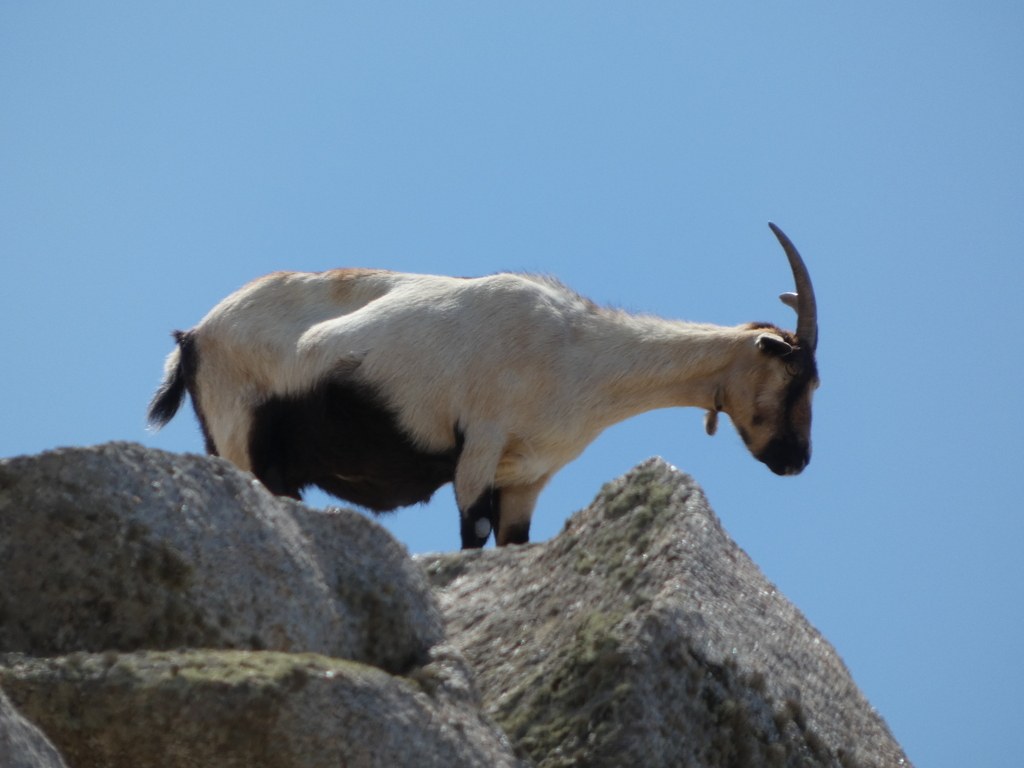
Coloration tells you almost nothing, and that is itself useful to know. Feral herds descend from escaped domestic stock with no consistent breeding, so white, black, brown, red, and blotched or spotted combinations all turn up, sometimes within the same herd.
Horns on both sexes
Horns are present on both sexes, hollow and swept back, larger on males. A short tail and, on bearded animals, a tuft of long hair under the chin round out the profile. Scent glands near the feet and groin are a genus-level trait that separates true goats from sheep.
Typical adult weight
Typical feral adults run about 40 to 60 kilograms, roughly 88 to 132 pounds. The species overall spans a far wider range due to selectively bred domestic lines, but unmanaged Hawaii herds sit closer to that smaller figure.
Axis deer, in Hawaii
Axis deer are the look-alike that actually matters in Hawaii. Axis deer, an established species on some of the same islands, have a reddish-brown coat with white spots that does not fade with age, and males grow antlers that shed and regrow each year rather than the permanent, backswept horns a feral goat carries on both sexes.
Mouflon sheep, on some islands
Mouflon sheep are the second look-alike, present as a hunted species on some islands. Mouflon lack the chin tuft and foot and groin scent glands that mark true goats, and mature rams carry large curled horns rather than a goat's straighter, backswept pair.
Herds bed down on high ground
Herds travel together and bed down on high ground. A single animal spotted at dawn or dusk on a ridge or steep slope is very likely part of a larger group using that terrain as a night camp.
Signs of Infestation
Stripped and girdled bark
On trees and shrubs. Goats browse standing on their hind legs or even climb into trees for foliage, and the bark damage that results is a strong early tell.
Denuded slopes
Denuded slopes and bare ground where understory vegetation used to be. On a hillside or watershed property this can progress to visible soil erosion.
Trampled trails on ridgelines
Trampled trails and bedding areas on ridgelines and steep terrain. Herds favor hard-to-reach high ground as a refuge, which is often visible as worn paths.
Cloven tracks and pelleted droppings
Cloven-hoof tracks and pelleted droppings similar in shape to deer. Useful for confirming goats rather than deer or pigs when damage is the first thing noticed.
Browsed-down landscaping
Garden beds and young trees go the same way. Ornamental plantings near an unfenced property edge are an easy, preferred target.
Eroding slopes and cloudy runoff
Bare, eroding slopes and cloudy runoff downstream of goat activity. On a property near a gulch, stream, or the coast, this is the sign that has been directly measured turning into coral reef sedimentation elsewhere in Hawaii, and it is worth taking seriously rather than treating as cosmetic.
Prevention and When to Call a Pro
Only goat-specific fencing works
Fencing is the only method documented to reliably keep feral goats out, and it has to be goat-specific. Hawaii's own long-running conservation exclosure research found that goats did not cross a 4-foot hog-wire fence even with highly palatable, visible forage growing on the other side. For a home garden, orchard, or landscaping bed, a sturdy woven-wire fence at least 4 feet high, without gaps a goat can squeeze through or climb, applies that same proven principle at property scale.
Keep planting off the edges
Keep palatable landscaping away from unfenced property edges. Goats are opportunistic browsers that will take ornamental plants, vegetable gardens, and young trees readily, so reducing what is reachable from outside the fence line cuts down the draw, though this is a secondary step behind fencing itself.
One hunt rarely solves a herd
A single hunt rarely solves an established herd problem, and Hawaii's own history proves it. Hawaii Volcanoes National Park removed goats by shooting alone for fifty years, at rates up to 5,000 a year at times, without reducing the population at all. What actually worked was fencing off management units and then removing the concentrated, contained population inside them. A property owner should expect the same pattern: fencing plus coordinated removal, not a single hunting trip.
Unprotected, not unregulated
Feral goats are unprotected but not unregulated, and that distinction matters before removing one. Hawaii manages feral goats as a regulated game mammal under state hunting rules, with each island's Division of Forestry and Wildlife setting its own seasons, units, and bag limits. A landowner dealing with crop or property damage generally works through that system's nuisance or crop-damage control permit process rather than removing goats outside the standard hunting rules on an ad hoc basis.
No sightings program exists
No active sightings-reporting program was found for feral goats the way Hawaii runs one for newly detected invasive species. The state's dedicated invasive-species reporting hotline focuses on species like little fire ant, coqui frog, and small Indian mongoose, where an early, undetected population is the concern. Feral goats are already long-established and actively hunted statewide, so the equivalent path for a homeowner is engaging the Division of Forestry and Wildlife's existing permit system directly, not a sightings hotline.
Call for a herd, or a real fence
Call a professional when it is a herd, not a single animal, and when a fencing project needs to actually hold. A herd repeatedly bedding down or browsing on the property is the threshold where coordinated fencing or a permitted hunt, not individual removal, is what resolves the problem. The same applies to any property showing active erosion on a slope or watershed from goat browsing, and to any fencing project meant to genuinely exclude goats long-term, since an ordinary garden fence shorter than the proven 4-foot goat-proof standard is unlikely to hold.
Frequently Asked Questions
Are feral goats protected in Hawaii?
No. Feral goats are not a protected species. The state legislature has formally classified them as invasive, causing harmful ecological damage, and they are actively managed as a regulated game mammal specifically to reduce their numbers.
Can I just shoot or trap a feral goat on my property in Hawaii?
Not without regard to the rules. Feral goats are managed under Hawaii's state game mammal hunting regulations, and a landowner dealing with crop or property damage generally needs to work through the Division of Forestry and Wildlife's nuisance or crop-damage permit process rather than removing goats on an ad hoc basis.
Why are feral goats such a big problem for Hawaii specifically?
Hawaii's native plants evolved for millions of years with no browsing mammal present at all, so many have little or no natural defense against sustained browsing, a vulnerability that mainland plant communities that coevolved with grazing animals generally do not share.
Do feral goats actually damage anything besides plants?
Yes. On Molokai's Kawela watershed, goat-driven erosion has been measured delivering roughly 1,350 tons of sediment per square mile to the coastline every year, smothering the adjacent coral reef, which is a documented ridge-to-reef damage chain and not just a landscaping nuisance.
What kind of fence actually keeps feral goats out?
Hawaii's own conservation exclosure research found that a 4-foot hog-wire fence reliably stopped goats even with preferred forage visible on the other side. Ordinary garden fencing shorter than that, or with climbable or squeezable gaps, is unlikely to hold.
Sources
- Biology and Impacts of Pacific Island Invasive Species. 9. Capra hircus, the Feral Goat (Mammalia: Bovidae), Pacific Science 67(2):141-156 University of Hawaii at Manoa / Pacific Science (Chynoweth, Litton, Lepczyk, Hess, Cordell)
- Home Range Use and Movement Patterns of Non-Native Feral Goats in a Tropical Island Montane Dry Landscape, PLOS ONE USGS Pacific Island Ecosystems Research Center
- Interpreting Feral Goat (Capra hircus) Movement to Guide Management in a Mesic Watershed on Oahu, Hawaii University of Hawaii at Manoa, Department of Natural Resources and Environmental Management
- Kawela Watershed: feral ungulate erosion and coral reef sedimentation findings Hawaii State Department of Health
- Watershed Processes From Ridge to Reef: Consequences of Feral Ungulates for Coral Reef and Effects of Watershed Management USGS Pacific Island Ecosystems Research Center / US Forest Service
- Controlling Ungulate Populations in Native Ecosystems in Hawaii (Kukalauula exclosure fencing findings) Hawaii conservation alliance position paper
- SB2963 (2024 session), legislative findings on feral goats, sheep, and pigs and DLNR trapping program directive State of Hawaii Legislature
- Game Mammal hunting unit rules for Molokai (Title 13, Chapter 123) Hawaii Department of Land and Natural Resources, Division of Forestry and Wildlife
- Feral Goat Control Permits Available For Hunting Unit F on Kauai (HAR 13-123-9 nuisance/crop damage permit example) Hawaii Department of Land and Natural Resources, Hunter Education Program
- About 643pest.org, listed priority invasive-species reporting categories Hawaii Invasive Species Council / Hawaii Department of Agriculture
Image Credits
- Image: César Alonso via iNaturalist. CC BY 4.0.
License.