Seasonal Timeline
A summer species across most of its range, with colonies forming in spring and most animals moving south for the winter rather than hibernating locally. Pups are born late May into June, which puts the loudest, most obvious weeks of a colony's year squarely inside the window when exclusion work must not happen.
A summer species across most of its range, with colonies forming in spring and most animals moving south for the winter rather than…
This bat migrates, and it is not known to hibernate in caves. Bat Conservation International states that evening bats store large amounts of fat in fall for a lengthy migration to southern parts of the range, that a banded bat recovery study found individuals as far as 547 kilometers south of their banding sites, that they have not been found hibernating in local caves and simply disappear from their summer habitat, and that once at their wintering sites they are thought to remain active through the winter. The North American Bat Monitoring Program reports the same pattern from its own banding data, with one individual sighted 340 miles from where it was captured in summer.
That non-cave, migratory winter biology is the sourced reason this species has not shown white-nose syndrome symptoms. A peer-reviewed study of species responses to white-nose syndrome in the Great Lakes region groups evening bat with the other migratory bats that have not shown symptoms of the disease. Little brown bat, big brown bat, Indiana bat, northern long-eared bat, and tricolored bat all overwinter in caves, mines, or structures, and all have been hit by the disease. Evening bat does not share that exposure route. The sourced claim is that the species has not shown symptoms, which is not the same as a demonstrated immunity.
The winter picture is not uniform at the range edge. Kentucky Fish and Wildlife describes most evening bats as believed to winter south of Kentucky, where they may remain active year round, but adds that new research suggests some could overwinter in Kentucky. The species was long treated there as a strictly summer resident that left every fall, and that assumption is being revisited. Texas Tech's Mammals of Texas account, at the other end of the range, documents the species as a common year round resident in the eastern third of Texas.
The practical consequence is the same in every region. The months a colony is most obvious, noisiest, and most likely to prompt a call are the months when flightless pups are in the roost. Nobody should seal anything during those months.
Where They're Found
This is a forest bat that ended up in buildings, and that order matters. Bat Conservation International is direct about it: a true forest bat, almost never encountered in caves, forming nursery colonies in hollow trees, behind loose bark, and sometimes in buildings and attics. Georgia's state biodiversity portal supplies the mechanism, noting that as forests have been cut many evening bats have moved into wooden buildings. Kentucky Fish and Wildlife corroborates independently, recording nursery colonies in buildings along with use of other structures such as bridges and cisterns, and stating that the species is not typically associated with caves.
On a property, that translates to attics, wall voids of wooden buildings, soffits and roofline gaps, barns, bridges, and cisterns, alongside the natural roosts of hollow trees and sloughing bark. Colony size is the part homeowners underestimate. Bat Conservation International describes nursery colonies as quite large, containing several hundred individuals, which is a different cleanup and a different odor problem from a handful of animals in an eave. Illinois' own agency lists the habitat associations behind all of this: bottomland forests, peatlands, swamps, coniferous and upland deciduous forest, and edge habitat. Kentucky flags the loss of that habitat as an active threat, naming conversion of forested wetlands to agricultural use and logging that removes prime roost trees.
Range, and why it spans three regions rather than one. The Southeast is the species' recognized stronghold, described by Bat Conservation International as abundant throughout the southeastern United States, with Virginia's wildlife agency calling it largely a bat of the southeastern United States and documenting a maternity colony found on the Virginia Tech campus during building renovations. South Central is carried by direct state sourcing: Texas Parks and Wildlife hosts its own species page, Texas Tech's account documents a common year round resident in the eastern third of Texas with active westward expansion into Tom Green, Val Verde, Midland, Presidio, Bailey, and Yoakum counties, Tennessee's wildlife agency hosts its own species page, Kentucky Fish and Wildlife describes the bat as relatively common only in the western third of the state with scattered records as far east as Floyd County, and a Fort Hays State University mammal atlas places the species across the central Great Plains of Kansas and Oklahoma. Arkansas and Louisiana fall inside general range descriptions, but no wildlife agency page from either state confirms the species, so both are unconfirmed. The Midwest is carried by Illinois, where the state agency says the evening bat may be found statewide and lists its Illinois status as common and native, and by Michigan, Indiana, Ohio, and Missouri records.
The Northeast has no established population. Some broader range descriptions reach toward central Pennsylvania and the southern Great Lakes, which would imply a Northeast presence. Pennsylvania's own Game Commission contradicts that plainly, stating that evening bats have been found a few times in Pennsylvania but are not considered regular residents, and noting that three pregnant evening bats have been captured there during the mid summer maternity season in recent years. Three captures is a rare southern visitor, not an established population, and a state agency's own account of its own fauna outweighs a range map. New York shows the same pattern of isolated observations rather than breeding colonies. Alaska and Hawaii are confirmed absences. No source places this species in either, the documented range runs through the eastern United States west to Nebraska and south into northeastern Mexico, and a peer-reviewed field identification key for United States bats places it east of the Rockies while explicitly excluding the northeastern and northern border states. Hawaii's only native bat is a separate and taxonomically distinct species.
Life Cycle
One birth event a year, and two litters is not a thing here. Published accounts describe a single annual birth event, typically producing two pups, born late May into June. The pups are flightless for roughly three weeks and reach full adult size by 6 to 7 weeks.
Two things about this bat are not known. Gestation length is not precisely reported for this species. And while fall mating with delayed fertilization until spring is standard biology for the vesper bats this species belongs to, it has not been confirmed for the evening bat specifically, so the documented fall mating is all that can be claimed, and the mechanism is not assumed from a better studied relative.

Mating
Pregnancy
Pups
Nursing
Volant Juvenile
Adult
Identification
The honest starting point
Same as for every bat: this is not a species most people identify by looking at it. A bat in a structure is seen briefly, at dusk, in bad light, if it is seen at all. What a homeowner actually identifies is guano, staining, and roost signs. The physical description matters most to whoever is called out to confirm what is in the building, and confirming the species carries real legal consequences.
A scaled-down big brown bat
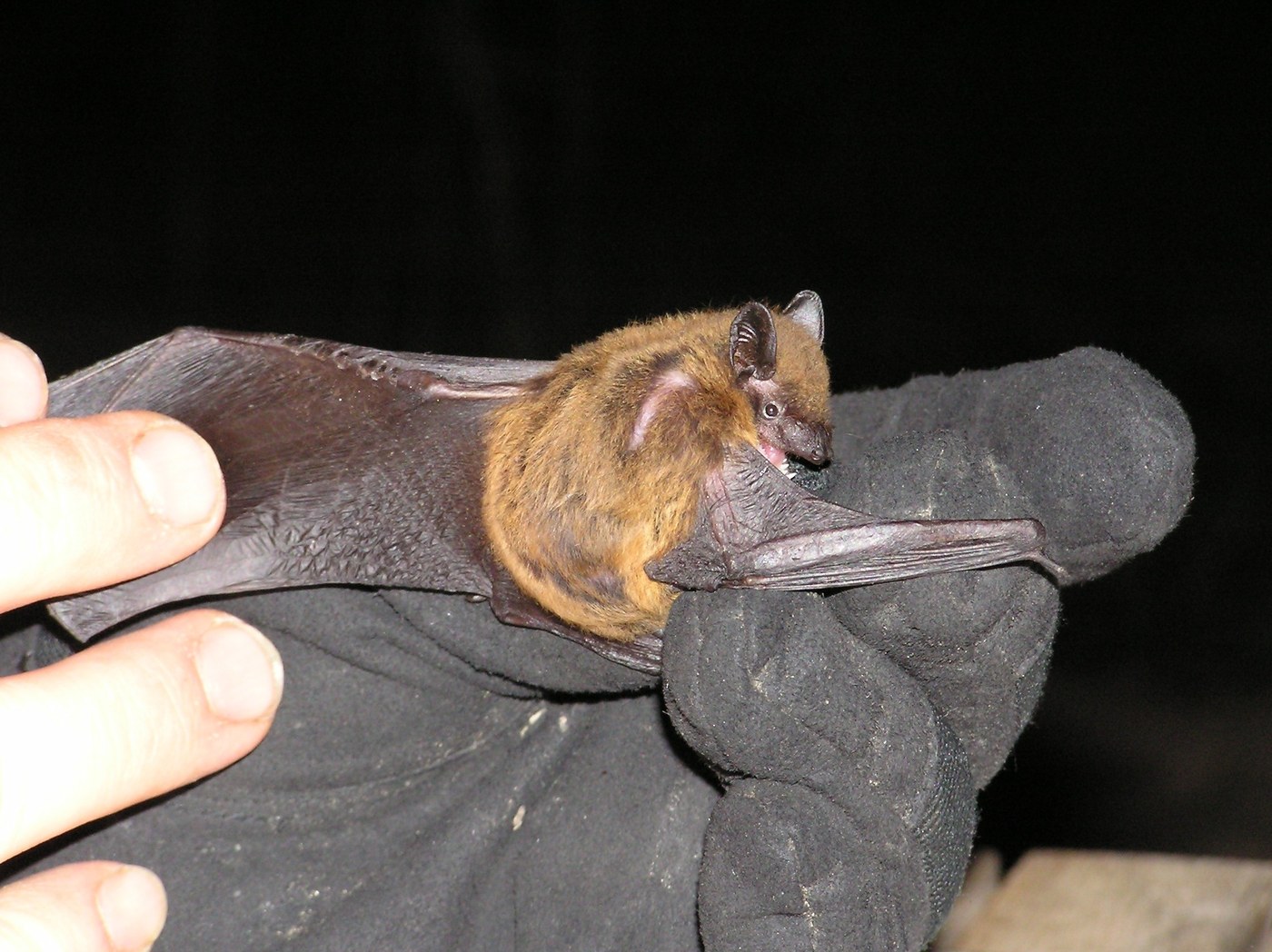
Small, nearly black, and best described as a scaled down big brown bat. Total length runs about 3 to 3.8 inches, forearm 34 to 37 millimeters, weight 5 to 14 grams, with sources differing slightly inside that range. Fur is glossy brown on the back with a paler belly, and the ears, wings, and tail membrane are black or blackish. Immature animals are darker than adults. Virginia's wildlife agency describes the species directly as looking like a scaled down version of the big brown bat, and Kentucky Fish and Wildlife's own page calls it remarkably similar in appearance to the big brown bat and runs a side by side size comparison photograph.
The calcar, against big brown bat
The reliable tell against big brown bat is the calcar. The evening bat has no keeled calcar, the small spur of cartilage extending from the ankle along the edge of the tail membrane, while the big brown bat does. That is a hand check on a captured animal, not a driveway observation, which is one more reason species confirmation belongs with a licensed operator rather than a phone photograph.
The tragus, against the Myotis bats
The tell against the Myotis bats is the tragus. This species has a short, blunt, slightly curved tragus, the fleshy projection in front of the ear opening. Similarly sized Myotis bats, little brown bat among them, have a longer and more pointed tragus. Unlike the solitary tree bats, this species' fur does not extend onto the wing or tail membranes.
An odor tell, and it is documented
There is an odor tell, and it is documented rather than folklore. Virginia's wildlife agency notes that evening bats have an acrid odor that distinguishes them from other bats in that state. It is an identification detail for an in person encounter, separate from the general guano odor of any occupied roost.
Legal rules vary by state
Identification decides which legal rules apply, and for this species the answer is not the same in every state. Globally the species is assessed as Least Concern, and Texas Tech's account states it does not appear on federal or state lists of concerned species in Texas, with populations stable as long as forested habitat is available. Illinois lists it as simply common and native. But Michigan's own threatened and endangered species list names the evening bat as Threatened, Indiana state sourced species listing data designates it State Endangered, and Kentucky Fish and Wildlife designates it a species of Special Concern. An academic study of the species at the northern edge of its range states the same split directly and adds that historically known Indiana maternity colonies in buildings have vanished over the years. A colony in a Georgia or Texas barn and the same species in the same situation in Michigan or Indiana are not the same legal problem.
Signs of Infestation
Guano is the confirming sign
It is distinguishable from rodent droppings. Bat droppings are segmented and friable. Crush one and it crumbles to powder, revealing shiny undigested insect fragments. Rodent droppings taper at the ends, are not segmented, are harder and more fibrous, and do not turn powdery. Look for accumulation on attic and barn floors, in wall recesses, and on the ground below an entry point.
Volume tracks colony size
This species' colonies can be large. Bat Conservation International describes nursery colonies of this species as quite large, containing several hundred individuals. That is not bridge scale, but it is well past the handful of animals people picture, and it is why guano accumulation in an established building roost is worth taking seriously rather than sweeping up.
Two chances to see them leave
Bats leaving at dusk, and this species gives you two chances to see it. Standing outside and watching animals leave is still the most useful thing a homeowner can do, because it locates the actual exit points. Texas Tech's account documents two preferred foraging windows for this species, early evening and again just before dawn, so the emergence to watch for comes soon after dusk.
An ammonia-like odor
It comes from accumulated guano and urine. This is general bat sign rather than species specific, and it scales with the size of the colony producing it. With several hundred animals in a building it is frequently the thing that prompts the first call, and it gets worse in damp weather.
Scratching from wall voids at dusk
Scratching and chittering from wall voids or attic space, especially around dusk as the colony stirs. Treat this as a question rather than an answer. Noise in an attic can be rats, mice, squirrels, or birds just as easily. Guano confirms bats. Sound only raises the possibility.
What is not documented for this species
No visual or audible sign specific to the evening bat has been documented beyond the general bat evidence. The species specific details are the acrid odor, the colony size, and the twice nightly foraging pattern. Every other sign is general bat sign rather than anything unique to this species.
Prevention and When to Call a Pro
Never handle a bat bare-handed
Never handle a bat with bare hands. This rule comes first, and it holds regardless of season or region. Bats are a designated rabies vector species, and Centers for Disease Control and Prevention data attributes the single largest share of reported United States wildlife rabies cases to bats as a group, ahead of raccoons, skunks, and foxes. This species is confirmed in its own right rather than assumed by family resemblance: a peer reviewed evaluation of species identification and rabies virus characterization among United States bat rabies cases identifies Nycticeius humeralis variant rabies among its surveillance specimens, at about 2.5 percent of the species specific viral characterizations in that dataset. It is not one of the five most frequently rabies positive bat species nationally, which are big brown bat, little brown bat, Brazilian free-tailed bat, hoary bat, and eastern red bat, but it is a documented positive species. No bare handed contact, no home capture and release. If a bat has to be handled at all, it is handled with gloves and a container by someone qualified to do it.
When to treat it as an exposure
Treat certain situations as a possible rabies exposure even with no visible bite, and call a health department rather than deciding at home. A bat bite is not always visible on human skin. Any bite, scratch, or unexplained contact needs medical evaluation, and a bat found in a room with a sleeping person or an unattended child is treated as a possible exposure whether or not anyone saw a bite. That is a call to your county or state health department. Keep pets current on rabies vaccination as well.
No exclusion in maternity season
Exclusion cannot happen during the maternity season, and the reason is mechanical rather than bureaucratic. Pups are born late May into June and cannot fly for roughly three weeks, reaching full adult size at 6 to 7 weeks. Sealing an active entry point during that window lets the adult females out and traps flightless pups inside, where they die. A mother separated from her trapped young may then try to reach them by flying into the home's living space. In many states doing this is also illegal. No do it yourself exclusion instructions apply to that window, because there is no safe version of the work.
The blackout dates vary by state
The blackout dates are set state by state, and no date should be assumed for a state without checking it. Florida publishes a statewide bat maternity season of April 16 through August 14, during which it is illegal to block bats from returning to a roost without a permit. Georgia's own wildlife agency recommends avoiding bat exclusions between April 1 and July 31. Those are two cited examples, not a national rule, and no state statute names the evening bat specifically. What protects this species is the general bat maternity season protection that covers every bat species present in a given state. Dates vary, they change, and neighboring states genuinely differ. Confirm the current window for your address with your state wildlife agency or a licensed nuisance wildlife control operator before any sealing work is scheduled.
A second layer in three states
In Michigan, Indiana, and Kentucky there is a second legal layer beyond the maternity window. Michigan's own threatened and endangered species list names the evening bat as Threatened. Indiana state sourced species listing data designates it State Endangered. Kentucky Fish and Wildlife designates it a species of Special Concern. Across the southern core range, Texas, Illinois, and the Southeast, the species is common and unlisted. If you are in one of those three states, permit aware professional handling is the safer default even outside the maternity window, and that is a different answer from the one a homeowner in Georgia gets. Anyone who tells you bat rules are the same everywhere is wrong in a way that can cost you.
Where to focus on a building
Where to focus prevention on a building, outside the maternity window. Because this species uses attics, wall voids of wooden buildings, soffits, barns, bridges, and cisterns alongside its natural tree roosts, the targets are attic and roof vents, soffit gaps, roofline and eave entries, and gaps in siding and edge boards. Do not assume an opening is too small to matter, because bats routinely use gaps people would never think to check. The correct sequence is a professional survey that locates every active and potential entry, then eviction and permanent sealing timed for a season when no flightless young are present. Specific device and sealing methods belong with the operator doing the work rather than in a how to on a website.
What is driving them indoors
Understand what is driving colonies into buildings, because it changes what prevention can realistically achieve. Bat Conservation International describes this as a true forest bat that roosts in hollow trees and behind loose bark and is almost never encountered in caves. Georgia's biodiversity portal documents the shift into wooden buildings as forests have been cut, and Kentucky Fish and Wildlife names conversion of forested wetlands to agriculture and logging that removes prime roost trees as active threats. Your attic is a substitute roost, not a first preference. Sealing it properly moves the colony along, and the insect eating carries on somewhere else, which is the outcome to aim for.
Guano cleanup is its own hazard
Guano cleanup is a separate hazard from rabies, and it scales with the colony. Histoplasmosis is a lung infection caused by inhaling spores of Histoplasma capsulatum from soil and material contaminated with bat or bird droppings, per the Centers for Disease Control and Prevention. The mechanism is the same for any bat. What differs is quantity, and with nursery colonies reaching several hundred animals a long established roost can hold a substantial accumulation. Old deposits should not be disturbed casually. That work needs proper respiratory protection and controlled handling rather than a shop vacuum and a dust mask on a Saturday.
Who to Call, and When
Call a licensed wildlife control professional for any colony, or any suspicion of one, in an attic, barn, soffit, or wall void, at any time of year. Call immediately if you find it in late spring or summer, because that is exactly when do it yourself sealing traps and kills pups and creates a legal problem on top of a wildlife one. Call your health department first after any bare handed contact, bite, or scratch, or any bat found loose in living space. Call before any guano cleanup large enough to need clearing out. And in Michigan, Indiana, or Kentucky, call before doing anything at all, because the species itself carries added state protection there.
Frequently Asked Questions
Do evening bats get white-nose syndrome?
Not the way cave-hibernating bats do. A peer reviewed study of species-specific responses to white-nose syndrome in the Great Lakes region lists the evening bat among the migratory species that have not shown symptoms of the disease, and the mechanism is straightforward: this bat is not known to hibernate in caves at all. Bat Conservation International reports that evening bats have not been found hibernating in local caves, simply disappear from their summer habitat, and are thought to stay active at their southern wintering sites. Compare that with little brown bat, big brown bat, Indiana bat, northern long-eared bat, and tricolored bat, all of which overwinter in caves, mines, or structures and all of which the disease has affected. To be precise about the claim: the sourced statement is that this species has not shown symptoms, which is not the same as proven immunity.
Why do I have evening bats in my attic instead of in a cave or a hollow tree?
Because the tree roosts came first and there are fewer of them than there used to be. Bat Conservation International describes the evening bat as a true forest bat, almost never encountered in caves, that forms nursery colonies in hollow trees and behind loose bark and sometimes in buildings and attics. Georgia's state biodiversity portal is explicit about the driver: as forests have been cut, many have moved into wooden buildings. Kentucky Fish and Wildlife records nursery colonies in buildings along with bridges and cisterns, and names logging and the conversion of forested wetlands as active threats to roosting habitat. A building colony of this species can reach several hundred animals, so an attic roost is not necessarily a small problem.
Are evening bats dangerous?
Not through casual proximity, but the rabies rule is absolute. Bats are a designated rabies vector species, and Centers for Disease Control and Prevention data attributes the largest single share of reported United States wildlife rabies cases to bats as a group. For this species specifically, a peer reviewed rabies surveillance study identifies Nycticeius humeralis variant rabies among confirmed United States bat rabies cases, so it is a documented positive species rather than one assumed positive by family. It is not among the five most frequently rabies positive bat species nationally. Never handle one with bare hands, treat any bite, scratch, or unexplained contact as a potential exposure needing medical evaluation, and treat a bat found in a room with a sleeping person or an unattended child as a possible exposure even with no visible bite. Separately, accumulated guano carries a histoplasmosis risk when it is disturbed, which is a cleanup hazard rather than a bat contact hazard.
Is it legal to remove evening bats from my house?
It depends on the month and on the state, and both parts matter. Exclusion cannot happen while flightless pups are in the roost, because sealing the entry traps and kills them, and doing it anyway is illegal in many states. Pups are born late May into June and cannot fly for about three weeks. Several states publish their own bat maternity blackout dates that cover this species along with every other bat present. Florida's runs April 16 through August 14 with a permit required to exclude during it, and Georgia's wildlife agency recommends avoiding exclusions April 1 through July 31. No state statute names the evening bat by name, and dates vary between neighboring states, so the current window for your address has to come from your state wildlife agency or a licensed operator. On top of the timing question, the species itself is state listed as Threatened in Michigan, State Endangered in Indiana, and a species of Special Concern in Kentucky, which raises the stakes further in those three states.
Are evening bats common everywhere in the eastern US?
No, and the honest answer changes depending on which state you are standing in. Across the southern core range the species is common and unlisted. Bat Conservation International calls it abundant throughout the southeastern United States, Illinois lists it as common and native statewide, and Texas Tech's account says it does not appear on federal or state lists of concerned species in Texas. At the northern edge of the range it is genuinely rare and formally protected: Threatened in Michigan, State Endangered in Indiana, and a species of Special Concern in Kentucky, with an academic study of the species at its northern range edge noting that historically known Indiana maternity colonies in buildings have vanished over the years. Farther northeast it is not really a resident at all. Pennsylvania's Game Commission states that evening bats have been found a few times in the state but are not considered regular residents, with only three pregnant individuals captured there in recent years.
How do I tell an evening bat from a big brown bat?
Mostly by size and by one hand check, which is why this is a job for whoever comes out to inspect rather than a phone photograph. Virginia's wildlife agency describes the evening bat as looking like a scaled down version of the big brown bat, and Kentucky Fish and Wildlife calls it remarkably similar in appearance and publishes a side by side size comparison. The evening bat runs about 3 to 3.8 inches long at 5 to 14 grams. The reliable structural difference is the calcar, the spur of cartilage at the ankle running along the tail membrane: the evening bat's is not keeled, the big brown bat's is. Against the similarly sized Myotis bats, the evening bat's tragus, the projection in front of the ear opening, is short, blunt, and slightly curved rather than long and pointed. Virginia also notes a distinctive acrid odor that separates this species from the state's other bats.
Sources
- Nycticeius humeralis species profile: true forest bat roosting in hollow trees and buildings, nursery colonies of several hundred individuals, fall fat storage and lengthy southern migration, 547 km banding recovery, absence from hibernating cave counts, diet, and Least Concern global status Bat Conservation International
- Species-specific responses to white-nose syndrome in the Great Lakes region: evening bat listed among migratory species that have not shown symptoms of the disease Peer-reviewed study, PMC10329912
- Evaluation of species identification and rabies virus characterization among bat rabies cases in the United States: confirms Nycticeius humeralis variant rabies among surveillance specimens Peer-reviewed study, PMC11351906
- Species account of the Evening Bat in The Mammals of Texas, Seventh Edition: size and weight, fall mating, litter size, late May to mid June births, first flight at about 20 days, year-round eastern Texas residency, westward range expansion, and Texas conservation status Texas Tech University Natural Science Research Laboratory
- Evening Bat: scaled-down big brown bat comparison, absence of a keeled calcar, acrid odor, nursing and submandibular scent marking, and the Virginia Tech campus maternity colony Virginia Department of Wildlife Resources
- Evening Bat (Nycticeius humeralis): Kentucky Special Concern status, western-third distribution, June births, nursery colonies in buildings, bridges and cisterns, non-cave association, winter range and overwintering research, and habitat threats Kentucky Department of Fish and Wildlife Resources
- Evening bat: statewide Illinois occurrence, common and native Illinois status, June births, flight at about three weeks, adult size at 6 to 7 weeks, and habitat associations Illinois Department of Natural Resources
- Threatened and endangered species list: Evening bat, Nycticeius humeralis, listed as Threatened in Michigan Michigan Department of Natural Resources
- Ecology of the evening bat (Nycticeius humeralis) at the northern edge of its range: Indiana, Kentucky and Michigan listing status, the Lenawee County Michigan colony, the Ohio rarity pattern, and the loss of historic Indiana building colonies Winhold and Kurta, hosted by the Illinois-Indiana Chapter of The Wildlife Society
- Indiana bat biological assessment and I-69 bat survey appendix, citing state-provided species listing data designating the evening bat State Endangered in Indiana Indiana Department of Transportation, citing Indiana Department of Natural Resources listing data
- Bats: states that the evening bat has been found a few times in Pennsylvania but is not considered a regular resident, with three pregnant individuals captured in recent years Pennsylvania Game Commission
- Statewide bat maternity season, April 16 through August 14, during which blocking bats from returning to a roost requires a permit Florida Fish and Wildlife Conservation Commission
- Evening bat: lifespan of roughly 4 to 6 years and a banded individual sighted 340 miles from its summer capture location North American Bat Monitoring Program
- Evening Bat (Nycticeius humeralis) species page Texas Parks and Wildlife Department
- Evening Bat species page confirming Tennessee occurrence Tennessee Wildlife Resources Agency
- Nycticeius humeralis species profile: movement into wooden buildings as forests have been cut, litter size, pup birth weight, and diet Georgia Department of Natural Resources biodiversity portal
- Evening Bat account corroborating distribution across the central Great Plains of Kansas and Oklahoma Kansas Mammal Atlas, Fort Hays State University
- Field Identification Key and Guide for Bats of the United States of America: range described as east of the Rocky Mountains, excluding the northeastern and northern border states Peer-reviewed study, PMC6537616
- Rabies in the United States: Protecting Public Health Centers for Disease Control and Prevention
- Histoplasmosis Centers for Disease Control and Prevention
Image Credits
- Image: photographer not named, via Wikimedia Commons. Public domain.