Seasonal Timeline
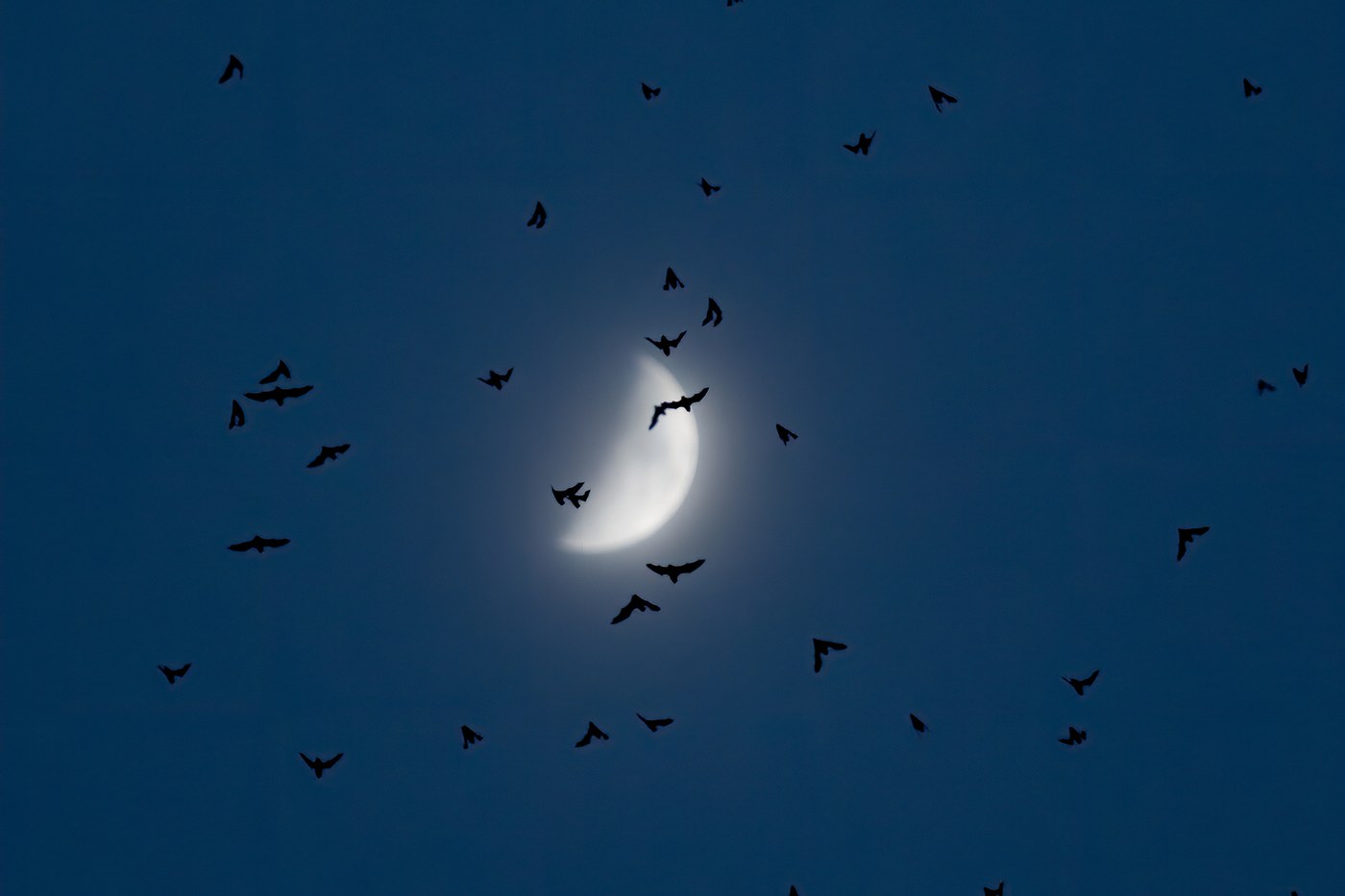
Present roughly April through September across most of its range, with populations migrating south into Mexico for the winter. Colonies are at their largest and loudest through the heat of summer, which is also the stretch when exclusion work is off the table.
Present roughly April through September across most of its range, with populations migrating south into Mexico for the winter. Colonies are…
This species migrates rather than hibernating, and that is the single most useful fact about it. Wildlife damage management guidance from the Internet Center for Wildlife Damage Management states directly that Mexican free-tailed bats demonstrate extensive migration, potentially traveling up to 1,000 miles. Bat Conservation International documents populations moving seasonally between the central and southern United States and Mexico, with females forming maternity colonies here through the summer while males occupy separate bachelor colonies. Multiple independent accounts of the Texas population converge on the same window: present roughly April through September, gone into Mexico for the winter.
Do not carry the big brown bat's overwintering pattern across to this species. Big brown bat stays put and drops into a lighter winter torpor, and it can be seen flying during warm winter spells. This bat leaves. A structure that had bats in it every night in July can be genuinely empty in January, and that is not a sign the problem solved itself. It is a sign the colony is in Mexico and the entry points are still open.
The comparison runs one step further. The eastern structural bat picture was rewritten over the last two decades by white-nose syndrome, a fungal disease that collapsed little brown bat populations across the Northeast and the Midwest and changed which species a homeowner should expect to find in an attic there. The picture across California, the Southwest, and South Central is shaped by a different driver entirely: seasonal migration. Which bat you have, and which months you have it, are set by the calendar here rather than by disease.
The practical consequence is a calendar with three separate windows rather than one. The colony is present April through September. Pups are flightless inside that stretch. And in Texas specifically, legal exclusion runs August 16 through March 31, which means the legal season and the occupied season barely overlap at all. Late August and September are the narrow band where a colony is still present, exclusion is permitted, and the work can actually be done before the animals leave on their own. See the prevention section below.
Where They're Found
Roosting habits are what put this species in a pest library, and they are broader than an attic. Colonies use caves, abandoned mines, bridges, culverts, and bat houses, and bridges and culverts specifically are a much larger part of this bat's roosting profile than they are for big brown bat. That is exactly why the most famous colonies of this species are named after infrastructure rather than caves alone. A concrete expansion joint under a highway bridge is, from this animal's point of view, a warm dark crevice with good sun exposure, which is the same thing an attic or a soffit offers. Structures with substantial sun exposure are preferred.
Colony sizes are the real outlier. Bat Conservation International describes roosts reaching hundreds of thousands, even millions of bats at a single site. Bracken Cave near San Antonio, which the organization owns and protects, holds reported figures around 20 million bats in summer and is the largest known bat colony in the world. The Congress Avenue Bridge in Austin holds an estimated 1.5 million and has become a nightly public viewing event. Tucson has four bridge colonies of its own, Broadway over the Pantano Wash, North Campbell Avenue and East Tanque Verde over the Rillito, and Ina Road over the Santa Cruz River, with a 2008 estimate putting roughly 200,000 bats citywide and 20,000 under the Pantano Wash bridge alone.
Those figures are not trivia. They are the reason scale has to be assessed before anything else gets acted on. A dozen bats in an eave and a long-established roost at bridge scale are the same species and not the same job.
Range is broad. The United States Geological Survey's own species habitat distribution model places the range as far north as Oregon and as far east as Nebraska and Kansas, covering the southern half of the country and extending into Mexico, Central America, and South America. Around homes, that means California, South Central, and the Southwest. Both Alaska and Hawaii are confirmed absences rather than omissions. No published range description places this species anywhere near Alaska, and every range model found stops well south of it. Hawaii's only native bat is a separate and taxonomically distinct species, and the two should not be conflated.
One note on how fast range can move. North Carolina's own wildlife agency documents this species as poorly known in that state into the early 1980s, recorded only from the southern Coastal Plain, and by 2025 occurring across much of the Piedmont and Coastal Plain as well. North Carolina is well outside those three regions, and that shift matters only as evidence that a bat range map is a snapshot rather than a fixed boundary.
Related Pests
Life Cycle
One generation a year, and the birth window is set by an unusual piece of biology. Bats generally mate in fall and winter, but the female stores sperm and delays ovulation and fertilization until spring. That is delayed fertilization, a different mechanism from the delayed implantation seen in bears, and it is why births cluster into a May through early July window across a very large geographic range. That tight window is what makes a fixed maternity blackout workable as a rule rather than a guess. The delayed fertilization mechanism is documented for North American bats generally rather than confirmed specifically for this species, and the same is true of the one generation per year figure and the 3 to 4 week first flight timing.
Total lifespan for this species is a genuine gap in the record. No published lifespan figure specific to Mexican free-tailed bat was found, and no figure is borrowed from another bat species in its place.

Pup
Juvenile
Adult2
Identification
The exposed tail
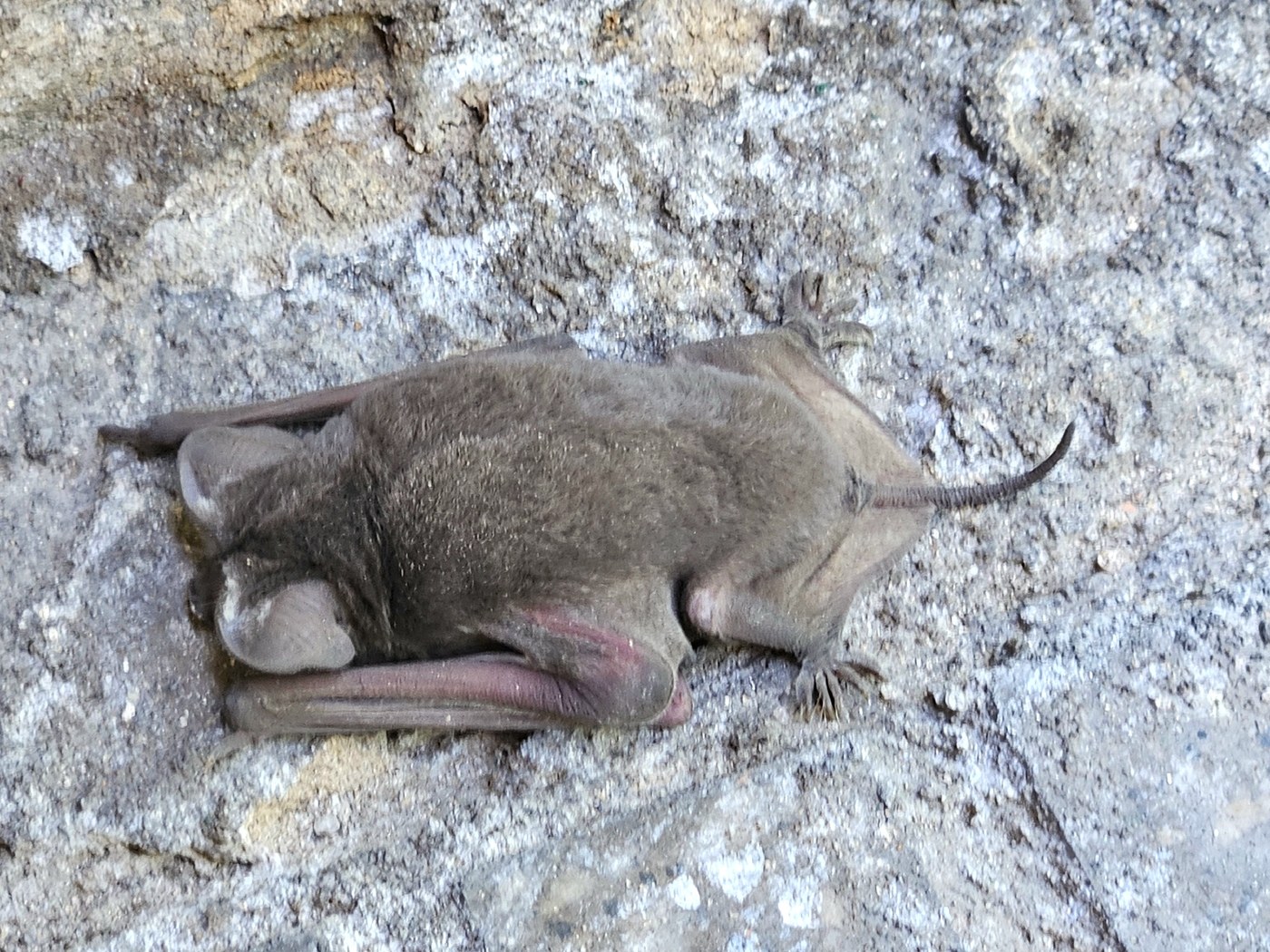
It is the one reliable tell, and genuinely easy to check on an animal in hand. The tail extends visibly beyond the tail membrane, the uropatagium, which is where the common name comes from. A big brown bat's tail stays fully enclosed in that membrane. This species belongs to Molossidae, the free-tailed bats, a different family from big brown bat's Vespertilionidae, and the tail difference is the family trait rather than a subtle field mark.
Two names, one animal
Mexican free-tailed bat and Brazilian free-tailed bat are the same animal. Both names are used interchangeably nationally, and Brazilian free-tailed bat is the name Florida Fish and Wildlife's own field guide uses. No other regional or colloquial name turned up in the published literature. If you are comparing guidance documents that use different names, check the scientific name before assuming they are describing different species.
Small, dark, and distinctive at close range
Roughly 12 grams or about 0.4 ounce, dark brown to gray, with short dense fur, large rounded ears, and wrinkly upper lips. None of that is much use at dusk from a driveway, which is the honest caveat that applies to every bat identification. What a homeowner actually identifies is the guano and the roost signs described below.
Flight speed, and it is not exaggerated
Flight speed is the behavioral tell, and the numbers are not exaggerated. Average flight speed runs over 60 miles per hour, with documented bursts approaching 100, among the fastest flight speeds recorded for any bat or bird species. Nightly foraging reaches altitudes over 3,000 meters, roughly 10,000 feet, to intercept migratory moths, among the highest documented foraging altitudes for any bat.
Colony size is diagnostic in its own right
This is among the most colonial bats in North America, with roosts reaching hundreds of thousands and, at Bracken Cave, millions. Colonies segregate by sex through the summer, females into maternity colonies and males into separate bachelor colonies. A very large aggregation under a bridge or in a culvert across these three regions is far more likely to be this species than anything else.
No real look-alike risk here
No significant look-alike risk in these three regions. No commonly confused species turned up in the published accounts for its range. Free-tailed bats are visually distinct enough from the vespertilionid bats, big brown bat and little brown bat among them, that the exposed tail resolves most confusion. That is unusual enough in wildlife identification to be worth stating outright rather than hedging.
Signs of Infestation
Guano, and the scale is the story
Guano is the confirming sign, and the scale here is the story. Bat droppings are segmented and friable. Crush one and it crumbles to powder, revealing shiny undigested insect fragments. Rodent droppings taper at the ends, are not segmented, are harder and more fibrous, and do not turn powdery. Given this species' documented colony sizes, guano accumulation at an established large roost can reach tons, which is a genuinely different problem from the accumulation under a household attic colony of a dozen big brown bats.
An ammonia-like odor
A strong ammonia-like odor from accumulated guano and urine. This is consistent across bat species generally, and it matters here specifically because the volume differs. An odor detectable from outside the building scales with the size of the colony producing it, and it is often the thing that prompts the first call.
Roost damage and staining
Both show on the structure itself. Sustained large colony guano accumulation and staining damages bridges, culverts, and buildings over time. On a residential property that shows up as staining and spotting below an entry point, on siding, windows, patio furniture, and vehicles parked underneath.
Colonies are noisy
A large one is very noisy. Beyond volume, Bat Conservation International documents a real social repertoire for this species: isolation calls, begging calls, and multi-syllabic songs on top of the usual echolocation. None of it is something a homeowner can pick out from inside the house. Guano confirms bats. Noise raises the question.
The nightly emergence
A nightly emergence is its own sign, and at scale it is unmistakable. Bats are nocturnal and leave the roost at dusk. At Bracken Cave and the Congress Avenue Bridge that emergence is large enough to draw dedicated public viewing. On a residential property the same behavior, at a much smaller scale, is the single most useful thing to watch for, because standing outside at dusk and counting animals leaving is how the exit points get located.
Prevention and When to Call a Pro
Never handle a bat bare-handed
Never handle a bat with bare hands, and this rule holds regardless of everything else. Bats are the leading wildlife rabies vector nationally. Centers for Disease Control and Prevention data attributes the single largest share of reported United States wildlife rabies cases, 35 percent, to bats as a group, ahead of raccoons, skunks, and foxes. That figure is reported at the taxonomic level for bats collectively rather than broken out by individual species, and no species-specific rate exists. Treat any bite, scratch, or unexplained contact as a potential rabies exposure requiring medical evaluation, and treat a bat found in a room with a sleeping person or an unattended child as a potential exposure whether or not a bite is visible. That is a call to your county or state health department, not a judgment call to make at home. If a bat has to be handled at all, it is handled with leather gloves and a container.
Exclusion, and its timing
Exclusion is the only correct method, and its timing is the most important variable of all. Standard national guidance is not to attempt exclusion between May 15 and August 15. The reason is mechanical rather than bureaucratic. A one way device installed during the maternity window lets adults out and traps flightless pups inside, and a mother separated from her young may try to reach them by flying into the home's living space. Trapped pups searching for a way out create the same risk from the other direction.
Texas sets its own window
It is both earlier-starting and legally specific. Texas Parks and Wildlife Code, Chapter 63, Section 63.101 makes it unlawful to hunt, sell, buy, or possess a bat, dead or alive, with one exception: a bat may be legally removed from inside or on a building occupied by people. Exclusion is the only legal removal method there. Texas A&M AgriLife Extension is the direct citation for that statute. The dates come from Texas's own published exclusion calendar as described consistently by multiple independent Texas operators rather than from the state agency directly, so treat the window as reported rather than confirmed: exclusion discouraged May 1 through August 15, and permitted August 16 through March 31. Note that the Texas blackout starts two weeks earlier than the generic national figure. If you are in Texas, use the Texas date, and confirm it with the state agency before work begins.
California, a permit question
California classifies bats as nongame mammals, and the practical effect is a permit question. California Fish and Game Code Section 4150 classifies bats as nongame mammals, meaning they cannot be taken, possessed, or killed without an appropriate permit. Non-lethal exclusion of bats from a structure, performed outside sensitive maternity periods, is generally available to a property owner without a separate permit for the exclusion itself. That reading comes from a secondary legal summary rather than from the Code text reviewed directly, so treat the classification as solid and the precise scope of what needs a permit as worth confirming with the state agency or a licensed operator before anyone starts work.
Arizona is protective throughout
Arizona takes a protective posture across the board, though the exact statute number could not be verified. Multiple independent sources describe Arizona state law as making it illegal to harm, injure, or disturb any bat, with all species protected regardless of individual conservation status, and describe specific state guidance on the timing and method of removing bats from structures. No Arizona Game and Fish Department page confirms the statute number, so the protective posture above is general rather than a numbered citation. Anyone working in Arizona should get the current rule from the department directly.
What to do in the blackout window
There is still legitimate work to do during the blackout window. Full exclusion is off the table, but sealing unused and inactive openings is not, and neither is concentrating effort on closing gaps between the roost space and the actual living space of the home. That protects the household without trapping anything. It is a licensed operator's job rather than a weekend project, and it is the answer to the very common question of whether the only option is to wait and do nothing.
One-way devices, with specs
One way exclusion devices, with the specifications that make them work. Fiberglass mosquito netting works well, mounted around three sides of an active exit hole and left open at the bottom, extending roughly 3 feet down and protruding 3 to 5 inches from the wall. Leave it in place a minimum of 3 to 5 days, and longer in wet weather, to confirm the roost has fully vacated before anything gets permanently sealed. Pulling the device early leaves bats inside.
Do not assume a gap is too small
Seal all gaps of one quarter by one and one half inches, and any opening five eighths by seven eighths inches or larger. Bats fit through openings most people would not think to look at. Use silicone caulk where permanence matters, since latex, butyl, and acrylic caulk last roughly 5 years by comparison. Galvanized, copper, or aluminum flashing handles seams. Knitted wire mesh and weather stripping handle narrow gaps, quarter inch hardware cloth handles larger ones, and self-expanding polyurethane foam handles openings over 3 inches.
Habitat modification helps twice
Habitat modification reduces the appeal of a structure before exclusion and after it. Replace white light bulbs with insect-resistant alternatives, which cuts the insect draw that brings foraging bats to a building in the first place. Install fans or vents to lower the temperature of a roost space, since this species prefers warm, sun-exposed roosts. Open closed-in soffits and remove shutters that create attractive roost cavities.
Guano cleanup is a bigger hazard
Guano cleanup is a separate hazard from rabies, and on this species it is a larger one. The Centers for Disease Control and Prevention confirms histoplasmosis as a fungal lung disease contracted by inhaling spores from soil contaminated with bird or bat droppings. The mechanism is identical to any other bat, but the quantity is not. A large established roost of this species can produce guano by the ton, and that makes the exposure risk more acute rather than less. Large-scale cleanup needs proper respiratory protection and controlled handling. It is not a shop vacuum and a dust mask on a Saturday.
What is not legal
Naphthalene repellents require state approval before use. Trapping is discouraged. Shooting is illegal in many states and is confirmed illegal in Texas under the statute cited above. Any method beyond passive exclusion and sealing belongs with a licensed nuisance wildlife control operator rather than in a how-to on a website.
Call for a roost at scale
Call a professional for any roost at genuine scale, regardless of season. Scale is what sets this species apart. Hundreds or thousands of animals, or a long-established roost at bridge scale rather than attic scale, is agency and professional territory by default. The colony sizes documented for this species make clear how far past a typical household bat problem it can go.
Call for a roost in the blackout
Call for any active roost discovered during the blackout window. May 15 through August 15 nationally, May 1 through August 15 in Texas. Exclusion has to wait, and only a professional should assess whether sealing the unused openings now is safe to do.
Call your health department first
Do it after any bare-handed contact, bite, or scratch, or any bat found loose in living space. That is especially true if it happened in a room with a sleeping person or an unattended child. Keep pets current on rabies vaccination as well.
Call before a large cleanup
Call before any guano cleanup large enough to need clearing out. The histoplasmosis exposure risk is real, and it comes from disturbing the material rather than from the bats themselves.
Frequently Asked Questions
Do Mexican free-tailed bats hibernate in my attic all winter like other bats?
No, and this is the biggest single difference between this species and most other bats. Mexican free-tailed bat is genuinely migratory. Populations in Texas and much of the Southwest are present roughly April through September and move south into Mexico for the winter, with documented migration distances potentially reaching 1,000 miles. Big brown bat, by contrast, stays put through a lighter winter torpor and can be seen flying during warm winter spells. The practical takeaway is that an empty-seeming attic in January is not proof the problem resolved. The colony is likely in Mexico, and the entry points it used are still open.
Is it true that millions of bats live under a bridge in Texas?
Yes, and the numbers are not folklore. The Congress Avenue Bridge in downtown Austin holds an estimated 1.5 million Mexican free-tailed bats and draws nightly public viewing crowds. Bracken Cave near San Antonio, owned and protected by Bat Conservation International, holds reported figures around 20 million in summer and is the largest known bat colony in the world. Tucson has four bridge colonies of its own, with a 2008 estimate putting roughly 200,000 bats citywide. All of that is the same species that can end up roosting in a home's attic, soffit, or eaves, which is why assessing the size of a roost comes before deciding what to do about it.
Can I seal up where the bats are getting in right now?
Not if it is roughly May 15 through August 15, and not if it is May 1 through August 15 in Texas specifically. Sealing an active roost during that window can trap flightless pups inside while the mother is still coming and going, and she may then try to reach them by flying into your living space. Exclusion has to wait until the window passes. In Texas the legal exclusion season runs August 16 through March 31. During the blackout, a licensed operator can still seal your unused entries and focus on keeping bats out of the living space, then complete the exclusion properly once the window closes.
Are Mexican free-tailed bats dangerous?
Directly, rarely. But bats as a group account for the single largest share of reported wildlife rabies cases in the United States, 35 percent according to Centers for Disease Control and Prevention data, so any bite, scratch, or bare-handed contact has to be treated as a potential exposure and evaluated medically. A colony roosting under a bridge or in an attic and interacting with nobody is a much lower-risk situation than a bat found loose in a bedroom. A bat found in a room with a sleeping adult or an unattended child is treated as a possible exposure whether or not a bite is visible, and that is a call to your health department.
Do these bats actually help with anything, or are they just a nuisance?
They do real agricultural work, and it is worth knowing before deciding what a colony is worth. This species eats enormous quantities of insects nightly, including agricultural pest moths named specifically in Bat Conservation International's species profile, cotton bollworm moth and army cutworm moth, along with beetles, flies, true bugs, and ants. It forages at altitudes over 3,000 meters, roughly 10,000 feet, to intercept migratory moths, among the highest foraging altitudes documented for any bat. A large colony's nightly consumption is a genuine pest-suppression benefit to surrounding farmland. That does not make an individual roost inside a structure any less of a problem to resolve. It does mean the goal is to move the colony out of your building rather than to get rid of the bats.
Why is the guano such a big deal with this species?
Volume. The health mechanism is the same as with any bat. Histoplasmosis is a fungal lung disease contracted by inhaling spores from soil contaminated with bat or bird droppings, per the Centers for Disease Control and Prevention. What differs is the quantity. Because this species roosts in aggregations reaching hundreds of thousands and, at the largest sites, millions, an established roost can accumulate guano by the ton. That makes the exposure risk during cleanup more acute rather than less, and it needs proper respiratory protection and controlled handling rather than a casual sweep-out.
Sources
- Tadarida brasiliensis species profile: seasonal movement between the United States and Mexico, sex-segregated summer colonies, diet including cotton bollworm and army cutworm moths, and foraging altitude Bat Conservation International
- Support Bracken Cave's Bats: the Bracken Cave and Congress Avenue Bridge colony-size figures Bat Conservation International
- Bats, Bat Biology, and Bat Damage Prevention and Control Methods: migration distance, delayed fertilization, the May 15 to August 15 maternity blackout, and exclusion device and sealing specifications Internet Center for Wildlife Damage Management (University of Nebraska-Lincoln / USDA APHIS Wildlife Services)
- Texas laws pertaining to bats: direct citation of Texas Parks and Wildlife Code Chapter 63, Section 63.101 Texas A&M AgriLife Extension, Bats in Schools program
- Rabies in the United States: Protecting Public Health Centers for Disease Control and Prevention
- Histoplasmosis Centers for Disease Control and Prevention
- Mexican Free-tailed Bat (Tadarida brasiliensis) mMFTBx_CONUS_2001v1 Habitat Map and range model United States Geological Survey
- Brazilian (Mexican) Free-tailed Bat field guide entry: alternate common name and species description Florida Fish and Wildlife Conservation Commission
Image Credits
- Image: Jonathan Eisen via iNaturalist. CC BY 4.0.
License. - Image: Naelin via GBIF. CC BY 4.0.