Seasonal Timeline
Nuisance activity runs year round, because Hawaii's stable climate keeps the roosting, the scavenging, and the vent nesting going with no real off season. Breeding is the part that does have a documented peak: the Bishop Museum's Hawaii monograph cites a 1967 study finding that mynas in Honolulu breed primarily from February through July, occasionally earlier. Those two findings do not contradict each other, because complaints about noise, droppings, and scavenging are not the same thing as the nesting cycle.
Nuisance activity and breeding activity are two different clocks, and a property owner feels both. Roosting and scavenging complaints run all year because the food and the shelter never go away. Nest-related problems, meaning a vent or wall gap that suddenly holds eggs and then noisy young, cluster into the documented Honolulu breeding window. One more Hawaii-specific detail matters for planning: mynas here stay paired year round rather than forming and breaking pairs seasonally, so a pair using your building is not a passing visitor waiting on a season to move along.
Where They're Found
This is a bird of developed, lowland Hawaii, not of the native forest. The Common Myna is strongly commensal with people and concentrates in exactly the modified environments where property conflicts happen: towns, suburbs, resorts, agricultural facilities, and the streets and parking areas around food service. The Bishop Museum's Hawaii monograph notes the birds were seldom if at all observed in higher-elevation native forests. In practice that means the species is almost entirely a lowland urban and suburban problem rather than a backcountry one.
It is a cavity nester, and on a building it will take your cavities. In less developed settings mynas use natural tree cavities. In Hawaii's urban and suburban areas they readily shift to the artificial equivalents on a structure: roof and soffit vents, wall gaps, and similar openings. Outside the nest, the birds gather in large communal roosts in urban trees, and those roosts can be long-lived landmarks. One historic roost sat on the grounds of the Royal Hawaiian Hotel in Waikiki and generated decades of amusing accounts of attempts to deal with it going back to the 1950s and 1960s.
The range inside the state is essentially complete. Mynas are established on all the main Hawaiian islands, with the monograph tracing the spread island by island from Oahu outward: Kauai by the early 1890s, Niihau some time after 1870, Molokai uncommon in 1906 and abundant by the 1960s, Lanai common by the 1910s and 1920s, Maui first noted in 1879 and the most abundant bird on the island by 1899 to 1900, and Hawaii Island first appearing near Hamakua around 1875. The species even reached Midway Atoll in the far Northwestern Hawaiian Islands in 1971, probably arriving on a cargo plane. Only Kahoolawe lacks an established record, resting on a single 1992 report that likely does not represent a breeding resident.
What they eat cuts both ways, and both halves are documented. Mynas are omnivorous generalists taking fruit, grain, grubs, and insects, along with small mammals such as mice, lizards, small snakes, spiders, earthworms, crabs, and flower nectar and petals. In Hawaii they continue to help control the cutworms they were originally imported to handle. They also disperse the seeds of Lantana camara, a significant invasive weed in the islands, and they prey on the eggs and young of other birds, with the native akepa honeycreeper named specifically. Worth separating carefully from that last point: a 1986 study cited in the Bishop Museum's monograph found mynas were exonerated of competing directly with native landbirds for nest cavities, so the cavity-competitor framing that fits some other introduced birds is not well supported here. Documented egg and nestling predation is a different mechanism from nest-site competition, and only the first of the two holds up for this species. That combination is why an honest account of this bird is not a single sentence.
Life Cycle
Two features of this life cycle drive the structural problem. The first is that the nest goes in a cavity rather than on an open branch, and on a developed property the available cavities are the ones you already own: roof vents, soffit vents, and wall gaps. The second is repetition. A pair may raise 1 to 3 broods in a season, and in Hawaii the pair does not break up between attempts. Clearing a nest without closing the opening therefore buys a short pause rather than a solution.

Egg
Nestling
Fledgling
Adult
Identification
Size
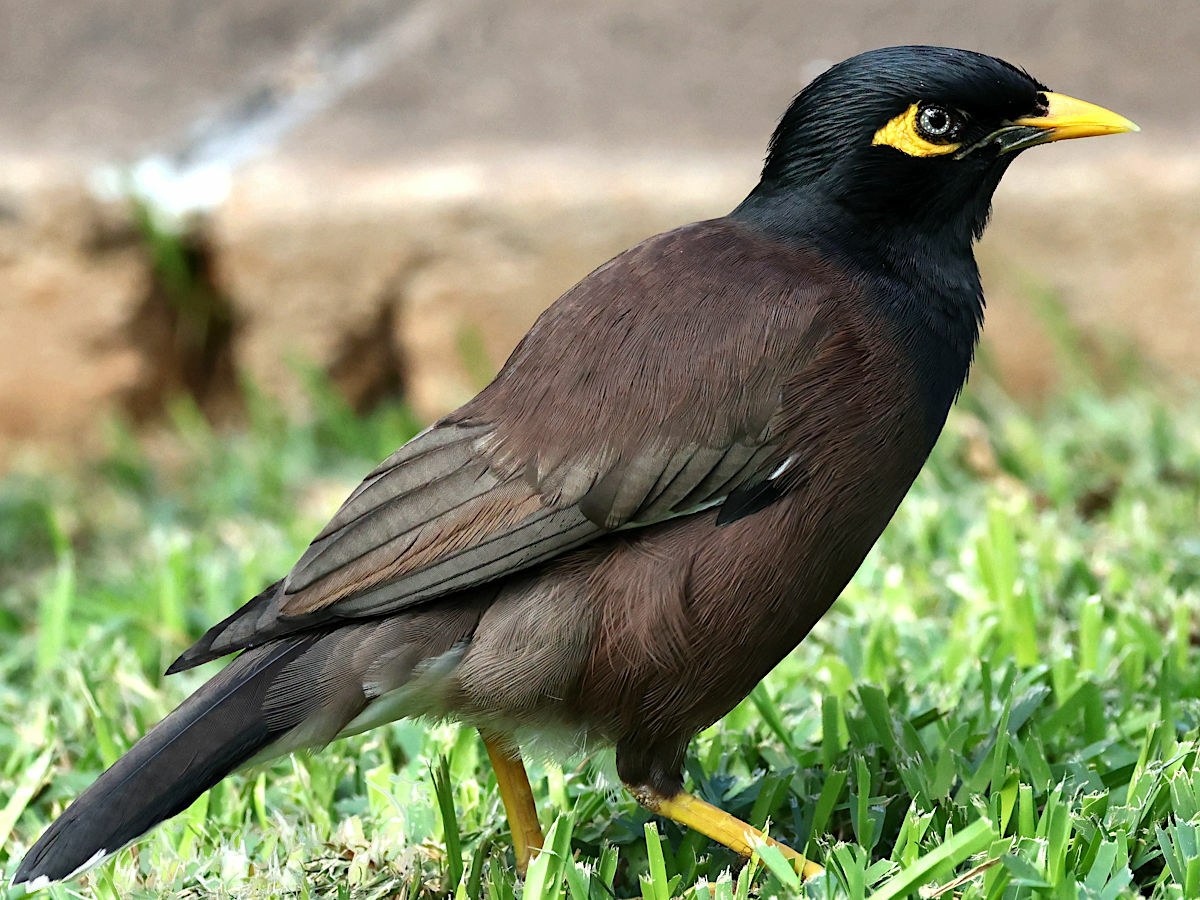
9.1 to 9.8 inches long, a 14.2 to 16.1 inch wingspan, and roughly 3.5 to 4.9 ounces in weight. The build is chunky and short-tailed rather than slim.
A chestnut-brown body
Body color is a rich reddish or chestnut brown, set against a glossy black head and hood that runs down over the throat and upper chest.
Three yellow marks
The three yellow marks are the fastest identification. A bright yellow bill, a patch of bare yellow skin around and behind the eye, and yellow legs. The bare yellow eye patch in particular is the mark to look for, because very little else in Hawaii carries it.
It changes in flight
In flight the bird changes appearance completely. A bold white wing patch flashes open, and the dark tail shows a clean white tip. Both marks are visible at a distance even when the bird is backlit and reads as a silhouette.
Jungle Myna is the look-alike to rule out
It is another introduced myna present in Hawaii, reported mainly on Oahu. It carries a tuft of feathers projecting forward from the forehead, which the Common Myna does not have, and it lacks the bare yellow eye patch that the Common Myna does have. Those two marks settle it.
It is a starling
This is a member of the starling family, Sturnidae, in a different genus from the European Starling. That family relationship is not trivia, because it is the exact reason the bird's federal legal status comes out the way it does.
Signs of Infestation
A nest packed into a vent
A nest packed into a roof vent, soffit vent, or wall gap. This is a cavity nester operating on a building, so the nest sits inside an opening rather than on an exposed ledge, and it is often found by sound or by droppings before anyone sees it.
Droppings under a perch line
Droppings accumulating under a roost or perch line. Buildup on structures, walkways, vehicles, and pavement beneath a roost tree is usually the first thing noticed on a commercial property.
Large flocks gathering in trees at dusk
Outside the breeding season mynas roost communally in groups that can run from tens to thousands of birds, and the evening assembly is visible from a distance.
Loud, near constant chattering and squawking
A large evening roost is genuinely noisy, and the volume rather than the specific call is what people report.
Aggressive scavenging around food
Birds working outdoor dining areas, trash cans, and food service waste at close range are a behavioral sign that a local population has a reliable food subsidy nearby.
An odor under an old roost
A noticeable odor under a long-established roost. This comes from accumulated droppings depth rather than from anything specific to the species, and it tends to appear only where a roost has held the same spot for a long stretch.
Prevention and When to Call a Pro
The federal question is settled
The federal legal question is settled. The Common Myna is not protected by the Migratory Bird Treaty Act. The U.S. Fish and Wildlife Service's 2020 final rule listing bird species to which the Act does not apply closes with a list of entire bird families outside the underlying treaties, and it names Sturnidae, the starling family, directly. The only Sturnidae members that qualify for protection are the ones listed in the treaty with Japan that occur naturally in the United States or its territories, and the codified protected-bird list at 50 CFR 10.13 shows exactly which two those are: the Chestnut-cheeked Starling and the White-cheeked Starling. Common Myna appears nowhere on that protected list. Standard exclusion, removal, and prevention work applies with no federal MBTA permit required.
Seal cavities before nesting
Seal and screen structural cavities before a nest establishes, because that is where the money goes. The documented $758,500 damage figure from the USDA Wildlife Services Hawaii assessment was overwhelmingly birds roosting in buildings and structures, concentrated at sugar mill roosts on Kauai. Closing and screening roof vents, soffit vents, and wall gaps ahead of the breeding window is the direct countermeasure to the actual cost driver, and it is far cheaper than clearing an established site afterward.
Remove the food subsidy
Mynas forage heavily around food waste and outdoor dining and food-service areas, and a reliable food supply is what holds a local population in place. Securing garbage in covered containers, clearing food scraps from outdoor eating areas promptly, and tightening food-service waste handling all reduce the draw. On a commercial property this is usually the highest-leverage change available.
Removal alone will not fix a roost
Do not expect removal alone to fix an established roost, and there is a Hawaii example proving it. At Midway Atoll, naval pest control agents shot mynas in the late 1970s, a campaign the record of the period describes as intended to prevent diseases and run-ins with aircraft. The control effort did not work: the population had grown to roughly 500 birds by the winter of 1979 to 1980. Taking birds out without closing the cavities and cutting the food supply that draw them back tends not to hold.
Reporting is encouraged, not required
Reporting sightings is encouraged, not required. Hawaii runs a statewide invasive-species reporting system through the Hawaii Invasive Species Council, co-chaired by the Department of Land and Natural Resources and the Department of Agriculture. Sightings can be reported to the 643-PEST hotline at 808-643-7378 or online at 643pest.org, including with a location pin. This is a general invasive-species reporting channel rather than a myna-specific tracking program, and nothing about it obligates a property owner to report or to wait for a response before addressing birds on their own building.
When to Call a Pest Control Professional
Any established roost on the property, or a vent or cavity that gets re-colonized season after season. The damage record for this species concentrates in exactly that scenario, and Midway shows that ad hoc removal without sustained follow-through does not durably reduce a local population. At that point the job is exclusion work on every opening plus a cleanup of what accumulated, which is licensed pest or wildlife control work rather than a weekend project. Scale matters too. Larger organized control operations in Hawaii run through a state permit system, with the Department of Land and Natural Resources issuing the Protected Wildlife Permit that specifies which species, locations, and methods are approved, so a large commercial or agricultural program means a properly permitted operator rather than any available contractor.
Frequently Asked Questions
Are common mynas protected by federal law in Hawaii?
No. The U.S. Fish and Wildlife Service's 2020 final rule on species to which the Migratory Bird Treaty Act does not apply names the family Sturnidae, which is the Common Myna's family, in its list of families outside the underlying treaties. The Service's own published response to comment explains that the only Sturnidae members qualifying for protection are those in the treaty with Japan that occur naturally in the United States or its territories. Checking the codified protected list at 50 CFR 10.13 confirms those are the Chestnut-cheeked Starling and the White-cheeked Starling, and that the Common Myna, Acridotheres tristis, is not on the list at all. Standard exclusion and removal work needs no federal permit for this bird.
How did myna birds get to Hawaii?
They were brought to Honolulu in 1866 by the physician and botanist William Hillebrand to control cutworm moths, informally called army worms, that were damaging sugarcane. The date is often quoted as 1865, but the Bishop Museum's own Hawaii bird monograph corrects that to 1866. The interesting part is that the plan worked. Mynas still help control cutworms in Hawaii today. What was not anticipated is how completely the species would adapt to town life. By 1879 they were being described in immense numbers in Honolulu, and they are now established on every main island.
Do mynas actually hurt native Hawaiian birds?
The honest answer is more specific than a blanket yes, and the two halves rest on different evidence. On direct competition for nest cavities, a 1986 study cited in the Bishop Museum's monograph found mynas were exonerated from the charge of competing directly with native landbirds, so the aggressive cavity-competitor framing that fits some other introduced birds is not well supported for this species in Hawaii. Separately, and this is a different mechanism entirely, mynas are documented preying on the eggs and young of other birds, with the native akepa honeycreeper named specifically. So: direct nest-cavity competition was investigated and not confirmed, while direct egg and nestling predation is documented. Both statements are true at once.
How much damage do mynas actually cause in Hawaii?
More than any other species in the damage table that tracked it. A USDA Wildlife Services environmental assessment for Hawaii found that Common Mynas roosting in buildings and structures cost cooperators $758,500 over a five year period in the 1990s, driven mostly by roosts at three sugar mills on Kauai. That was the highest figure in the assessment's damage table, ahead of feral pigeons at $53,300 and feral pigs at $36,350 over the same period. The concentration matters as much as the total: the cost came from birds roosting directly in structures, which is the specific problem structural exclusion addresses.
Should I report myna sightings to the state?
You can, and it is welcome, but it is not required and it is not a reason to delay dealing with birds on your own building. Hawaii's invasive-species reporting system runs through the Hawaii Invasive Species Council, and reports go to the 643-PEST hotline at 808-643-7378 or online at 643pest.org, where a sighting can be pinned to a location. It is a general invasive-species channel rather than a myna-exclusive tracking line, so a report helps the statewide picture rather than triggering a myna-specific response.
Sources
- List of Bird Species To Which the Migratory Bird Treaty Act Does Not Apply, 85 FR 21262, whose family-exclusion clause names Sturnidae directly and whose comment response explains the Japan treaty carve-out U.S. Fish and Wildlife Service, via the Federal Register
- 50 CFR 10.13, List of Birds Protected by the Migratory Bird Treaty Act, checked directly to confirm the Family Sturnidae entry lists only Chestnut-cheeked Starling and White-cheeked Starling, with Acridotheres tristis absent Office of the Federal Register, eCFR
- Environmental Assessment, Reducing Damage Caused by Nuisance Wildlife Species and Feral Animals in the State of Hawaii, 1998: the $758,500 myna damage figure, the species damage-cost table, annual take numbers, and the state Protected Wildlife Permit mechanism USDA Animal and Plant Health Inspection Service, Wildlife Services
- The Birds of the Hawaiian Islands, Common Myna species account: the 1866 introduction correction, island-by-island establishment history, the Honolulu February to July breeding window from a 1967 study, the Royal Hawaiian Hotel roost, the Midway control history, and the 1986 finding exonerating mynas of direct competition with native landbirds Bishop Museum, Pyle and Pyle monograph
- Acridotheres tristis, common myna: clutch size, incubation and nestling periods, brood count, lifespan, roosting and pairing behavior, diet, Hawaii cutworm control, Lantana camara seed dispersal, and egg and nestling predation including the akepa Animal Diversity Web, University of Michigan Museum of Zoology
- Common Myna Identification: length, wingspan, weight, plumage, the bare yellow eye patch, and the white wing patch and tail tip visible in flight Cornell Lab of Ornithology, All About Birds
- Invasive Species, Wildlife Program: the state agency framing of introduced wildlife management in Hawaii Hawaii Department of Land and Natural Resources, Division of Forestry and Wildlife
- Report an Invasive Species: the 643-PEST hotline and 643pest.org online reporting infrastructure Hawaii Invasive Species Council, Hawaii Department of Land and Natural Resources
Image Credits
- Image: Peter Chen 2.0 via iNaturalist. CC BY 4.0.
License.