Seasonal Timeline
The season splits in two. There is an entry peak in early autumn, when adults fly to sunlit walls and get in, and then a separate indoor season running through winter, when the same adults come out of the walls into living space on unseasonably warm days. The date that decides your year is the sealing deadline in late summer, not the day you first see one on the ceiling.
The season splits in two. There is an entry peak in early autumn, when adults fly to sunlit walls and get in, and then a separate indoor…
Those are two different behaviors, not two seasons. The entry peak is a flight. Shortening days in late summer shut down reproduction and send adults looking for a protected place to overwinter, and on warm autumn afternoons they mass on foundations, siding, eaves and window frames before working their way in. Japanese researchers tracked that flight to building walls starting at the end of September, peaking in the third week of October and stopping by the end of November, and the autumn windows above line up with it. The indoor season is something else. Inkley's study of an infested Maryland home found that bugs coming out of wall voids into living space correlated with how much warmer the day was than normal for that date. An unseasonably warm day in February brings them out. That is why a house that seemed to settle down in December gets a fresh wave in late winter. The off months are not dormant months. May through July is when they are outdoors on garden and landscape plants, laying eggs and raising the nymphs that become next autumn's invasion. It is also the only window in which sealing work is worth doing. California and the Mountain West belong in the range too, on UC IPM's record of reproducing populations in Los Angeles County, Sacramento and Yuba City, and on Utah State University's report that the species is established and causing nuisance problems across four northern Utah counties.
Where They're Found
California has confirmed reproducing populations: UC IPM records a reproducing population first found in Pasadena and San Marino in 2006 and large reproducing populations in Sacramento and Yuba City in 2013. The Mountain West does too: Utah State University Extension reports the species established and causing nuisance problems in northern Utah as of 2016, across Weber, Davis, Salt Lake and Utah counties. The Southwest does not. The Arizona record lists the species as detected but not established, and a detection is not a range. Nationally the distinction matters more than the headline number. The species has been detected in 47 states and four Canadian provinces, but detection is not establishment. Of those states, the StopBMSB project classifies 10 as having severe agricultural and nuisance problems and 21 others as having nuisance problems, where nuisance means reproducing populations exist and are mostly still in residential areas. The heaviest concentrations are in the mid-Atlantic. Outside that region EPA notes it is generally not yet a significant agricultural pest, even in places where homeowners are dealing with it every autumn.
Related Pests
Life Cycle
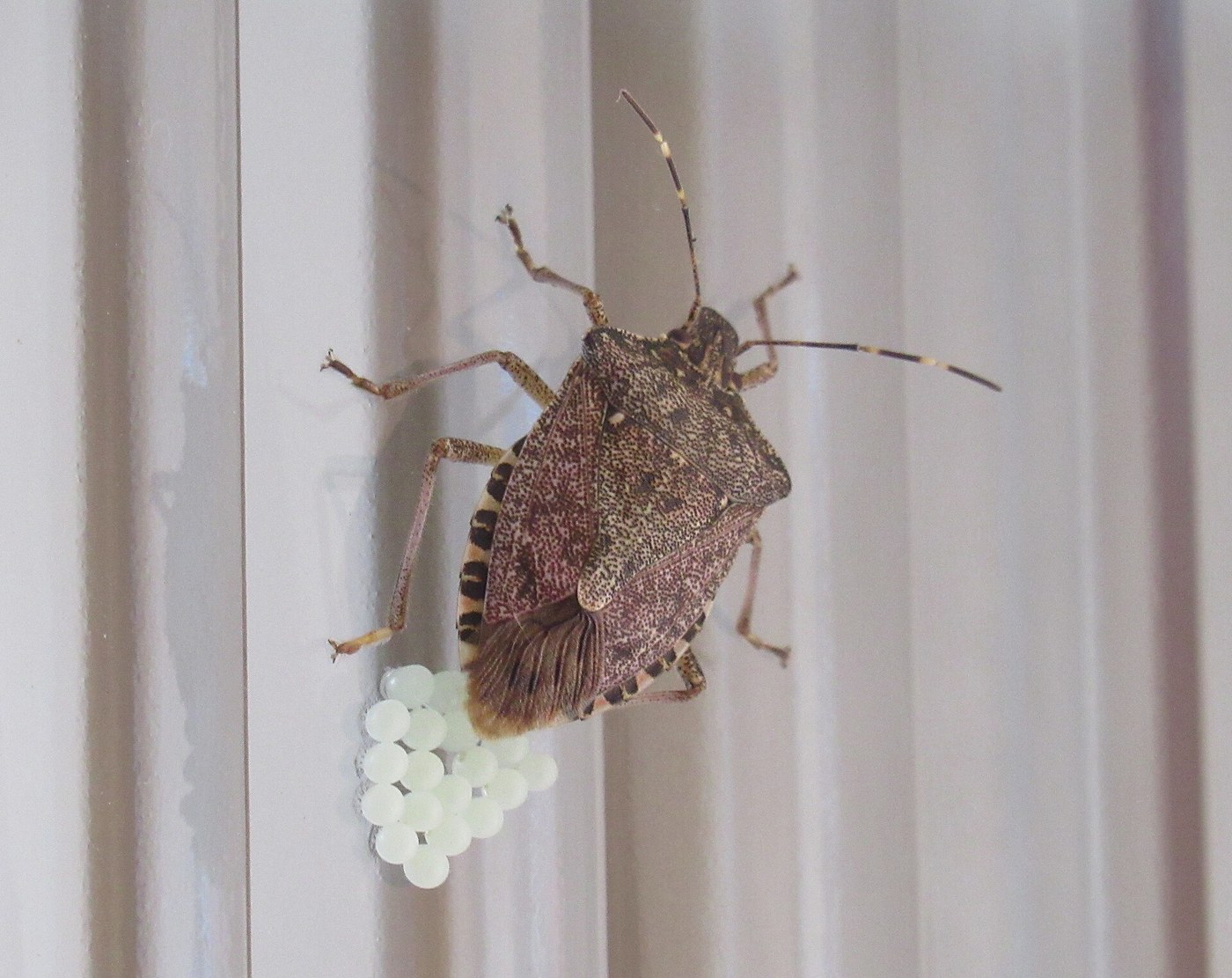
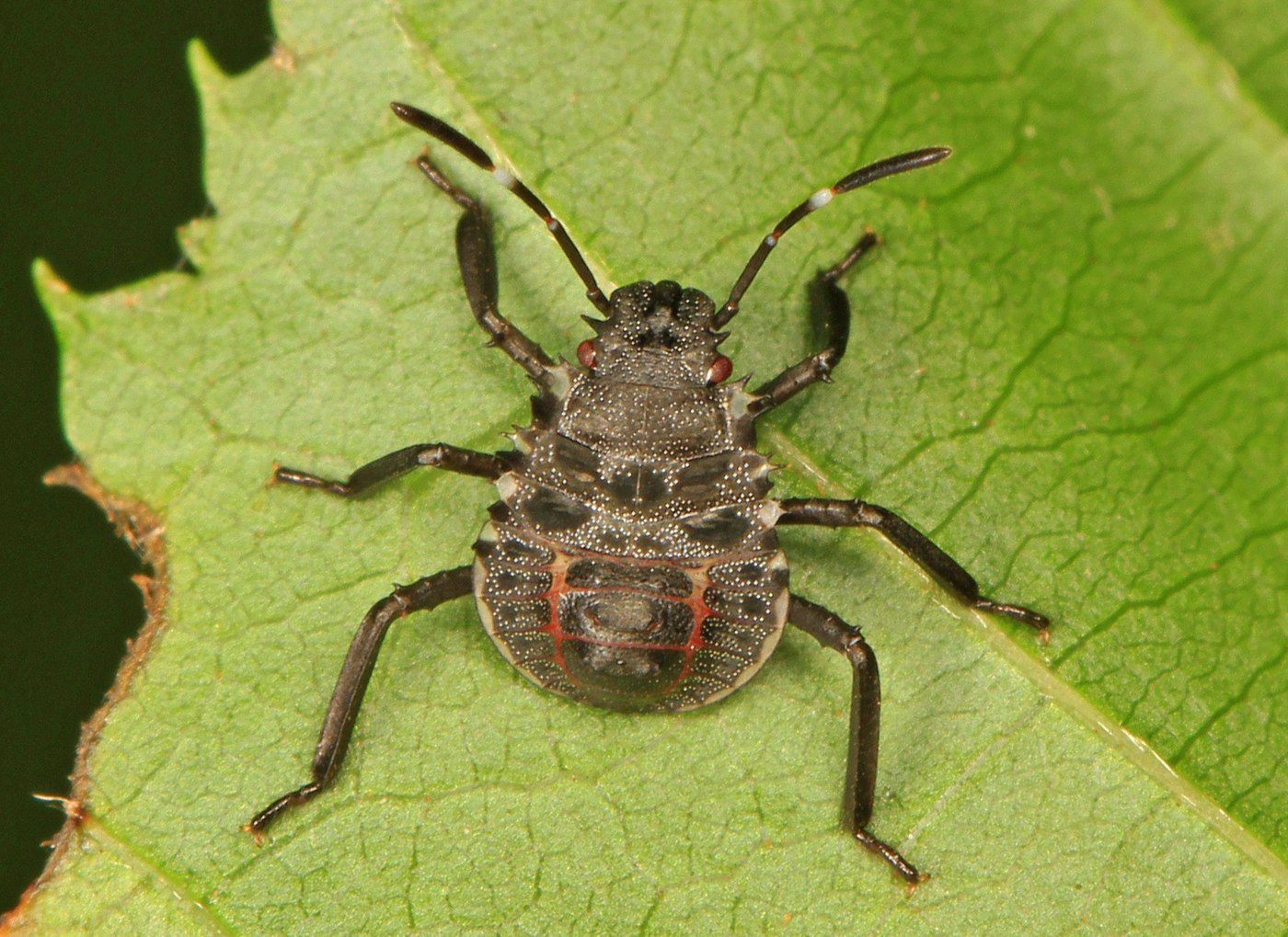
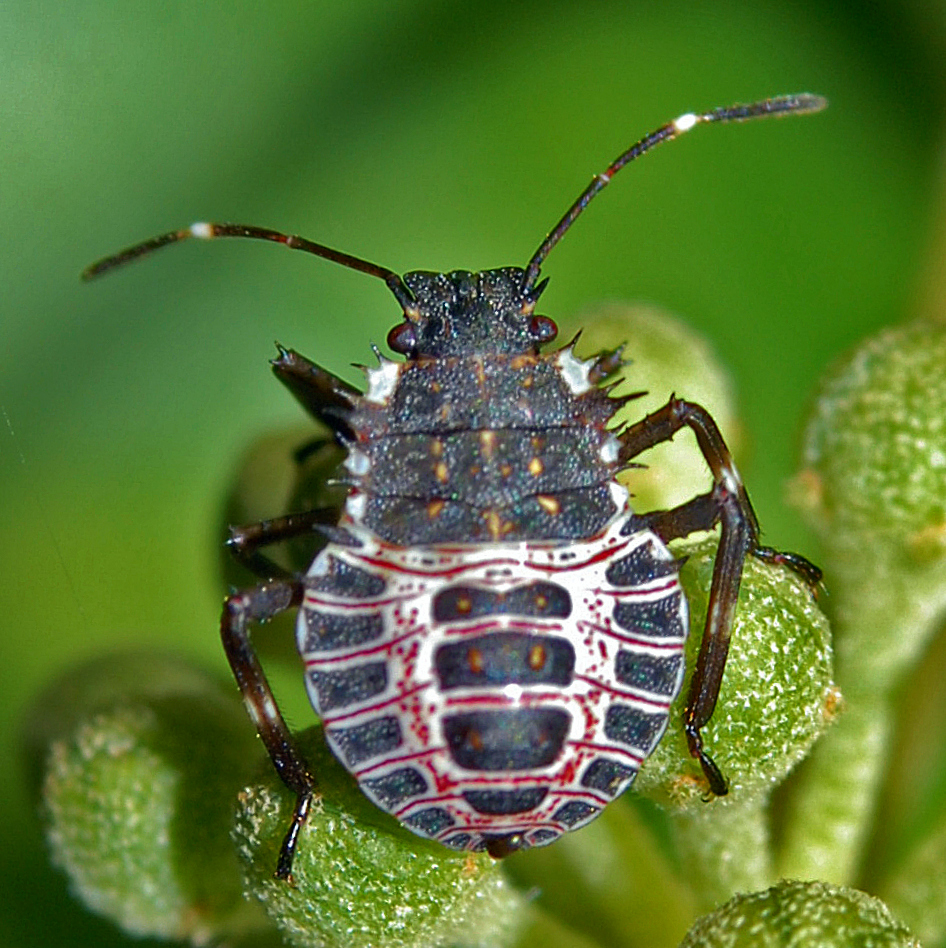
Egg to adult takes 40 to 60 days, and none of it happens indoors. Temperature sets the pace. A mid-July clutch in the Japanese field studies finished in 40 days, an early-August clutch took 62, and almost the entire difference fell on the fourth and fifth instars as the season cooled. Laboratory rearing has run as fast as 27 days in southern China. How many generations you get depends on where you live. Penn State expects one a year in Pennsylvania, with a possible second in a warm year. The mid-Atlantic runs one or two, Tennessee typically two, and EPA notes up to five in the warmest climates. Females lay in multiple clusters, and UC IPM puts lifetime output at 212 to 486 eggs. The practical consequence of all of this is short. There is no life cycle inside your house. No eggs, no nymphs, no shed skins, no growing population. If you find nymphs indoors, you have found a different insect.
Egg Mass2

First Instar
Second Instar
Third Instar3
Fourth Instar4
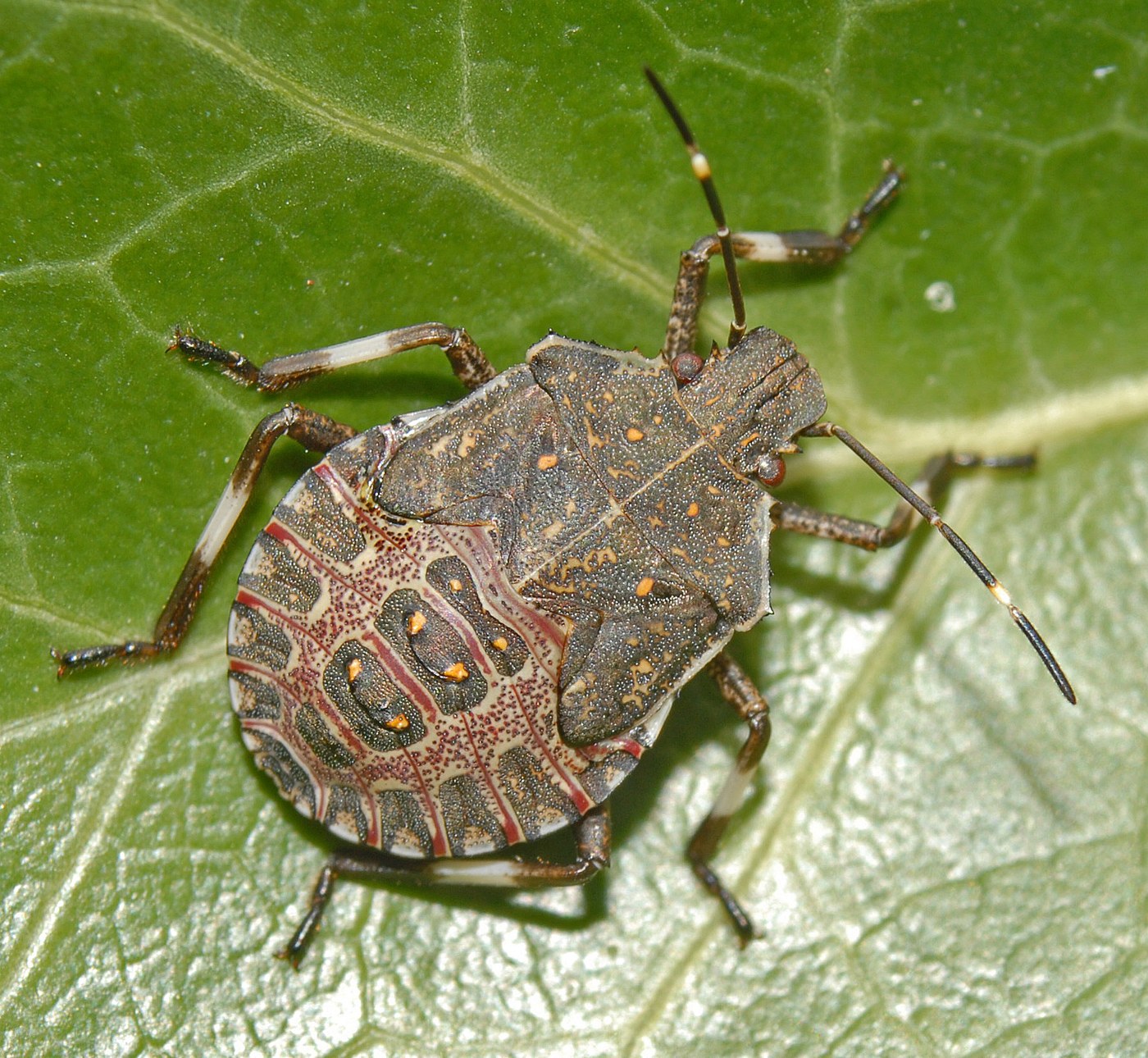
Fifth Instar4
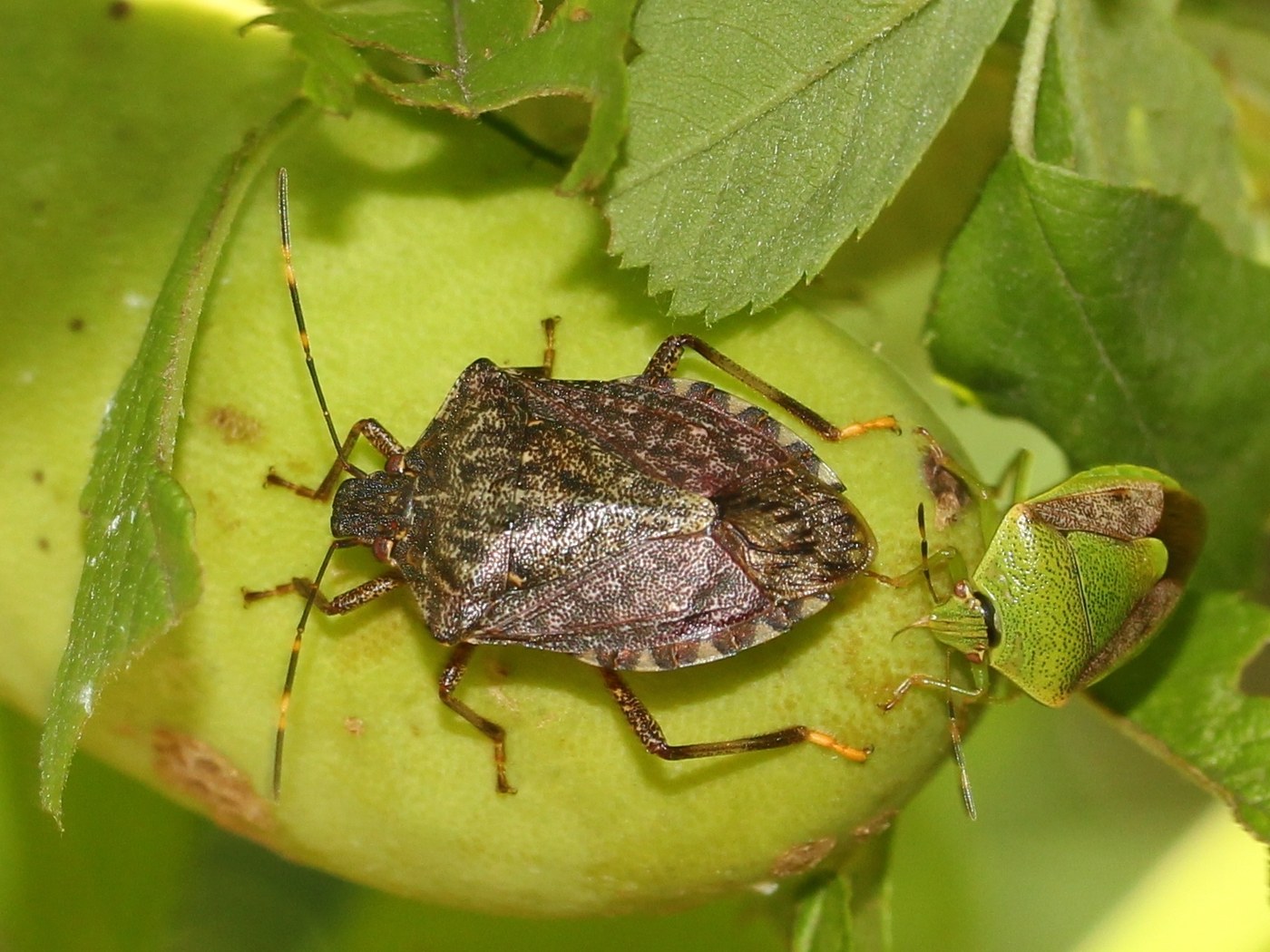
Adult5
Identification
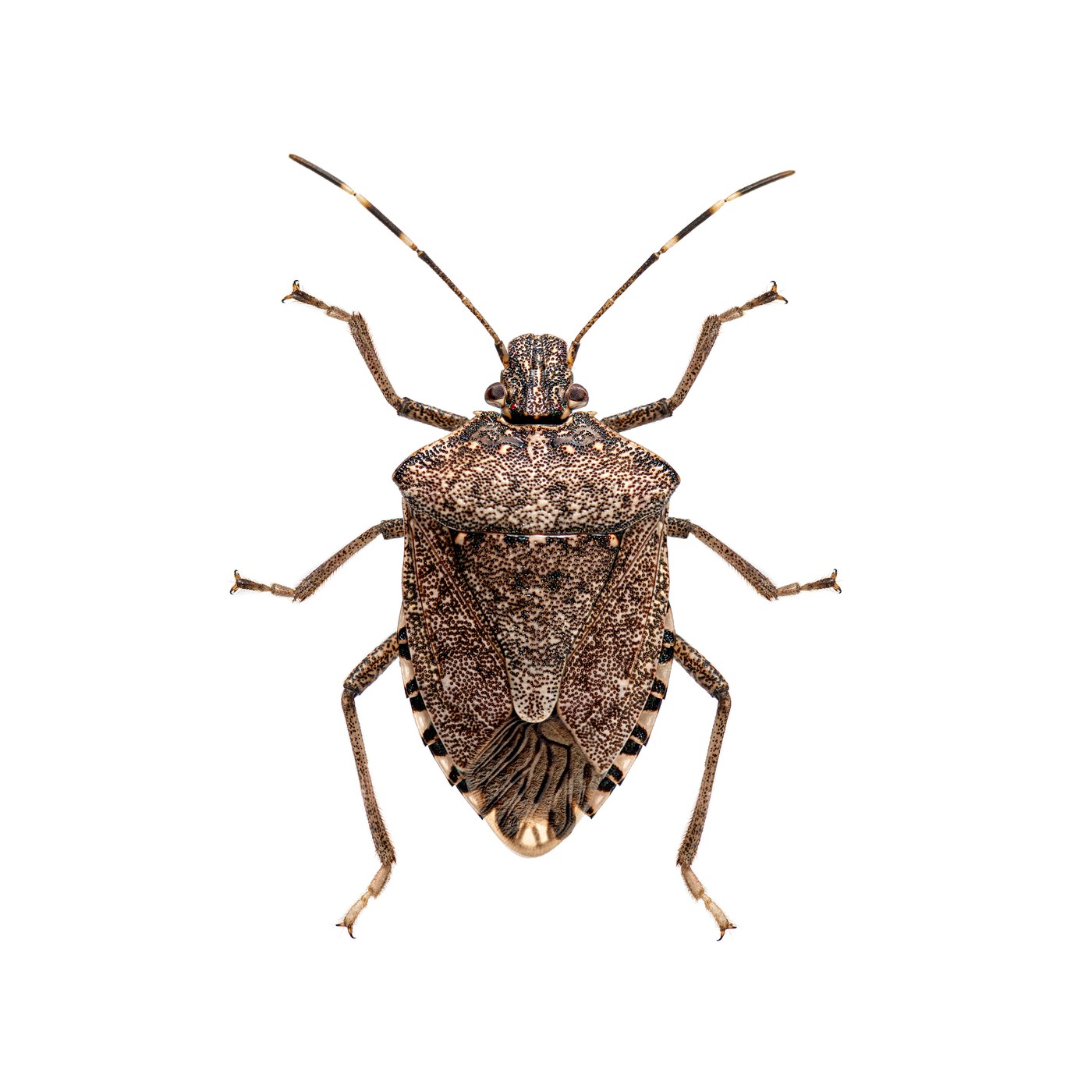
Two white bands on the antennae. Start here
The outer antennal segments carry alternating broad light and dark bands, and no other brown shield-shaped bug in a US house has them this crisply. Precisely, the fourth segment is ringed white at both ends and the fifth is ringed at the base. If you are holding a brown stink bug and you can see two clean white rings near the tip of each antenna, you are almost certainly done.
Smooth shoulders, not toothed
Run your eye along the leading edges of the shield, the ones that angle out behind the head. On this species they are a clean, unbroken curve. There are no teeth, no spines and no notches, and no tooth on either side of the face. That single character separates it from the rough stink bugs, which are coarsely toothed along the same edge, and from the spined soldier bug, whose shoulders come to sharp protruding points.
A banded edge to the abdomen
The rim of the abdomen sticks out past the folded wings and shows an alternating pattern of dark and pale patches, like stitching around the outside of the shield. There are also dark bands across the membrane at the rear of the wings, and coppery or bluish metallic flecking on the head and thorax if you look close.
About the size of a dime
12 to 17 mm, about half to five-eighths of an inch, roughly the size of a dime. Across the shoulders it runs 7 to 10 mm. It is one of the largest stink bugs most people will ever find in the house, but it is not huge, and it is almost as wide as it is long. Turn it over and the underside is cream or beige with metallic green markings on the thorax, which is a surprise the first time.
The smell only happens if you disturb one
An undisturbed bug on a wall gives off nothing. The scent glands sit on the underside of the thorax and the upper surface of the abdomen, and the secretion has been chemically identified as a mix of (E)-2-decenal, 4-oxo-(E)-2-hexenal and tridecane. The (E)-2-decenal doubles as the species' alarm pheromone, which is why nudging one bug in a cluster sets the rest of them off. As for what people report actually smelling, University of Tennessee Extension is the one extension source that names a comparison, and it calls the odor pungent and cilantro-like. Penn State, EPA and UC IPM all decline to name it and say only that it is unpleasant.
Brown stink bug, the native one
Similar size, similar banded abdominal edge, and the shoulders read as rounded enough to fool you. The antennae settle it. This native species has yellowish, faint antennal bands rather than crisp white ones, and its shoulders are more pointed than rounded. It is a plant pest, most common in the Southeast, and it does not invade houses at anything like the same scale.
Rough stink bug
Uniform brownish gray, roughened and somewhat flattened. Look at the shoulder edge and the face: rough stink bugs have a row of coarse teeth along the shoulder and a tooth on each side of the face, and the front of the head is drawn out into two points where this species is blunt. Their nymphs also have spiny shoulders, but no clean white antennal stripes. Rough stink bugs eat both plants and other insects, and they are the bug most often mailed to Texas A&M as a suspected kissing bug.
Spined soldier bug. Do not kill this one
It is a predatory stink bug, a common natural enemy across the continental United States, and it eats caterpillars, beetle larvae and other stink bug nymphs. Nymphs are sold commercially for pest control. The tells: about 13 mm, noticeably smaller than an adult brown marmorated stink bug at 17 mm, with shoulders that come to sharp protruding points rather than rounded curves, a smaller head, a dark line on the forewings, and antennae that are often reddish instead of white-banded. The mouthpart is the giveaway if you can see it, because the first segment of the beak is short and thick, a harpoon for stabbing prey rather than a straw for sap. University of Maryland Extension says to leave them be and let them get on with it. NC State lists the species as a beneficial predator and publishes a dedicated look-alike page for exactly this reason.
Western conifer seed bug
Not a stink bug at all, but it does everything a stink bug does in autumn: overwinters as an adult in protected places, invades houses, and flies noisily around indoor lights on warm days. Up to three-quarters of an inch, drab brown with cream markings along the abdominal edge, and completely unmistakable once you look at the back legs, because the hind shins are flared into flat leaf-like paddles. Harmless. One accidental bite is recorded worldwide.
Kissing bug: get this one right
Kissing bug. This is the one worth getting right. Kissing bugs are not stink bugs, they feed on vertebrate blood, and they can transmit the parasite that causes Chagas disease. Five tells, and they are not subtle once you know them. The head is cone-shaped, narrow and stick-like in front of the eyes, where a stink bug's head is broad and blunt. The legs and antennae are thin and bare, with no spines. The body is elongate and pear-shaped rather than a broad shield. The piercing mouthparts are stout and straight and held clear of the body underneath, where a plant feeder's are thin and folded flat against it. And the ground color is dark brown to black with distinct red, orange or cream stripes along the abdominal edge, which is what drives the confusion, because the stink bug's own banded abdominal margin looks superficially similar. Kissing bugs are also mostly active at dusk and after dark. If what you are holding has a cone-shaped head, thin legs and red or orange stripes instead of a broad shield and white antennal bands, do not pick it up bare-handed. Photograph it and send it to your state diagnostic lab or to the Texas A&M kissing bug program.
Boxelder bug
Also an autumn home invader, also clusters on sunny walls, but smaller at up to half an inch, dark gray, with red eyes and bright orange stripes on the thorax and wings. Nobody confuses the two once they are side by side, but photographs of stink bug swarms on siding are frequently boxelder bugs.
Signs of Infestation
A cluster on a sunlit wall in autumn
A cluster of shield-shaped brown bugs on a sunlit outside wall in autumn. Foundations, siding, eaves, window and door frames, on warm days from late August into November. This is the sign worth acting on fastest, because it is the last moment sealing still changes the outcome. Once they are behind the siding, the year is decided.
Single bugs indoors in winter
Single bugs walking on interior walls and ceilings in winter, or flying noisily around a lamp. They come out of cracks under and behind baseboards, around window and door trim, and around exhaust fans and ceiling lights, and they turn up after a day that was warmer than normal for the date. UC IPM points out that the noisy blundering flight around indoor lights is itself a large part of what alarms people.
Dead bugs in window tracks
Dead bugs collecting in window tracks, light fixtures and attic corners. That is the fraction of the overwintering population that did not make it, and finding them is normal rather than a sign the problem is getting worse.
Small dark excrement stains
They show on walls and curtains.
A pungent odor with no source
A pungent odor with no obvious source, in a house with a large aggregation. There is no ambient smell from undisturbed bugs, but Penn State notes that when many are crushed or sucked into a vacuum the smell can be quite apparent, which in a heavily infested house means the whole place can smell of it.
Egg rafts outdoors in summer
Outdoors in summer: egg rafts and nymph clusters on garden and landscape plants. A tidy raft of 20 to 30 barrel-shaped eggs on the underside of a leaf, or a tight knot of orange and black hatchlings sitting on the empty shells. Look on plants with fruit and seed pods first, and on tree-of-heaven, princess tree, catalpa, mimosa, boxelder, maple and ash.
Dimpled fruit, called cat-facing
Dimpled, malformed fruit, which growers call cat-facing. Feeding stops the flesh expanding, so peaches and apples come out pitted and scarred, mealy or corky under the skin. Leaves show stippled spots around an eighth of an inch across that later turn brown and scabby.
No nest and no shed skins indoors
No nest, no tubes, no shed skins indoors, and that absence is diagnostic. Because they do not breed inside, there are no eggs, no nymphs and no molted skins in a house. Anyone who finds nymphs indoors has found a different insect.
Prevention and When to Call a Pro
Sealing is the fix
Everything else is cleanup. Penn State states it plainly: mechanical exclusion is the best method for keeping stink bugs out of buildings. UC IPM puts it the same way, that sealing a structure is far more effective and far sounder environmentally than spraying it. The specific openings, named: cracks around windows and doors, gaps in siding, utility pipe penetrations, behind chimneys, underneath the wood fascia, torn screens, window air-conditioner units, vents, soffits and eaves, foundation cracks and crawlspace entries. Use good-quality silicone or silicone-latex caulk or foam sealant, and stuff steel wool into larger gaps around plumbing before you caulk. Repair damaged screens, add weather stripping around door frames, fit tight sweeps and thresholds at the bottom of exterior doors, and screen the attic and foundation vents, including window screening inside gable vents. Cap or screen the chimney.
The daylight test
It is the best two-minute job on this list. University of Tennessee Extension: stand outside a closed exterior door after dark with the interior light on. If you can see light around the edges of the door, you do not have a seal. If light gets through, so does a stink bug.
Never put insecticide in a void
Do not put insecticide in a wall void. This is the single most important warning about stink bug control. Dust treatments into voids and attics will kill hundreds of bugs. Penn State then names the consequence: carpet beetles feed on the pile of dead stink bugs and move on from there to woolens, stored dry goods and other natural products in the house. University of Tennessee gives the same warning independently and recommends against indoor insecticide application for exactly this reason. You trade a seasonal nuisance for a year-round fabric pest. If you find where bugs are emerging into a room, seal that opening with caulk and leave the void alone. Sealing an untreated void is the correct move. Sealing a poisoned one is not.
Timing decides if sealing works
Timing decides whether any of the sealing works, and a lot of people go looking for it in the wrong month. Pest-proofing should be done after the bugs leave in spring and before they come back in autumn, which puts the real window at roughly May through August. University of Tennessee sets the deadline for exterior professional treatment at before mid-September. The entry peak starts at a different time in each region, which moves that deadline: Midwest by mid-August, because the entry peak there begins in late August. Northeast and Pacific Northwest by the end of August. Southeast and South Central by mid-September. Anyone starting in December has already lost the year. The work has to happen in July.
Be honest about chemicals here
Be honest about what chemicals do here, because it is not much. Exterior sprays are broken down by sunlight, and Penn State says the residual may not kill much beyond several days to a week. UC IPM says the same, that they break down within days. Indoor sprays are generally ineffective. Crack-and-crevice sprays will not stop bugs emerging and Penn State rules them out by name. Pyrethrum foggers kill what is already on the walls and ceiling but do nothing about the bugs that walk out an hour after the room is aired, so they are not a solution. EPA notes there are currently few effective pesticides even labeled for this pest. An exterior treatment is a supplement to caulk with about a one-week half-life. It is not a substitute for caulk.
Take away what draws them
Take away what is drawing them to the property. Remove volunteer host trees along fence lines, specifically tree-of-heaven, princess tree, mimosa and boxelder. That reduces the local population but will not eliminate it, because the host range runs to several hundred plant species. Manage the lighting, since they come to lights: University of Tennessee recommends yellow bug lights or sodium vapor lights close to the house and putting mercury vapor or incandescent fixtures further away, and UC IPM suggests turning off unnecessary exterior lights and keeping the exterior light away from the door you are using. Rake leaf litter and edible vegetation back from the foundation. One counterintuitive note from University of Tennessee: denser neighborhoods may see fewer bugs per house, because there are more places for them to spread across. An isolated house backing onto woods gets the worst of it.
Do not squash or plain-vacuum them
Do not squash them, and do not use a plain vacuum. Crushing releases the odor and can leave a stain, and crushing one against bare skin can cause a rash at the point of contact. A regular vacuum works, but Penn State, EPA and UC IPM all warn that the vacuum itself will then hold the smell for a while. The fix is cheap. Slide a knee-high stocking down the vacuum tube and fold the elastic back over the end of the attachment. The bugs collect in the stocking and never reach the reservoir. Tie it off, bag it and put it in the outside trash. Some people simply dedicate one old vacuum to the job. For bugs sitting high on a wall, cut the top off a plastic soda bottle, invert it into the base to make a funnel, and run the rim up toward the cluster. Disturbed bugs tuck their legs and drop, straight into the bottle. Freeze the sealed bag or bottle for a couple of days, or tip them into soapy water. Do not flush them, and do not put live bugs in the trash.
When to Call a Pest Control Professional
Any one of these is enough. It is August or early September and you can see bugs massing on the sunlit walls of the house, which is the strongest and most time-sensitive trigger here, because that window closes before mid-September. The house has more openings than you can find or safely reach, and soffits, fascia, chimney flashing, gable vents and utility penetrations are exactly what a homeowner on a ladder misses. Bugs are coming into living space in numbers all winter, which means a large aggregation in a void and a professional can trace the route from inside. You are about to put insecticide in a wall void, in which case call instead of doing it. Or you are not certain what the insect is, particularly if it has a cone-shaped head, thin legs and red or orange stripes rather than a broad shield and white antennal bands.
What an honest company says
What an honest company will tell you before you hire it. The service worth buying here is inspection and exclusion, not spraying, because the sources above are unanimous that spraying barely works on this pest. Sealing is unglamorous and it is the whole job. A homeowner who does the exclusion work properly in August will not need much else, and anyone who tells you these bugs are damaging your house is wrong. Penn State, EPA, UC IPM and University of Tennessee all state that they cause no structural damage and do not reproduce indoors.
Frequently Asked Questions
Do stink bugs bite?
No. They have piercing-sucking mouthparts built for plant sap and no chewing mouthparts at all, so they cannot bite a person or a pet. EPA and UC IPM both say so directly, and UC IPM adds that they do not sting, suck blood or spread mammalian diseases. University of Maryland entomologist Michael Raupp, who has handled thousands of them, says he has never been bitten. Two things are worth knowing anyway. Crushing one against bare skin can produce dermatitis at the point of contact. And the defensive chemicals can act as an airborne allergen, so people already sensitive to cockroach or lady beetle allergens may get rhinitis or conjunctivitis symptoms. Both Penn State and University of Tennessee hedge that second point carefully: there has not been much research, it appears to affect only a small percentage of people, and it is primarily an issue for those working in crops where the bugs are abundant.
Are the stink bugs in my house going to multiply or damage anything?
No, on both counts, and four separate government and university sources say so. They do not reproduce indoors. They do not feed indoors, or if they feed at all it is minimal, because there is nothing in a house for a sap feeder to eat. They do not chew or bore into wood, wiring or fabric. Penn State: the stink bug will not reproduce inside structures or cause damage. EPA, UC IPM and University of Tennessee all state the same thing independently. Every bug in your house in January flew in last autumn, and from that point the population can only go down until spring.
Why do they suddenly appear inside on a warm day in the middle of winter?
Because they were never in your living room to begin with. They are in diapause in a wall void, an attic or a similar cool, protected space, and they are not moving much. Inkley's study of an infested home in western Maryland found that the number of bugs coming out of hiding places into indoor living space correlated positively with how much warmer the day was than normal for that date. An unseasonably warm winter day brings them out of the walls. That is why a house that seemed to quiet down in December gets a fresh wave in February, and it is also why the count does not simply taper off over the winter.
Should I squash it or vacuum it?
Neither one plainly. Crushing releases the odor, can leave a stain, and can cause a rash if you do it against bare skin. A regular vacuum will pick them up, but Penn State, EPA and UC IPM all note the vacuum will then smell of stink bug for a while. The fix costs about a dollar: push a knee-high stocking down the vacuum tube and fold the elastic over the end of the attachment. The bugs end up in the stocking and never touch the reservoir. Tie it off, bag it, and put it in the outside trash. For a cluster high on a wall, hold an open container just below them, because disturbed bugs reflexively tuck their legs and drop.
How do I tell a stink bug from a kissing bug?
A brown marmorated stink bug is a broad brown shield with two crisp white bands near the tip of each antenna, smooth rounded shoulder edges, and thick spiny-looking legs. A kissing bug has a narrow cone-shaped head, thin bare antennae, thin bare legs, an elongate pear-shaped body, and bold red or orange stripes along the edge of the abdomen. Its mouthparts are stout and straight and stand clear of the body underneath. Kissing bugs are real, they are a genuine vector of the parasite that causes Chagas disease, and Penn State notes that 9 of the 11 US species have tested positive for it. But Texas A&M is categorical that no insect other than a kissing bug carries that parasite. A stink bug carries no disease at all. If you are not sure, do not handle it bare-handed. Photograph it and send it to the Texas A&M kissing bug program or your state diagnostic lab.
When is it too late to seal the house?
Earlier than most people think, and it varies by region. Sealing should happen after they leave in spring and before they come back in autumn, so May through August is the real window. University of Tennessee sets the deadline for professional exterior treatment at before mid-September. When the entry peak actually starts in each area tightens that: Midwest by mid-August, Northeast and Pacific Northwest by the end of August, Southeast and South Central by mid-September. In the Midwest the entry peak begins before Labor Day, so mid-September is already late. Exterior insecticide, if it is used at all, has to go on before they congregate and only lasts days.
Is this the bug that has been ruining apple crops?
Yes, and that is why it is more than a household annoyance. University of Florida puts the losses from the 2010 mid-Atlantic outbreak at over $37 million to tree fruit producers, citing Leskey and colleagues. It feeds on several hundred plant species with a strong preference for anything that fruits, and it pushed growers back toward broad-spectrum pesticides, undoing established pest management programs with knock-on damage to natural enemies and pollinators that University of Florida calls difficult to measure but undoubtedly significant. Indoors it is only a nuisance. Outdoors it is one of the most economically significant invasive insects to reach the United States in decades.
Where did they come from?
East Asia, almost certainly inside a bulk freight container. The first confirmed US sighting was in Allentown, Pennsylvania in the fall of 1996, with further sightings there in September 1998 and January 1999, and Penn State dates the first collected specimen to September 1998. Nobody knew what it was. In late September 2001 an extension entomologist at the Lehigh County office, Karen Bernhard, sent two Allentown specimens to the Cornell University Insect Diagnostic Lab, and on 1 October 2001 E. Richard Hoebeke identified them as Halyomorpha halys, an Asian species not previously known from North America. Two days later he and Bernhard walked Allentown on an unseasonably warm afternoon and found adults covering the foundations, walls, eaves and window frames of houses. The paper describing the find came out in 2003. The known range at that point was five Pennsylvania counties. It has since been detected in 47 states and four Canadian provinces.
Photo Gallery
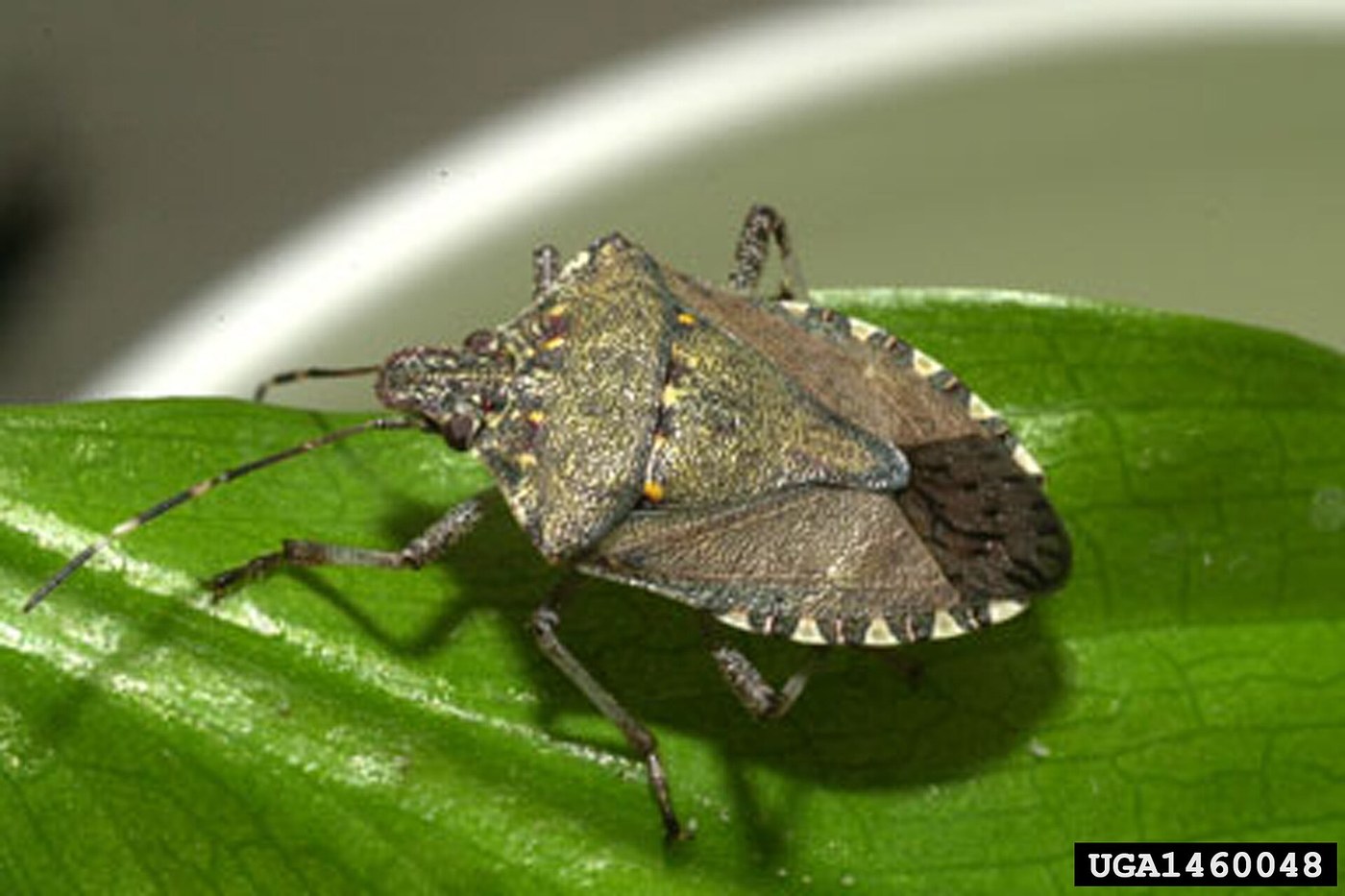
Adult on a leaf.
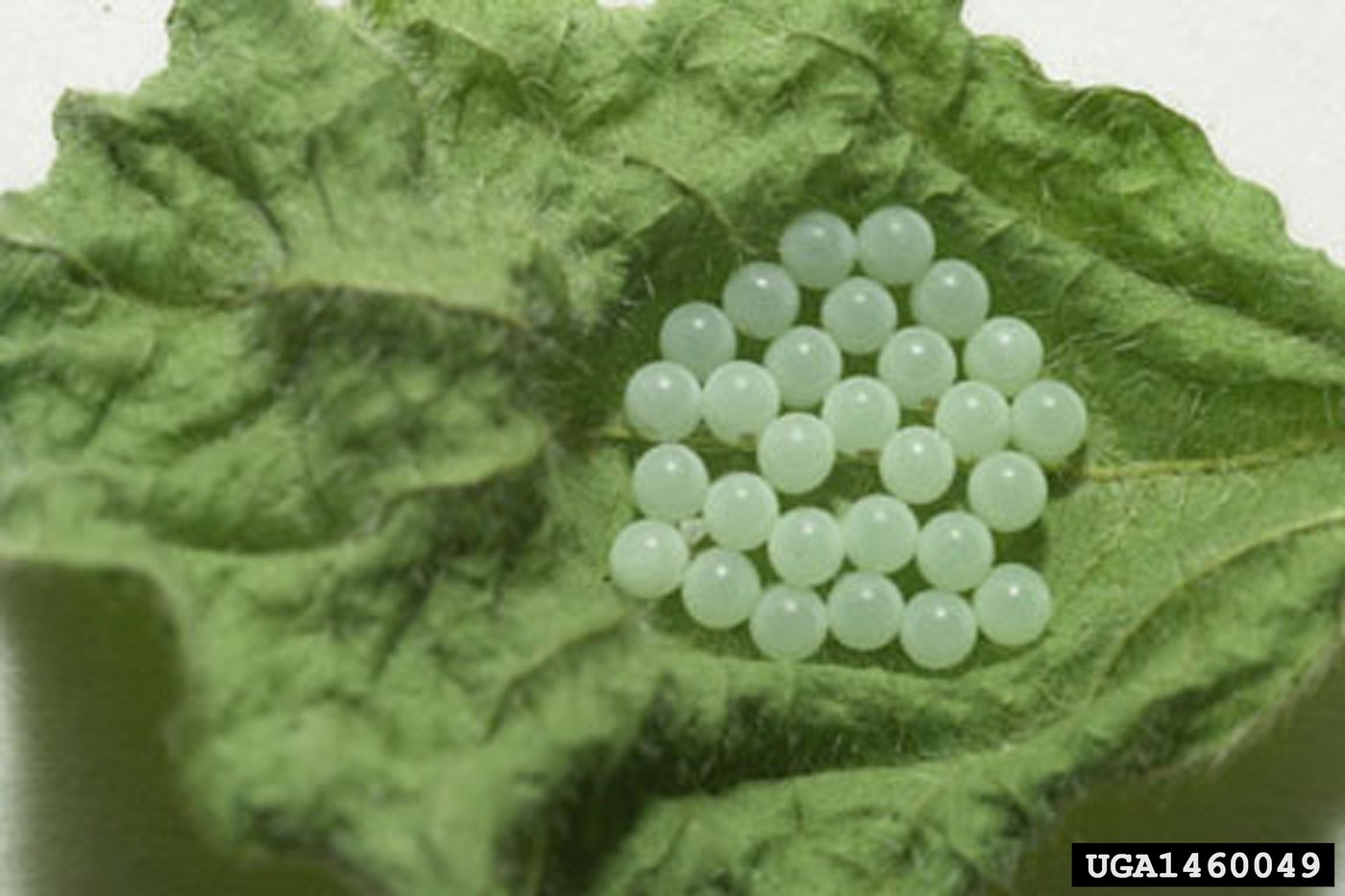
Unhatched egg mass on leaf.
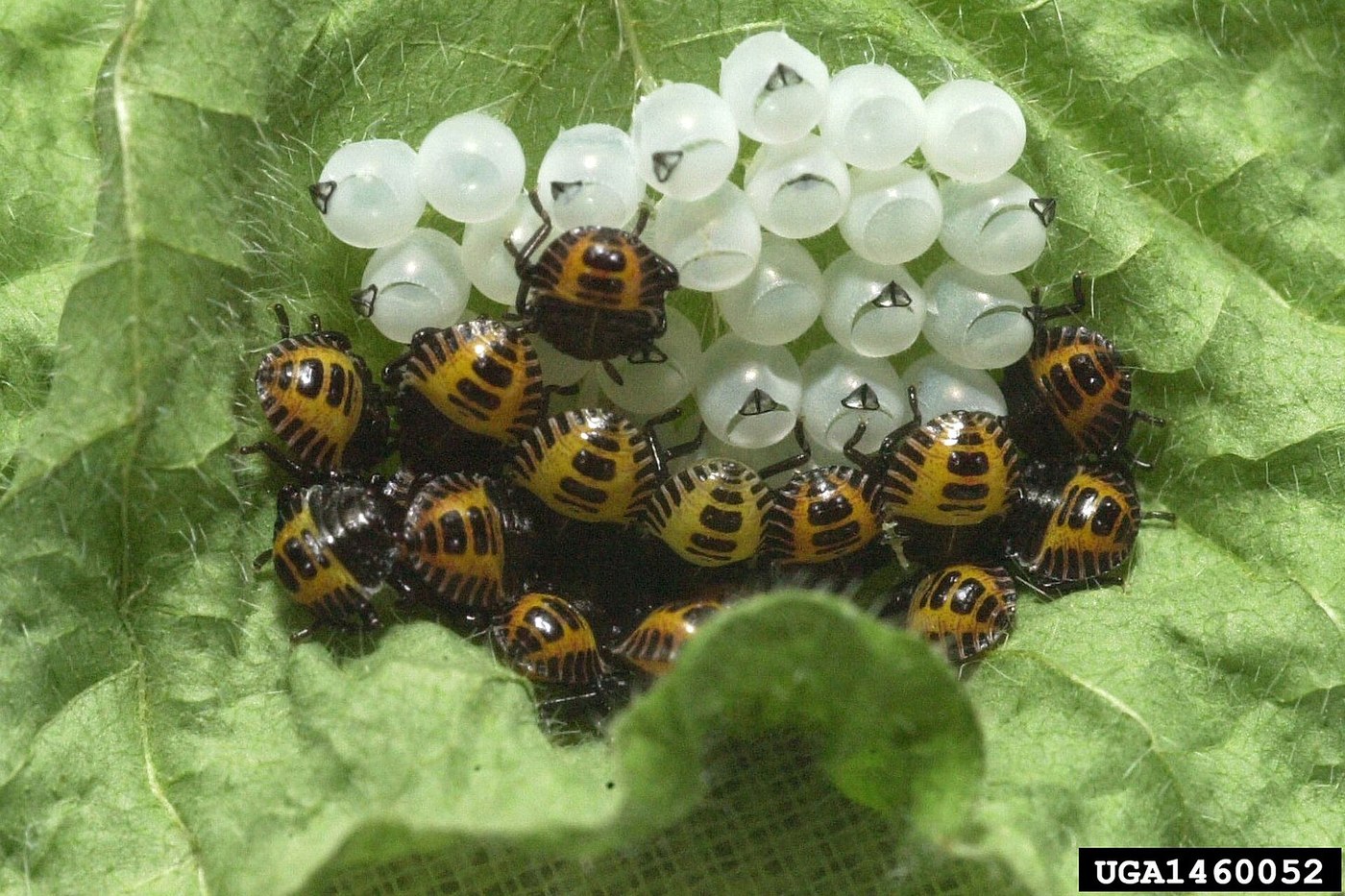
First instars on empty egg shells.
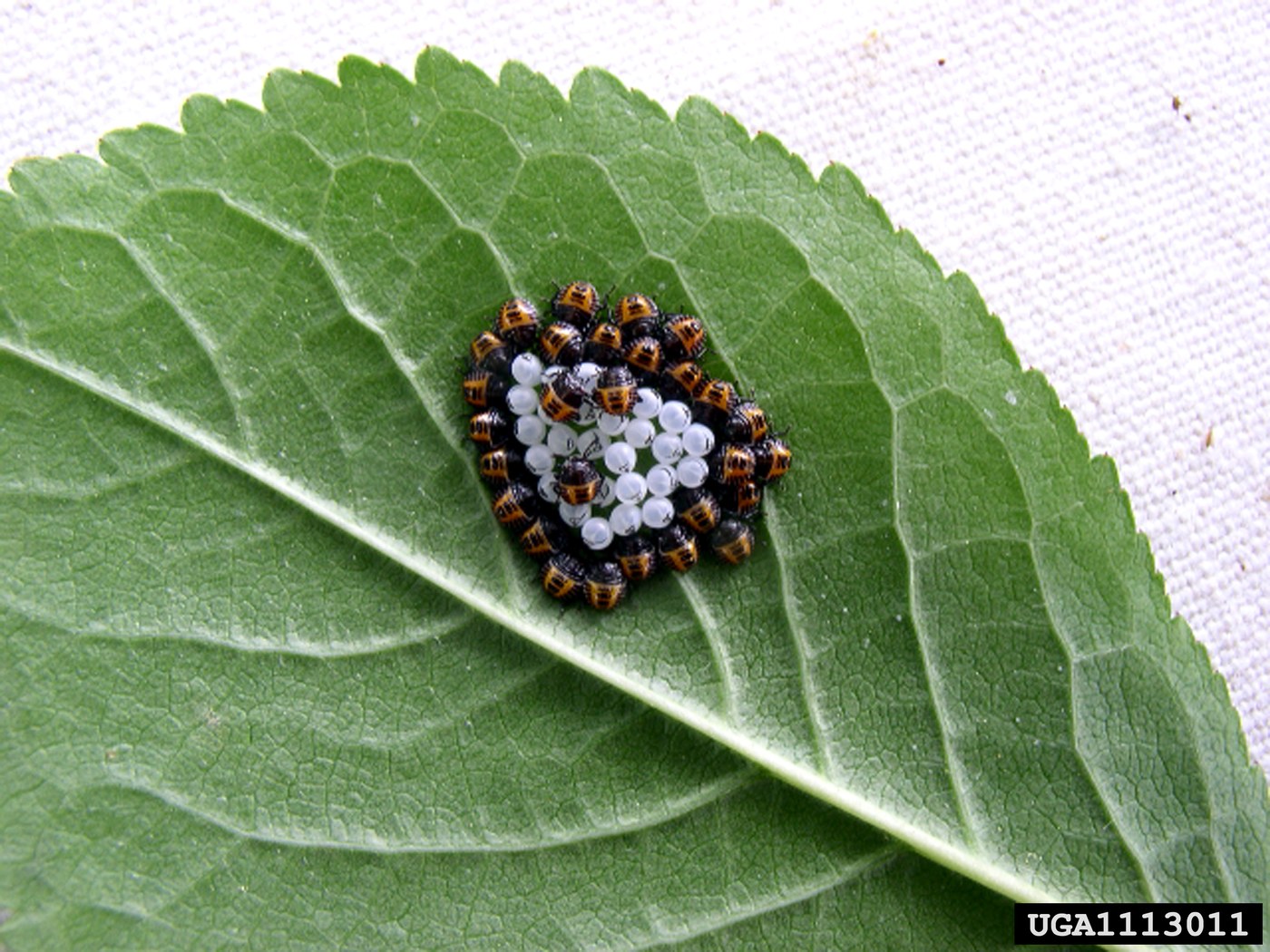
First instars ringing unhatched eggs.
Sources
- Brown Marmorated Stink Bug Penn State Extension, Department of Entomology
- Managing Brown Marmorated Stink Bug in and Around Homes, Publication W 779 University of Tennessee Extension
- Pest Notes: Brown Marmorated Stink Bug, UC ANR Publication 74169 UC Statewide IPM Program
- Brown Marmorated Stink Bug, Halyomorpha halys (Stal), EENY-346 University of Florida IFAS Extension
- Halyomorpha halys (Stal): A Polyphagous Plant Pest from Asia Newly Detected in North America, Proc. Entomol. Soc. Wash. 105(1) Hoebeke and Carter, 2003
- Characteristics of Home Invasion by the Brown Marmorated Stink Bug, Journal of Entomological Science 47(2) Inkley, 2012
Image Credits
- Image: Adobe Stock, licensed.
- Image: Keimzelle, via Wikimedia Commons. Dedicated to the public domain under CC0.
License. - Image: Judy Gallagher, via Wikimedia Commons. Licensed CC BY 2.0.
License. - Image: Hectonichus, via Wikimedia Commons. Licensed CC BY-SA 4.0; this resized copy is offered under the same license.
License. - Image: Alpsdake, via Wikimedia Commons. Licensed CC BY-SA 4.0; this resized copy is offered under the same license.
License. - Image: David R. Lance, USDA APHIS PPQ, via Wikimedia Commons. Licensed CC BY 3.0 US. Resized.
Source. License. - Image: David R. Lance, USDA APHIS PPQ, via Wikimedia Commons. Licensed CC BY 3.0 US. Resized.
Source. License. - Image: David R. Lance, USDA APHIS PPQ, via Wikimedia Commons. Licensed CC BY 3.0 US. Resized.
Source. License. - Image: Gary Bernon, USDA APHIS, Bugwood.org, via Wikimedia Commons. Licensed CC BY 3.0 US. Resized.
Source. License.