Seasonal Timeline
Year-round. Hawaii's climate gives none of these species a winter dormancy period. The house gecko shows a documented dip in reproductive activity from October through March, coinciding with the islands' cool-wet season, but it remains active and visible through the year.
There is no closed season for any of these three species. Hawaii's climate does not force the kind of winter shutdown that would give you a calendar to work against. What changes through the year is reproductive intensity, not presence: a Hawaii-specific study of common house gecko specimens from Oahu and Molokai found females reproductively active in every month sampled except a sharp quiescent dip in October, which lines up with the start of the islands' cool-wet season running October through March.
The daily cycle matters more than the yearly one. The gold dust day gecko is genuinely unique among Hawaii's introduced geckos in being active by day rather than night, which is the fastest way to tell it apart from the other two without needing to look closely at color or pattern. The common house gecko's own daily rhythm is well studied: its calling activity peaks sharply at dusk and again about 30 minutes before sunrise, and increases on warmer nights.
Where They're Found
All three species are established in Hawaii, and the Hawaii populations are the ones described below. The gold dust day gecko has no other confirmed wild population in the country. The common house gecko does have small separate established populations in Florida and a few other warm points on the mainland, but the Hawaii population is the one described below. The mourning gecko's US presence is effectively a Hawaii population as well.
The gold dust day gecko has the most recent and best-documented arrival story of the three. The entire wild Hawaiian population traces to eight lizards a University of Hawaii student illegally smuggled in and released near the Manoa campus on Oahu in 1974. It is now established on Oahu and on Hawaii Island, and on Maui, where residents first began noticing it around Kihei in the mid-1990s; it is now common through South Maui, Central Maui and Upcountry.
The common house gecko has a longer history and the widest range of the three. It is believed to have reached Hawaii during or shortly after World War II, with an early published record from Hawaii Island in 1951. It is now found on every main Hawaiian island as well as Lanai and Kahoolawe, in both urban yards and forested habitat away from any building, and it is Hawaii's single most abundant gecko species.
The mourning gecko arrived earliest of the three, before European contact, either as an inadvertent stowaway with early Polynesian voyagers or by natural rafting on floating debris, since its eggs are documented as saltwater tolerant. It is established on all the main islands plus Niihau, Lanai and Kahoolawe. By most accounts it was the most abundant gecko in Hawaii before the house gecko's post-war spread, and peer-reviewed research has since documented the house gecko competitively displacing it, particularly around buildings and lights.
Alaska carries none of these species and is trivial to rule out. None can survive outside a warm, essentially frost-free climate, and there is no introduction pathway or detection record for any of the three.
Related Pests
Life Cycle
The practical question homeowners ask is which gecko am I looking at, not what stage of life is it in. All three species are egg-laying, and all three hatch as fully independent miniature adults with no larval stage and no parental care beyond nest-site selection. The common house gecko is the one with a Hawaii-specific reproductive study behind it: a mean clutch of about two eggs, incubation of 45 to 70 days, sexual maturity at roughly six months to a year, and a typical lifespan around five years, with reproductive activity dipping sharply every October as the islands enter their cool-wet season. The mourning gecko is unusual enough to note on its own: it is an all-female species that reproduces without males, and Hawaii's population is documented as entirely female. The gold dust day gecko's clutch and incubation figures come from care-sheet sources rather than a Hawaii field study and should be treated as a range, not a fixed number, until better sourced.

Gold dust day gecko
Common house gecko
Mourning gecko
Identification
Time of day is the fastest three-way split
If it is out in the sun, it is the gold dust day gecko, Hawaii's only day-active lizard. If it is on a wall or screen after dark near a light, it is either the common house gecko or the mourning gecko.
The gold dust day gecko is obvious
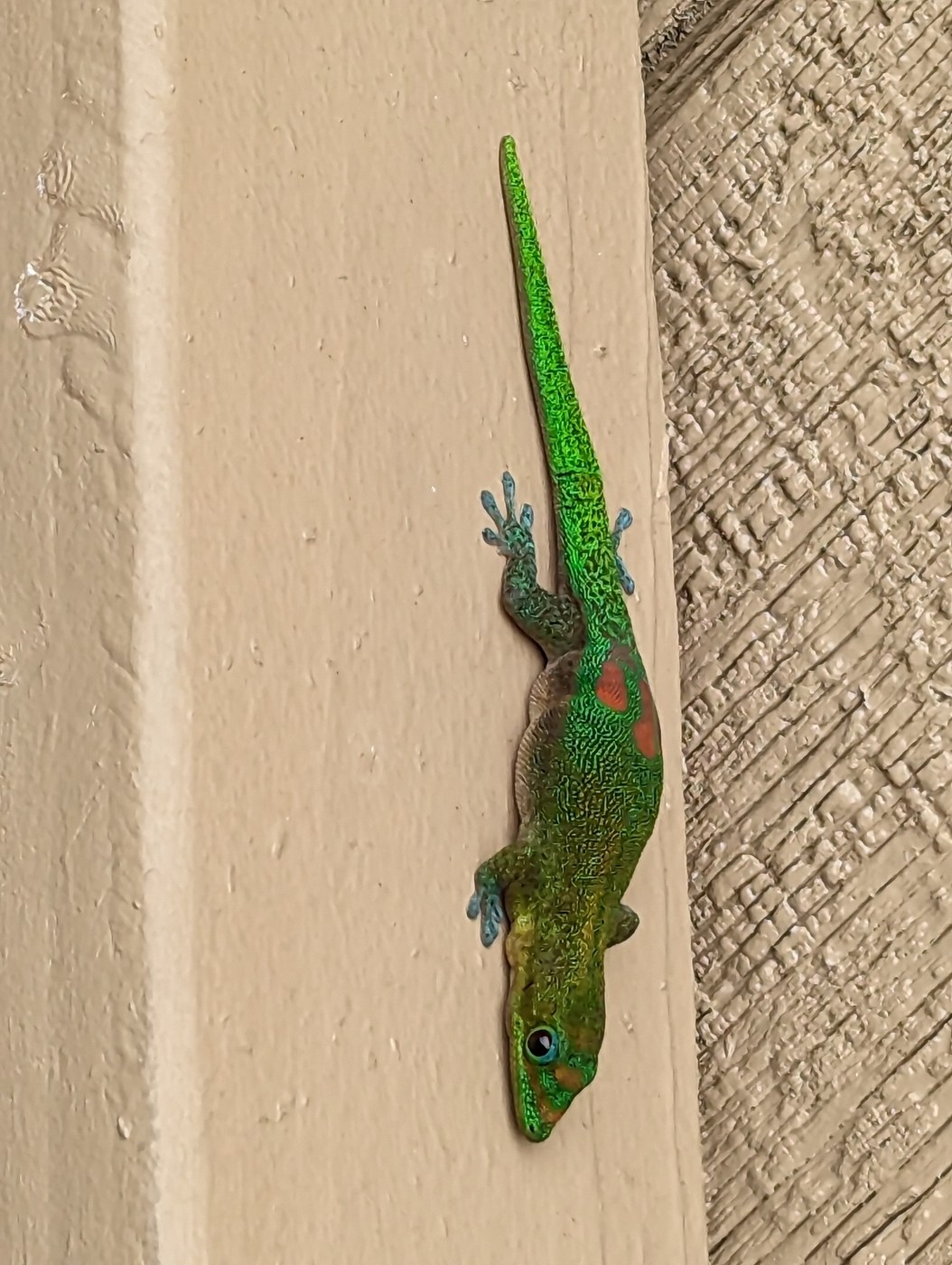
The gold dust day gecko does not require close inspection. Bright green to yellowish-green, 3.9 to 5.1 inches long, with a dusting of gold speckles on the neck and upper back, three rust-red bars across the snout and head, pale blue skin around the eyes, and three tapering red bars low on the back near the tail. Juveniles lack the red markings. Nothing else in Hawaii looks like it.
Between the night species, texture
Between the two nighttime species, texture is the tell, not size alone. The common house gecko has small bumpy tubercles arranged in rows down its back and a ring of spiny scales around the tail. The mourning gecko's skin is smooth and satiny with no tubercles and no spiny tail at all. The mourning gecko also runs smaller and stockier, 2.7 to 3.7 inches against the house gecko's up to 6 inches including tail, and carries a distinctive dark line running from the snout tip through the eye that the house gecko lacks.
The house gecko makes the noise
The house gecko is the one making the loud noise. Its repeated three-to-five note chuck-chuck-chuck call, made almost exclusively by adult males, is markedly louder and more frequent than either the day gecko or the mourning gecko, and is the single most common reason homeowners go looking for an identification in the first place.
What none of these three is
No bite, sting, venom, or disease-transmission risk to people or pets is documented for any of the three species. There is no damage checklist to give, because none of them threatens a structure, wiring, or stored goods.
Signs of Infestation
A chuck-chuck call at dusk
A loud, repeated chuck-chuck-chuck call at dusk and again just before dawn is the common house gecko, and it is a sign of a healthy population, not a problem. The call is made almost exclusively by adult males defending territory or courting, peaks sharply at those two times of day, and increases on warmer nights.
A faster run of short chirps
A faster run of five to ten short chirps in quick succession, rather than a steady three-to-five note pattern, points toward the mourning gecko instead, though most homeowners will not reliably separate the two calls by ear alone.
Lizards out in full sun
Small lizards visible in full sun on a lanai railing, tree trunk, or sunny wall are the gold dust day gecko. It is the only one of the three active during the day.
Droppings below a favorite perch
Small, dark, tapered droppings accumulating in one consistent spot below a favorite perch, usually near an exterior light fixture, are the main visible sign of activity for either of the two nocturnal species.
Concentration around porch lights
Security lights and any fixture that draws night-flying insects do the same.
Prevention and When to Call a Pro
Low-risk and largely beneficial
These are low-risk, largely beneficial animals, and the state does not ask residents to remove them. Unlike a handful of other, less-established day gecko species on Oahu that Hawaii's invasive species committees do ask people to report, the gold dust day gecko, common house gecko and mourning gecko are already thoroughly established and are not active eradication targets. The practical approach here is coexistence and light-touch exclusion, not removal.
Reduce entry, not the population
Reduce indoor entry rather than target the population. Door sweeps, tight-fitting window screens, and sealing gaps around utility penetrations keep geckos, and the insects that draw them, out of living space without any pesticide or removal step.
Manage the light, not the gecko
If the nighttime chirping or the insect traffic around a light is the actual complaint, manage the light rather than the gecko. Switching an exterior light to a yellow bug light, adding a motion sensor, or relocating a fixture farther from a bedroom window reduces both the insect draw and the gecko activity that follows it.
Do not move plants between islands
This one is a real legal matter rather than a nuisance tip: do not move potted plants, nursery stock, luggage, or moving boxes between Hawaiian islands without checking them first. Hawaii's interisland movement law requires a state permit to move live reptiles, including any of these geckos, from one island to another, regardless of whether the species is already established on both islands. This is enforced through the state's own interisland agricultural inspection stations, and it applies even to accidental hitchhikers riding along in cargo, not only to someone deliberately transporting an animal. A quick visual check of pots, root balls, and packed boxes before an interisland move covers this.
The gold dust day gecko wrinkle
The gold dust day gecko carries an added legal wrinkle worth knowing even though it changes nothing for a typical homeowner. It is specifically named on Hawaii's official Restricted Animal List, which means keeping, breeding, or newly transporting one for pet-trade purposes requires a state permit. This does not require a homeowner to do anything about wild geckos already living in a yard; it means the animal cannot legally be collected and kept as a pet or bred without that permit.
When to Call a Pest Control Professional
Rarely necessary for any of these three species on their own. A licensed pest control operator is the right call if gecko droppings or the insects gathering around a light point to a broader porch-light insect issue worth addressing at the source, or if a homeowner wants an exterior-lighting or exclusion retrofit handled professionally. There is no permit barrier to a licensed operator performing routine exclusion work; the permit requirement described above attaches to keeping, breeding or transporting the animals themselves, not to ordinary pest-control service.
Frequently Asked Questions
What's making that loud chirping or clicking sound at night in Hawaii?
Almost certainly the common house gecko, Hemidactylus frenatus. Its repeated chuck-chuck-chuck call is made mostly by adult males defending territory or courting a female, peaks right at dusk and again shortly before sunrise, and is a sign of a healthy gecko population doing exactly what geckos do, not a problem with the house.
Is the bright green gecko I keep seeing on my lanai dangerous or invasive?
That's the gold dust day gecko, Phelsuma laticauda, a day-active species native to Madagascar that has been established in Hawaii since eight animals were illegally released on Oahu in 1974. It is not dangerous to people or pets and actively eats insects like cockroaches and flies, but it is legally a restricted animal in Hawaii, meaning it cannot be kept, bred, or newly transported without a state permit.
Can I bring a gecko, or a plant it might be hiding in, from one Hawaiian island to another?
Not without checking first. Hawaii's interisland movement law requires a permit to move live reptiles, including any of these geckos, between islands, regardless of whether the species is already established on both islands, and it is enforced through the state's own interisland agricultural inspection stations. Check potted plants, moving boxes, and luggage before an interisland trip for exactly this reason.
Are the geckos in my house harmful, or should I just leave them alone?
Leave them alone. None of Hawaii's introduced geckos bites, stings, carries venom, or is a documented disease risk, and they earn their keep by eating mosquitoes, roaches, moths, and other actual household pests, particularly around outdoor lights.
Why do I mostly see gray geckos at night and a green one during the day?
Because they are genuinely different species on different schedules. The common house gecko and the mourning gecko are both nocturnal and gray to tan; the gold dust day gecko is Hawaii's only day-active lizard and is bright green with gold and red markings. The two nighttime species are told apart by texture: the house gecko has small bumpy tubercles and a spiny tail, while the mourning gecko's skin is smooth.
Sources
- Gold Dust Day Gecko species page: release history (eight animals illegally released on Oahu in 1974), Maui distribution and timeline, diet, and the state's active-reporting stance toward the closely related but less-established orange-spotted and Madagascar giant day geckos Maui Invasive Species Committee
- Common House Gecko species account: Hawaii distribution across all main islands plus Lanai and Kahoolawe, displacement of the earlier-established mourning and stump-toed geckos, diet, and droppings as the primary nuisance sign GeckoWeb
- Mourning Gecko species account: Hawaii range, decline relative to the common house gecko and introduced red-vented bulbul predation, identification versus house gecko (smooth skin, no tubercles), communal nesting and saltwater-tolerant eggs, and call description GeckoWeb
- Reproduction in the common house gecko, Hemidactylus frenatus, from Hawaii: Bishop Museum specimen-based study from Oahu and Molokai establishing mean clutch size, monthly reproductive activity, and the October reproductive quiescence tied to Hawaii's cool-wet season The Herpetological Bulletin (British Herpetological Society)
- Calling behaviour in the invasive Asian house gecko (Hemidactylus frenatus) and implications for early detection: peer-reviewed bioacoustics study establishing that the call is made almost exclusively by adult males, peaks at dusk and pre-dawn, and functions as territorial and mate-broadcast signaling James Cook University research repository
- Mechanisms in the competitive success of an invading sexual gecko over an asexual native, and the companion paper Invasions and competitive displacement among house geckos in the tropical Pacific: peer-reviewed research establishing the house gecko's documented displacement of the mourning gecko and stump-toed gecko around structures and lights Science (1993) and Ecology (1994), cited via NatureServe Explorer
- Rules Amending Title 4, Hawaii Administrative Rules Chapter 4-71 Restricted Animal List (Part A): official state listing naming Phelsuma laticauda (gold dust day gecko) as a restricted animal requiring a permit to keep, breed, or import State of Hawaii Department of Agriculture
- Hawaii Revised Statutes Chapter 150A, section 150A-8, Transporting in State: the interisland movement permit requirement covering live reptiles between Hawaiian islands, and the class C felony penalty structure for unpermitted transport, transfer or possession of a restricted or prohibited animal Animal Legal & Historical Center, Michigan State University College of Law (statutory text)
- Penalties for Possession of Illegal Animals: the Plant Quarantine Branch's interisland inspection program and penalty framework corroborating the 150A-8 interisland transport requirement State of Hawaii Department of Agriculture, Plant Industry Division
Image Credits
- Image: David Anderson via iNaturalist. CC BY 4.0.
License.