Seasonal Timeline
Brown bears run on a denning calendar. Most enter a winter den once food becomes scarce, and northern Alaska populations may stay denned for as long as eight months, which leaves a comparatively short active season above ground. Mating happens in spring, roughly May through July.
Brown bears run on a denning calendar. Most enter a winter den once food becomes scarce, and northern Alaska populations may stay denned…
The denning window is the single most useful thing to know about brown bear timing in Alaska, and it is longer than most people expect. During denning, body temperature, heart rate, and metabolic rate all drop sharply. Northern populations can be underground for up to eight months, so the active season is compressed into the remainder of the year rather than spread across it.
The rest of the calendar nests inside that. Mating runs May through July, and a pair stays together only for that window. Cubs are born in the den in January or February, and the mother brings them out around June. Families then stay together for two to three years before the young disperse, which is why a sow with cubs is a multi-year presence in an area rather than a one-season event.
Where They're Found
Brown bears occur throughout Alaska with three named exceptions: islands south of Frederick Sound in southeast Alaska, islands west of Unimak in the Aleutian Chain, and the Bering Sea islands. For practical purposes this is a statewide species, not a regional one.
How many bears share a given area varies enormously with how productive the habitat is, and the spread is wide enough to matter. Low-productivity terrain may hold about one bear per 300 square miles. Rich coastal salmon habitat like the Alaska Peninsula and Kodiak Island can hold about one bear per square mile. Central Alaska typically runs somewhere in between, around one bear per 15 to 25 square miles. Typical habitat includes coastal salmon streams, alpine and subalpine terrain, and river corridors.
The Kodiak Archipelago population is classified as its own subspecies, Ursus arctos middendorffi, isolated from mainland brown bears for roughly 12,000 years since the last ice age.
Brown bears also range into parts of the Lower 48, but that is a separate and much smaller population listed as Threatened under the federal Endangered Species Act, a materially different legal situation from Alaska's healthy population. The legal information here applies to Alaska only, and should not be applied outside the state. There is no brown bear population in Hawaii.
Related Pests
Life Cycle

Mating
Denning
Cubs
Family Group
Adult
Identification
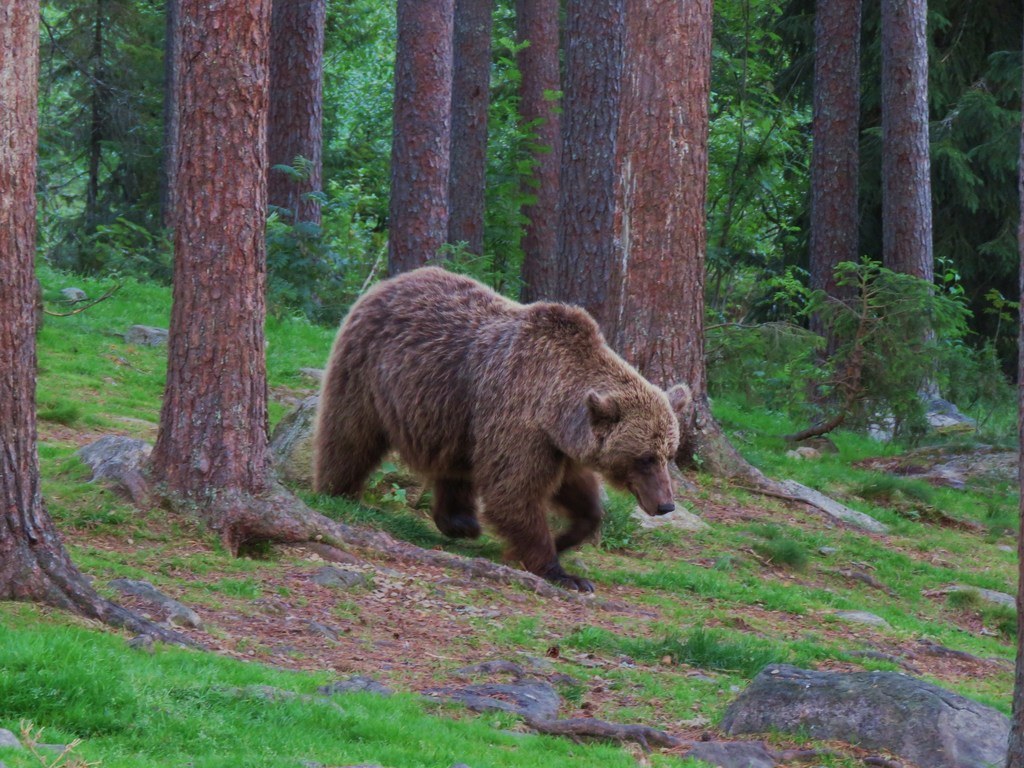
The size is not subtle
Size is the first thing people notice, and it is not subtle. Brown bears reach up to 1,500 pounds, notably larger than a black bear.
The shoulder hump is the most reliable tell
It is a mass of muscle adapted for digging and for short bursts of speed, the kind used chasing moose or caribou calves. A black bear does not have it.
The ears
Ears look less prominent on a brown bear than on a black bear, which reads at a distance once you know to check for it.
The claws
Claws are longer and straighter than a black bear's, matching the digging build.
Color tells you nothing
Brown bear coats range from dark brown all the way to very light blond, and that range overlaps substantially with black bear coats. Anyone identifying a bear by color alone is guessing. Use the hump, the ears, and the claws instead.
Their senses are not what folklore says
Eyesight and hearing are roughly comparable to a human's, so the idea that bears are nearsighted is a myth, according to Alaska Fish and Game. Sense of smell exceeds that of a dog, which is the practical reason stored food and garbage draw bears in from well outside sight range.
Signs of Infestation
Nothing gets into an attic
This is not a species that gets into an attic or a wall void. The signs that matter are outdoors, on the property, and most people find the evidence before they ever see the animal.
Tracks and scat
They turn up in and around the yard.
Garbage cans overturned or torn open
A bear that got food out of a can once has a reason to come back to it.
Wrecked bird feeders
Damaged bird feeders pulled down or destroyed.
Wrecked livestock enclosures
Damaged livestock enclosures, including pens and fencing pushed through or broken open.
Claw marks on trees and buildings
Claw marks on trees or on structures around the property.
Interest in caches and outbuildings
Interest in food caches, fish drying racks, and outbuildings. Property loss for this species centers on food, garbage, livestock, and unsecured storage rather than on damage inside a home.
Prevention and When to Call a Pro
Attractants are the primary lever
Attractant management is the primary lever, and Alaska Fish and Game frames it that way itself. Secure garbage in bear-resistant containers and store food and waste properly. Protect dwellings, vehicles, pets, livestock, and fish drying racks from bear access. Brown bears eat salmon, berries, grasses, sedges, cow parsnip, ground squirrels, carrion, and roots, and they can take moose and caribou calves. That much dietary flexibility is exactly why a reliable human food source is worth returning to, and why removing it is the step that actually ends the problem.
Bears are naturally shy of people
Alaska Fish and Game's own framing is that conflicts come from food and garbage attraction or from surprise encounters, not from baseline aggression. That is useful, because it means the homeowner controls most of the risk.
Check the state rule first
Legal and regulatory status: check state and local wildlife regulations before taking any action. Rules for this species are set by the state, they vary, and they change. For Alaska specifically there is a written rule, and it is narrower than most people assume.
Alaska's 5 AAC 92.410 rule
Alaska's Defense of Life or Property rule is 5 AAC 92.410. A person may kill a bear in defense of life or property only if they did not provoke the encounter and had already done everything else reasonably possible to protect life and property first. "Property" is defined narrowly: a dwelling, a means of travel, pets, livestock, fish drying racks, or other valuable property necessary for livelihood or survival. Game meat does not count, except where that meat is critical for survival.
The disqualifier most people miss
If the bear was attracted by improperly stored food or garbage, it cannot legally be killed under this rule. Alaska Fish and Game states that explicitly. Leaving garbage or food accessible does not just invite a bear onto the property, it removes the legal option a homeowner might assume they still have if that bear becomes a problem. This is the single most important reason to treat attractant management as the whole strategy rather than a suggestion.
A kill triggers reporting
A kill under this rule triggers mandatory reporting. Anyone who kills a bear in defense of life or property must notify the Alaska Wildlife Troopers and the nearest Alaska Fish and Game office, surrender the hide with claws attached and the skull to Alaska Fish and Game, and submit a completed questionnaire within 15 days. These are legal requirements, not paperwork suggestions.
If a bear shows up, get inside
If a bear shows up while you are outside, get inside a building or a vehicle, or group up with other people. Then make noise, yelling or banging pans, to encourage the bear to leave. Once it has gone, find whatever attracted it and remove it. That sequence, shelter first and attractant last, is Alaska Fish and Game's own recommended order.
Call on any repeat visit
Call for help on any repeat visit. A bear that found food at a property once will come back, and Alaska Fish and Game treats that as an attractant problem to solve rather than something to scare off one time. For any encounter that escalates past a bear passing through, the right contact is your local Alaska Fish and Game office or the Alaska Wildlife Troopers, not a general pest control company. Given both the physical danger and the legal complexity, this is a state wildlife and safety matter.
Frequently Asked Questions
What is the real difference between a brown bear and a grizzly?
There is no species difference. They are the same animal, Ursus arctos. "Brown bear" is commonly used for coastal Alaska populations and "grizzly" for inland and northern populations of that same species.
How do I tell a brown bear from a black bear?
Shoulder hump, ear size, and claw length, not color. A brown bear has a prominent shoulder hump, ears that look smaller and less prominent, and longer, straighter claws. Coat color runs from dark brown to light blond in both species, so it is not a usable tell.
Can I legally shoot a bear that is raiding my garbage in Alaska?
Not under the state's Defense of Life or Property rule if the bear was drawn in by improperly stored food or garbage. That circumstance specifically disqualifies a kill under that rule. The rule also requires that you did not provoke the encounter and had exhausted other reasonable options first. Secure the garbage rather than counting on a legal option that may not be there.
How big of an area does one brown bear need?
It varies enormously with habitat quality. Low-productivity terrain may support about one bear per 300 square miles, while rich coastal salmon habitat like the Alaska Peninsula or Kodiak Island can support about one bear per square mile. Central Alaska typically runs around one bear per 15 to 25 square miles.
What should I do if a bear shows up on my property?
Get inside a building or vehicle, or group up with other people, then make noise to encourage the bear to leave. Once it is gone, find and remove whatever attracted it in the first place. That is Alaska Fish and Game's own recommended sequence.
Sources
- Brown Bear (Ursus arctos) Species Profile Alaska Department of Fish and Game
- What To Do If You Have A Conflict With A Bear Alaska Department of Fish and Game
- 5 AAC 92.410, Taking game in defense of life or property Cornell Law School Legal Information Institute
- Defense of Life or Property Game Animal Kill Report Alaska Department of Fish and Game
- ECOS Species Profile, Grizzly bear (Ursus arctos horribilis) U.S. Fish and Wildlife Service
- Ursus arctos Animal Diversity Web (University of Michigan)
Image Credits
- Image: Annika Lindqvist via iNaturalist. CC BY 4.0.
License.