Where They're Found
Found across the Southeast, the Midwest, the South Central states, the Northeast and the Mountain West. This is one species, Reticulitermes flavipes, and its range is the eastern half of North America, as far north as Ontario and as far south as Key Largo. You will read that Reticulitermes termites occur in every state but Alaska, and that is true, but it is a statement about the whole genus. The Pacific Coast belongs to a different species, R. hesperus, and the inter-mountain West to another, R. tibialis. Those are separate pests. Colorado is the entry that surprises people. Colorado State University says plainly that in Colorado the eastern subterranean termite is usually the species responsible for structural damage, the same species that is a pest in the Northeast, even though the more widespread termite in Colorado soil is the aridland subterranean termite. Put simply, the termite under a log in Colorado is probably not the one eating the house. CSU also says the belief that there are no termites in Colorado is itself part of the problem, because houses there were often built without the termite-proofing that is routine elsewhere, and landscape irrigation and poor downspout drainage have made infestations more common in residential areas than they used to be. The U.S. Department of Veterans Affairs requires wood-destroying-insect information in 43 named Colorado counties, including high-country ones. That is a lender rule rather than a range map, but it tells you how mortgage underwriting sees the state. One more range note. This species has been moved around by human activity. Researchers documented two isolated detections in California and established populations in France, Chile and Spain. Two detections are not a range, but they explain why termites occasionally turn up where they should not.
Seasonal Timeline
The months below are a swarm calendar, not an activity calendar. An established colony feeds on wood year round, 24 hours a day, and does not stop in July. What happens once a year is the dispersal flight, and that flight is the one thing a homeowner reliably sees.
The months below are a swarm calendar, not an activity calendar. An established colony feeds on wood year round, 24 hours a day, and does…
Watch wider than the peak. The peak months are when most flights happen, not the only times they can happen. Penn State puts the Pennsylvania window at February through June, which starts a full month before our Northeast shoulder. UF/IFAS puts the Florida flight season at January through April, with south Florida flying earlier than north Florida, so a Florida homeowner should be watching from January. NC State says that in North Carolina, given the right conditions, you could see swarmers at nearly any time of year. A warm spell pulls a flight forward. Two regional notes worth knowing. In the Northeast, a warm pocket around a furnace, chimney, water heater or hot water pipe can trigger an indoor flight in winter, which Penn State and Ohio State both document. In the Mountain West, Colorado State does not give month ranges at all and says winged adults emerge in spring or fall, so a Colorado homeowner should treat spring as the main window and not dismiss a fall flight. The flight itself is brief. Warm conditions and recent rain are the settled triggers. Sources disagree on wind, so ignore what the weather is doing and pay attention to what is on your window sill.
This species does not run one calendar. The bar shows the pattern that covers the most regions; the cards above give every region its own window. Read your own row rather than the bar if the two differ.
Life Cycle
This is a caste system, not a life cycle, and the difference matters for treatment. Termites go through incomplete metamorphosis, so there is no pupa. Eggs hatch into a pre-worker stage that several extension sources call a larva, with Ohio State carefully adding that it is not a true larva. From there the path branches. Most become workers. Some become nymphs, identified by wing buds, and only the nymph route produces winged swarmers. A worker can stay a worker, or become a soldier by way of a real single-instar stage called a presoldier, or become a supplementary reproductive. Two consequences worth understanding. First, the colony does not have one nest. Ohio State says eastern subterranean termites have no defined nest territory: every food source they occupy is a satellite nest, and the colony shifts as food shifts. That is why treating only where you saw them fails. Second, the colony does not depend on one queen. Satellite nests can each hold their own backup reproductive, so a colony that loses its king or queen keeps going. Numbers, with the disagreement left in. The one colony-size figure with a real primary study behind it is from a Florida field study reported by UF/IFAS: 100,000 to 1,000,000 individuals. NC State puts the average nearer 300,000 with mature colonies reaching several million. University of Kentucky notes the opposite end too, that a small colony may have a foraging footprint no bigger than a bedroom. Primary reproductives are long lived. Ohio State puts the king and queen at roughly 20 years, and NC State says they sometimes survive for decades. Colonies are perennial and brood continuously, so there is no meaningful count of generations per year. There is one flight per year, and that is it.
Egg1
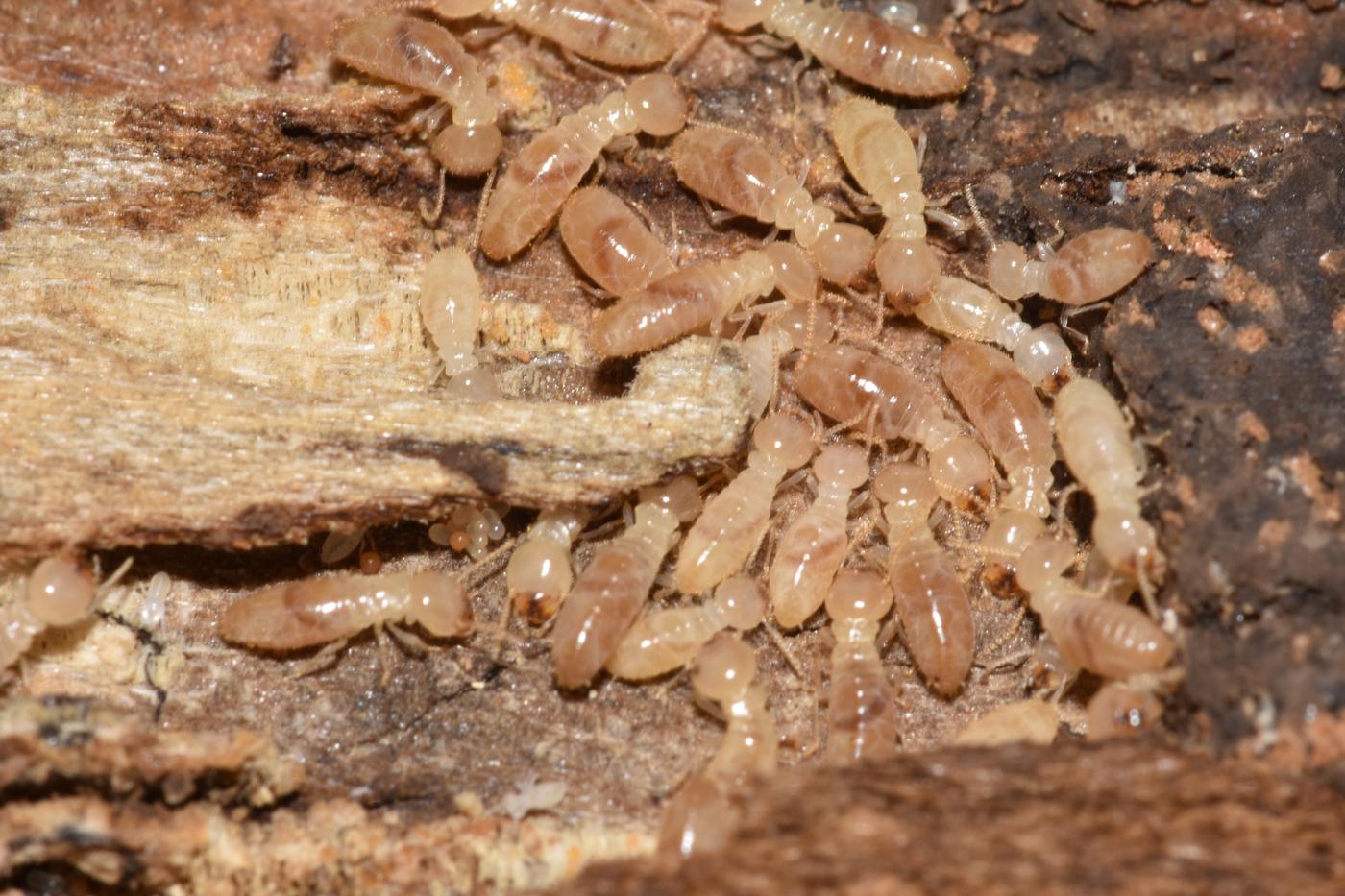
Eggs are laid in clusters and look like small translucent jelly beans. The king and queen tend the very first batch themselves. After that, workers do it, keeping the eggs clean of soil bacteria and fungi. No university or federal source states how long the eggs take to hatch or how many go into a clutch. A homeowner will never see this stage.
Worker2
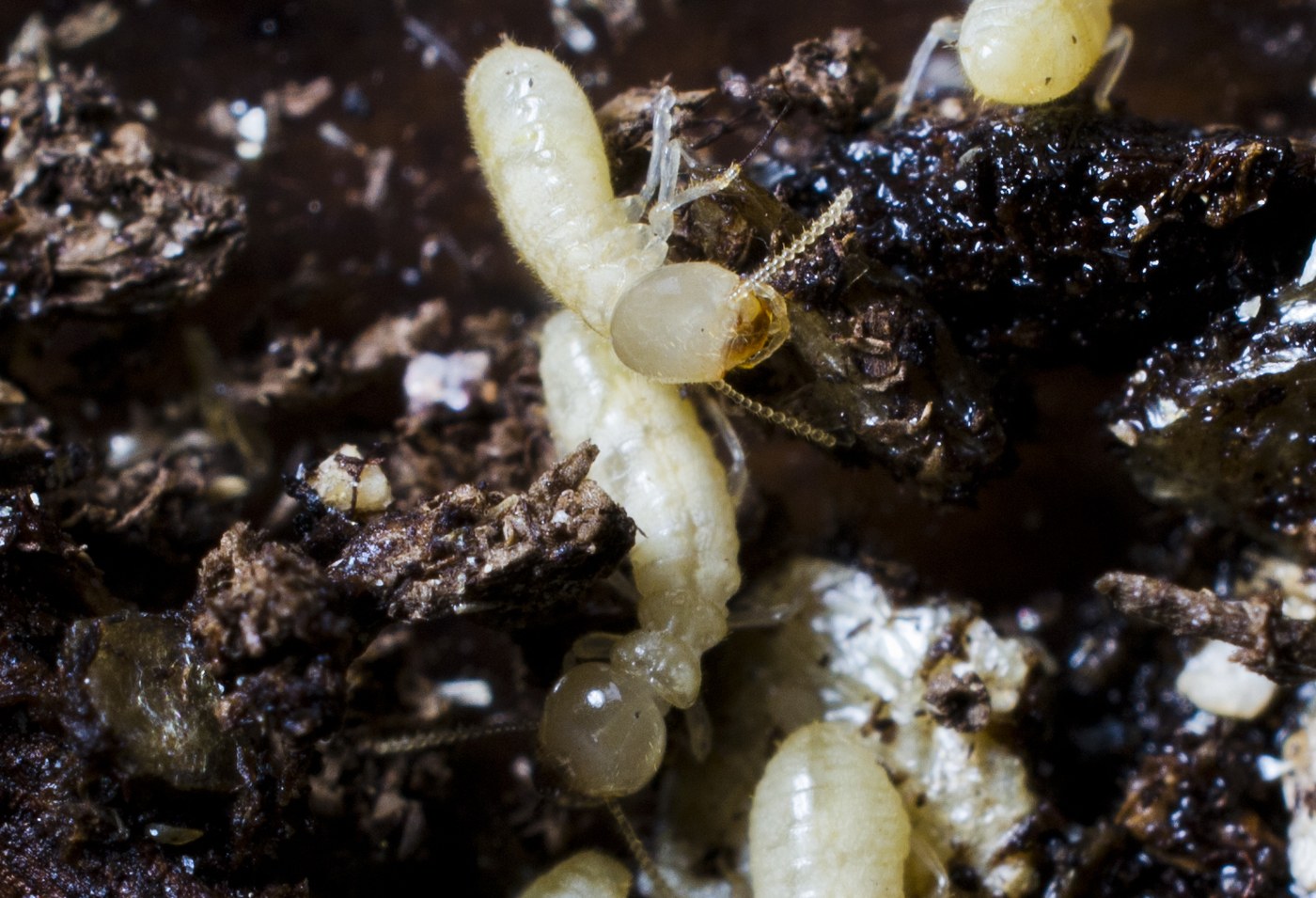
Workers are the ones eating the house. They are small, soft-bodied and creamy white, with a darker head and hardened mouthparts, and they make up the large majority of the colony. They feed continuously, day and night, year round. Odd fact: they keep molting for the rest of their lives without getting any bigger, growing a fresh set of mouthparts every time. Penn State reports individual workers are believed to live up to five years. You will only ever see them if a mud tube is broken open, a board is lifted, or infested wood is probed. Ohio State says they are usually undetectable in open air.
Soldier1
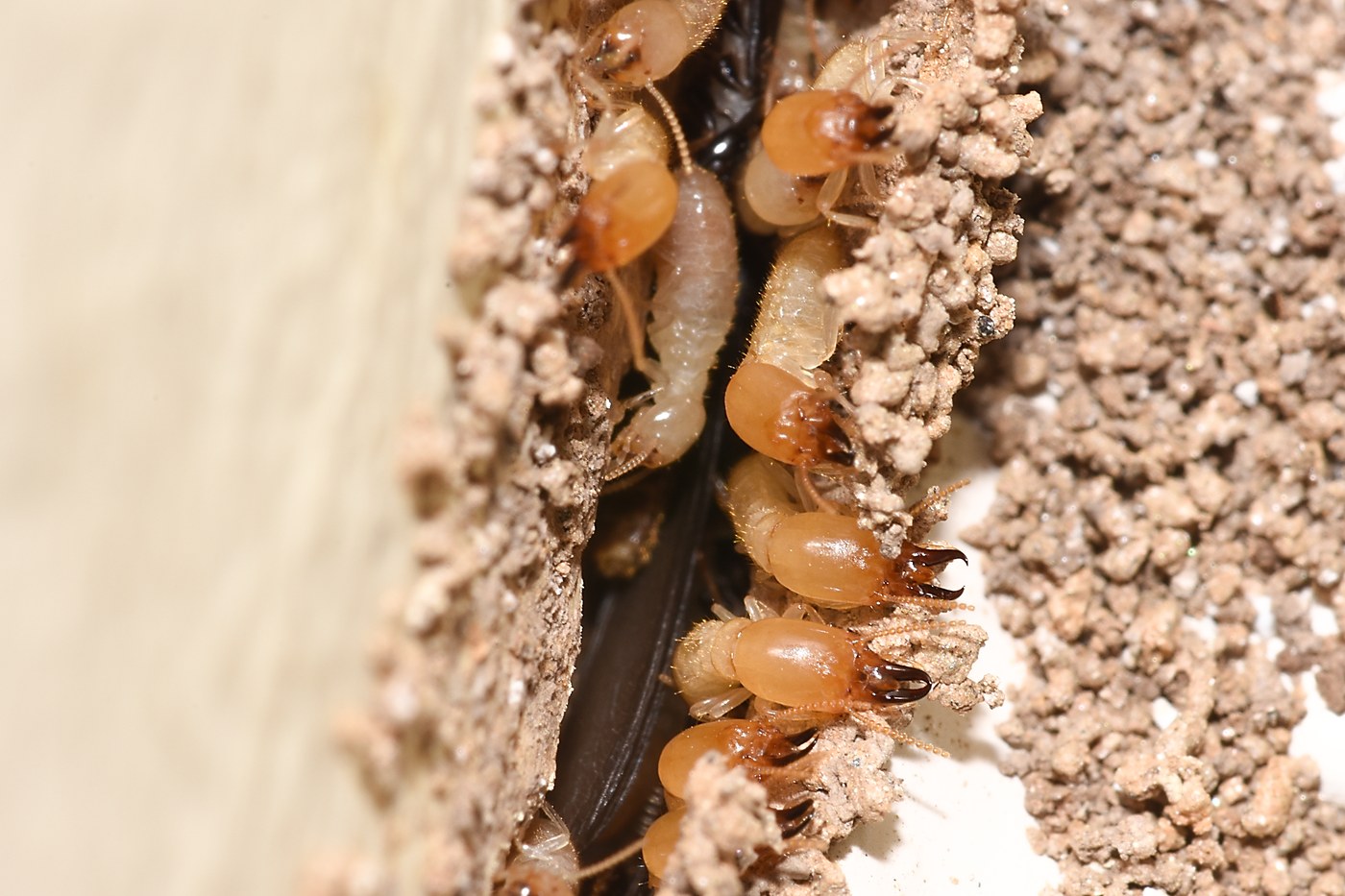
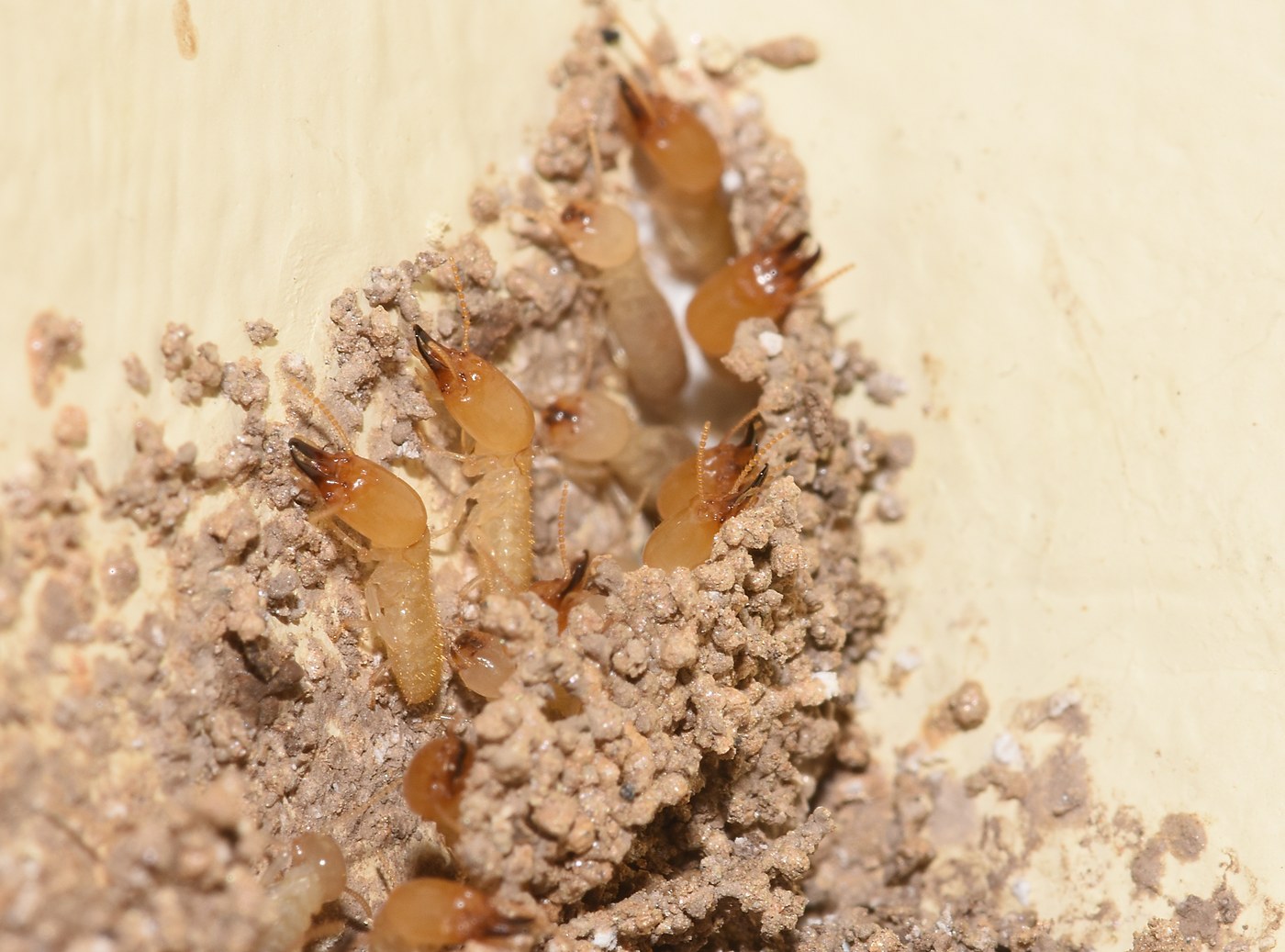
Soldiers have a pale body like a worker and an elongated, hardened, yellowish head with oversized jaws. The jaws are so large the soldier cannot feed itself and has to be fed by workers. In this species soldiers are scarce, and the sources put the share slightly differently: UF/IFAS says 1 to 2 percent of the colony, NC State says 2 to 4 percent. That scarcity is itself an identification clue. If a broken tube spills out a pile of soldiers, an inspector starts thinking Formosan termite, where soldiers run closer to 10 percent. Soldiers bang their heads against the wood to alarm the colony, which is the closest thing this species has to a sound you could notice.
Swarmer3
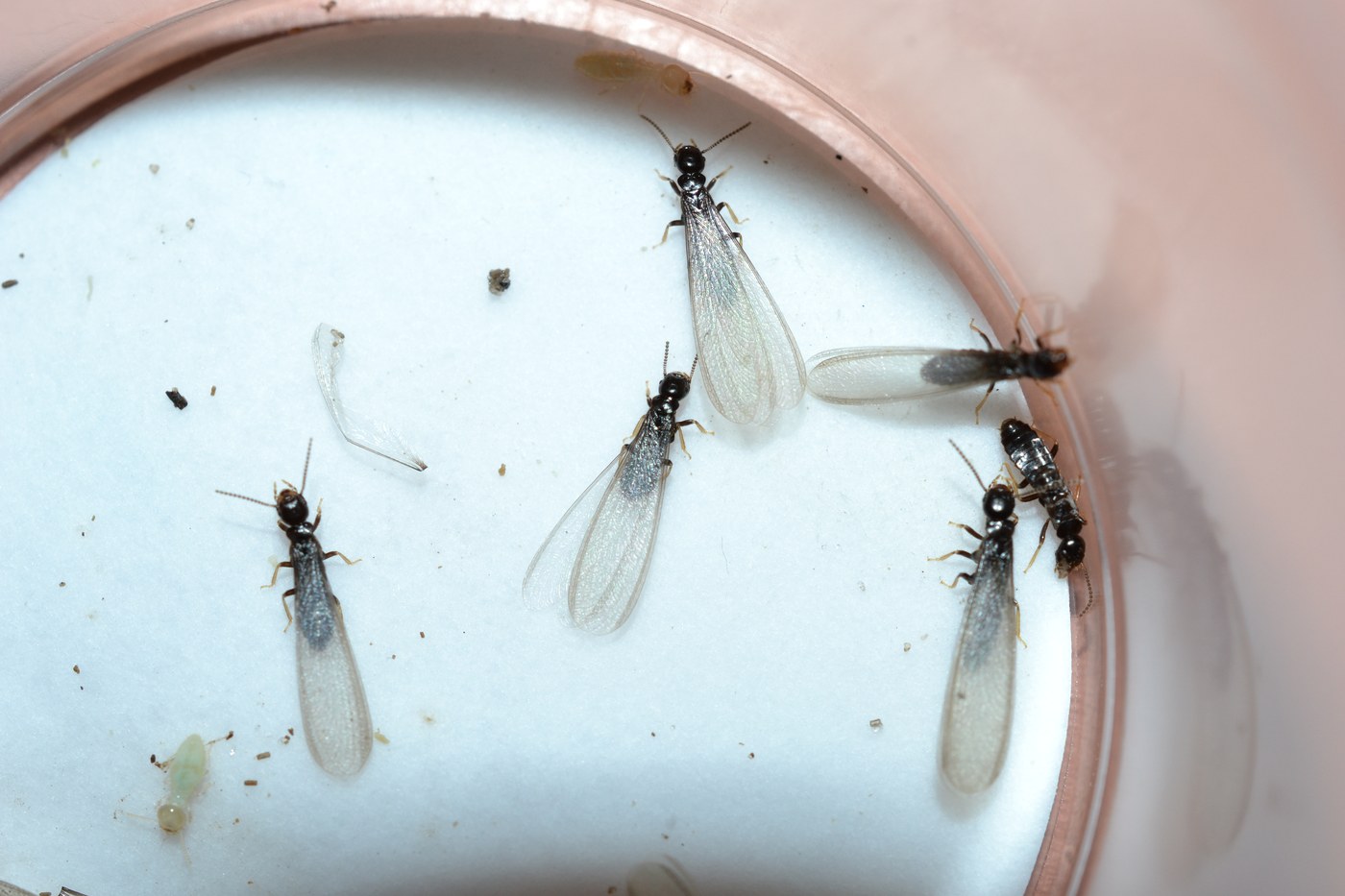
This is the one a homeowner actually meets. Swarmers, properly called alates, are the winged reproductives, about 3 by 8 inch long, dark brown to nearly black, with four wings all the same size and shape that stick out roughly a full body length past the abdomen. They fly once a year, in daylight, on a warm day after rain, in numbers from hundreds to tens of thousands. Indoors they head straight for windows, doors, sinks, bathtubs and light fixtures, and they die within about a day because they cannot get moisture. <strong>Swarmers cause no damage at all</strong>, and killing them accomplishes nothing. Their value is as evidence. It takes roughly five to ten years for a new colony to mature enough to produce them, so a swarm is not the beginning of the problem. It is the first visible symptom of one that started years ago.

Mud Tube
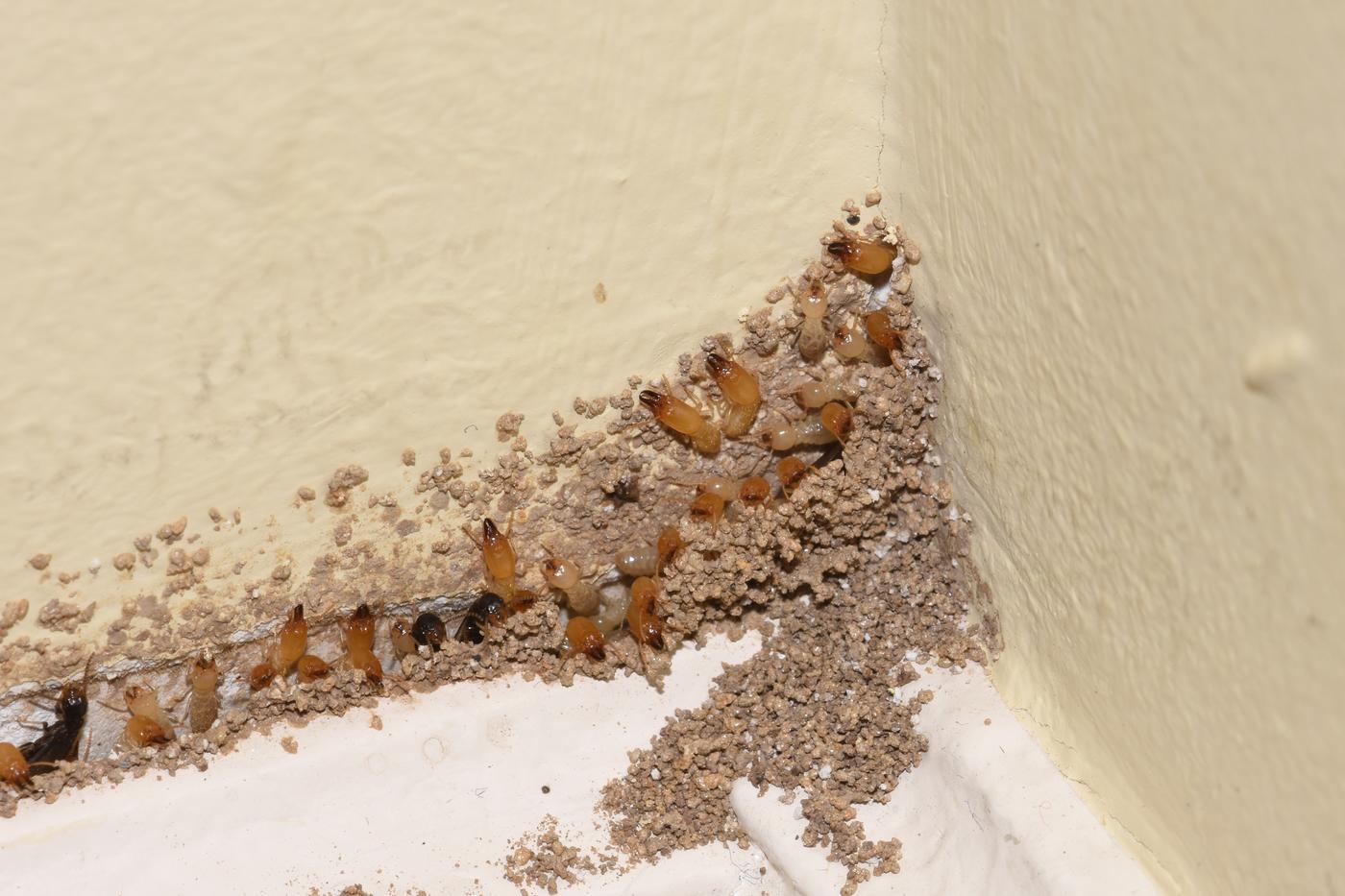
Not a life stage, but it is the other thing a homeowner sees. Workers dry out and die fast in open air, so any trip above soil happens inside a sealed tube built from soil, feces, saliva and chewed wood. Tubes are usually about the width of a pencil, roughly a quarter to a half inch, and they run up foundation walls, piers, sill plates, joists, wall studs and door and window trim. Ohio State also names a specialized mud structure called a swarm castle that alates emerge through. Break a tube and workers repair it quickly, so a resealed tube on a recheck is itself evidence of activity.
Damage4
The signature is mud. This species packs a fecal and soil mixture into its galleries to hold humidity, so termite-damaged wood looks dirty inside, hollowed out along the soft spring grain with the hard grain and a thin outer shell left behind. Wood damaged by a leak, or by carpenter ants, will not have that soil lining, and carpenter ants leave coarse sawdust and smooth polished galleries instead. The outer surface usually stays intact, which is why damage goes unnoticed. University of Kentucky describes a case found only when a vacuum head broke through a baseboard.
<p><strong>This is a caste system, not a life cycle, and the difference matters for treatment.</strong> Termites go through incomplete metamorphosis, so there is no pupa. Eggs hatch into a pre-worker stage that several extension sources call a larva, with Ohio State carefully adding that it is not a true larva. From there the path branches. Most become workers. Some become nymphs, identified by wing buds, and only the nymph route produces winged swarmers. A worker can stay a worker, or become a soldier by way of a real single-instar stage called a presoldier, or become a supplementary reproductive. <strong>Two consequences worth understanding.</strong> First, the colony does not have one nest. Ohio State says eastern subterranean termites have no defined nest territory: every food source they occupy is a satellite nest, and the colony shifts as food shifts. That is why treating only where you saw them fails. Second, the colony does not depend on one queen. Satellite nests can each hold their own backup reproductive, so a colony that loses its king or queen keeps going. <strong>Numbers, with the disagreement left in.</strong> The one colony-size figure with a real primary study behind it is from a Florida field study reported by UF/IFAS: 100,000 to 1,000,000 individuals. NC State puts the average nearer 300,000 with mature colonies reaching several million. University of Kentucky notes the opposite end too, that a small colony may have a foraging footprint no bigger than a bedroom. Primary reproductives are long lived. Ohio State puts the king and queen at roughly 20 years, and NC State says they sometimes survive for decades. Colonies are perennial and brood continuously, so there is no meaningful count of generations per year. There is one flight per year, and that is it.</p>
Identification
Flying ant or termite: check the wings against the body first. Everyone tells you to compare the two pairs of wings to each other, and that is a good check, but it needs two intact wings side by side. The check that works on a single specimen is wing length against body length. A termite's wings stick out roughly a full body length past the end of the abdomen. A winged ant's wings are about as long as the ant. Penn State states this one explicitly and almost nobody else prints it.
Then the waist. A termite is the same width end to end, with no pinch between the thorax and the abdomen. A winged ant has an obvious wasp-like pinch. This is the tell you can see with the naked eye from across a window sill.
Then the wings against each other. A termite's four wings are all the same length and shape. An ant's front pair is noticeably longer than the hind pair. Missouri Extension adds a secondary color cue: termite wings look cloudy white, ant wings look clear.
Then the antennae. Termite antennae are straight and beaded, like a tiny string of beads, and they may droop. Ant antennae are elbowed, with a sharp bend partway along. Three checks, and you only need one of them to be sure.
Discarded wings on a window sill are often the only evidence left, and they are enough. Penn State says very often the shed wings are the only evidence that termites are in a building. Check window sills, door frames, sinks, bathtubs, the edges of floors and around light fixtures. NC State points out that termite wings are all the same length and ant wings are not, so even one wing is diagnostic. Colorado State adds a mechanical detail: the wings break off cleanly and leave only a small stub where they attached. UF/IFAS notes a quirk specific to this genus, that dead alates indoors are often found with their wings still attached rather than in a neat shed pile.
Save the specimens instead of sweeping them up. NC State's advice, and it is good advice: collect a few swarmers or wings in a bag or on a piece of tape and have them identified. Sweeping the evidence away and then trying to describe it over the phone helps nobody.
Sizes and colors, by caste. Swarmers run about 3 by 8 inch and are dark brown to nearly black. UF/IFAS gives about 0.4 inch including wings, NC State gives 8 to 10 mm head to wingtip, and Penn State gives 3 by 8 to 1 by 2 inch, so expect a little spread depending on how the source measures. Workers and soldiers are around a quarter inch, creamy white and soft-bodied, with the soldier carrying an elongated yellowish head. Only one published source gives a worker measurement, and it gives it indirectly.
Carpenter ants are the other wood insect people confuse this with. Beyond the ant and termite tells above, look at the wood. Carpenter ants push coarse sawdust out at the gallery entrance and their galleries are smooth, almost polished inside. Termite galleries have no sawdust, are caked with mud, and often connect to soil through a tube.
Other termites, if you want the fine detail. Subterranean termites have a pronotum narrower than the head, while drywood and dampwood termites have one equal to or wider than the head. Within the subterraneans, this species has a rectangular-headed soldier, while the Formosan termite's soldier head is oval. The single best character is on the wing: Formosan alate wings are covered in small hairs and this species' are not. Two closely related natives, R. virginicus and R. hageni, are smaller and separable only under a microscope, which is why Clemson notes the two commonest South Carolina species can be told apart by lab work and not by eye.
A true thing worth knowing: a termite is taxonomically a social cockroach. They sit in the order Blattodea, alongside cockroaches, and have been eating wood since roughly 150 million years ago. Some publications still use the older order name Isoptera, including one from 2024, so the older label is not simply out of date. It is just no longer the current placement.
Signs of Infestation
Winged swarmers indoors. University of Kentucky puts it about as strongly as an extension source ever puts anything: discovering winged termites indoors almost always indicates an infestation that warrants treatment. They cluster at windows and doors because they head toward light. Swarmers outdoors coming from a stump or a woodpile out in the yard are not automatically a reason to worry, but swarmers emerging next to the foundation or out of an attached porch or patio mean there is a good chance the house is infested too.
Discarded wings on window sills, in sinks and bathtubs, and along the edges of floors. Frequently the only thing left behind after a flight. With this species you will often find the dead swarmers as well, near windows or dried up in a sink, and often with the wings still attached.
Mud tubes. Pencil width, roughly a quarter to a half inch, built from soil, feces, saliva and chewed wood. Look on foundation walls, support piers, sill plates, floor joists, cellar walls, wooden posts, wall studs, and door and window trim, plus behind siding and inside crawl spaces.
Here is how to test whether a tube is active, and this is the part most pages get wrong. Break it open and look for small creamy-white workers. If you find them, it is active. But an empty tube proves nothing. University of Kentucky and NC State both say termites routinely abandon sections of tube while foraging elsewhere in the same building. The better test is Missouri Extension's, and it is the best thing a homeowner can do without tools: look at the fecal and soil packing inside the wood's galleries. In an active infestation that soil looks moist. In old damage it looks dry.
You cannot date termite damage by looking at it. Missouri Extension says so outright. The extent of the damage across the house is a rough proxy for how long it has been going on, and nothing more. If a salesperson glances at a joist and tells you the damage is recent, or that it is years old, they are guessing. A professional uses a moisture meter, because infested areas read wet from the water the termites carry in.
Damaged wood, hollowed along the grain, with dried mud in the galleries. The mud is the signature. Wood softened by a leak or excavated by carpenter ants does not have it. In badly infested wood only the hard grain and a paper-thin outer shell remain.
Blistered or peeling paint, and wood that sounds hollow. Lumps and blisters in paint on wood trim are a sign. So is a dull thudding sound when you tap, which is Colorado State's description, and wood that a screwdriver, awl or ice pick sinks into with little resistance. Penn State notes that when you probe it, many of the hidden workers may spill out.
Tiny holes bored through drywall or plaster with bits of soil around the edge. Also rippled or sunken traces behind wallpaper and wall coverings where termites are tunneling underneath. This is the most overlooked visual sign on the list.
Damage that looks like nothing at all. The outer surface usually stays intact, so feeding can progress in fully exposed wood without showing. University of Kentucky describes one case discovered when a vacuum head broke through a baseboard.
No reliable sound, and no smell. Do not let anyone tell you they can hear termites chewing. Soldiers bang their heads against the wood to alarm the colony, which transmits a vibration, but no published source describes a homeowner-audible sign. No published source attributes any odor to this species or its damage either.
Prevention and When to Call a Pro
Break every point where wood touches soil, and know that the sources disagree on how much clearance. Missouri Extension says 4 to 6 inches between the soil surface and the bottom of siding or brick veneer, and gives the best reason for the rule: the gap is what lets a mud tube be seen during an inspection. University of Kentucky says at least 6 inches. Colorado State says at least 8 inches for wooden shingles or supports. Penn State says do not permit wood within 18 inches of soil where possible. Four sources, four numbers, and nobody reconciles them. More clearance is the safer read, and Missouri's reasoning is the one to remember: if you cannot see the foundation, you cannot inspect it. Never let siding extend below grade. Support steps and posts on a concrete base. Remove stumps, dead roots and any form boards left behind after construction.
Get water away from the foundation. Working gutters, downspouts and splash blocks pointed the right way. Grade so surface water runs away from the house. Fix leaking faucets, pipes and air conditioning condensate. Aim sprinklers and irrigation so they are not soaking the foundation. Colorado State makes the point that landscape irrigation and poor drainage are a large part of why termite problems have increased in Colorado residential areas, which is a reminder that this is the single most controllable risk factor anywhere.
Crawl spaces have real numbers, and they are checkable. University of Kentucky: most building codes call for one square foot of vent opening per 150 square feet of crawl space, dropping to one square foot per 300 to 500 square feet once a vapor barrier is in. One vent within three feet of each exterior corner. Keep vents clear of leaves, dirt, debris and plantings. Lay 4 to 6 mil polyethylene sheeting over about 75 percent of the soil surface.
The mulch advice you have heard is probably wrong. The usual recommendation is to swap wood mulch for gravel. University of Kentucky says termites are drawn to mulch for its moisture and temperature insulation, not for the wood, and that mulch is poor food for them and a non-preferred one. So it makes little difference which mulch you use, and crushed stone or pea gravel are comparable in attractiveness because they hold moisture in the soil underneath too. What actually matters is depth and clearance. Apply it sparingly, a couple of inches at most. Ohio State says keep the layer under 2 inches and at least 6 inches back from the foundation. Never let mulch touch wood siding or door and window framing, and keep the foundation wall visible so tubes can be spotted.
Move the firewood, and know that pressure-treated wood is not immune. Never stack firewood, lumber, cardboard or newspapers against the foundation or inside a crawl space. They are food, they are hidden cover, and they let termites bypass treated soil completely. Keep dense vines and ivy off the walls. And on treated wood, University of Kentucky and Missouri Extension both correct the same myth: termites enter treated wood through cracks and cut ends, or simply build tubes over the surface to reach untreated framing above.
Seal the gaps, but be honest about what sealing buys you. Fill cracks and voids in the foundation, and seal where plumbing and electrical lines pass through. Then understand the limit: Missouri Extension notes termites exploit gaps as small as 1 by 32 inch, and cracks eventually form in nearly every foundation. Sealing reduces risk. It does not exclude termites.
Call a professional if any one of these is true. You find winged termites or shed wings indoors. You find swarmers coming out next to the foundation or from an attached porch or patio. You find a mud tube on a foundation wall, pier, sill plate or joist. Wood sounds hollow or a screwdriver sinks into it. You are buying or selling a house. And NC State recommends an annual professional inspection regardless of symptoms, which for a pest that hides everything it does is reasonable advice.
This one genuinely is not a do-it-yourself pest, and here is specifically why. The equipment does not exist at consumer level: a typical liquid treatment uses masonry drills, large-capacity spray tanks and long metal soil injection rods, and puts hundreds of gallons of termiticide into the ground along the foundation, under slabs and inside foundation walls. The products are restricted. UF/IFAS, Ohio State and EPA all state that termiticide application requires a licensed applicator. Retail and internet products seldom eradicate an existing infestation, and Missouri Extension says flatly that there are no do-it-yourself termite control measures that achieve the desired result. And the knowledge required is construction knowledge more than bug knowledge, because most of the entry points are hidden. University of Kentucky allows exactly one exception: a small wooden object not attached to the house, like a mailbox post.
Liquid or bait, told straight: there is no simple answer. A liquid soil treatment creates a treated zone under and around the building, works within weeks, and stays active for at least five years to label, with Missouri saying 5 to 8 years under normal conditions. It is invasive, involving trenching, rodding and drilling through slabs, porches and patios. Baiting uses a slow-acting active that foragers carry back to the colony, is minimally invasive with stations in the ground a foot or two from the foundation, and usually keeps the technician out of the house entirely. It is slow, taking months to work, and it leaves no residual protection in the soil, so it only keeps working as long as the stations are maintained. Baits are often the only option where there are wells, cisterns, nearby water, sub-slab ducts, inaccessible crawl spaces, a high water table, or a liquid treatment that already failed. Liquid is preferred for a severe infestation or a real estate closing you cannot wait months for. On liquids, one mechanical detail matters: repellent products cause no mortality, so the colony keeps tunneling and will likely find an untreated gap, which is why Missouri Extension recommends only non-repellent termiticides for post-construction soil treatment.
Spot treatment is a gamble, and treatment can fail. Because a colony forages in many directions at once, University of Kentucky says localized spot treatments are usually a gamble and most reputable firms will not warrant them. And more importantly: even the best treatment by a knowledgeable firm may fail when termites find their way through an untreated gap in the soil. Penn State reports treatment failure rates of 20 to 30 percent in some areas. Penn State also notes it is common for companies to charge a yearly warranty renewal of ten percent of the original treatment price, meaning after ten years you have paid for a second treatment, and considers keeping the warranty advisable given those failure rates. If termites swarm the year after a treatment, that is usually an untreated gap, not a chemical that wore out. A company that tells you any of this up front is being straight with you.
There is no hurry, and any company that says there is, is selling you something. Five separate university extension services say the same thing independently. University of Kentucky: termites damage wood slowly, an extra day, week or month to make an informed decision is generally inconsequential, and you should avoid firms that pressure you into signing immediately with specials or scare tactics. Penn State: damage is the result of years of infestation, not a sudden onslaught. Missouri Extension: if you find damage there is no hurry, a few weeks of delay is of little consequence. Colorado State: infestations build up slowly, there is plenty of time to select the best course of action, and do not panic. Maryland Extension: to cause structural damage, termites have to work in a home for quite a while. Missouri also publishes a list of company behaviors to avoid: no working phone number, arriving uninvited to show you termites found in your neighbor's yard, quoting a per-gallon price, offering a discount for treating today, offering a reduced price for leftover material from another job, claiming a secret formula, pushing you to sign while hinting the house is unsound, targeting the elderly or people living alone, or claiming to be endorsed by a government agency. Ask instead for years in business, the technician's experience, references, proof of state license, proof of insurance, and a copy of the label for the termiticide they intend to use.
Frequently Asked Questions
How much damage do termites really cause in the United States?
Less certainly than you have been told. Nearly every termite page online quotes an annual damage total, and we could not trace that number to a primary source. It appears even in university extension publications with no citation attached, and different institutions give different numbers for different quantities, which is a sign nobody is working from the same measurement. The one figure with a real citation behind it is from a 2012 review by Rust and Su in Annual Review of Entomology, which estimated the worldwide cost of termite control plus repair at about $40 billion a year, roughly half of it in the United States, with subterranean termites responsible for about 80 percent. Here is the part almost nobody mentions. That estimate was not built by surveying damage. It was back-calculated from termiticide sales, scaled up by a repair-to-control cost ratio taken from Formosan termite work in New Orleans, and the researcher himself allowed it may run a little high for that reason. It is a defensible order of magnitude. It is not a measurement, and anybody quoting you a precise national damage total is repeating something they did not check.
How do I tell a flying ant from a termite swarmer?
Three checks, and any one of them settles it. Waist: a termite is the same width end to end with no pinch, an ant has an obvious narrow waist. Wings: a termite's four wings are all the same length and shape, an ant's front pair is longer than the hind pair. And the version that works on a single specimen, which almost no other page gives you: a termite's wings extend roughly a full body length past the end of the abdomen, while an ant's wings are about as long as the ant. Antennae: a termite's are straight and beaded, an ant's are elbowed with a sharp bend.
I found a pile of small wings on my window sill. What does that mean?
It usually means termites swarmed indoors, and very often those shed wings are the only evidence left behind. Do not sweep them up. Collect a few in a bag or on a piece of tape and have them identified, because termite wings are all the same length and ant wings are not, so even a single wing tells you which insect you are dealing with. With this species you will often find the dead swarmers too, near windows or dried up in a sink or bathtub, frequently with the wings still attached rather than shed.
How can I tell if a mud tube is still active?
Break it open and look for small creamy-white workers. If they are in there, it is active. But an empty tube proves nothing at all. University of Kentucky and NC State both note that termites routinely abandon sections of tube while they feed elsewhere in the same building, so the standard advice to break a tube and see whether it gets rebuilt is incomplete. The better test comes from Missouri Extension: look at the fecal and soil mixture packed inside the galleries in the wood. In an active infestation that soil looks moist. In old damage it looks dry. And whatever you do, do not try to date the damage by eye. Missouri says plainly that it is impossible to tell how old termite damage is by looking at the wood.
I saw swarmers. How fast do I need to act?
You need to act, but you do not need to act today. Five separate university extension services independently tell homeowners that termite damage is slow and there is time to choose properly. Penn State says damage is the result of years of infestation, not a sudden onslaught, and that termite problems generally appear ten years or more after construction. Missouri Extension says if you find damage there is no hurry and a few weeks of delay is of little consequence. Colorado State says infestations build up slowly and there is plenty of time to select the best course of action. University of Kentucky goes further and names the sales tactic directly: avoid firms that pressure you into signing immediately with specials or scare tactics. Take a week. Get more than one estimate. What a swarm does tell you is the opposite of urgency and more useful than it: it takes roughly five to ten years for a colony to mature enough to produce swarmers, so the colony has been working, unseen, since before you noticed anything.
Can I treat termites myself?
Realistically, no. A liquid treatment needs masonry drills, large-capacity tanks and soil injection rods, and often puts hundreds of gallons of termiticide into the soil around and under the building. The effective products are restricted to licensed applicators, which UF/IFAS, Ohio State and EPA all state. Retail and internet DIY products seldom eradicate an existing infestation, and Missouri Extension says there are no do-it-yourself termite control measures that achieve the desired result. The skill involved is mostly building construction knowledge, because the entry points are hidden. University of Kentucky allows one exception, and it is a narrow one: a small wooden object not attached to the house, such as a mailbox post.
Could the colony be in my neighbor's yard?
Yes, and this is one of the more useful things to understand about this pest. A single colony forages over a large area, and the sources put the distance differently. A Florida field study reported through UF/IFAS gives up to 150 feet. NC State gives up to 200 feet and territories up to a third of an acre. University of Kentucky gives up to half an acre, and Maryland Extension notes a single colony can use food sources more than 200 feet apart. Whichever figure you take, the territory routinely runs well past a property line, and University of Kentucky states the consequence outright: the colony damaging your house may physically be located in a neighbor's yard. It also explains why, after a colony is eliminated, termites from neighboring colonies can move back in, which is the argument for ongoing monitoring rather than a one-time fix.
Do termites bite people or spread disease?
No. No university extension or federal source attributes any bite, sting, venom, allergen or disease risk to this species. The soldiers do bite, but they bite invading insects inside the colony, not people. The risk here is entirely to the building.
Are there really termites in Colorado?
Yes, and Colorado State University says the belief that there are not is part of the reason Colorado houses get damaged, because construction there has often skipped termite-proofing that is standard practice elsewhere. The eastern subterranean termite is the species usually responsible for structural damage in Colorado, even though the more widespread native termite in Colorado soil is the aridland subterranean termite. Damage was historically concentrated where the water table is high, but CSU says landscape irrigation and poor downspout drainage close to foundation walls have made infestations more common in residential areas. Colonies overwinter below the frost line, so a quiet winter is not an absence.
What does a termite inspection actually cover when I buy a house?
The standard document is the NPMA-33 Wood Destroying Insect Inspection Report, a two-page form approved for FHA and VA loans, and there are four things a buyer should know about it. It is valid for 90 days from the date of inspection for mortgage and settlement purposes. It is not a warranty, and the form says so in those words, unless a separate written warranty or service agreement is attached. It covers termites, carpenter ants, carpenter bees and reinfesting wood-boring beetles, and it explicitly does not cover mold, mildew or wood-decay fungi, which need a separate wood-destroying-organism attachment. And it reports what was visible on the day, not what is there. Even an experienced inspector can miss hidden signs, as University of Kentucky acknowledges. As for whether one is required, HUD's four triggers are that it is customary to the area, mandated by state or local rules, that the appraiser sees evidence of infestation, or lender discretion. The VA requires wood-destroying-insect information statewide in more than 30 states and territories, and county by county in several others. Who pays for it is negotiated in the purchase contract and varies by loan type and by state, so ask your lender and your agent rather than assuming.
Should I replace my mulch with gravel to keep termites away?
Probably not for that reason. University of Kentucky found termites are drawn to mulch mainly because it holds moisture and insulates the soil, not because they want to eat it. Mulch is poor nutritional quality for them and a non-preferred food. That means the type barely matters, and crushed stone or pea gravel are comparable in attractiveness because they hold moisture in the soil underneath too. What actually matters is applying it sparingly, a couple of inches at most, keeping it back from the foundation, and never letting it touch wood siding or door and window framing. Keeping the foundation wall visible also means a mud tube has nowhere to hide.
Sources
- Native Subterranean Termites: Reticulitermes flavipes, R. virginicus, R. hageni, EENY-212 UF/IFAS Extension, Entomology and Nematology
- Termite Control: Answers for Homeowners, ENTFACT-604 University of Kentucky Department of Entomology
- Eastern Subterranean Termites Penn State Extension, Department of Entomology
- Subterranean Termites, Publication G7420 University of Missouri Extension
- Biology and Behavior of Eastern Subterranean Termites NC State Extension
- Termites, Fact Sheet No. 5.532 Colorado State University Extension
Image Credits
- Image: NPMA. Used under NPMA member image license. Identified to family (Heterotermitidae) only; species not confirmed.
- Image: NPMA. Used under NPMA member image license.
- Image: NPMA. Used under NPMA member image license. Genus confirmed (Reticulitermes). Species not confirmed.
- Image: NPMA. Used under NPMA member image license. Shows damage attributed to Reticulitermes; species not confirmed.