Seasonal Timeline
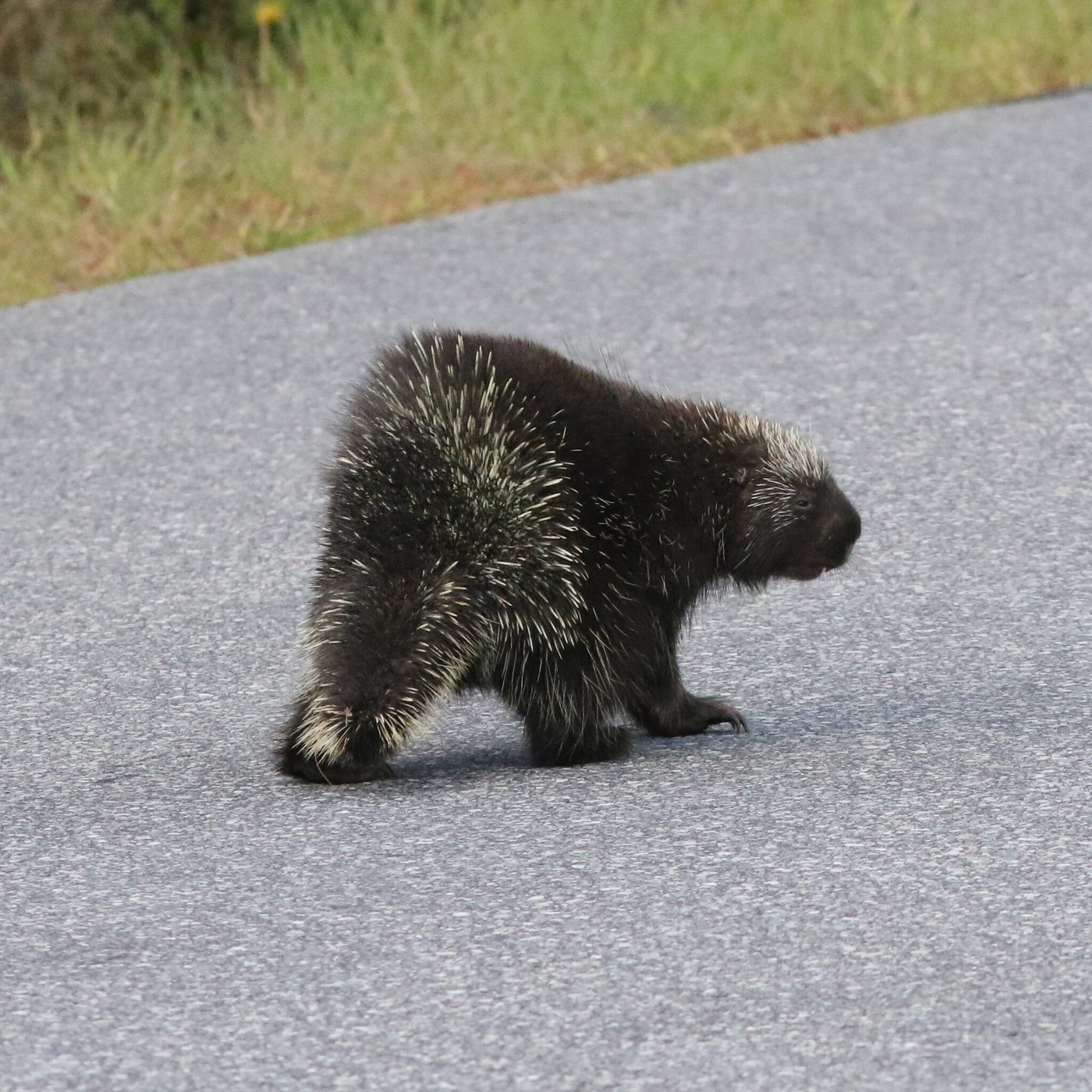
Porcupines are active year-round and do not hibernate. Tree girdling damage concentrates in winter, once evergreen needles and inner bark become the primary food source. Fall breeding season (October and November) and spring green-up both drive increased road-crossing and yard-encounter activity in northern parts of the range, including Alaska.
Porcupines are active year-round and do not hibernate. Tree girdling damage concentrates in winter, once evergreen needles and inner bark…
The fall breeding window and spring roadside-movement pattern are documented specifically for Alaska and should be treated as broadly representative of the species' northern range rather than a fixed calendar for every region.
Where They're Found
Porcupines live in coniferous and mixed forest most often, but also range into grasslands, desert shrub country, chaparral, and even tundra at the northern edge of their range. They den in hollow logs, rock crevices, or among tree root systems rather than building a true nest, and during severe winter weather several animals may share a den, though the species is otherwise solitary outside of a mother with young.
This species has a genuinely wide range across North America, well beyond the single region it is most often associated with. Alaska's population is well documented and covers most of the state's forested areas, with the notable exception of Prince of Wales Island and its neighboring islands in southern Southeast Alaska, which the species apparently never recolonized after the last ice age. Beyond Alaska, established populations are documented in the Pacific Northwest, California (Sierra Nevada, Cascades, Coast Ranges, and scattered Central Valley and Southern California populations), the Mountain West (Colorado, Montana, Utah), the Southwest (Arizona, going back to a 1935 University of Arizona ecology study), South Central states (western and southern Texas), the Midwest (Michigan, Wisconsin, most of Minnesota), and the Northeast (New York, Pennsylvania, with documented recent range expansion into parts of the Mid-Atlantic). The species is confirmed absent from most of the Southeast and from Hawaii.
Life Cycle
Two figures are given as ranges rather than single numbers because sources genuinely differ. Quill count is cited anywhere from roughly 30,000 to 35,000 depending on the source, and wild lifespan is cited as either up to 18 years or a narrower 5 to 7 years by different wildlife sources. Neither discrepancy changes anything practical about identification, prevention, or timing, so the honest answer is the range rather than a single precise number.

Newborn Porcupette
Nursing Young
Juvenile2
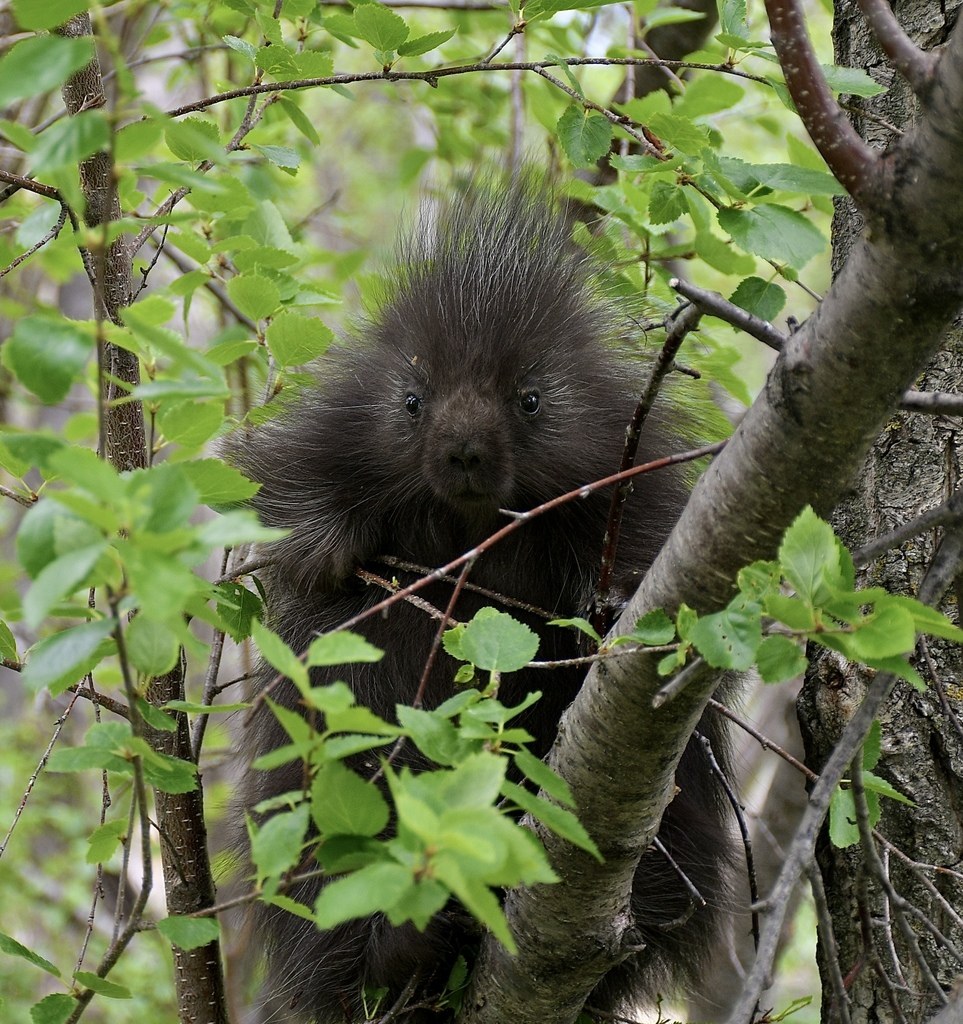
Sub-adult
Adult
Signs of Activity
Identification
Body length
Body length runs 25 to 31 inches by Alaska Department of Fish and Game's cited range, or up to about 40 inches including tail by a separate New York state account. Adult males weigh 22 to 27 pounds, occasionally up to 30, while adult females run about 10 percent lighter at 15 to 18 pounds.
A chunky, high-arched body
A large, chunky, high-arched body with short legs and long, strongly curved claws built for climbing.
Coat color runs east to west
Coat color runs black or brown in the eastern part of the range and more yellowish in the West, with long guard hairs whose lighter tips give the overall coat a yellow-to-white cast.
About 30,000 quills
Roughly 30,000 quills cover the body everywhere except the face, ears, legs, and belly. Each quill is a modified, hollow guard hair with microscopic backward-facing barbs at the tip, which is why an embedded quill is hard to pull out and can migrate deeper into tissue rather than working its way free.
They cannot throw quills
Porcupines cannot throw or shoot their quills. This is a persistent, well-documented myth. Quills are loosely attached and detach on contact when a predator brushes against the animal or is struck by its heavily muscled, quill-covered tail. If the tail strikes a hard object like a rock, a quill can occasionally dislodge and fly a short distance, which is one likely real-world origin of the shooting myth.
No commonly confused species exists
The porcupine is the only quilled mammal native to the United States and Canada, so there is no real field look-alike. The one mix-up that does come up is with the hedgehog, an entirely different, Old World animal with no wild population anywhere in North America, which is a naming confusion rather than an identification problem.
Signs of Infestation
Girdled bark, well up the trunk
Girdled bark, typically well up a tree's trunk and branches rather than at ground level. This height distinguishes porcupine damage from rabbit or vole girdling, which happens low on the trunk at snow-line height.
Tooth grooves in stripped wood
Tooth-groove marks visible in stripped wood, and curved, woody-fiber droppings about an inch long with rounded ends near a den or feeding site.
Quills stuck in wood or a pet
Quills found stuck in wood, fencing, or a pet's coat around a den entrance or a heavily fed-on tree.
Gnawing on anything salty
Unexplained gnawing on tires, plywood, tool handles, boots, or other gear carrying road-salt residue or trace sodium. Porcupines actively seek out salt because their plant-based diet is naturally low in sodium, and this salt-seeking behavior is a distinctive, well-documented sign separate from tree damage.
No characteristic sound
No distinctive vocalization is commonly documented for routine porcupine activity beyond occasional grunting or chattering when the animal feels threatened.
Odor is not a reliable sign
Nothing usable as a routine infestation smell has been documented for this species.
Prevention and When to Call a Pro
States regulate trapping and take
Several state wildlife agencies specifically regulate porcupine trapping and take. Rules vary by state, from a permit required only when the animal is actively damaging property, to a full trapping license and closed-season requirements. Check state and local wildlife regulations before trapping or relocating a porcupine, since rules vary and change, and a licensed nuisance wildlife control operator is the safer default over a DIY trap purchase.
Protect individual trees
Not the whole property line. Circle the trunks of valued trees with a 30-inch-wide band of aluminum flashing, or wrap the trunk in wire mesh or hardware cloth. Porcupine damage happens well up the trunk, so the barrier needs to run higher than a typical rabbit or vole guard.
Fence the small plantings
Fence small plantings, gardens, and orchards rather than the whole yard. An 18 to 24 inch woven wire fence with the top folded outward at a 65 degree angle discourages climbing, and a smooth electric wire strung about 1.5 inches above the top of the fence adds further deterrence. Bury the bottom of the fence 12 to 18 inches to stop the animal from pushing underneath.
Remove the salt attractants
Remove salt attractants around the property. Store tires, tools, and salt-exposed gear away from open yard areas where a porcupine can reach them, since unexplained gnawing on this kind of equipment is frequently salt-seeking behavior rather than random chewing.
Sealing the house does not apply
Standard seal-the-house advice does not apply. There is no documented pattern of porcupines entering attics, walls, or crawl spaces. This is not a structural pest, and everything worth doing happens outdoors at individual trees and the yard perimeter.
Who to Call, and When
Bring in a licensed nuisance wildlife control operator once girdling damage shows up on multiple valued trees, a porcupine has denned close to a house or outbuilding, or fencing and barrier measures are no longer keeping pace with the damage. If a pet is quilled, veterinary quill removal is the right call rather than home removal beyond a very small number of superficial quills, since quills can break off under the skin and migrate deeper into tissue if left too long.
Frequently Asked Questions
Can porcupines actually shoot their quills?
No. This is a persistent myth. Quills are loosely attached and detach on contact when a predator brushes against the animal or is struck by its tail. They are never launched through the air at a target.
How many quills does a porcupine have?
Roughly 30,000, though different wildlife sources cite figures ranging from about 30,000 to 35,000.
Can a porcupine's quills give my dog rabies?
No. Rabies has not been documented in porcupines, and a quilling injury does not automatically require a rabies booster for a vaccinated dog. The real risk from quilling is physical injury and infection from the quills themselves, which can migrate deeper into tissue if not removed promptly by a veterinarian.
Why is a porcupine damaging my trees?
Porcupines eat bark and evergreen needles heavily in winter once softer plant food is gone, and repeated feeding on the same tree can girdle and kill it. This is the main property-damage risk this species poses.
Why does a porcupine chew on my tires, boots, or tools?
Porcupines have a strong craving for sodium because their plant-based diet is naturally low in salt, and they will gnaw on anything carrying road-salt residue or trace sodium, including tires, plywood, and leather gear.
Sources
- North American Porcupine (Erethizon dorsatum) Species Profile Alaska Department of Fish and Game
- Porcupine quill injuries in dogs Cornell University College of Veterinary Medicine, Riney Canine Health Center
- Porcupine quill injuries in dogs: A retrospective of 296 cases (1998-2002) Canadian Veterinary Journal, via PMC/National Library of Medicine
- North American porcupine Smithsonian's National Zoo and Conservation Biology Institute
- 038 - Identifying & Preventing Porcupine Damage to Trees Utah State University Extension
- Common Human-Wildlife Conflict Species (Porcupine) Colorado Parks and Wildlife
- Furbearer trapping seasons and rules Washington Department of Fish and Wildlife
- Animal Rabies Within the United States Northwest Center for Public Health Practice, University of Washington
- Rabies in the United States: Protecting Public Health Centers for Disease Control and Prevention
- Life history account for Common Porcupine California Department of Fish and Wildlife (California Wildlife Habitat Relationships System)
- Species account of the North American Porcupine Texas Tech University Natural Science Research Laboratory
- Porcupine Damage Prevention and Control Methods Internet Center for Wildlife Damage Management (University of Nebraska-Lincoln / USDA APHIS Wildlife Services)
Image Credits
- Image: jeffcherry via iNaturalist. CC0 1.0.
License. - Image: Emma via iNaturalist. CC BY 4.0.