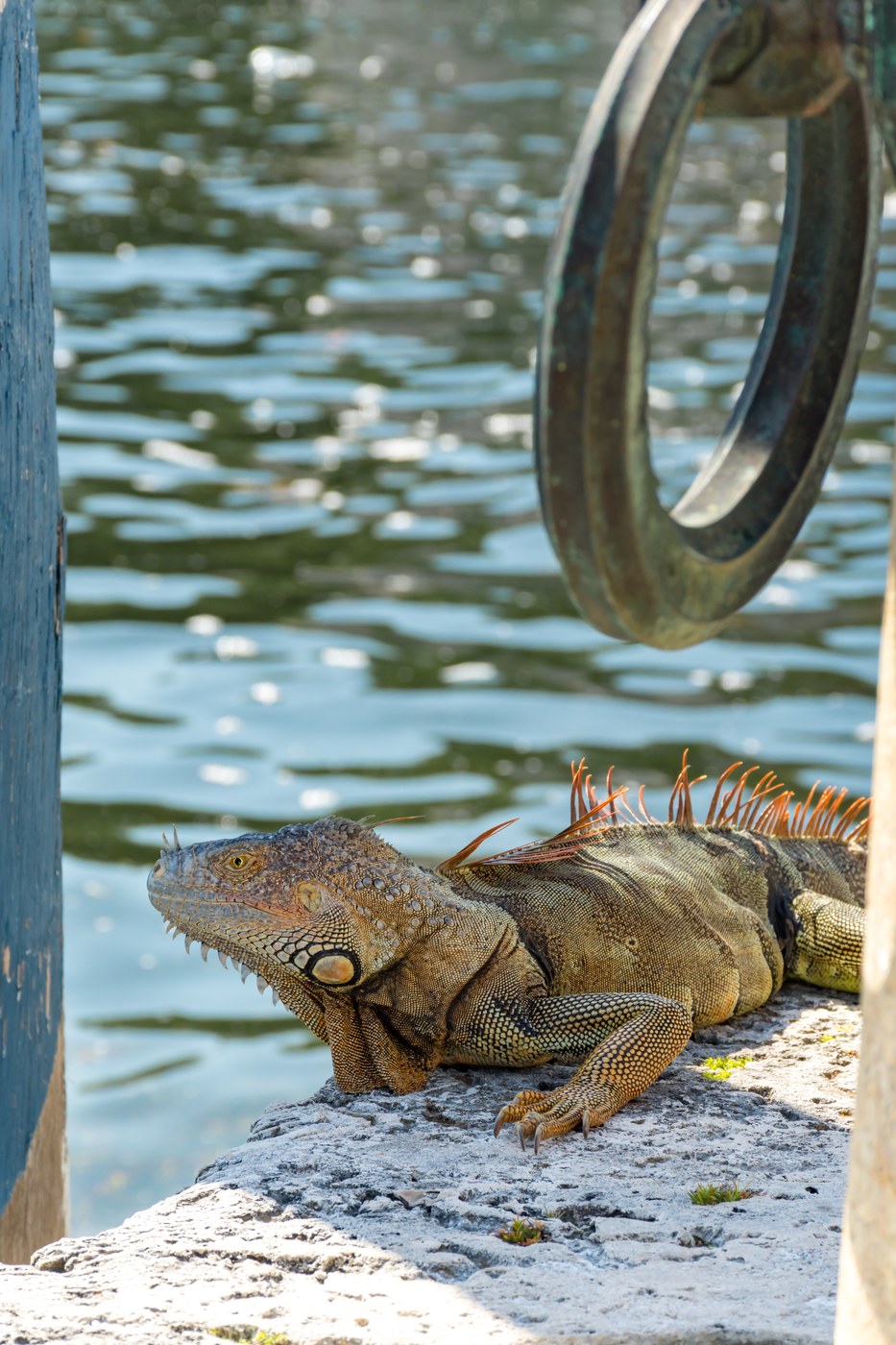
Seasonal Timeline
Green iguanas are active year-round in Florida and South Texas, with no true dormancy period, though cold snaps below about 40 degrees Fahrenheit cause them to go lethargic and stiff, a state known as cold-stunning, sometimes causing them to fall out of trees. Breeding and nesting follow a fall-to-winter window.
Green iguanas are active year-round in Florida and South Texas, with no true dormancy period, though cold snaps below about 40 degrees…
There is no off-season to plan around. A burrow started in spring gets just as much time to undermine a seawall in December as it does in June, because nothing about Florida's or South Texas's climate forces this animal into dormancy.
The one real seasonal event is cold weather, and it runs backward from what a homeowner might expect. A hard cold snap does not send iguanas away, it drops them, often literally, out of the trees they were basking in, cold-stunned and lethargic. They are not dead and they recover faster than they look like they should, so an animal found stiff on the ground in a cold snap still deserves the same caution as an active one.
Where They're Found
Green iguanas have two confirmed, established wild populations in the continental United States: an extensive one along Florida's coasts, and a smaller one in the Rio Grande Valley of South Texas. In Florida, populations stretch along the Atlantic coast through Broward, Martin, Miami-Dade, Monroe, and Palm Beach counties, and along the Gulf coast through Collier and Lee counties, with occasional sightings reported as far north as Alachua and Hillsborough. Wildlife officials consider those more northern sightings to be escaped or released pets rather than a true breeding front, since the species is not cold hardy enough to sustain a population outside the warmest coastal counties.
Within that range, iguanas favor the same infrastructure that makes South Florida's canal-and-seawall landscape distinctive: canal banks, drainage culverts, storm drains, rock piles, and seawalls, plus ordinary suburban landscaping, parks, and agricultural edges near water. They are strong swimmers, tolerant of both salt and fresh water, and can submerge for up to four hours.
A second, feral population of green iguanas is also established on Oahu and Maui in Hawaii. Florida's specific legal framework for humane removal does not carry over to Hawaii's own wildlife regulations, so the two populations are not the same regulatory situation.
Life Cycle
Sources disagree on the exact bounds of clutch size, with figures ranging from about 14 to as high as 76 eggs depending on the study. A broad range of roughly 20 to 70 eggs is more honest than any one precise number a single source happened to report.

Egg
Hatchling
Juvenile
Adult
Identification
Length and weight
Adult green iguanas can reach over five feet in length, with males topping 17 pounds and females usually staying under seven. Despite the name, most adults are not green. Color runs through dull green, olive, tan, gray, and near black, darkening in cool weather to absorb more heat from the sun, and breeding males can turn a striking orange or pink.
The dewlap and the dorsal spines
Both sexes carry a dewlap, a flap of skin hanging under the jaw, and a large, round scale at the rear of the jaw. A row of spike-like spines runs down the center of the neck, back, and upper tail. The tail itself is long and comparatively smooth, with faint dark banding, on top of short legs, long toes, and sharp climbing claws. The teeth are built for shearing plant material but can still deliver a painful bite.
Two spiny-tailed look-alikes
Two other invasive lizards in Florida, the black spiny-tailed iguana and the Mexican spiny-tailed iguana, are commonly mistaken for green iguanas, especially as juveniles when they can still show green coloring. The reliable field tell is the tail: a green iguana's tail is smooth, while a spiny-tail's tail is ringed with rows of pointed spiny scales its whole life. Spiny-tails also lack the green iguana's large, round jaw scale.
Signs of Infestation
Burrows in banks and foundations
Burrow entrances dug into canal banks, seawalls, levees, or building foundations, sometimes part of an extensive tunnel system nearly 80 feet long built for nesting or shelter.
Basking openly in daylight
Animals basking openly in daylight on seawalls, docks, rooftops, or pool decks, since green iguanas are active by day and rely on sun exposure to regulate body temperature.
Stripped ornamentals and fruit
Stripped or defoliated ornamental plants, orchids, garden vegetables, or dooryard fruit, since adults eat almost any flowering or fruiting plant except citrus.
Droppings at the basking spots
Droppings left on docks, boats, seawalls, porches, decks, pool platforms, or inside swimming pools, often at the same spots used for basking.
Prevention and When to Call a Pro
Avoid the plants they prefer
Avoid planting iguana-preferred ornamentals such as hibiscus, orchids, and roses close to structures, and protect vegetable gardens and fruit trees with physical barriers, since iguanas will eat nearly any fruiting or flowering plant except citrus.
Fill a confirmed empty burrow
Once a burrow is confirmed empty, fill it in, and remove brush, rock, or debris piles near seawalls and canal banks that offer cover or nesting sites. In chronically affected areas, an installed barrier along a seawall can reduce new burrow establishment.
Florida allows a direct response
Florida allows an unusually direct response to this species. Green iguanas are not protected in Florida beyond general anti-cruelty law, and the Florida Fish and Wildlife Conservation Commission's own species guidance confirms they can be humanely killed on private property, year-round, with landowner permission, without any state permit or hunting license. The state actively encourages landowners to remove iguanas from their own property. This does not mean there are no rules at all: capturing iguanas alive for transport, sale, or eradication-and-control purposes still requires a specific state permit, captured animals cannot be relocated and released elsewhere in Florida, and green iguanas were added to Florida's Prohibited species list in 2021, which affects live possession as a pet.
Report sightings to IveGot1
Sightings can be reported through Florida's IveGot1 hotline or app, which the state names as its preferred reporting channel for lower-priority nonnative species like iguanas. Reporting is offered as a resource for tracking distribution, not a required step before removal.
A cold-stunned iguana is not dead
If an iguana is found stiff or unresponsive during a cold snap, it is very likely cold-stunned rather than dead. Never bring a cold-stunned iguana indoors to warm it up; it can recover faster than expected and become defensive, with its teeth and claws fully intact.
Who to Call, and When
If burrow damage already affects a seawall, dock, foundation, or other structure, or if a homeowner is not able to safely and humanely capture or dispatch a large adult animal themselves, a licensed nuisance wildlife trapper or professional wildlife control operator is the appropriate next step rather than a DIY attempt. No published source gives a comparable state-specific law for South Texas, so homeowners there should confirm current local rules before acting rather than assume Florida's framework applies.
Frequently Asked Questions
Can I legally kill a green iguana on my property in Florida?
Yes. Florida does not protect green iguanas beyond general anti-cruelty law, so they can be humanely killed on private property year-round with landowner permission, without a state permit or hunting license.
Do green iguanas damage seawalls and foundations?
Yes. Their nesting and hiding burrows dug into canal banks, seawalls, and foundations are a documented cause of erosion and structural damage, including a nearly two million dollar dam repair in Palm Beach County linked in part to iguana burrowing.
Are green iguana droppings a health risk?
Like nearly all reptiles, iguanas can carry Salmonella bacteria in their droppings without appearing sick, which is why droppings around pools, docks, and porches should be cleaned up with basic hygiene precautions.
What should I do if I find a green iguana that fell out of a tree during cold weather?
It is very likely cold-stunned, not dead. These animals can recover quickly and become defensive, so they should never be brought indoors to warm up.
Do green iguanas eat garden plants?
Yes. Adults are almost entirely herbivorous and eat most ornamental flowers, fruit other than citrus, and vegetables, making landscape and garden damage one of the most common homeowner complaints.
Sources
- Green Iguana species profile: regulatory status, description, diet, burrowing/infrastructure damage, distribution by county, and cold-stunning behavior Florida Fish and Wildlife Conservation Commission (FWC)
- Dealing with Iguanas in the South Florida Landscape (ENY-714/IN528): identification, diet, damage to plants and infrastructure, droppings/salmonella caution, and bite/scratch/tail-strike risk University of Florida IFAS Extension
- Florida's Introduced Reptiles: Green Iguana (Iguana iguana) (WEC440/UW485): burrowing damage to water-containment infrastructure and the 2020 West Palm Beach dam repair cost University of Florida IFAS Extension
- FAQ confirming green iguana populations established in Hawaii, Florida, Texas, Puerto Rico, and the U.S. Virgin Islands U.S. Geological Survey
- State of knowledge for invasive green iguanas in Florida reveals negative impacts and pervasive research needs: burrow density, per-burrow repair cost estimate, and crop-loss reports Frontiers in Amphibian and Reptile Science (peer-reviewed)
- Report Sightings of Nonnative Species: IveGot1 hotline/app as the preferred reporting channel for iguanas Florida Fish and Wildlife Conservation Commission (FWC)
Image Credits
- Image: Adobe Stock, licensed.