Seasonal Timeline
Gray wolves are active year-round and do not hibernate. The one seasonal window that matters is the spring breeding-and-denning period, roughly January through April depending on latitude, when a pack's dominant pair mates, dens, and later whelps and rears pups, and when a den site (if found) should be left undisturbed.
Gray wolves are active year-round and do not hibernate. The one seasonal window that matters is the spring breeding-and-denning period…
Wolves are active in every season and show no long seasonal dormancy the way a denning bear does. The one window that changes anything practical is spring denning: a pack reuses or digs a den for whelping, pups are den-bound for roughly the first six to eight weeks of life, and this is the one period where a known den site should simply be left alone and reported to a state wildlife agency rather than approached.
Where They're Found
The map for this species only makes sense alongside the legal status section below, because in several regions the two are tied directly together. Alaska carries the largest and longest-established population, an estimated 7,000 to 11,200 wolves found through most of the state, never listed as threatened or endangered and managed by the state as both a big game animal and a furbearer.
Mountain West holds real, current, state-managed populations in Idaho, Montana, and Wyoming, all descended from the mid-1990s Yellowstone and central Idaho reintroduction and now federally delisted with regulated hunting seasons; Montana's 2025 estimate is 725 wolves and Wyoming's is 253. Colorado, in the same region, is a different story entirely: the state's own reintroduction program released its first wolves in December 2023 following a 2020 ballot initiative, and the roughly 32 wolves counted there as of March 2026 remain federally and state endangered under a special federal rule.
Midwest carries the largest population in the contiguous states outside the Mountain West. Minnesota's Department of Natural Resources estimated 2,911 wolves in 2023, Wisconsin's DNR estimated 1,226 wolves in 336 packs for winter 2024-25, and Michigan's Upper Peninsula held a minimum winter count of 792 in 2026. All three states' wolves are currently federally endangered, reinstated by a February 2022 federal court ruling, even though state agencies and the federal government's own past rulemaking agree the population has exceeded recovery goals for close to two decades.
Pacific Northwest splits within itself. Washington counted 270 wolves in 49 family groups and Oregon counted 230, both as of April 2026, but the eastern third of Washington and the eastern part of Oregon fall under the already-delisted, state-managed Northern Rocky Mountain population, while wolves in the western two-thirds of Washington and western Oregon are federally endangered under the same 2022 ruling that affected the Midwest.
California has a small, real, growing population, around 55 wolves as of May 2026, descended from wolves that dispersed south from Oregon, and it is both federally and state endangered.
Southwest is the most legally distinct of them all. Arizona and New Mexico host the Mexican wolf, a federally recognized subspecies reintroduced starting in 1998 under its own special federal rule, entirely separate from the Colorado program; the 2025 count was 142 in Arizona and 175 in New Mexico. Nevada and Utah, the other two states in this region, have no established wolf population found in any reliable source.
Regions not included, and why. No established, breeding gray wolf population was found in the Northeast, South Central, or Southeast. A 2009 petition to list a proposed Northeast population has never been formally decided, so there is no confirmed population there, listed or otherwise. The red wolf, a small reintroduced population of a genuinely separate species in eastern North Carolina, should not be confused with the gray wolf. Hawaii has no wild wolf population of any kind.
Life Cycle
One litter per breeding pair per year is the rule, since a mature female comes into estrus only once annually. Wolves generally live six to eight years in the wild, with starvation, conflict with rival packs, human conflict, disease, and vehicle collisions as the leading causes of death. A Yellowstone study found that sixty-five percent of collared wolves were ultimately killed by rival packs, a reminder that most of the pressure on a wolf's lifespan is other wolves, not people.

Breeding
Gestation
Pups
Juvenile growth
Dispersal
Identification
Size settles most misidentifications
Size is the fastest, most reliable identification tool, and it settles most misidentifications on its own. Adult gray wolves measure roughly 4.5 to 6.5 feet from nose to tail tip and stand 26 to 33 inches at the shoulder. Weight varies by region and sex: females typically run 60 to 100 pounds and males 70 to 145 pounds, with northern populations in Alaska running larger than southern ones.
Build follows size
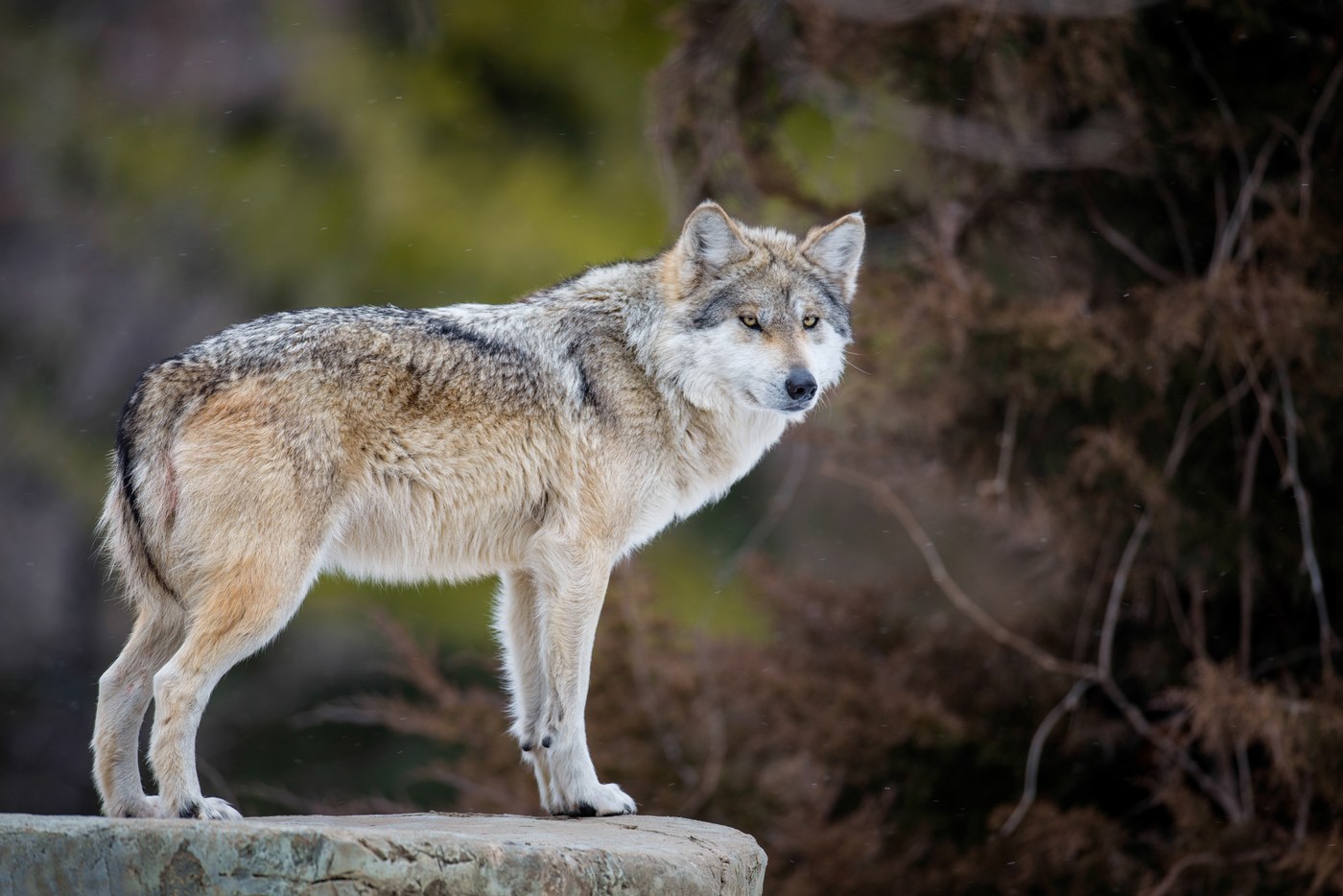
Build and features follow the same pattern as size. Wolves have a broad, blocky muzzle, small rounded ears relative to head size, long legs, and large, robust paws built for covering distance. The tail is long, often black-tipped, and carried straight out or raised during normal travel, not tucked.
Color is not a reliable identifier
Color is highly variable and not a reliable identifier on its own. Coats range through gray, black, white, brown, and tan, often with lighter facial markings and undersides. Northern populations show more color variation, including solid white and solid black animals, than southern ones do.
Coyote is the real-world confusion
Coyote (Canis latrans) is the species this animal is confused with in the real world, far more often than any other, and the tells are exact rather than a matter of impression. Coyotes stand about 16 to 22 inches at the shoulder and weigh 20 to 50 pounds, roughly half a wolf's shoulder height and a third to a half its weight. One state wildlife agency describes the gap as the difference between a golden retriever and a Saint Bernard.
Ears and muzzle run the other way
Build, ears, and muzzle run opposite the size difference and are worth checking together. Wolves have a broad chest, long legs, and large paws; coyotes have a narrower, more tapered body, shorter legs, and small, narrow paws. Coyotes have proportionally larger, more pointed ears and a narrower, more pointed muzzle, while wolves have smaller, rounder ears and a broader, blockier head and muzzle.
Tail carriage is the clearest tell
Tail carriage is the single clearest field tell, confirmed independently by more than one wildlife agency. A wolf carries its tail straight out or raised during travel. A coyote characteristically carries its tail low, often between the hind legs, especially while running.
Tracks confirm the same size gap
A wolf track runs about 4.5 to 5 inches long by 3.5 to 4 inches wide, roughly twice the size of a coyote's 2 to 2.5 inch track, with more pronounced, clearly visible toe pads from the larger paw. One state wildlife agency adds a real caveat worth repeating directly: wolves are genuinely rare across most of their range, and some large domestic dog breeds leave tracks as large as or larger than a wolf's, so a big canine track by itself is not confirmation without other supporting sign.
Signs of Infestation
This is not an infestation species
The signs below help confirm that a wolf, rather than a coyote or a dog, is responsible for observed sign or livestock loss. They are not about detecting a hidden household problem.
Track size
Tracks 4.5 to 5 inches long by 3.5 to 4 inches wide, showing a direct, evenly spaced, purposeful travel line rather than the meandering path typical of a domestic dog.
Scat diameter
Scat generally over an inch in diameter, often containing fur and bone fragments from prey.
Large-canid kill patterns
Livestock or wild-ungulate kills showing large-canid predation patterns, most useful when compared against a confirmed depredation report from a state wildlife agency or USDA Wildlife Services rather than judged alone.
Howling, and how far it carries
Howling, audible up to six or seven miles in good conditions, used as a social rally call, a hunting signal, and a territorial statement, along with growling and barking used mostly within the pack to reinforce social hierarchy.
Prevention and When to Call a Pro
The legal reality varies by state
Start with the legal reality, because it changes what is even possible to do, and it varies by exactly where you are standing. Gray wolf is never a do-it-yourself trapping, relocation, or lethal-control situation anywhere in its range. In Alaska, Idaho, Montana, and Wyoming it is a regulated big game or furbearer species taken only under a licensed state season. In Colorado, and separately in Arizona and New Mexico for the distinct Mexican wolf, it is federally protected under special rules that specifically restrict who may act and under what conditions. In the Great Lakes states, California, and western Washington and Oregon it is fully federally endangered with no special exception at all. Killing a federally endangered wolf outside an authorized action is a federal crime, and taking a wolf outside a licensed season in a delisted state is a state wildlife violation. Rules and current boundaries change, so verify your state's specific status before assuming anything, rather than relying on a single nationwide answer.
Livestock predation, honest scale
Livestock predation is the real, documented conflict this species causes, and it is worth stating the actual scale honestly. USDA data show gray wolves cause just over one percent of cattle and sheep losses nationally in the states where wolves live, with disease, weather, birthing complications, and theft causing more than ninety percent of unwanted livestock losses combined, roughly nine times the loss from all predators together. Where predation does happen it is real and often concentrated on a small number of chronically affected producers, so the response below is about proactive management, not panic.
Manage attractants before a loss
Manage attractants and vulnerable animals before wolves are active nearby, not after a loss. Night-pen vulnerable animals, give extra protection during calving and lambing and to newborn young, promptly remove carcasses and afterbirth since both draw predators generally, and monitor known wolf activity so herds can be moved away from an active corridor when possible.
Livestock guardian animals
This is a currently used method, not a folk remedy. Federal wildlife agencies actively place livestock guardian dogs with ranchers specifically to protect against wolf predation, alongside black bears, mountain lions, and coyotes, and guardian dogs, llamas, and donkeys are used more broadly across wolf country. Effectiveness depends on breed, training, the number of animals deployed, and whether the livestock are sheep, which flock and are easier to guard, or free-ranging cattle, which are a genuinely harder case.
Layer the fencing and deterrents
Fencing and physical deterrents work best layered together, not used alone. Electrified fladry, flagged rope lines that exploit a wolf's aversion to bright colors and motion, is most effective for smaller, high-risk areas like lambing grounds and night corrals, and works best as a temporary measure since wolves habituate to a static deterrent over time. Permanent, buried-apron woven-wire perimeter fencing has also been funded for producers with significant documented, repeated losses.
Range riders and human presence
Range riders and active human presence are a documented, funded tool, not a niche practice. Riders patrol livestock areas during the hours wolves are most active, dawn, dusk, and night, and actively haze wolves away from livestock when found. Combining several deterrents, fladry with range riding and guardian dogs, or acoustic tools with lighting, is consistently recommended over relying on any single method, since a wolf that learns a deterrent carries no real consequence will eventually test it again.
Federal funding exists
It exists specifically for this conflict, and producers should know about it rather than being told only to manage the risk themselves. A federal grant program funds both proactive non-lethal measures, fencing, guard dogs, and range riders, and compensation for confirmed depredation losses, administered through states and tribes.
Call the state, not a trapper
For repeated or ongoing livestock predation, the correct first call is the state wildlife agency or USDA Wildlife Services, not a private trapper. These are the agencies that verify a depredation, can authorize or carry out lethal control within the bounds of whatever rule applies in your state, and administer loss-compensation programs.
Call for a sighting or a sick wolf
For a sighting, a suspected sick or injured wolf, an animal showing unusual boldness around people or pets, or uncertainty over whether you saw a wolf, a coyote, or a wolf-dog hybrid, call the state wildlife agency, or for the Mexican wolf program specifically, the interagency Mexican Wolf Recovery field team. Never approach, feed, or attempt to handle a wolf. Direct human-safety risk from wild wolves is genuinely, verifiably low, documented at essentially zero recorded North American deaths from non-rabid wild wolves across most of the twentieth century, but a habituated or food-conditioned animal is both a safety concern and a sign trained wildlife staff should evaluate, not a homeowner.
Frequently Asked Questions
Are gray wolves endangered?
It depends entirely on where. Wolves are federally delisted and state-managed with regulated hunting in Alaska (never listed at all) and in Idaho, Montana, and Wyoming. They are fully federally endangered in the Great Lakes states, California, and the western two-thirds of Washington and Oregon. And they are managed under special, more restrictive federal rules as reintroduced populations in Colorado, and separately as the distinct Mexican wolf subspecies in Arizona and New Mexico.
How can I tell a wolf from a coyote?
Size and tail carriage are the fastest tells. Wolves stand about 26 to 33 inches at the shoulder and weigh 70 to 145 pounds with a straight-out or raised tail during travel, while coyotes stand 16 to 22 inches, weigh 20 to 50 pounds, and carry their tail low, often between the legs. Wolf tracks also run about twice the size of a coyote's.
Are wolves dangerous to people?
The documented risk is very low. A hundred-year study of Alaska and Canada, where over 60,000 wolves live, found zero recorded human deaths from wild, healthy wolves. A more recent global review found only two fatal North American wolf attacks between 2002 and 2020, both involving unusual circumstances, against tens of thousands of wolves sharing the landscape with hundreds of millions of people.
Do wolves attack livestock?
Yes, but at a much smaller scale than commonly assumed. USDA data show gray wolves cause just over one percent of cattle and sheep losses nationally in the states where wolves live, versus more than ninety percent from disease, weather, birthing problems, and theft combined. Where losses do happen they are real for the affected producer and often concentrated on a small number of chronically affected operations.
Why are there wolves in Colorado and Arizona now if they were gone for decades?
Both are the result of deliberate reintroduction programs, not natural recolonization. Colorado's began in December 2023 following a 2020 voter-approved ballot initiative. The Mexican wolf program in Arizona and New Mexico began in 1998 and manages a genetically distinct subspecies. Both operate under special federal rules that give wildlife agencies more management flexibility than a standard endangered listing allows, but neither one makes the animal open to private trapping or removal.
Sources
- Wolf identification: size, weight, and physical comparison to coyotes Washington Department of Fish and Wildlife
- 4 Quick Ways to Tell A Wolf from a Coyote Iowa Department of Natural Resources
- Was that a wolf? Physical and behavioral comparison table International Wolf Center
- Wolf pup development: stage-by-stage physical and social timeline International Wolf Center
- Wolf FAQs: breeding season, gestation, litter size, and pack size International Wolf Center
- Species Profile for Gray wolf (Canis lupus): listing history and current status by Distinct Population Segment U.S. Fish and Wildlife Service, ECOS
- Are wolves dangerous to humans? 2002-2020 global attack data International Wolf Center
- Wolves and Human Safety: hundred-year Alaska and Canada bite study, Yellowstone attack record Colorado State University Extension
- Wolves and Livestock: USDA and USFWS predation data comparison, guardian dog and fencing detail Colorado State University Extension
- Livestock predation by gray wolves nearly nil: analysis of USDA livestock loss data Humane World for Animals
- Wolf Ecology: pack size, social structure, and diet in Yellowstone National Park National Park Service
- Alaska wolf population, legal status, and harvest figures International Wolf Center
- How many wild wolves are in the United States? State-by-state population and status figures Wolf Conservation Center
- USFWS finalizes designation of gray wolf experimental population in Colorado U.S. Fish and Wildlife Service
- Conserving the Mexican Wolf: reintroduction history and experimental population area U.S. Fish and Wildlife Service
- DNR estimates Wisconsin had 1,226 wolves, 336 packs in winter 2024-25 Wisconsin Department of Natural Resources, via Milwaukee Journal Sentinel
- Washington Gray Wolf Conservation and Management 2025 Annual Report: federal listing history and 2022 court ruling Washington Department of Fish and Wildlife
- Wildlife Services' Nonlethal Initiative: guardian dog placement and fencing projects USDA APHIS Wildlife Services
Image Credits
- Image: Adobe Stock, licensed.