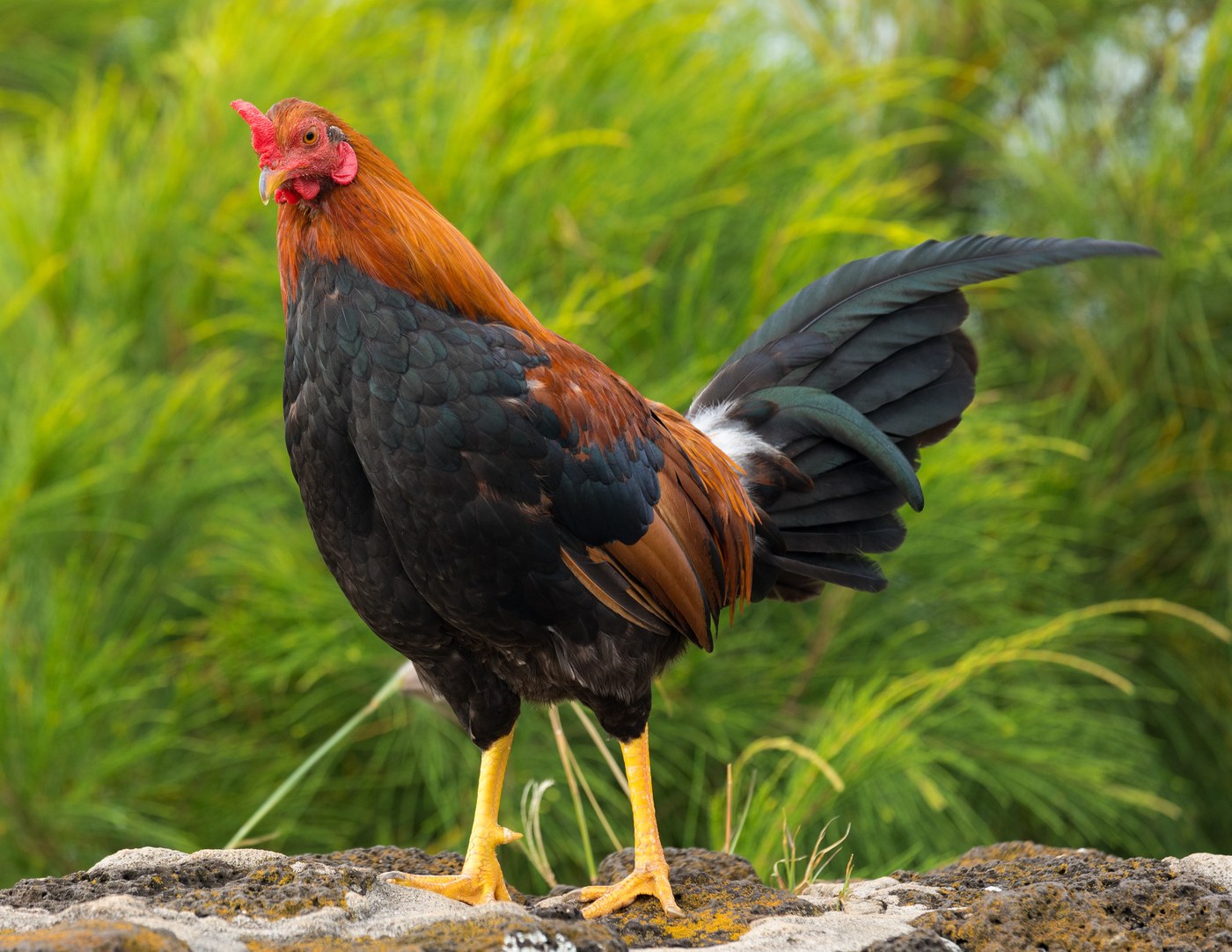
Seasonal Timeline
There is no season. Hawaii's warm climate and steady food supply let this population breed essentially year-round, which is a documented behavioral difference from wild Red Junglefowl in their native Asian range, where breeding is seasonal. What varies is the time of day, not the time of year: foraging concentrates in early morning and late afternoon, and roosters crow at any hour, including well before sunrise.
Two conditions keep this cycle running without a pause. The first is climate: warm year-round weather with no winter die-off pressure. The second is the absence of a natural predator on Kauai specifically. Because the birds breed continuously, a flock on a property is not a seasonal visitor that leaves on its own, and a garden that gets scratched up in March gets scratched up again in November.
Where They're Found
The Hawaii population is verified, not assumed. Small free-roaming chicken pockets exist here and there on the mainland, but Hawaii is the only place in the United States with a large, well documented, self-sustaining breeding population descended from a real, dated release event. Populations are confirmed on Kauai, Oahu, Maui, and the Big Island, which makes this a statewide species rather than a Kauai curiosity, although Kauai's density is by a wide margin the highest.
Kauai's story starts with two hurricanes. Hurricane Iwa in 1982 and, far more destructively, Hurricane Iniki in 1992 tore apart backyard chicken coops across the island and released large numbers of domestic birds, which then interbred with the Red Junglefowl already living there. A peer-reviewed genetic study of the resulting population confirmed what that history predicts: these are genuinely admixed birds, neither pure Red Junglefowl nor pure domestic stock.
The reason Kauai's population outran every other island is a mammal that never got there. The small Indian mongoose was imported to Hawaii from Jamaica in 1883 to control rats in the cane fields, and it became established on Oahu, Maui, Molokai, and the Big Island. It never established on Kauai. Mongooses are effective predators of ground-nesting birds' eggs and chicks, so on the other islands there is something eating the next generation and on Kauai there is not. Flocks on the other islands are patchier and less dense as a result, though they are still real: Honolulu has trapped and removed close to 2,000 birds since 2022, and birds are reported in the Haleakala foothills on Maui and in the Puna and Kona districts on the Big Island. The clearest confirmation that this is a four-county problem rather than a Kauai story is the state's own 2024 appropriations record, which granted 50,000 dollars each to the City and County of Honolulu, the County of Hawaii, the County of Maui, and the County of Kauai for the implementation of a feral chicken control program in each respective county.
Habitat is wherever people are, which is the practical problem. These birds are habituated. They forage on beaches, hiking trails, public parks, golf courses, grocery store and big box parking lots, airport grounds, and residential yards and gardens, as well as in the forest edge and brush that would be ancestral Red Junglefowl habitat. They do not nest or den inside structures. At night they roost off the ground, in trees or on other elevated sheltered perches, out of reach of ground predators.
Alaska has no population, and that is a documented absence rather than a gap. No source places any feral or wild population of this species in Alaska, and a tropical-origin bird with no cold-hardiness adaptation has no documented mechanism for surviving an Alaska winter outdoors.
Life Cycle
The population's success comes down to three things stacking on each other. Year-round breeding instead of the seasonal breeding of wild Red Junglefowl, a retained natural brooding instinct that most modern production chickens have lost, and, on Kauai, no mongoose eating the eggs and chicks. Take away any one of those and the numbers look different. That is also why a property level response is realistic and a neighborhood level one is not. You can make your own yard unattractive. You are not going to reduce the island's population by doing it.
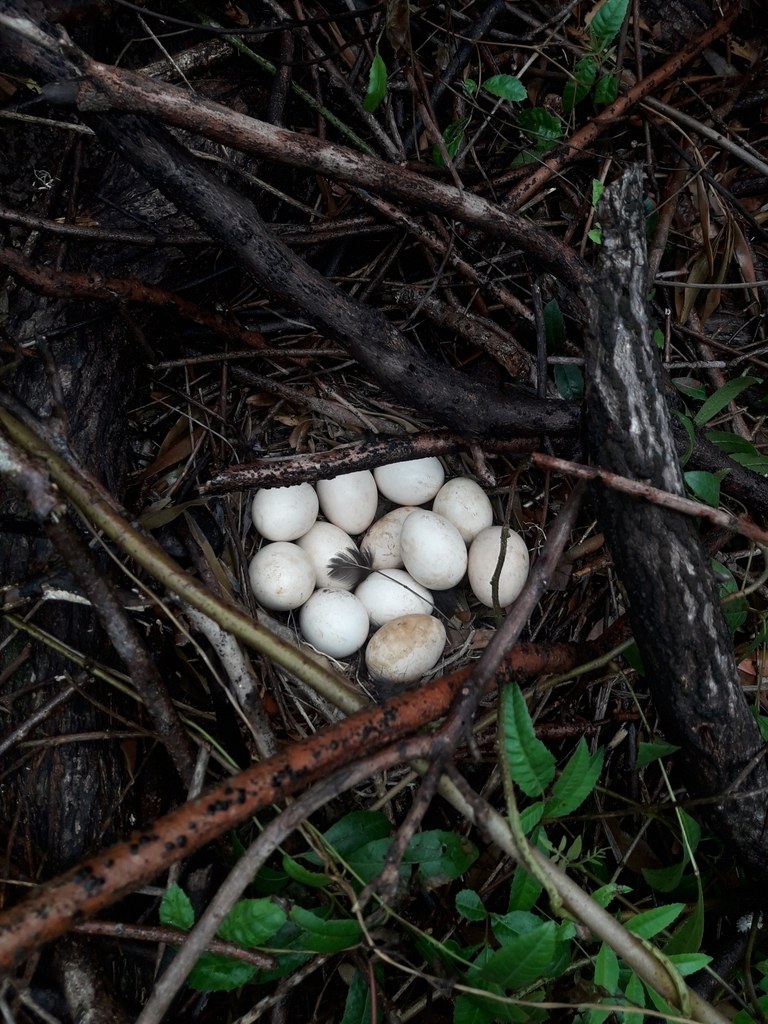
Egg2
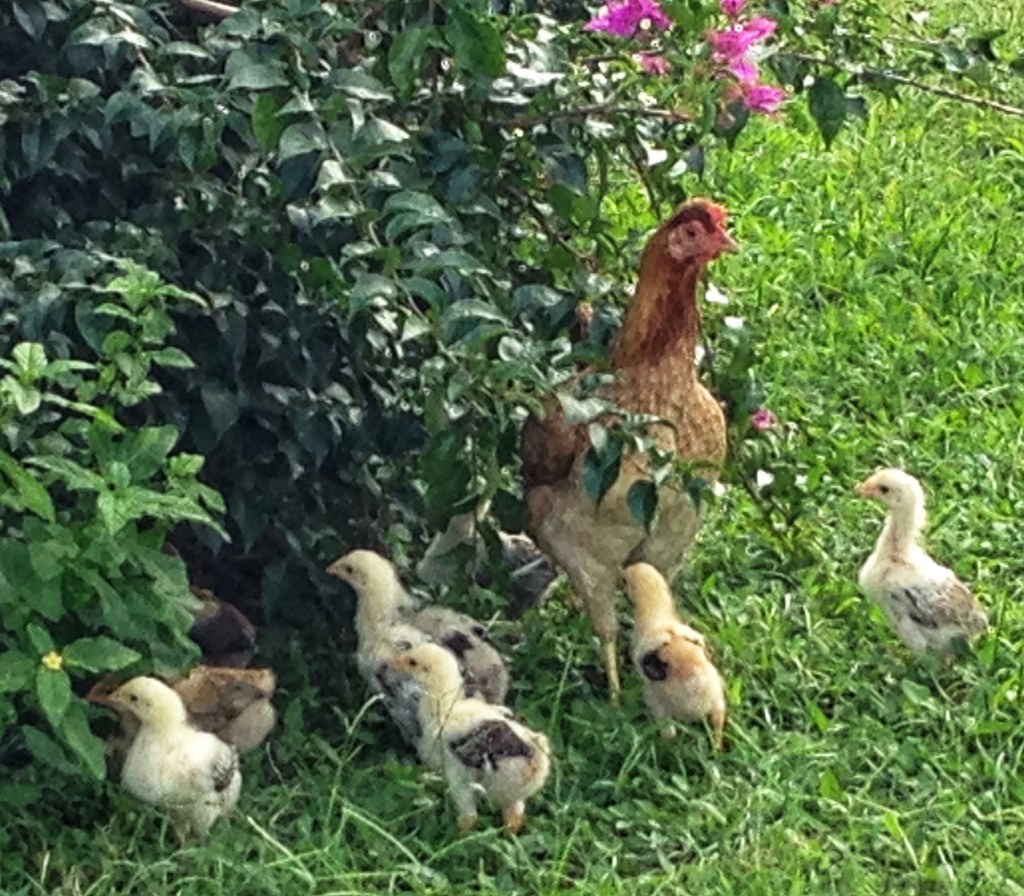
Chick3

Juvenile
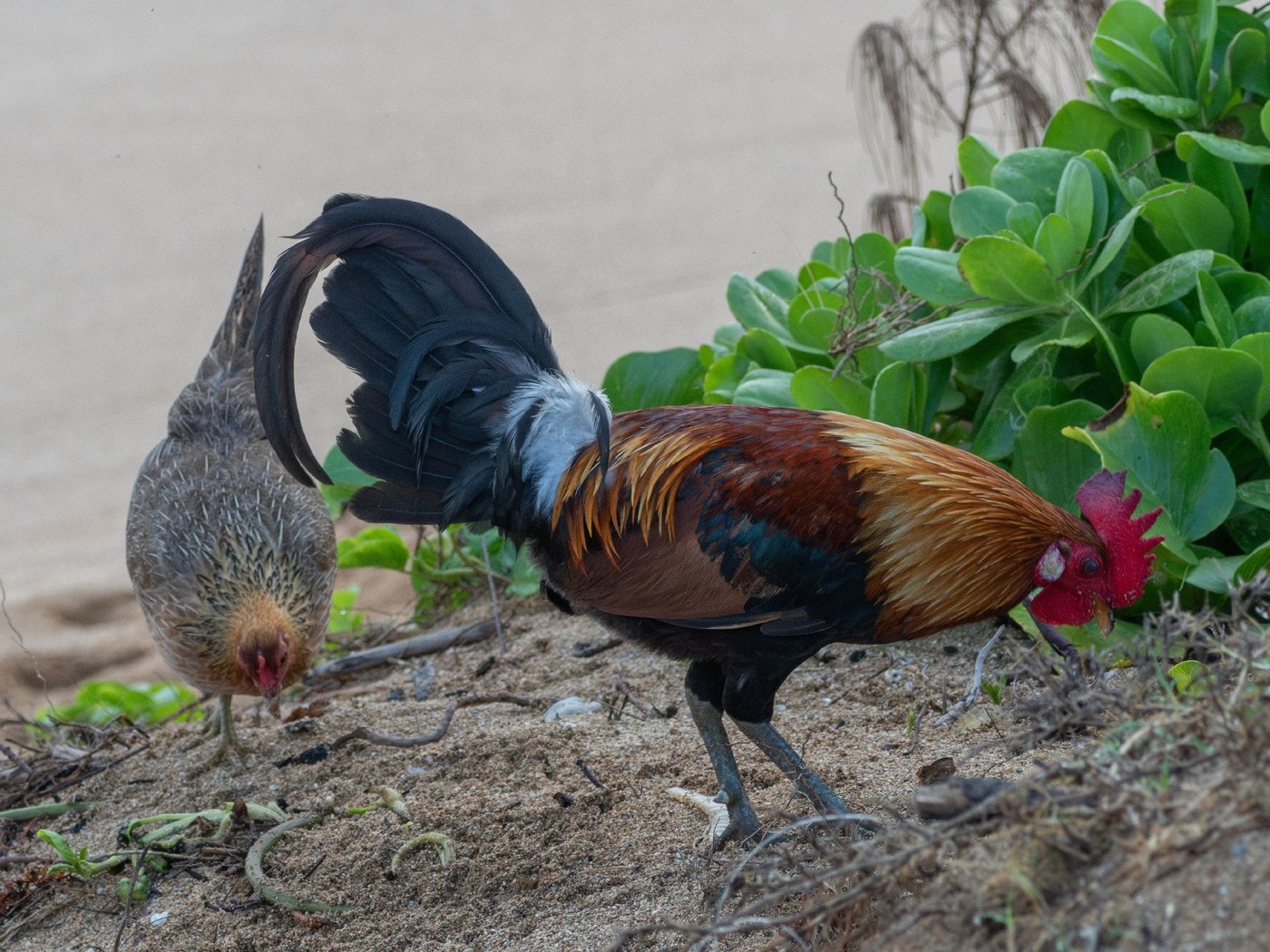
Adult4
Identification
Comb and wattles are the fastest tell
A fleshy red comb on top of the head and red wattles under the bill separate a chicken from every other ground foraging bird you are likely to see in a Hawaii yard.
Males and females are easy to split
Roosters have the comb and wattles, spurred legs, and the tall arching tail. Hens are smaller, mottled brown with light streaking, and lack the tail sweep.
Red Junglefowl type males
Classic Red Junglefowl type males show golden-orange to bronze neck hackles running down the back with an iridescent blue-green tail, but do not expect that bird specifically. Ongoing interbreeding with escaped domestic stock means real birds run across the full range of domestic chicken color and patterning.
Plumage will not tell you feral
Plumage alone will not tell you feral from loose backyard bird, and Cornell Lab's own guide says as much: many of these birds cannot be reliably separated from ordinary free-ranging domestic chickens by sight. The practical tell is behavioral and locational. Unowned birds roaming in flocks through parks, beaches, parking lots, and brush are the feral population. Feral and free-roaming domestic birds also interbreed on the same island, so the line is genuinely blurry.
Size is variable, not diagnostic
Red Junglefowl ancestry runs smaller and slimmer than most domestic breeds, and the Kauai population spans a wider size range than either ancestral group.
Two francolins mistaken for hens
Two introduced francolins get mistaken for hens, especially by visitors. Gray Francolin, a smaller brown bird of open grassy areas introduced in 1958, and Erckel's Francolin, a larger brown-mottled bird introduced in 1957, are both in the same family as chickens. The tell: francolins have no fleshy red comb or wattles, carry a rounder and more hunched body profile, and will run for cover rather than stroll among people the way a habituated feral chicken does.
Signs of Infestation
Birds that keep coming back
A flock roaming the same property repeatedly, rather than a one-time bird passing through, is the baseline sign. Flocks typically run one to a few roosters with several hens.
Torn-up garden beds, turf, and mulch
The damage comes from the foraging method itself. These birds scratch and peck through soil for insects and seeds, and they do it indiscriminately across planted vegetable beds, ornamental plantings, and lawn.
Crowing at any hour
That includes well before sunrise. This is the single most reported complaint, and it is documented independently by the City and County of Honolulu and by Hawaii's own 2024 legislative finding, which notes crowing at all times of the day and night leading to numerous noise complaints by residents statewide.
Droppings on walkways and patios
Droppings accumulating on walkways, patios, and around structures, which is where the sanitation complaint comes from. Both Honolulu and the state legislative finding describe concentrated droppings as unsanitary and a health concern. Neither names a specific pathogen for that general claim.
Odor where a flock concentrates
It comes from the droppings.
Nests low and hidden
Not in your structure. Look for a shallow scrape under dense brush, in bamboo, or in a sheltered corner at ground level. There is no attic occupancy, no gnawing, and no tunneling to look for, because these birds do not go inside buildings.
Birds roosting in trees at dusk
Feral chickens go up off the ground at night, so a tree near the house filling with birds each evening is a roost, not a passing flock.
Prevention and When to Call a Pro
Stop feeding them
Get the neighbors to stop too. State and city agencies name human feeding as a direct driver of population growth. Hawaii's Act 185 of 2024 specifically directs public education focused on not making the problem worse by feeding the chickens, and the City and County of Honolulu tells residents plainly that they can help manage the nuisance by not feeding feral chickens. This is the one step with the broadest documented effect and it costs nothing.
Cut off the accidental food
Pet food left outdoors, unsecured trash and food waste, and open compost all feed a flock just as effectively as deliberate feeding. These are opportunistic omnivores that forage human refuse alongside natural insect and seed forage.
Fence the garden at the bottom
Fence the garden, and pay attention to the bottom edge. Chicken wire or similar mesh that keeps a ground foraging bird out will protect vegetable beds and ornamental plantings from scratching damage. Bury or pin the base so birds cannot simply walk under it. This is the standard approach for any ground foraging bird nuisance.
Trim back the roosting cover
Trim back roosting and nesting cover close to the house. Because these birds roost in trees and nest in ground level brush and clumped vegetation, keeping dense shrubs and low brush cut back from the immediate perimeter makes that specific spot less appealing as a roost or nest site. Be realistic about what this buys you: it changes your yard, not the neighborhood's bird population.
Do not handle the birds
Keep children away from them too. The CDC's own backyard poultry guidance states that these birds can carry Salmonella germs even when they look healthy and clean, and it tells people to wash their hands after any contact with the birds or their environment, to keep the birds away from the face, and not to handle droppings barehanded. Public health reporting on the CDC-investigated multistate outbreaks tied to backyard and live poultry adds that children under 5 are especially vulnerable. That is a general risk that comes with the species anywhere, not a claim that Hawaii's feral flocks have been tied to a named outbreak. It is still the reason feeding by hand, petting, and catching birds barehanded are all bad ideas.
Report sick or dead birds
Leave sick or dead birds alone and report them. USDA APHIS confirmed highly pathogenic avian influenza in a non-commercial backyard flock in Honolulu County in November 2024, the first detection in domestic birds in the state during the outbreak that began in February 2022, and Hawaii's Department of Agriculture and Biosecurity runs active statewide avian influenza monitoring while stating that the general public health risk remains very low. Nothing in that establishes feral chickens as known carriers. It does establish why nobody should be picking up a sick or dead bird barehanded.
Not federally protected
On the legal side, start with what is settled: these birds are not federally protected. The U.S. Fish and Wildlife Service's own published list of bird species to which the Migratory Bird Treaty Act does not apply exempts families not named in the Canada, Mexico, and Russia Conventions, and it names Phasianidae directly in that exempt list. Chickens sit squarely in Phasianidae. That is a direct reading of the published federal list, not an inference from the family name.
State law is unsettled
State law is a genuinely unsettled picture, and it is worth saying so rather than picking a side. Hawaii passed Act 185 in 2024, directing the state Department of Agriculture and Biosecurity to work with each county on control programs and public education, with counties required to provide full matching funds. As of a June 2025 status report the law remained unfunded at the state level, so the official mechanism it describes is not actually operating. A separate 2025 bill written to clarify that killing feral chickens is legal under specific conditions, on private land, with landowner permission, using methods consistent with humane euthanasia guidelines and still prohibiting animal fighting, torture, starvation, and beating, had not become law. What that adds up to: the birds carry little protection, the state treats them as a manageable nuisance rather than a protected species, and the legislature has not yet settled exactly what a private individual may do to remove one. Animal cruelty law applies to whatever method anyone uses in the meantime.
Use the county program
Where a county program exists, use it instead of improvising. On Oahu, the City and County of Honolulu has contracted a private pest control company for a cage and disposal service and subsidizes part of the cost for private property owners, with nuisances reported through the city's 311 system or the non-emergency police line depending on who owns the property. That is the clearest legal removal path documented as currently operating. No equivalent program is documented for Maui, Kauai, or Hawaii County, so check locally rather than assuming one exists.
Who to Call, and When
A flock large enough that yard level measures are not holding, repeated garden or crop damage, or any situation where you are considering removal and there is no county program to hand it to. Rules here vary by county and are actively changing, and Hawaii's animal cruelty statutes still constrain acceptable methods even though the species itself carries little protection. A licensed nuisance wildlife or pest control operator who knows the local ordinances is the safer default over a do-it-yourself trap.
Frequently Asked Questions
Why does Kauai have so many wild chickens?
Hurricanes Iwa in 1982 and Iniki in 1992 destroyed large numbers of backyard chicken coops and released domestic birds, which interbred with the Red Junglefowl already on the island. Two things then let the hybrid population grow essentially unchecked. Kauai is the only main Hawaiian island with no established mongoose population, so nothing is preying on eggs and chicks the way it does on Oahu, Maui, Molokai, and the Big Island. And the climate supports breeding year-round instead of seasonally.
Are feral chickens in Hawaii protected by law?
No. They are not covered by the federal Migratory Bird Treaty Act. The U.S. Fish and Wildlife Service's published list of species the Act does not apply to names the family Phasianidae, which is the family chickens belong to. State law treats them as a manageable nuisance rather than a protected species. That said, it is not a free-for-all: Hawaii's Act 185 of 2024 set up a state and county control framework that remains unfunded, a 2025 bill written to spell out when killing a feral chicken is legal did not become law, and animal cruelty statutes still govern how any removal is carried out. Rules vary by county and are actively changing, so verify locally.
Do feral chickens cause real damage, or are they just noisy?
Both. Hawaii's 2024 legislative finding states directly that feral chickens and roosters dig up plants and damage food crops in yards and gardens, and that they jeopardize native plants and resources. The noise is real too and is documented as a top complaint category: roosters crow at all hours, including well before dawn, and the City and County of Honolulu says feral chicken nuisances are among its top sources of complaints. Add droppings accumulating where flocks concentrate, which both the city and the state describe as unsanitary.
Do feral chickens help with anything, or are they only a nuisance?
They genuinely help with something. As part of normal omnivorous foraging they eat Hawaii's venomous centipedes along with other garden insects, and residents call that benefit out specifically even while complaining about the crowing and the torn-up flower beds. The same scratching and pecking that finds those centipedes is also what tears up the flower beds, so it is one behavior producing both outcomes rather than two separate things to weigh.
Can you eat Kauai's wild chickens?
Some residents do hunt and eat feral chickens and their eggs, and it is one of the informal population control approaches Hawaii has tried. It has not meaningfully reduced the overall population, given how fast the birds breed. Handling raw poultry of any kind carries the standard Salmonella precautions, and the legal question of what a private individual may do to take one of these birds is exactly the point the state legislature has not settled, so this is not something to improvise your way into.
Who do I call about a feral chicken problem?
On Oahu, the City and County of Honolulu contracts a private pest control company for a cage and disposal service and subsidizes part of the cost for private property owners, with nuisances reported through the city's 311 system or the non-emergency police line depending on who owns the property. That is the clearest removal channel documented as currently operating. Hawaii's 2024 appropriations record funded a feral chicken control program in all four counties, so it is worth checking what your own county runs, though no equivalent service is documented for Maui, Kauai, or Hawaii County. Note the framing across all of it: the state's approach is population management for a long established species, not the rapid eradication response Hawaii applies to newly arriving invasive pests.
Sources
- List of Bird Species To Which the Migratory Bird Treaty Act Does Not Apply, 85 FR 21262, naming the family Phasianidae among exempt families U.S. Fish and Wildlife Service, via the Federal Register
- Red Junglefowl life history and identification: plumage, size, diet, nesting, clutch size, roosting, and daily activity Cornell Lab of Ornithology, All About Birds
- Red Junglefowl, Gallus gallus: taxonomy, order Galliformes and family Phasianidae Cornell Lab of Ornithology, Birds of the World
- Erckel's Spurfowl, Pternistis erckelii: behavior and habitat, used to separate francolins from feral hens in the field Cornell Lab of Ornithology, Birds of the World
- Population structure and hybridisation in a population of Hawaiian feral chickens, and the 2015 Molecular Ecology study of mixed ancestry and admixture in Kauai's feral chickens Heredity, peer-reviewed, via Nature
- The Attainment of Sexual Maturity in the Hawaiian Jungle Fowl The Elepaio, Journal of the Hawaii Audubon Society
- Feral Chickens: nuisance complaints, crowing and sanitation concerns, the do-not-feed instruction, and the city contracted trap and removal service Department of Customer Services, City and County of Honolulu
- Bills Passed by the Hawaii State Legislature, Regular Session 2024: Act 185, originally Senate Bill 2401, on feral chicken control programs and public education, and House Bill 2619 CD1, appropriating feral chicken control funds to all four counties Hawaii Legislative Reference Bureau
- Mongoose: confirmation that no established mongoose population exists on Kauai, unlike the other main Hawaiian islands Kauai Invasive Species Committee
- USDA Confirms Highly Pathogenic Avian Influenza in a Backyard Non-Poultry Flock in Hawaii, November 2024 U.S. Department of Agriculture, Animal and Plant Health Inspection Service
- Avian influenza information portal for Hawaii: statewide monitoring status and the current public health risk assessment, maintained as a live site rather than a dated document Hawaii Department of Agriculture and Biosecurity
- Backyard Poultry, Healthy Pets Healthy People: Salmonella carriage in healthy-looking birds, handwashing after contact, keeping birds away from the face, and not handling droppings barehanded Centers for Disease Control and Prevention
- CDC confirms new Salmonella outbreak linked to backyard poultry, including the elevated risk to children under 5 Center for Infectious Disease Research and Policy, University of Minnesota
- Incubation duration periods: the standard 21-day incubation period for chicken eggs Mississippi State University Extension Service
Image Credits
- Image: Frank Schulenburg via Wikimedia Commons. CC BY-SA 4.0. Resized, so this version is offered under the same license.
License. - Image: naturewatchwidow via iNaturalist. CC BY 4.0.
License. - Image: photographer not named via iNaturalist. CC0 1.0.
License. - Image: Eugene Eric Kim via GBIF. CC0 1.0.
License.