Seasonal Timeline
DeKay's brownsnakes are most active from spring through fall, shifting from daytime activity in the cooler spring and fall months to nocturnal activity during the hottest weeks of summer, and spend the cold season underground or beneath deep cover.
DeKay's brownsnakes are most active from spring through fall, shifting from daytime activity in the cooler spring and fall months to…
This species runs on a straightforward spring-mating, late-summer-birth calendar. Mating occurs in spring, generally late March through May. There is no egg stage: young develop inside the female for roughly 105 to 113 days before live birth, which follows most commonly from early July into September, with many litters recorded in late July and August.
Activity itself follows a documented seasonal shift rather than one fixed pattern. State wildlife agencies in Massachusetts and Illinois both describe this species as active during the day in spring and fall, then shifting to nocturnal activity during the hottest weeks of summer. Outside of the active season it retreats underground or beneath deep cover and is not seen again until temperatures warm.
Where They're Found
The range runs through four regions: Northeast, Midwest, South Central, and Southeast. State wildlife agencies confirm established, often common populations across all four. In the Northeast, Maine, New Hampshire, Massachusetts, and Connecticut all describe the species as common, widespread, and well adapted to developed and suburban habitat within their states.
In the Midwest, Missouri, Illinois, Wisconsin, and Kentucky all confirm established populations, and Illinois specifically notes the species may be found statewide. In the South Central region, the Oklahoma Department of Wildlife Conservation confirms the species occurs throughout most of the state except the panhandle and southwest corner, and describes the wider brownsnake complex's range as running from central-west Texas east through the entire eastern United States. Tennessee's own wildlife agency confirms two interbreeding forms occur across that state.
In the Southeast, the University of Georgia's Savannah River Ecology Laboratory confirms the species throughout the eastern United States, including Georgia and the Florida panhandle, where it is eventually replaced by the separate Florida brownsnake toward the southern tip of the Florida peninsula. The Florida Museum of Natural History independently confirms the Florida panhandle population.
The Southwest, Mountain West, Pacific Northwest, and California all sit outside the range. Published distribution accounts, including the U.S. Fish and Wildlife Service's own species profile, describe the documented range as bounded by the Great Plains and Rocky Mountains to the west. Alaska and Hawaii are outside it too: no source places this species in either state, the entire range sits in the eastern half of the continental United States plus adjoining southern Canada and Mexico, and Hawaii has no established wild snake population of any kind.
Life Cycle
Total wild lifespan is an open question. No state wildlife agency or university publication gives a settled wild-lifespan figure. A university-hosted academic reference notes a single captive individual reached 7 years, but that is a captive data point, not a wild-population finding, so the wild figure stays unestablished rather than filled in with an unsourced number.

Mating
Gestation
Birth
Juvenile2
Adult3
Identification
Size and the faint spotted stripe
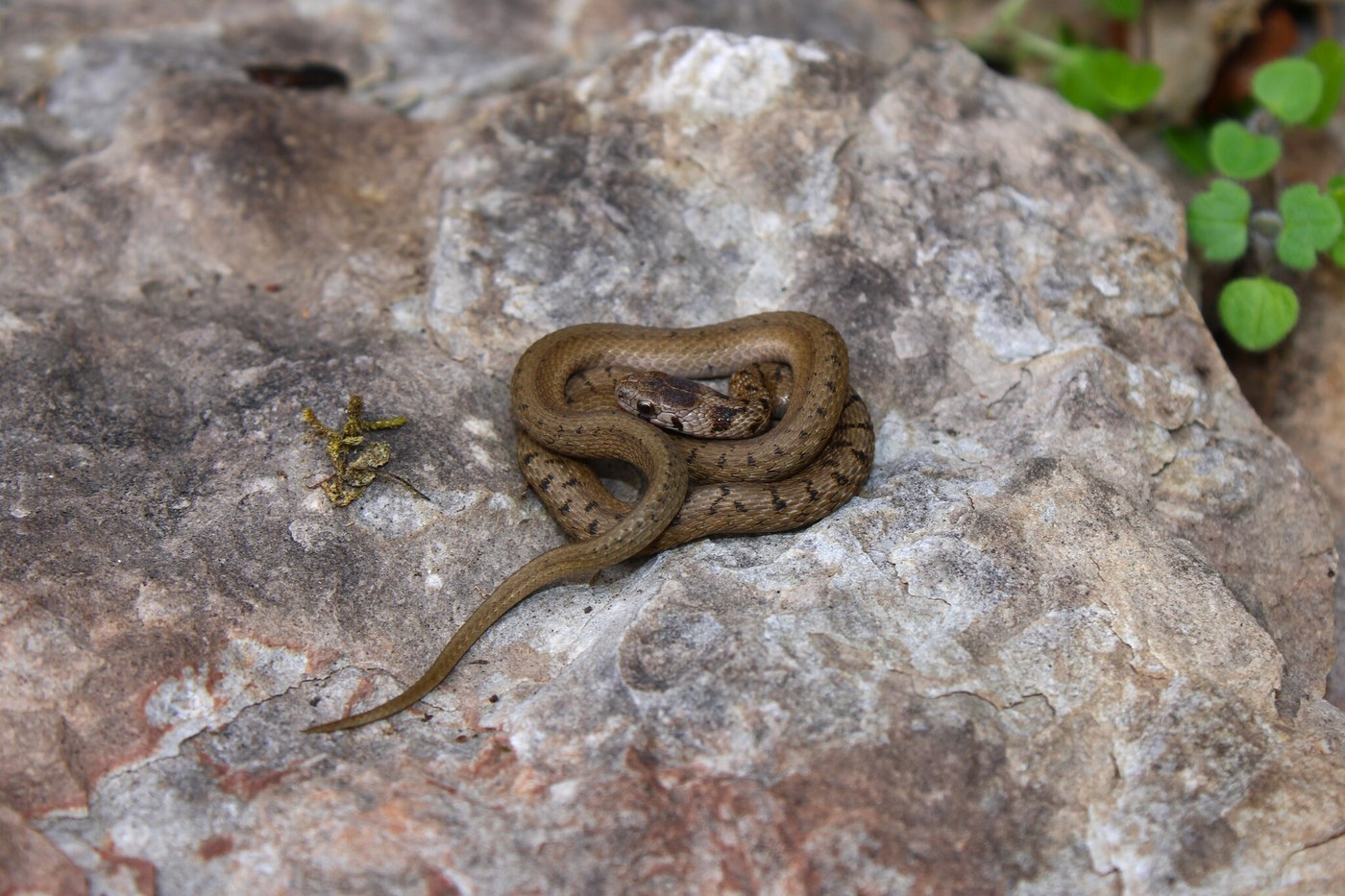
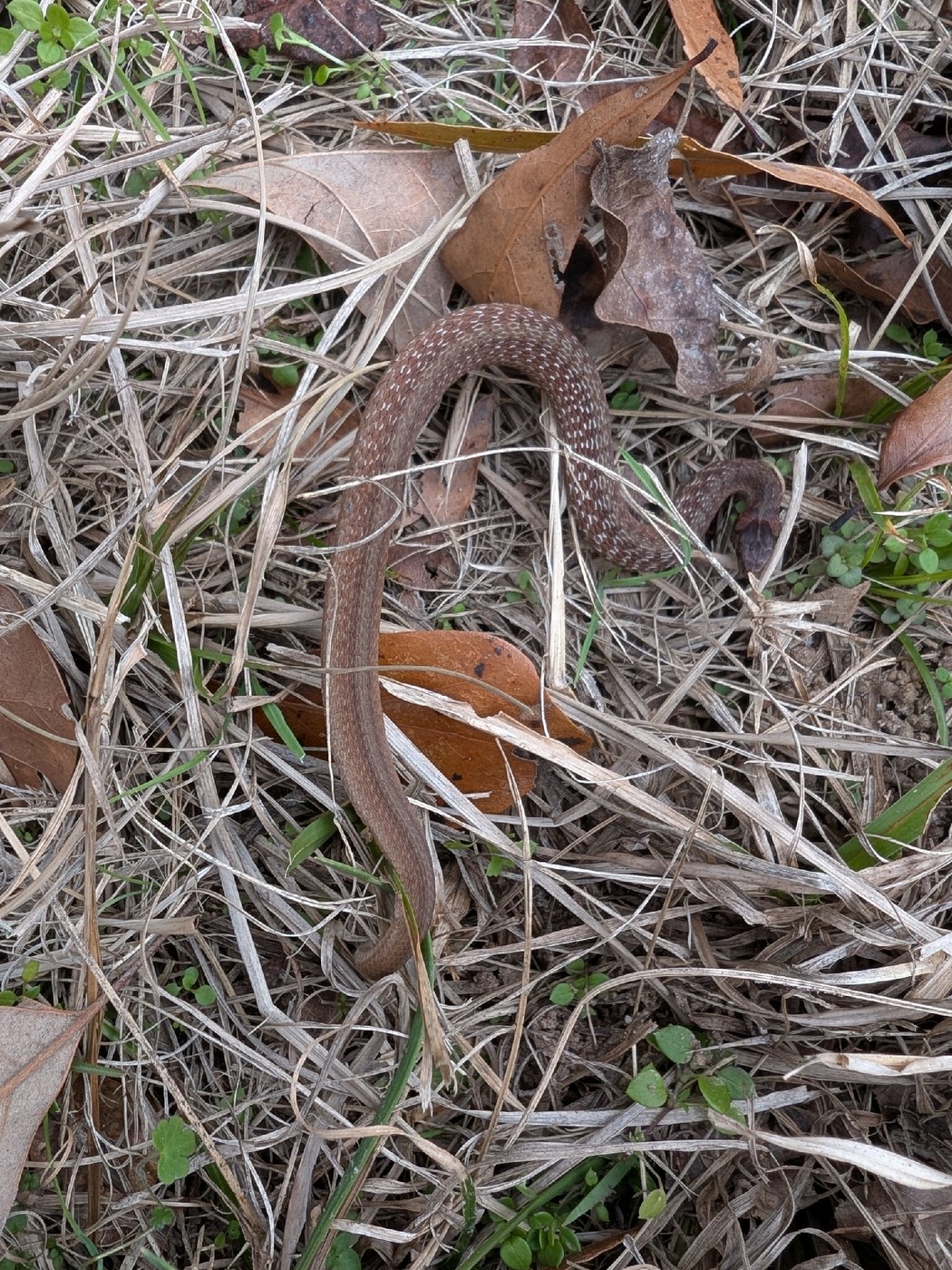
They are the fastest checks. Adults typically run 9 to 13 inches in total length, occasionally to 18 inches. The back carries a faint, lighter stripe bordered on both sides by two rows of small dark spots, sometimes connected by narrow crossbars that give a ladder-like look. Scales are keeled, meaning each one has a raised ridge you can feel or see under light.
Head and belly confirm it
Head and belly details confirm the identification. The top of the head and back of the neck are dark brown, with a lighter band crossing the back of the head. The belly runs cream, tan, yellow, or pink, usually with small black dots along the scale edges.
Newborns look nothing like adults
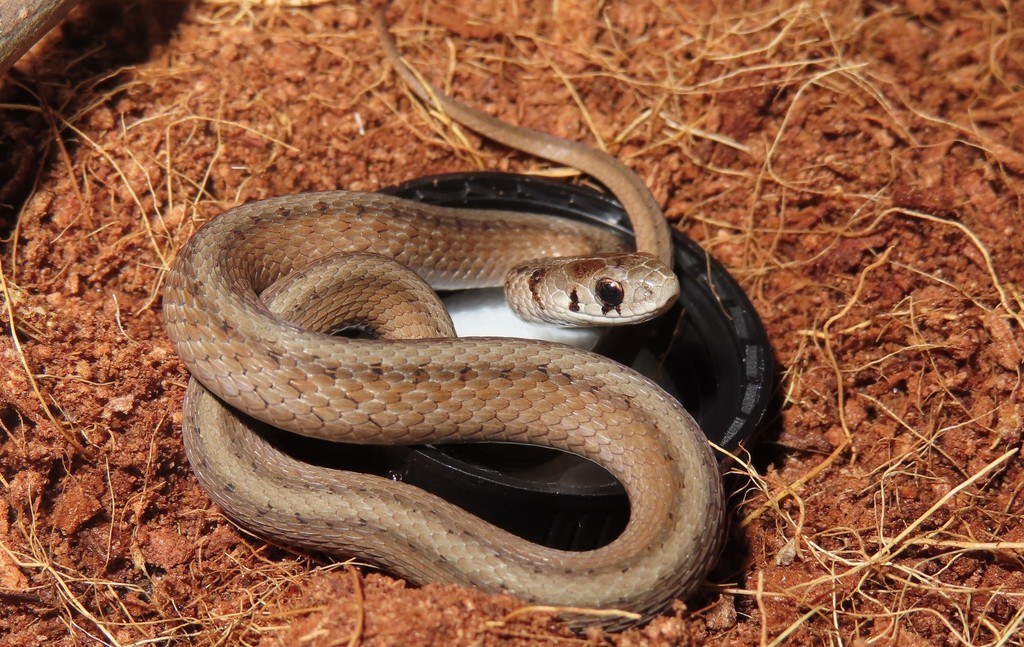
That surprises people. A DeKay's brownsnake is born dark, almost blackish, with a pale cream or yellowish collar across the back of the neck. That collar fades and the coloration lightens toward the adult pattern over roughly the snake's first year.
The copperhead mix-up
It is real, documented, and worth getting right. University herpetology programs specifically flag that homeowners frequently kill this species after mistaking it for a young copperhead. The tell: a copperhead has bold, hourglass-shaped dark crossbands and, in young copperheads, a bright yellow-green tail tip, while a DeKay's brownsnake has a fine, longitudinal spotted stripe and no hourglass banding at all.
Juvenile garters and ribbonsnakes
Juvenile gartersnakes and ribbonsnakes are the other common mix-up. A state wildlife agency's own identification guide notes a DeKay's brownsnake is stouter-bodied than a similarly sized juvenile gartersnake or ribbonsnake, and its neck band is interrupted by dark crossbars, while the gartersnake or ribbonsnake juvenile neck band is a continuous, uninterrupted orange or yellow ring.
Its closest relative, and a plainer one
Its own closest relative and a plainer look-alike round out the list. The red-bellied snake, its nearest relative, has a bright red, orange, or salmon belly, versus this species' cream, tan, or pink belly with small black dots. Earthsnakes lack the paired rows of dark spots on the back and head that a DeKay's brownsnake carries, giving them a plainer, more uniform look.
Signs of Infestation
A sighting is the only sign
A direct sighting is essentially the only sign, because this species leaves no infestation evidence. It does not chew, gnaw, or leave a droppings pattern worth tracking. Because it is small, secretive, and spends most of its time under cover, most people who share a property with one never see it at all.
Lifting cover
Lifting cover is the classic way people encounter one. A DeKay's brownsnake turning up under a rock, log, board, or a thick layer of mulch, or in loosened garden soil during yard work, is the typical way this animal is found. It is not drawn out by anything inside a home the way a rodent or insect would be.
Nothing to hear
This species is silent. There is no rattle, hiss, or scratching sound to listen for.
Musk only when handled
A musk odor only occurs during handling, not as a lingering sign. Like many harmless snakes, a DeKay's brownsnake handled or threatened will flatten its body and release a foul-smelling musk from glands at the base of the tail, but this is detectable only in the moment, not as an ongoing indicator of presence.
Prevention and When to Call a Pro
Coexistence, not removal
The honest, source-backed answer for this species is coexistence, not removal. Every sourced fact points the same direction: no venom, no meaningful bite risk, no structural damage, and a genuine, if modest, benefit to a garden through slug and snail control. This is not a pest-control problem in the way a rodent or a structural insect is.
Identification matters most
Correct identification matters more than removal for this species, because the documented risk runs toward the snake, not the homeowner. University herpetology programs specifically document homeowners killing this species after mistaking it for a young copperhead. Before assuming any small brown snake in the yard is dangerous, check for the copperhead's bold hourglass-shaped crossbands, which a DeKay's brownsnake simply does not have.
Take away the cover
If you would simply rather not encounter one close to the house, take away the cover it shelters in. DeKay's brownsnakes use rocks, logs, boards, leaf litter, and thick mulch as cover. Clearing loose debris and unused boards away from a foundation, and keeping mulch beds from piling directly against siding, reduces the odds of a close encounter.
No regulatory flag applies
No state or federal agency lists a protected status for this species, so standard coexistence guidance applies with no additional legal caveat.
Frequently Asked Questions
Is a DeKay's brownsnake dangerous or venomous?
No. It is entirely non-venomous, and university and state wildlife sources both describe it as a species that typically does not bite even in defense.
Why do people sometimes kill DeKay's brownsnakes thinking they're copperheads?
Both share a brown body tone, but a copperhead has bold, hourglass-shaped crossbands and, in young copperheads, a yellow-green tail tip, while a DeKay's brownsnake has a fine, longitudinal spotted stripe and no hourglass pattern. Two university herpetology programs specifically document this misidentification as a cause of unnecessary killing.
Will a DeKay's brownsnake get into my house?
It is not a structure-invading species. It shelters outdoors under rocks, logs, leaf litter, and mulch, and no source documents it living inside homes or causing any property damage.
What does a DeKay's brownsnake eat?
Mostly earthworms, slugs, and snails, which makes it a modest, genuine benefit to a garden rather than a pest in its own right. It will occasionally take small salamanders, insects, and other soft-bodied invertebrates.
How can I tell a DeKay's brownsnake from a baby gartersnake?
A state wildlife agency's own identification guide notes the brownsnake is stouter-bodied, and its pale neck band is interrupted by dark crossbars, while a juvenile gartersnake or ribbonsnake has a continuous, uninterrupted orange or yellow neck ring.
Sources
- Dekay's Brownsnake (Florida Snake ID Guide) Florida Museum of Natural History, University of Florida
- DeKay's brownsnake Illinois Department of Natural Resources
- Dekay's Brownsnake Missouri Department of Conservation
- Learn about DeKay's brownsnakes Massachusetts Division of Fisheries and Wildlife
- Dekay's Brownsnake (Storeria dekayi), Kentucky Snake Identification University of Kentucky, Martin-Gatton College of Agriculture, Food and Environment, Forestry Extension
- Dekay's Brownsnake Oklahoma Department of Wildlife Conservation
- Dekay's Brownsnake (Storeria dekayi) Virginia Herpetological Society
- Brown Snake (Storeria dekayi) Savannah River Ecology Laboratory Herpetology Program, University of Georgia
- DeKay's Brownsnake Tennessee Wildlife Resources Agency
- Dekay's Brown Snake (Storeria dekayi) species profile U.S. Fish & Wildlife Service