Where They're Found
All eight U.S. regions, and that needs a qualifier immediately, because eight regions on a map implies an even risk that does not exist. Texas A&M says the quiet part out loud: the black widow "is uncommon in the north but quite abundant in the south and west." Read the map that way. Four regions are where this spider is a genuine everyday problem: Southwest, California, South Central and Southeast, with the Southwest the heaviest of the four. The other four are additions from published extension research, at honestly different evidence strengths. Midwest rests on Michigan State Extension's own in-state note that the northern widow is more common in Michigan's western Lower Peninsula, plus University of Florida and clinical literature placing the southern widow as far north as Ohio. Northeast rests on Penn State stating the southern widow is found in Pennsylvania, plus Texas A&M's statement that widow spiders are known from every state, plus clinical sources placing the northern widow in New England. Mountain West and Pacific Northwest each rest on a single sentence in a single source, UC IPM's note that western black widows are common in urban Colorado and in central and eastern Washington. That sentence names states and calls the spider common, which is enough to put the region on the map, but one source is still only one source. Which widow you have depends on where you are, and the four species do not overlap evenly, so the identification section below breaks the map down species by species.
Seasonal Timeline
Widows are active when it is roughly 70 degrees F or warmer, which runs March through November in the Southwest and California and April through October across the South Central states and the Southeast. The single peak month for reported bites is September, not July, because the curve tracks when people start clearing out garages and stacking firewood rather than when spiders are busiest.
Widows are active when it is roughly 70 degrees F or warmer, which runs March through November in the Southwest and California and April…
An off month is not an empty month. The calls stop in January and February, not the spiders. UC IPM records western black widows living above 5,000 feet in Southern California mountains where snow covers the ground every winter, and Texas A&M has found adults of both sexes inside buildings in every month of the year. In cold weather they are inactive and hidden, which is exactly why the first warm-day garage cleanout in spring produces a surprise. Month-by-month timing is not established for every part of the range. For the Midwest and Northeast, the South Central and Southeast pattern is the closest guide, and the California and Southwest pattern is the closest guide for the Mountain West and Pacific Northwest.
One limit, stated rather than hidden. No month window is documented for Pacific Northwest, Mountain West, Midwest and Northeast, so they are not on the bar.
Life Cycle
There is no metamorphosis here. No larva, no pupa, no caterpillar to moth moment. A spiderling comes out of the sac looking like a small adult in shape if not in color, and it simply molts its way up in size. That matters for a practical reason: there is no vulnerable life stage to time a treatment around, the way there is with an insect. What there is instead is the egg sac, and the sac is the job. Each one can hold 200 to 800 eggs, a single female can produce nine or more of them from one mating, and there is a genuinely obscure finding behind why they survive treatment: egg sac silk repels water, and most registered spider products are water based. In a 2016 study, water based insecticides sprayed onto widow egg sacs had no significant effect on the eggs inside, while petroleum based products penetrated the silk and killed them. That is a single university source relaying a single study, so treat it as a strong lead rather than settled practice, but it explains a lot of failed treatments. On generation counts, no reliable published source states a clean number. What is documented is that a female may produce several sacs across one summer, that adults have been found in Texas buildings in every month of the year, and that colder parts of the range look more like one annual cycle with immatures overwintering.
Egg Sac2
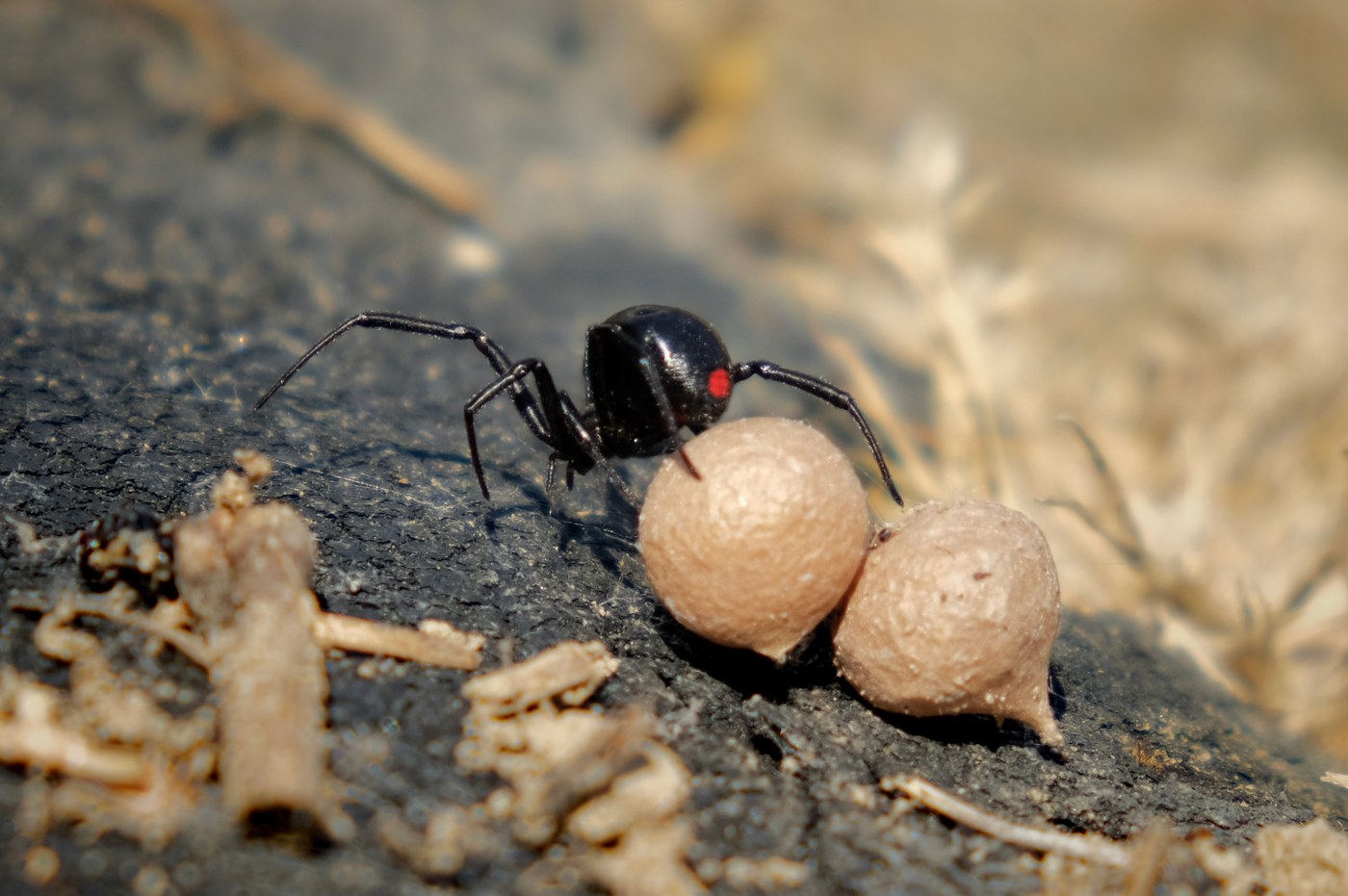
Egg sac. Roughly 3 to 4 weeks from the day it is built to the day the young come out. Eggs are about 0.8 mm across and hatch inside the sac at around 8 days, then the spiderlings stay in and molt once before emerging. This is often the thing a homeowner actually finds, and it is diagnostic: a black widow sac is tan to beige, teardrop or pear shaped, about a quarter to half an inch across, with clean well defined margins and a covering tough enough to be hard to tear. Sources give 200 to 800 eggs per sac, and a single mated female can produce nine or more sacs without ever meeting another male, because she stores sperm from one mating.

Spiderling
Spiderling. Days to weeks. Nothing about them looks like the famous spider. Descriptions vary slightly by instar: tan legs and a tan front body with a mostly white abdomen carrying a few black spots, initially white with no pattern at all, or orange and white. There is no hourglass yet, just a whitish shield on the belly where one will grow in. They leave by ballooning, climbing to a high point on a warm day, lifting the abdomen and releasing silk until the air carries them off. Ballooning spiderlings have been captured 10,000 feet up and 200 miles offshore, which is why treated areas get repopulated no matter what anyone sprays.
Immature Instar
Immature instars. Development from egg to adult runs 26 to 103 days for males and 57 to 122 days for females under good conditions, though a temperate field season can stretch that toward a full year. The abdomen darkens from tan and olive gray toward black while the white stripe down the back and the diagonal flank stripes thin out with each molt. On the belly, the shield goes white, then yellow, then orange red, and only then narrows into an hourglass. Males need fewer molts than females. Only the larger immature females can bite through human skin.
Adult
Adult. The female lives about a year and a half and is the spider everyone pictures: shiny black, round bodied, roughly 3/8 to 1/2 inch in body length and 1.5 to 2 inches with the legs out. The male lives two to five months, is one half to two thirds her body length or smaller, keeps the juvenile striping, stops eating once mature so his abdomen shrinks, and cannot bite through human skin. Mating happens in spring and summer. The name is built on a myth: three university sources state that the female rarely eats the male, and that where it was observed it was mostly in laboratory cages the male could not escape.
<p><strong>There is no metamorphosis here.</strong> No larva, no pupa, no caterpillar to moth moment. A spiderling comes out of the sac looking like a small adult in shape if not in color, and it simply molts its way up in size. That matters for a practical reason: there is no vulnerable life stage to time a treatment around, the way there is with an insect. What there is instead is the egg sac, and the sac is the job. Each one can hold 200 to 800 eggs, a single female can produce nine or more of them from one mating, and there is a genuinely obscure finding behind why they survive treatment: <strong>egg sac silk repels water, and most registered spider products are water based.</strong> In a 2016 study, water based insecticides sprayed onto widow egg sacs had no significant effect on the eggs inside, while petroleum based products penetrated the silk and killed them. That is a single university source relaying a single study, so treat it as a strong lead rather than settled practice, but it explains a lot of failed treatments. On generation counts, no reliable published source states a clean number. What is documented is that a female may produce several sacs across one summer, that adults have been found in Texas buildings in every month of the year, and that colder parts of the range look more like one annual cycle with immatures overwintering.</p>
Identification
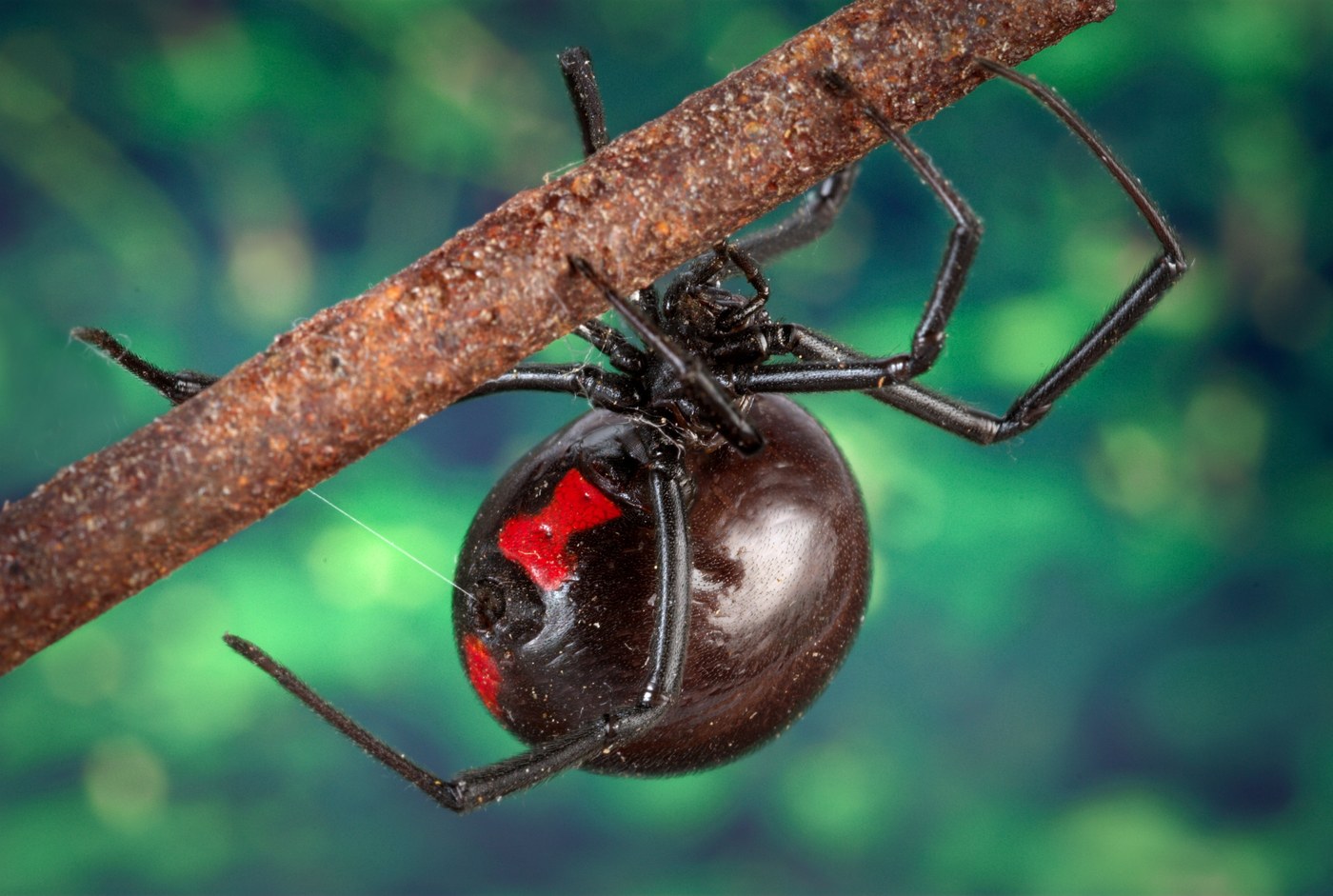
The hourglass is not always an hourglass, and it is not always red. UC IPM catalogs five states of the mark on a single species, the western black widow: two perfect triangles joined into a true hourglass; two triangles separated by a gap; a triangle and a small bar; red so minimal it is almost imperceptible; and, on rare occasions, no red at all. By species it gets more specific. The southern black widow normally carries a complete hourglass, often with a single red spot behind the spinnerets. The western black widow's is usually connected, with the front triangle larger and wider than the back one. The northern black widow's hourglass is normally split down the middle, and it usually carries a row of red spots along its back and pale stripes along the sides. Some individuals of both eastern species lack the mark completely. And the brown widow's is orange, not red.
Which widow you have depends on where you live, and there are four of them plus an immigrant. The western black widow is the only widow species in the western U.S., running from British Columbia and Alberta to Mexico, throughout the Rockies out to the western Great Plains, and it displaces the southern species in the western half of Texas. The southern black widow covers the Southeast and South Central and reaches as far north as Ohio, Maryland and Pennsylvania. The northern black widow covers the eastern half of the country from southern Canada down to Florida and west to eastern Texas, Oklahoma and Kansas. The red widow is Florida only, which is why a red widow in a Georgia yard is a misidentification. And the introduced brown widow is the one that is moving. It sat in Florida alone for decades, then in the 2000s it spread from Texas across the Gulf Coast and up the Atlantic into South Carolina, and appeared at the same time in huge numbers in Southern California. As of 2016 it was well established from Santa Barbara to San Bernardino and south to Mexico, but not north of the L.A. Basin, not in the Central Valley and not in the deserts. Reports from north of that line were checked and turned out to be immature black widows, false widows or orbweavers.
The one field rule that actually holds. A shiny jet black spider with a round bulbous abdomen, hanging upside down in a tangled web, with any red or orange mark on its belly, is a widow. The absence of a textbook hourglass rules nothing out. Body color is not reliable either: a female with a brownish or plum tinge is usually just a very well fed female whose black abdomen has been stretched until the pigment looks brown.
The male and the juveniles look nothing like the female, and neither is a medical concern. This is the fact that most directly reduces a homeowner's fear and almost no consumer page carries it. UC IPM: only the larger immature females and adult females can bite through a person's skin and inject enough venom to cause a painful reaction, and the male has venom but his fangs are too small to break skin. Penn State says the same thing independently: immature and male black widows do not have fangs large enough to pierce human skin, so bites are almost entirely from adult females. The small striped spider in your garage is not the problem. One trap worth pre-empting: the stripe on an immature widow sometimes has a vivid red line inside its white border, and people identify that as an Australian redback. Redbacks do not occur in North America.
Brown widow, and the egg sac settles it in two seconds. A mature female brown widow looks a lot like an immature western black widow, which is the confusion that matters most. Forget the spider and look at the sac. A brown widow's egg sac is covered in silk spikes all over its surface and looks like a very large pollen grain; a black widow's is smooth, tan, teardrop shaped with clean margins. UC IPM says the sac alone is enough to confirm brown widows even when you never see the spider. On the animal itself: the brown widow's hourglass is orange with the bottom half larger and its edges rough, the black spots on its side stripes are large and squarish rather than small and elliptical, and its background is tan rather than olive gray. Dark brown widows are a flat black. Black widows are a shiny black.
False widows are not widows. The false black widow has the same round abdomen, the same cobweb and the same family, but it is chocolate brown and never has any red on the belly. It is slightly smaller at about 3/8 inch, its egg sac looks like a cotton ball with fuzzy edges, and its spiderlings emerge dark like the mother rather than pale. Unlike real widows it genuinely thrives indoors, in washrooms, cupboards and under appliances, which is why it is involved in more bite incidents than black or brown widows. Its venom is mild and produces something like a yellowjacket sting. The noble false widow is bigger, up to 5/8 inch, with a light tan pattern on its back that looks like a house with two windows and a domed roof.
The cellar spider is the one people kill by the thousand for nothing. Long thin legs, tiny body, irregular webs in dark places, and it hangs upside down under its web exactly like a widow does. That posture is why it gets mistaken. The tell is the body, not the legs: a widow has a large round bulbous abdomen, and a cellar spider has a small elongate body dwarfed by enormous legs. Cellar spiders are only marginally capable of biting a human because their fangs are too short to pierce skin in most cases, and the University of Kentucky lists them first among common building spiders and calls them harmless. Their only offense is untidy cobwebs. The common house spider is the same story, mottled brown and tan, no shiny black body, no red belly mark, harmless.
Brown recluse is the other spider people ask about, and the difference is at the eyes. A recluse has six eyes in three pairs arranged in a semicircle; a widow has eight. The recluse carries its violin mark on top of the front body, not underneath. Most usefully: recluse venom causes skin necrosis and widow venom does not. Black widow bites do not cause conspicuous swelling, necrosis or tissue deterioration. If you are looking at a spreading, breaking down skin lesion, you are not looking at the work of a black widow. Brown recluses also do not occur in California.
The web is a tangle, never an orb, and you can hear it. Irregular, three dimensional, no recognizable pattern, built at night, usually under a foot across and within about three feet of the ground, with vertical trip lines running down to the surface below. There is a retreat hole at one edge, in a brick gap, a pipe penetration or a crevice, and she spends the day in it. The unusual part: widow silk is strong enough that running a finger through a mature web produces an audible ripping sound. No cellar spider or house spider web does that. It is a single source observation, so treat it as a useful field check rather than proof, but it is real enough that the silk was used for gun sight crosshairs in the Second World War.
Sizes, and do not trust a single number. Female body length runs roughly 3/8 to 1/2 inch depending on the species and the population, or about 1.5 to 2 inches with the legs extended. Texas A&M notes outright that sizes vary widely between geographic populations. The male is one half to two thirds her body length, and the male brown widow at 3/16 inch is small enough to be routinely overlooked entirely. The size gap between the sexes is extreme: a female's body can be up to 20 times the male's.
Signs of Infestation
An irregular, tangled web near ground level, under a foot across, with no orb and no funnel. Look at garage doors, vents, meter boxes, brick veneer, the corners of sheds and crawl spaces, and behind anything stacked and left alone. Widows follow insects, so webs cluster where insects pass.
A retreat hole at one edge of the web. A gap between bricks, a pipe penetration, a rock crevice, an old rodent burrow, with a small silken tent about 1/16 to 5/16 inch across. If you see the web in daylight and not the spider, she is in the hole.
A spider hanging upside down in the middle of the web with her belly facing up. That posture is not aggression and it is not unusual. It is the normal resting position, and it is the only reason the hourglass is ever visible.
A tan, teardrop or pear shaped egg sac about half an inch across, suspended in the web with a female standing guard nearby. If the sac is bumpy like a large pollen grain, that is a brown widow, not a black widow, and the two are a different conversation.
Webs on the undersides of things people put their hands on. Picnic tables, lawn chairs, trash can grips, plant pots with curled lips, plastic playhouses and molded toys with spaces facing downward, and the undersides of cheap plastic patio furniture. People find these with a hand rather than an eye, and that is the whole problem. Brown widows also use chain link fences, where black widows generally do not.
Finding several is normal, not an emergency. In habitat that suits them, mature females occur every few feet and sometimes within inches of each other. One spider in a woodpile is background. A dozen webs in a garage you use every day is a management problem.
Nothing to smell. No odor from widow spiders, their webs or their egg sacs is documented. If something smells, it is not this.
A dusty web indoors is an abandoned web. This is a sign by its absence and it is genuinely useful. Occupied webs get maintained, because dust and debris reduce prey capture. A dusty cobweb in a basement corner means the spider has already gone.
Prevention and When to Call a Pro
Wear gloves. If you do one thing, do that one. Five separate sources say it independently, and it addresses the exact mechanism behind nearly every bite: a hand going somewhere the eyes have not been. Gloves for cleaning out garages and storage areas. Gloves before picking up a piece of firewood, ever. Gloves for basements, attics, garden work, and anything stacked and undisturbed. Add long sleeves, long pants and boots when you are handling piles of stored material.
Look before you reach, with a flashlight. The recommended way to actually find widows is a night time flashlight search, since they are nocturnal and come out at dusk. Run the beam through cracks, corners, dark undisturbed areas and the undersides of outdoor furniture. Where you can see webs, treat that space as occupied until you have looked properly.
Bag and tape the things you put your hands into. Keep gardening clothes and gloves in bags closed with zipper locks or twist ties, and store outdoor apparel and equipment in tightly closed plastic bags. Store seasonal items, sports gear, camping gear, winter clothes and holiday decorations in boxes taped shut, off the floor and away from walls, with as little empty space between stacked items as you can manage. Almost nobody does this and it costs nothing.
Shake it out. Shoes that have not been worn recently, stored clothing, towels and equipment, before you put them on or pick them up.
Check under the seat in an outhouse or outdoor toilet. This sounds like a joke and it is not. There are many documented bite cases in outhouses, and federal occupational guidance independently lists outdoor toilets with lots of flies as widow habitat. The flies are the reason the spider is there.
Kill the light and you cut the insects, which cuts the spiders. Outdoor lighting pulls in night flying insects, and the insects pull in the widows. Move fixtures off the structure and away from windows and doorways where you can, and switch to yellow or sodium vapor bulbs, which attract far fewer insects. This is upstream of every other control on the list, because the spider is only there for the food.
Clear the foundation line and move the woodpile. Keep the strip next to the foundation free of trash, leaf litter, heavy vegetation and stacked materials. Trim shrubs, vines and limbs touching the house. Move firewood away from the building and get it up on a raised structure. Sources that give a distance are not the strongest ones, so take the instruction as away from the house rather than as a specific number of feet.
Seal the gaps, and screen the openings. Cracks in the foundation, gaps around windows and doors, holes between bricks, and the spaces around pipe penetrations, which are a favorite retreat site. Tight fitting window screens and working door sweeps do double duty, because they also keep out the insects the spiders are hunting.
Vacuum, and destroy every egg sac you find. A vacuum or a broom removes spiders, webs and sacs effectively, and widows have soft bodies that usually do not survive the trip through a vacuum. Destroying sacs is the part that matters, since each one can hold hundreds of young. And do not carry them indoors in the first place, on plants, firewood or boxes.
On spraying, the university sources are lukewarm and one is blunt, so here is the honest version. UC IPM says insecticides do not provide long term control against spiders outdoors and should not generally be used, and adds that it is just as easy and much less toxic to crush the spider or vacuum it up. The University of Kentucky is more permissive, naming perimeter barrier sprays applied monthly to bi-monthly in warm months and crack and crevice dusts applied as a barely visible film. It also notes that total release foggers, the bug bombs, are seldom effective. Those two positions have not been reconciled by anybody, and spraying should not be treated as the answer when the strongest source says it is not.
Nobody can eliminate them, and anyone who tells you otherwise is selling. UC IPM states it plainly: it is not practical to eliminate these spiders completely, and treated areas will be re-infested, because spiderlings balloon in continuously from off your property. What a professional actually delivers is an ongoing management interval and the skill to find and destroy egg sacs in places you cannot reach or see. That is worth paying for. Eradication is not on the table for anyone.
If someone is bitten, that is a medical call and not a pest control call. Stay calm and promptly seek medical advice. Apply a cold pack for the pain. Do not try to draw out or remove venom, and do not try to catch or handle the spider. Poison Control is free, confidential and open 24 hours at 1-800-222-1222. Keep tetanus boosters current, since any bite wound can get infected.
Call a pest control professional when any one of these is true. You are finding multiple webs with mature females in a space you actually have to use, such as a garage, a crawl space or a meter box. You are finding egg sacs, which means the population is breeding on site rather than passing through. The webs are where children play, under playground equipment or inside molded plastic playhouses. Someone in the household is in the higher risk group, meaning a small child, an older adult, or a person with an existing health problem. Or you are about to disturb a large, long undisturbed store, a woodpile or a shed or a crawl space nobody has entered in years, which is precisely the moment bites happen. The University of Kentucky, a university extension service with nothing to sell, says outright that black widow infestations often require specialized skills and equipment and that it would be prudent to enlist a professional pest control company.
Frequently Asked Questions
How many black widow bites happen each year in the U.S.?
In the most recent decade of data, roughly 1,300 to 1,400 widow spider exposures a year are reported to U.S. poison centers. A 2016 national report counted 1,330, and a review of 15,299 cases from 2012 to 2022 averages about 1,390 a year. You will still see 2,200 or 2,600 quoted on plenty of pages, including some university ones. Those come from older reports and they are dated. Two caveats belong with that number. An exposure reported to a poison center is a phone call, not a verified bite, and the spider is almost never identified by an arachnologist. And UC IPM warns that people and their physicians often blame spiders for skin lesions with no proof of spider involvement, when a long list of non-spider conditions look similar. The real number of confirmed black widow bites is smaller than the reported number, not larger.
Can a black widow bite actually kill you?
Almost certainly not, and the data behind that is stronger than the data behind most things you will read about this spider. No death from a black widow bite has been reported to the national poison center system since 1983, a run that had already passed 40,000 cases by 2003, was independently confirmed across 23,409 exposures through 2008, and is still being stated by Penn State Extension today. In that 23,409 exposure review, 9,872 cases had at least minor clinical effects, and of those symptomatic cases 65 percent were minor, 33.5 percent moderate and 1.4 percent major, with no deaths. Those percentages describe the symptomatic group, not every call. A separate and more recent review of 15,299 cases from 2012 to 2022 found that 48.6 percent were managed entirely outside a healthcare facility and 10.0 percent required hospital admission, and concluded that most black widow exposures result in minor consequences. A bad case is a genuinely awful 24 to 48 hours. It is not the death sentence the internet implies. Seek medical advice anyway. As for what a bad case actually feels like: the bite itself is usually painless or feels like a small pinprick, because the venom is neurotoxic rather than tissue destroying. Pain arrives one to two hours later and generalized symptoms develop over one to three hours. The venom jams nerve endings open, which UC IPM describes as flipping on a light switch you cannot turn off, so the signature effect is severe muscle cramping and rigidity, often in the abdomen, sometimes severe enough to mimic an acute abdomen. Pain spreads outward from the bite, so an ankle bite works up the leg and then to the trunk. Sweating that is sometimes limited to the bitten limb, redness at the site, nausea, chills, raised blood pressure and fatigue are all common. It is worst in the first 12 to 24 hours, then eases over several days, with recovery generally in 24 to 48 hours and up to about four days without supportive care. Notably, there is almost no swelling and no tissue breakdown, which is the clean line between this and a brown recluse bite.
Is it true black widow venom is 15 times stronger than a rattlesnake's?
It is a drop for drop laboratory potency comparison, and it says nothing about the dose you actually receive. Michigan State Extension prints the 15 times line and the national trade association repeats it, and MSU's very next sentence concedes the point: "due to the small amount of the venom injected into the bite, widow bites are far less serious." A spider the size of a pencil eraser does not deliver a snake's dose. The brown widow settles the argument entirely. Its venom is more potent than the black widow's drop for drop, and its bite is milder, because it is smaller and injects less. Potency is not danger. Anyone quoting you the rattlesnake number without the second half of the sentence is either not reading their own source or is counting on you not to.
Who is actually at higher risk?
Not a healthy adult. UC IPM: small children, the elderly and persons with health problems are the ones likely to suffer the more severe consequences, and the National Capital Poison Center independently names young children and elderly people. Michigan State adds that severity depends on the age, size and sensitivity of the person as well as the bite itself. On heart conditions specifically, the clinical reference literature advises an electrocardiogram when chest pain is present, particularly in patients with a history of coronary artery disease, and lists heart muscle inflammation as a rare manifestation. That cardiac point rests on one source and should be read as such rather than as settled. For a healthy adult, the honest description from UC IPM is a bad flu episode that usually clears in a few days.
Does every black widow have a red hourglass?
No. On one species alone, UC IPM documents five states of the mark: two triangles joined into a true hourglass, two triangles separated by a gap, a triangle and a small bar, red so faint it is almost imperceptible, and on rare occasions no red at all. The northern black widow's hourglass is normally split down the middle, and it usually has a row of red spots along its back too. Some individuals have no mark. The brown widow's is orange. If you are waiting for a textbook hourglass before you take a spider seriously, you will miss most of them.
I found a small spider with white or orange stripes. Is that a baby black widow, and is it dangerous?
It may well be an immature widow or an adult male, both of which look nothing like the famous female. And neither one is a medical concern. Two independent university sources state that immature and male black widows do not have fangs large enough to pierce human skin. Only the adult female and the larger immature females can envenomate a person. The adult male keeps the juvenile pattern, a stripe down the back with diagonal stripes on the flanks, stops feeding once he matures so his abdomen shrinks, and is one half to two thirds the female's body length or smaller.
How do I tell a black widow from a brown widow?
Look at the egg sac and you are done. A brown widow's sac is covered in silk spikes and looks like a giant pollen grain. A black widow's is smooth, tan, teardrop shaped with clean margins. UC IPM says the sac is characteristic enough to confirm brown widows even if you never see the spider, which makes it the most reliable identification a homeowner can actually perform. On the spider: the brown widow's hourglass is orange with a larger, rough edged bottom half, its side stripes carry large squarish black spots, and its background is tan. This matters more every year in urban Southern California, where a 2012 study found brown widows outnumbering black widows, and residents report that the black widows they used to find have been replaced. Two university sources point out the part nobody in this industry wants to say: if a milder species is displacing a more toxic one, bite risk in those areas may actually be going down.
Are the long legged spiders in my basement black widows?
Almost certainly not, and this is the mistake that costs the most harmless spiders their lives. Cellar spiders hang upside down under their webs just like widows, which is exactly why they get killed by the hundred. The difference is the body: a widow has a big round bulbous abdomen, and a cellar spider has a tiny elongate body on enormous thin legs. Their fangs are too short to pierce human skin in most cases, and the University of Kentucky lists them first among common building spiders and calls them harmless. Their only real offense is messy cobwebs.
Do black widows live inside the house?
Rarely, and the reason is simple. UC IPM: both black widows and brown widows are almost never found in homes, because most people do not tolerate enough insects indoors for a widow to find sufficient prey. The University of Kentucky says black widows are seldom found indoors in Kentucky, and when they are, it is usually a vestibule or a garage. Where they are genuinely common is around the home: garages, woodpiles, meter boxes, brick veneer, rock walls, sheds, crawl spaces, and the undersides of outdoor furniture.
Should I get antivenom if I am bitten?
That is a physician's decision, and in practice most people do not receive it. Antivenom was given in 3.4 percent of reported exposures between 2012 and 2022. It does work: a 2019 randomized, double blind, placebo controlled trial found treatment failure in 51.7 percent of the antivenom group against 77.4 percent of the placebo group, which is a real and statistically significant difference. It is withheld for four sourced reasons. It is derived from horse serum and carries an anaphylaxis risk. Supply has been restricted for years, so patients in severe pain sometimes wait a day or more. Most people recover without it. And the older whole immunoglobulin product has, per that same 2019 trial report, been associated with anaphylaxis and two reported fatalities, a count that traces through that paper to two earlier case reports. Set against zero reported deaths from the bite itself since 1983, that is why physicians weigh it carefully rather than reaching for it. Standard care is wound care, tetanus prophylaxis, pain relief and benzodiazepines for muscle spasm. Calcium gluconate and methocarbamol have been shown to be ineffective and are no longer recommended, despite still appearing in older treatment lists.
Are black widows aggressive?
No, and it is the best supported behavioral claim about this spider. Five independent sources say the same thing in their own words. Texas A&M: the spider is quite timid, and even when disturbed in its web it attempts to escape rather than attack. Michigan State: bites are infrequent because the spider is very timid and prefers fleeing when disturbed. The University of Kentucky: it will only bite in response to being threatened or injured. UC IPM: any disturbance suggesting something larger than prey sends her straight to her retreat. And federal occupational guidance: spiders are usually not aggressive, and most bites occur because a spider is trapped or touched. That last phrase is the whole prevention strategy in six words. The brown widow is even more passive. Disturb it and it pulls in its legs, drops off the web and plays dead.
Sources
- Pest Notes: Widow Spiders and Their Relatives, UC ANR Publication 74149 UC Statewide IPM Program, UC Riverside
- Southern Black Widow Spider Penn State Extension, Department of Entomology
- Southern Black Widow Spider, Field Guide to Common Texas Insects Texas A&M AgriLife Extension Service
- Northern Black Widow Spider (Latrodectus variolus) Michigan State University Extension, Plant and Pest Diagnostics
- Black Widow Spider Exposures: A Retrospective Review of the National Poison Data System 2012-2022, Wilderness and Environmental Medicine Kerns, Scheffel, Farah and Holstege, 2024
- The Efficacy of Antivenin Latrodectus Equine Immune F(ab')2 Versus Placebo in the Treatment of Latrodectism, Annals of Emergency Medicine Dart, Bush, Heard et al., 2019
Image Credits
- Image: James Gathany via Wikimedia Commons. Public domain.
- Image: Adobe Stock, licensed.